More Than Just a New Job

The way the world is designed, heck, the way life itself is designed, it is impossible to go through a full lifetime without some major life changes and adjustments.  Regardless of what lifestyle choices we make, we all undergo periodic transformations.  Every one of us transforms from being an infant, to a child, to an adolescent, and to an adult.  Afterwards, most of us will transform to becoming parents ourselves.

Life in the 21st Century requires more personal transformations than ever!  Today nearly all of us go to college.  A life transformation occurs both at the start and the completion of our college education.  Additionally, the world is changing at an ever faster pace.  Gone are the days when one would be able to learn a couple of key skills to use over the course of a 40 year career with the same company.  Recent writing has even suggested that the most effective people reinvent themselves every 3-5 years.  Coincidentally, the current average time that a person stays at a job is 4.6 years.

It is hard for me to pinpoint the exact moment in which I realized that I needed to undergo a significant re-invention.  We often have this notion that ideas just pop into people’s heads out of nowhere.  We have all seen shows where a light bulb suddenly pops upon the screen, indicating that someone has come to a sudden realization.  This is not actually the case.  In reality, ideas are often developed over time, with contributions from multiple people.

For me, it took two separate disappointing experiences in traditionally-structured jobs, a whole bunch of reading, extensive self-reflection, and discussions with plenty of individuals, including some who had undergone a similar transformation themselves.

Chicago_Skyline

Life after college started off really good for me, all things considered.  In Chicago, I had a steady job with a large corporation, where I met a lot of people who were also in their 20s, and had plenty of chances to enjoy big city life.

casino_winnigns

It was the life I had imagined for myself at the time, but inevitably, things had to change.

The hardest thing I learned about life working for a large corporation is that a person can put in several good years, and have their work output feel quite well received by those around them, and still have decisions made on their behalf that are not necessarily in their best interest.  Essentially, what I learned, which sounds elementary to me now, is that corporations do not care about people, and that in large structured environments, people are often far removed from people making decisions.  It is common for someone to have decisions being made regarding their career path by people who do not know them much beyond what would be included in a two page resume.

During this time, I did explore a bit about non-traditional work environments, reading books such as The Art of Non-Conformity.  But, I guess I was not ready for it, and so I returned to another traditional structured work environment.

IMG_4732

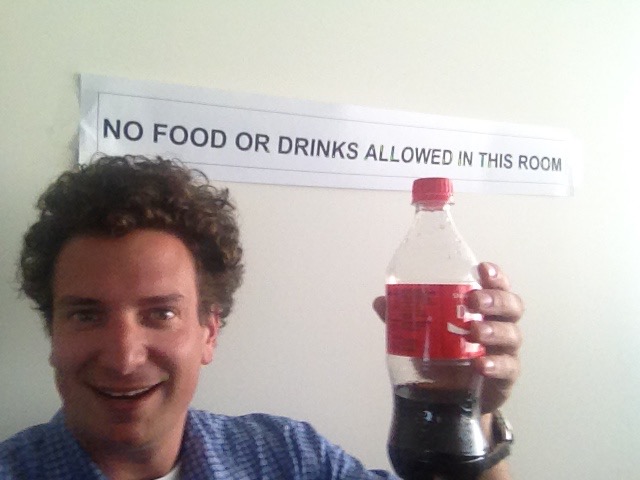
I have not discussed this much in this blog.  As a matter of fact, I kind of feel like a phony even admitting that while I have been writing this travel blog, documenting the trips I was taking, I spent a good number of days sitting at a desk in an office like this.  Most people would not consider that the lifestyle of a “travel writer”.

I am starting to believe that every life transformation has both externally driven and internally driven components.  What I mean by this is that, the same way rehab programs only work for people who first “admit they have a problem”, someone can only re-invent themselves, when they come to some form of realization that it needs to happen.  However, I do not see situations where someone decides to make major life changes in response to nothing.

Usually, something happens to make one come to the realization that what they are currently doing is not working.  Sometimes, it’s just bad luck, like bad market conditions for a particular industry.

IMG_4741

Other times, it is something more positive, like being introduced to something new, a new idea, a new way of thinking, or a new opportunity.
IMG_4509

For me, it unfortunately took a combination of experiences.  At work, I once again felt that feeling of alienation, as once again decisions were made without my best interests in mind.  It actually lead to a work environment that I found not only non-fulfilling, but also unpleasant.

Through the afore mentioned self-reflection, reading and discussions I had over the course of 2015, I came to several key realizations that go beyond the standard “I need a new job”.  I realized that….

  • I had originally decided to apply for the types of work I had applied for because I had not really considered the alternatives.
  • It is not just the few bold people that work in environments other than office jobs with 9-5-ish hours.
  • With automation, globalization, and other forces, we are going to have to be more creative, self-directed, and individually motivated in order to maintain our current standard of living.
  • In order to get what I want out of life I am going to make some major adjustments myself.

For the last few weeks, I have been transitioning to a new employment situation, as a “consultant”.  This environment is described to me as being halfway between being in a “traditional” structured office environment and being a freelancer.  It requires me to work differently, think differently, and act differently.  As is the case for many that are self-employed, there are some financial risks, but in exchange, there is increased flexibility and autonomy.  With all these changes, who knows what adventures await!
IMG_4167

I am actually quite excited about making these adjustments.

In my new world, there are no more cubicles, and I do not have a permanent office.  This means that both meeting people and finding work will require significantly more individual initiative.  Without having the same people around me every day, I am going to have to determine for myself which people I should be associating with, both in a personal and professional sense.

In my new world, there is significantly less structure.  Nobody is there to tell me what time I should be doing what.  In order to ensure productivity, I will have to create this structure myself, determining each day, week, and month what I need to get done and when I will be doing it.

And, most importantly, my new world requires me to fully embrace thinking of life as a “slalom”.  Just as those that compete in slalom skiing must think several turns ahead of time, I must be prepared to think several moves ahead of time to ensure that I am setting myself up for a successful, and more importantly, enjoyable life both short and long term.

This requires a new me, and hopefully a better me.  It requires me to be more confident, both in what I believe in, as well as what decisions I make and what I believe myself capable of.  It requires me to take initiative without being paralyzed by the fear of failure that causes so many people to not pursue their ideas and passions.  But, most importantly, I believe it requires me to not lose sight of who I am and what makes me a unique individual.  Of late, I have been active in encouraging others as they pursue their individual pursuits.  What I am hoping for, both for myself, and for everybody around me, is that we do not transform ourselves into a completely different person, but that we are able to become what I refer to as the best version of yourself.


Tea that Isn’t Really Tea

IMG_4704

Tea is not something I ever give any real thought to.  For me, it is one of those products that has always just been there.  As much as I claim to be a curious-minded person, I had never even sat and pondered who was the first person to come up with the idea to take a bunch of ground up leaves, put it in a tiny little bag and dip it into a cup of hot water.  In fact, if you think about almost every product we use on a regular basis from the standpoint of a culture that has never been introduced to that product, it probably sounds absurd.  As I write this, I am eating a bagel.  Imagine telling someone who has never heard of a bagel that you have an idea to take condensed bread, bake it into a cylindrical shape with a hole in the middle, and maybe put some random seeds on top.

You would have probably been told, by at least some portion of the people around you, that your idea was either absurd, or unnecessary.  If I could, I would communicate this point to an entire generation of aspiring entrepreneurs, as nearly all of them, will at some point receive a similar reaction from people they describe their idea to.  In fact, some will even be turned down and laughed at by potential customers and investors.

IMG_4615

One of the reasons I had never given tea too much thought is that in my mind I had always associated it with things that I do not find too exciting.  Our subconscious minds have this strange ways of synthesizing our experiences, the experiences we hear about, and even some of the media we consume into some general associations.  Whenever anyone mentions tea, the image that naturally pops into my head is a fancy table with fancy chairs on someone’s lawn, in front of a garden on a day with the most pleasant weather imaginable, and people wasting that pleasant afternoon, with so many possibilities to engage in activities and explore what the world has to offer, just sitting around drinking tea.

In fact, I did not even start drinking tea until I got my first job after Graduate School.  It was free at work.  I started drinking it to save both money and calories, particularly on chilly mornings.  The only variety of tea that was free at my job was “black” tea, which is perfect, because, as I learned at the Celestial Seasonings tour, it is one of the most heavily caffeinated teas out there (surpassed only by Oolong tea).  So, I conditioned my taste buds to the rather plain flavor of black tea and did not ponder other options.

IMG_4701

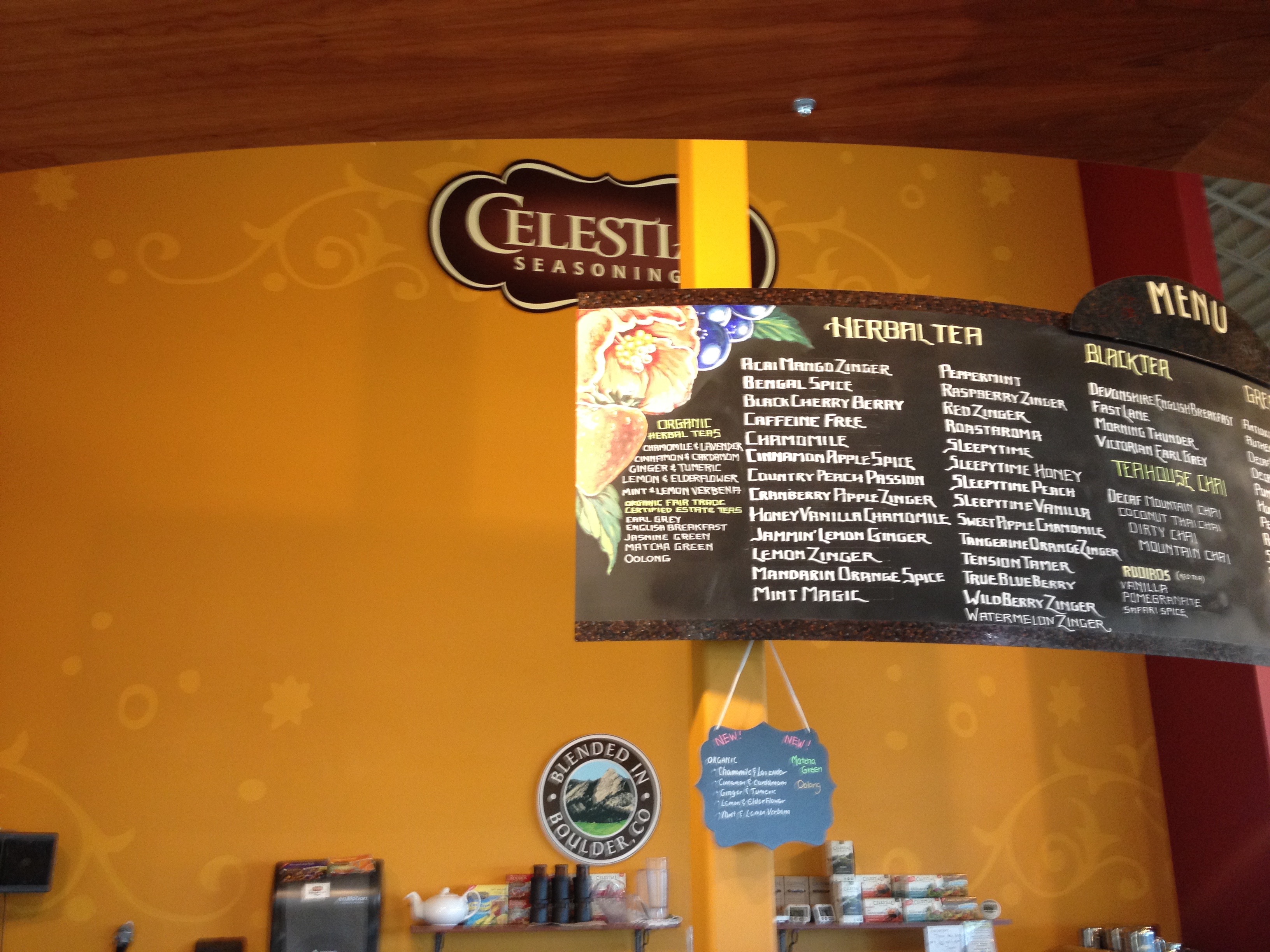
However, Celestial Seasonings is a place that has way more character than the stuffy images I think of when I think of the average “tea time”.  It was started by a bunch of hippies, which should not really surprise me given that it is in Boulder and was started in the late 1960s.  They would gather leaves in the Rocky Mountains outside of Boulder to make their beverages.

IMG_4514

However, the leaves that constitute “tea” come from plants that cannot be grown in this part of the world.  So, the beverages they put together were drinks that could not actually be considered “tea” by the technical definition.  They would have been considered “herbal infusions”.  The phrase “herbal infusion” had a clear association with the hippie movement.  So, to sell these products to the general public, which was (and still is) largely skeptical of the hippie movement, they labeled the beverages “herbal teas”.

IMG_4703

Now nearly a half a century has passed.  A lot has happened.  First, the hippies reached full-fledged adulthood (over 30, is that what they said?), got jobs, bought houses on cul-de-sacs, and, eventually SUVs and mini-vans.  A new generation emerged, powered by a rejuvenated economy, and became Yuppies.  They managed to both continuously enlarge the houses and vehicles in suburbia, while also turning formally blighted neighborhoods in city centers across the country into high-class urban playgrounds.  Many of the areas that were once focal points to the hippie sub-culture, including San Francisco, and even Boulder, are now firmly under the domain of this new urban culture.  Of course, this is all an over simplification, but hippie communes still exist, largely in the same way soda fountains and other relics still exist.  A family will randomly encounter one in an out of the way place on a road trip, and grandma and grandpa will explain to the children what they are/ were all about.

Yet, the label “herbal tea” is still there, both in this tasting room, and in their packaging.  It is still there despite the fact that so much has changed.  Not only does the general public have absolutely nothing to fear from the hippie sub-culture anymore, but, I would argue that many of their ideas have penetrated our mainstream thinking, both “right” and “left”.  We do not wear suits to baseball games anymore.  People aren’t mocked or reprimanded nearly as much when they explore their feelings, and try to find themselves.  There is no more stigma around going to seek therapy, and tons of people participate in yoga classes.  We may largely be in boring cubicles and offices, but it is not unheard of to openly defy the authority structures there.

Despite all of this, people are still drinking “herbal tea” instead of “herbal infusions”.  “Herbal teas” are Celestial Seasoning’s three top selling “teas”.  Is this simply the power of inertia?  Are there still a significant enough number of people that would shy away from drinking something if it was labeled an “herbal infusion”?  Or is something greater at work?  Our world is in a constant state of flux, and that flux includes language, definitions, and standards.  The hippie movement did not survive, but some of the ideas joined the mainstream.  Maybe, although, these “herbal infusions” were not considered “tea” in 1969, they are now.  Very few people, when they buy these products at the store, even ever realize that they are not actually drinking tea.  For all practical purposes, it is tea despite the technical definition.  After all, Colorado is already a major part of a movement that changed the standards for what is considered beer, why not another product?

Hitting Goals

IMG_4682

Some people thrive on goals.  They are always working towards something, and always working towards something that can specifically be measured.  Sometimes it’s something along the lines of a specific marathon time.  Other times it is a major life event, such as earning a promotion, or being able to afford a house. Sometimes it’s even something a bit more unusual, like trying every ice cream flavor at a local ice cream shop.  But, in all cases, there is a goal, and a clear measurement.  At any given time, they know whether or not they have achieved their goal, and, in most cases, how close they are to reaching it.

Sometimes I envy these people.  Being driven by reaching specific, tangible benchmarks like this fits quite nicely into our present day results-driven society.  Tons of people writing about what makes people effective, or successful, stress the importance of making and achieving goals on a regular basis, both from the standpoint of improving your confidence and demonstrating your ability to achieve to others.

IMG_4306 IMG_4490

Unfortunately, I tend to be driven by ideas and concepts that are more big-picture and abstract.  I am more interested in knowing that I am generally in good health and feeling energetic than reaching a specific weight target.  As a person who believes in flexibility and individuality, and shuns rigidity, I will often look at something like wanting to buy a house, and say, wait a second, is there some kind of way I could be just as happy in a condo, given certain circumstances?  Do I need to make a specific commitment to some sort of a budget, when circumstances in life often vary, and adhering strictly to a certain number might even cost me opportunities that could go a long way towards some of the most important goals of all, which I see as happiness, purpose, satisfaction and the like?

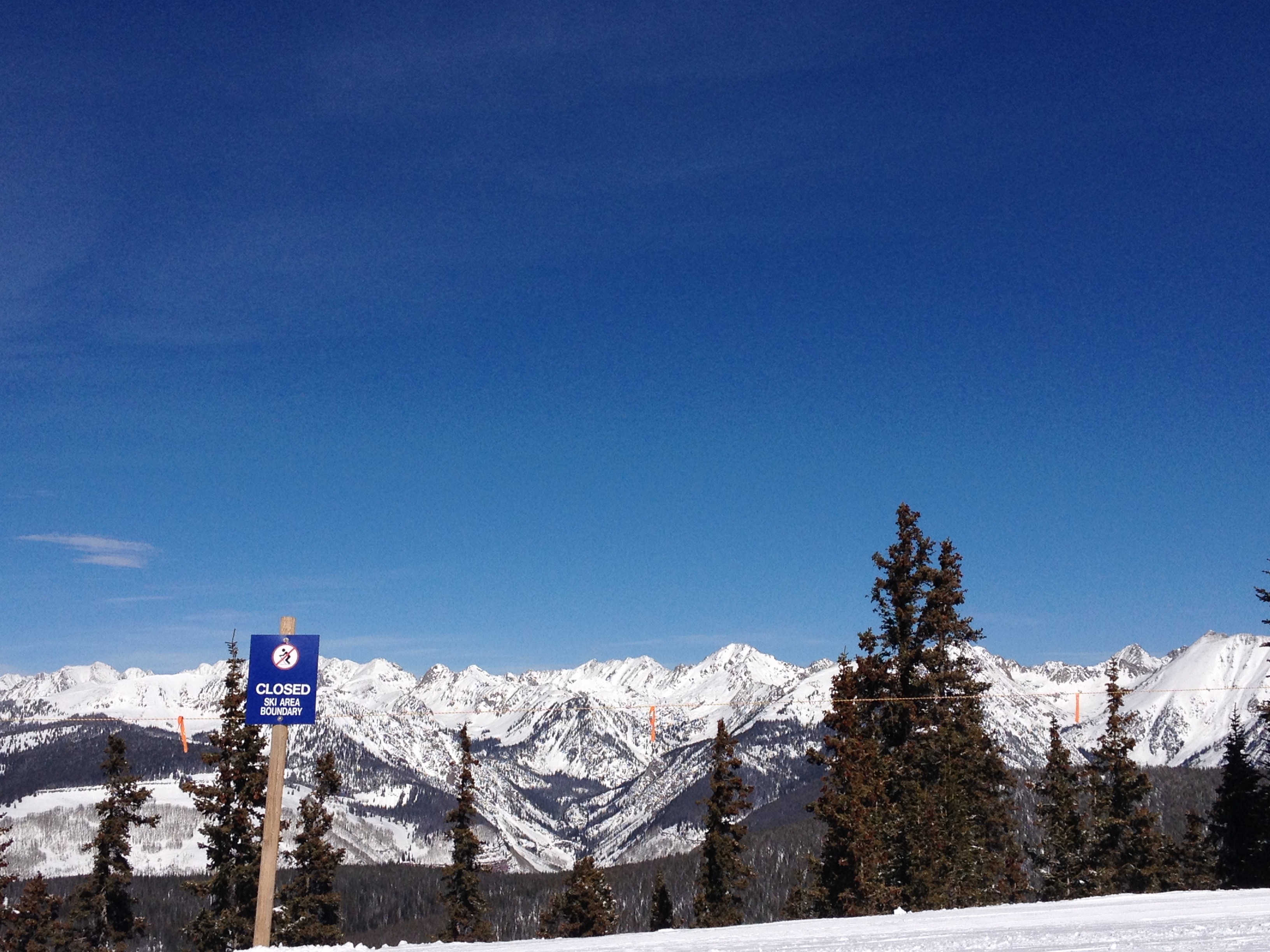
I do, however, have to acknowledge some of the reasons we operate in this fashion.  After all, we do live in a complicated world where we all have thousands of things competing for our attention at any given time.  The easiest way to grab someone’s attention is to say something specific.  Vail Ski Resort will tell you it has a 3450 foot vertical drop, or that it gets 348 inches of snow per year.  They do not try to get your attention by saying that skiing will provide an exhilarating experience that will often improve one’s happiness as well as physical fitness.

IMG_3121

In 2015, in addition to my big picture goal to “feel more energized and be in better shape”, I attached a specific goal.  I was going to bicycle at least 1500 miles this year.  Now, I do understand that this is not that high of a number.  The most hard-core cyclists will often ride 10,000 miles in one calendar year.  One bike ride across the country is more than 3000 miles. But, 1500 miles would make this my biggest bicycling year yet (2014 was previously my highest at 1385 miles), and it would be an easy number for me to point to as a way to indicate to others how much bicycling I do.

There were a couple of obstacles that got in the way of me reaching this goal.  The first was a wet early season.  In May, Denver recorded measureable precipitation 19 out of 31 days. This was followed by 13 rainy days in June.  Ironically, one of those rainy days included a hailstorm, on bike to work day!

IMG_3632

Later on, job/career related issues took some of my attention away from cycling.  And, finally, although this one is definitely not a bad thing, during the second half of summer and the first half of fall, a lot of my plans took me places where cycling was simply not possible, including travel, visitors, and social events.

IMG_4680 IMG_4681

However, despite all of this, on Sunday, November 1st, 2015, I reached my goal, and pedaled my 1500th mile of the year.  And, I decided to do it in style.  I didn’t want to get to this milestone just anywhere, biking on some random road in some neighborhood that doesn’t mean anything to me.  I wanted to go somewhere iconic!  I wanted to go somewhere appropriate, for both the day’s conditions, as well as a place where I had significant experiences during the first 1478 miles I rode this year.  Really, there was only one true choice; Red Rocks amphitheater.  At exactly 22 miles from my home, I would hit that 1500 mile mark somewhere along my final ascent to the top of the road.  Red Rocks is an iconic place, both beautiful and full of memories for mankind.  And, it is a place I have ridden my bike to over half a dozen times on previous rides.  One of my favorite half day rides is to go to Red Rocks, and then into Golden for lunch, followed by a nice quick ride on the Clear Creek Trail back to Denver.

IMG_3452

Yet, the story of me and my bike in 2015 cannot simply be summarized with a number; 1500, or 1600, or whatever I get to in two months when the year is complete.  It is so much more than that.  It is the exhausting three day, 230 mile ride through Yellowstone and the Grand Tetons.  But, it is also the countless treks over the same roads in town, to and from work, and to all of the other places I went to on a regular basis.  It’s the improvements I made in climbing, something I am weak at due to living in Chicago for several years, but also all the flat tires I got and had to change.

Outcomes are best communicated to others when they are demonstrated both qualitatively and quantitatively.  Behind every story, there is a number, probably multiple numbers.  I can say I biked 1500 miles.  I can also figure out how many vertical feet I climbed, how many times I biked certain roads and trails, and even how many tires I changed.  But to just say the number, without answering that all important question, why I am doing what I am doing, would also not be effective.  I bike to improve my health, spend some time outside, visit interesting places, and to save some money on fuel.

More importantly, bicycling contributes to my larger scale goals of being happy, healthy, unique, and true to myself.  How much different would it be to have biked 1475 miles vs. 1525 miles?  Not too much.  The same way a .301 batting average is not too different than a .299 average.  So, I guess while I am happy I reached the mark I set out for at the beginning of the year, I still need to recognize that it is not the end all, be all.  While it is good to have a goal, or a target, to stay on track, and provide a construct for how far one wants to take a certain activity, we all must keep mindful of the big picture. And, if reaching a certain number would cost us more than it is worth, we should be willing to adjust.

A Tribute to a Companion

IMG_2938

October has been a crazy emotional month.  Most of what I write about in this blog pertains to specific experiences.  This past summer was certainly filled with activities of all kinds, trips to various interesting places, and new experiences.  It is what I love doing.  I started writing this travel blog to catalog my experiences.  However, this month, I feels like all I have been writing about is heavy emotional types stuff.

For an experience is not just simply the place one visits.  It is also about what one does at that specific place.  It is often about the company one keeps, and who that experience is shared with.  It is the thoughts and feelings we all experience when in various places.  It is the revelations we come to, about life, about the people around us, and about ourselves.  It is also the connections we make, or the connections we deepen on these trips.  I often have some of the deepest conversations with others on lengthy road trips.

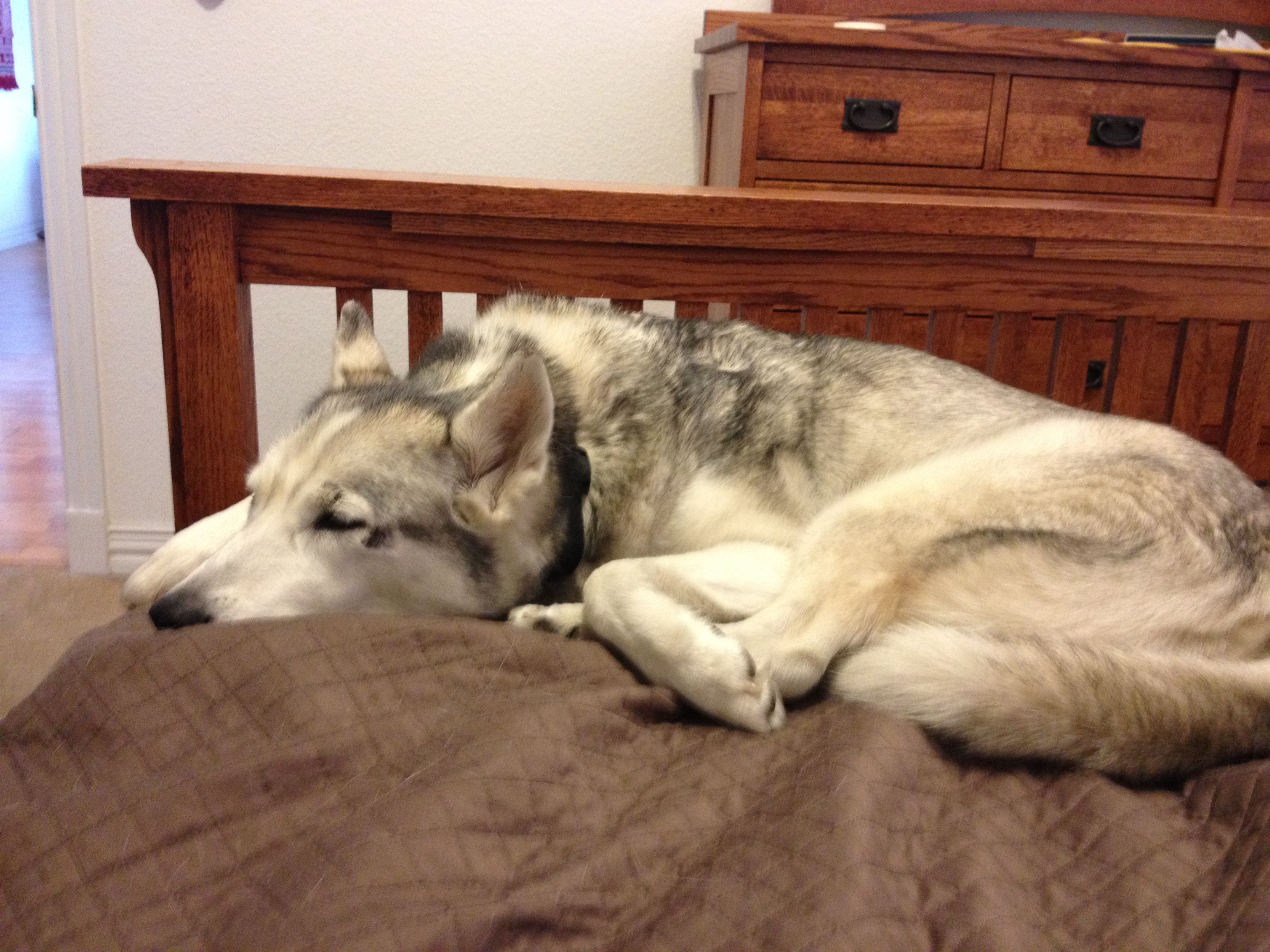
On the evening of Tuesday, October 27th, 2015, last night at the time of writing, I unexpectedly had to say goodbye to not only a travel companion, but also a companion in life- my dog Juno.

IMG_1010 IMG_1626

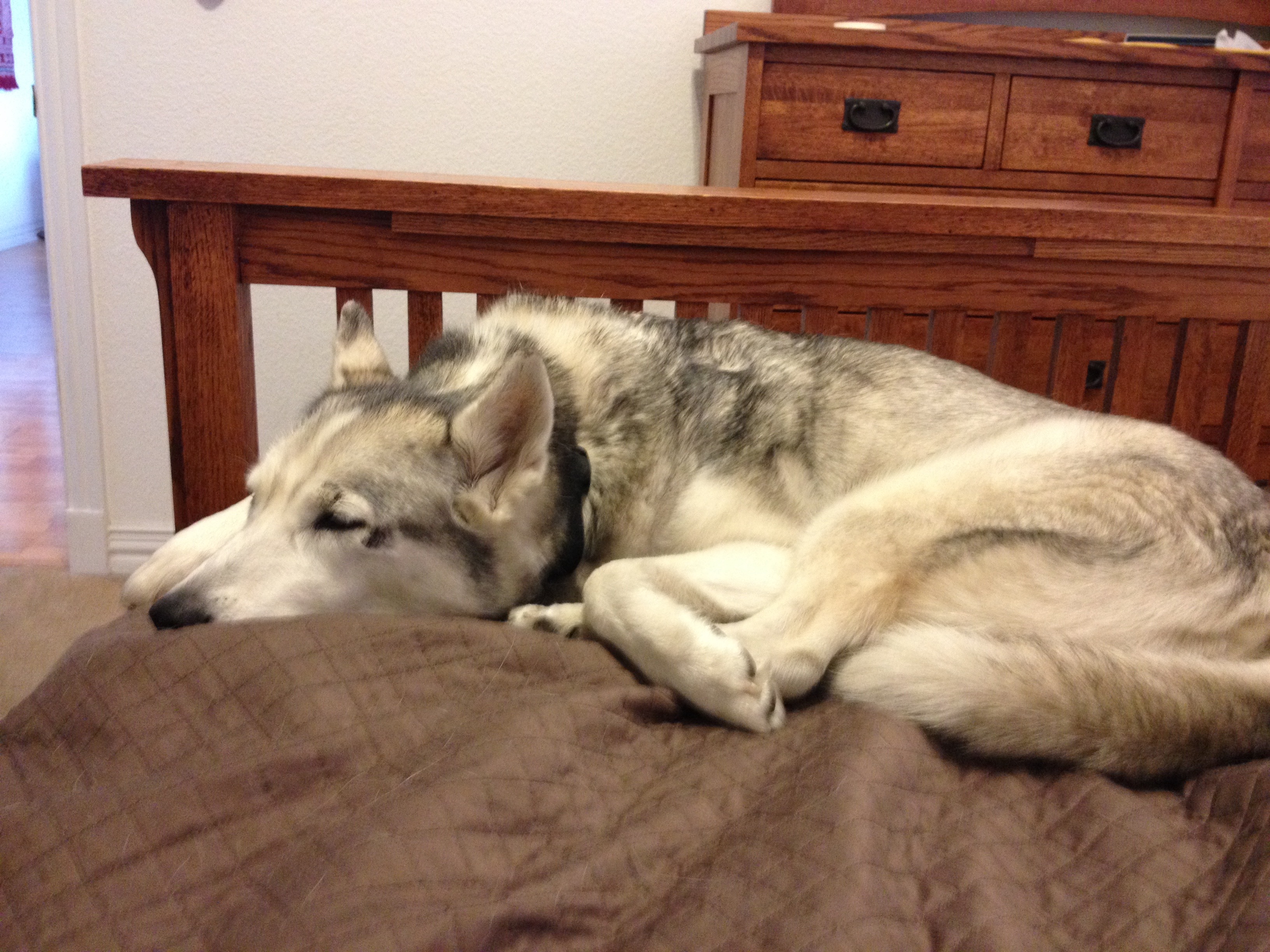
It is nearly impossible to fully describe how it feels to have lost a companion an wonderful as Juno.  Not only did we share a ton of adventures together, but we also shared a lot of aspects of day-to-day life.  As one can see by looking through the pictures on this blog, Juno would accompany me on quite a few adventures, from hiking, to camping, and so much more.  As a cold weather dog (Siberian Husky), she particularly loved the mountains.  In fact, I remember the look on her face when we departed from one of our weekend camping trips in the mountains.  She knew we were headed back to Denver, and the look on her face said, clearly, “Why don’t we live here (in the mountains) instead of there”.

IMG_2196

But not only was she around through all of the fun times and adventures, she was also present for my day-to-day life, the ups and the downs, and well, the part of our lives that is not always as glamorous.  One thing we as human beings in the 21st Century tend to do, when we invite others into our lives, is only invite them for the good part, the fun part, the adventurous part.  This comes, obviously, out of the desire to be liked.  So, we present the portion of ourselves that we feel is most likely to be desired by others.  But, it is when those around us see the part of us that is not so great, the part of us that deals with discomfort, pain, disappointment, and heartbreak, that we build deeper connections.  Juno saw me in all parts of life; the night, as well as the morning after, when the consequences often come.

IMG_2115 IMG_4615

It is really impossible to replace a companion like this.  A friend, whether it be a two-legged friend, or a four-legged one, simply cannot be replaced.  There is no substitute for the experiences we have had together.  There is no substitute for the way we interacted with one another.  And there is no substitute for the joy we had brought into each other’s lives.  Experiences cannot be replicated by design.  One can only hope to find something similar, or to happily move on to a new and positive experience when one is done.

I will miss the way Juno greets people in the neighborhood, almost invariantly getting a positive response from anyone we would walk by.

IMG_1150

I will miss the way Juno problem solves her way through the rocky sections of hiking trails.

IMG_1473

I will miss the way Juno would always give me a facial expression that made me feel confident in knowing that she was happy to see me.

IMG_2978

I will miss the way Juno often sits on the ground in a manner that makes her look like a three-legged-dog.

IMG_2654

I will miss the way Juno would alternate between sticking her head in front of the head rest on the drivers and passenger seat sides on car rides.

IMG_2688

I will even miss the way Juno found sneaky ways to pull random chicken wing bones off the ground on walks, particularly on Sundays, without me noticing.

Most of all, I will just miss the happiness she would always bring.  I guess there is no better way to describe how I feel right now that simply with the word sad.  Sure, there are thousands of other ways to complexify the emotion.

I know I took care of Juno responsibly, but was I responsible enough?  Juno started acting strangely roughly a couple of weeks ago.  The main thing I noticed was that she was kind of lethargic, moving slower than normal, and drinking a lot of water.  This felt to me like someone who has a bad cold, something which people can usually recover from with rest and plenty of fluids.  It was not until Monday, when Juno did not appear to be recovering, that I brought her into the Vet.  Still, I was not prepared to lose Juno this quickly.  I was just perplexed by why she had not been recovering and still seemed to be acting strangely.  We had brought Juno home from an animal shelter in 2011, four years ago.  At the time, the shelter told us she was five years old.  Some of the vets we had brought her to had subsequently estimated her age to be less than five.  So, at most she had been nine years old.  And, although she had EPI, a disease that renders a dog’s pancreas as useless (we had to mix her food with enzymes to get her to absorb it properly), I still seriously had expected to have her for at least several more years.

I took Juno on adventures, but did I take her on enough of them?  Did I really give her the life she deserved?  A look through this travel blog, which covers much of what I had done for a large portion of the time I had her, shows many adventures she was a part of, but also many adventures in which she was not included.  Additionally, as someone who has had to work standard M-F 9-5 types jobs for much of life, she has spent a good number of weekdays home alone for more than eight hours.  I know this is typical in today’s society, but does that make it right?  I wonder how she felt all those days.

Mostly, I just hope I gave Juno the best life I could have given her.  Because, as many animal lovers will attest to, a dog is not just a pet, it is part of the family.  I remember how strange it would feel to come home to an apartment without a dog anytime I would be out of town for the weekend and have brought Juno somewhere else.  The coming weeks will not only feel strange, but sad.  There are some sad events where one reach deep down inside and find a way to take comfort.  Many people can find a way to come to view a lost job as “for the best”, or see something like the not-quite world series bound Chicago Cubs as still having had a “great season” that “exceeded expectations”.  But, when it comes to something like this, I dig down, deep inside my heart, and all I see is a hole, for I know that I had a great pet and a great companion, she is gone, and there is nothing I can do about it.

Ideas I Am Not Giving Up On

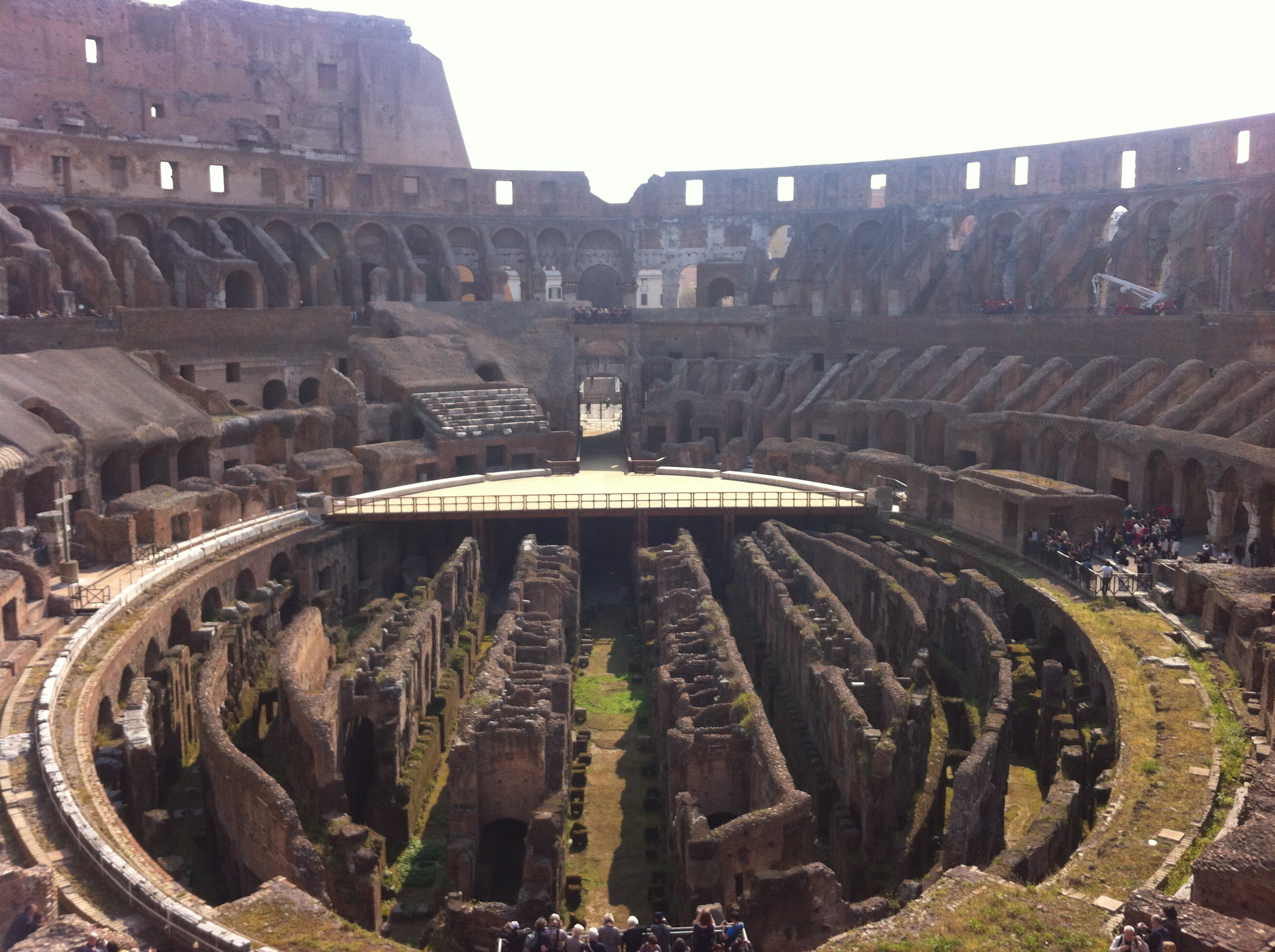
Ideas are powerful!  They can outlive the people, and even the places and things originally associated with them.  Rome was all but destroyed in the 4th, 5th, and 6th centuries.  The people that created Rome, and the representative republic which governed Rome for the first five centuries were long gone.  Yet, these ideas made a resurgence in the 18th Century, when the founders of a new country called the United States of America created a representative republic in a new land far away.  The writings of ancient Roman authors, from those that formed the Republic after overthrowing a King of their own, to those that later tried to defend the Republican form of government from power hungry politicians, are said to have provided inspiration for the country’s founders.

Roman_Coleseum

For all intensive purposes, Rome was a place that no longer existed.  Yet, ideas that originated from this place had found their way to a land that Romans had no idea even existed, at a time over two thousand years later!  Over the next Century, these ideas would proliferate, inspiring additional revolutions all over the world, and even counter-revolutions.  Roughly a century later, that idea would actually find its way back to the very place it originated, when Rome, now part of a nation called Italy, would adapt a roughly similar form of Government.

It is for this reason people are often more threatened by ideas than they are by specific people.  Today, when those of us look at someone like Osama Bin Laden, or any specific leader of ISIS, what we are looking at, and what we are threatened by goes way beyond a specific individual.  Even Bin Laden, long the subject of ire for many, needed the aid or cooperation of many other individuals to successfully carry out the attacks he carried out.  Simply put, for many of us in the United States, he became the face of an idea, and one that we largely found repulsive.

Churchill01

We all have ideas.  Even those of us that do not consider ourselves creative, or inventive people, have ideas.  It doesn’t have to be world changing like the invention of the computer.  Maybe it is something as simple as the idea that it would be nice to have a train line or an additional road built to alleviate traffic.  Or maybe it is the idea that animals should not be mistreated by their owners.  Either way, as long as one understands the idea, why they feel the way they do about it, and has enthusiasm for it, the idea is worth pursuing and standing up for.

June2-05 tornado

I have a ton of ideas, and many do relate to how I feel the world should work.  Lately I have been hearing all the time that some people see the world as it, while others see the world as it could be.  I would consider myself firmly in the later group.  I commonly see some aspects of our society, and how it works, and think to myself (and sometimes say it to people around me) “we can do better”.  After discussion, I will often hear from others what has come to be my least favorite sentence of all time: “It is what it is”.  This is because, in many cases, I really see no reason it has to be that way.  Some people see this as the mark of someone who refuses to mature beyond a state of artificially prolonged adolescence.  However, I see it as refusing to give up on me, and what makes me unique.

I see an entire generation of people pursuing college education, and, more and more, post-graduate degrees, in interesting intellectually stimulating subjects just to join the workforce and be asked to perform menial, repetitive job duties and have their ideas rejected due to their low standing on the corporate totem poll.  We can do better to nurture and develop these promising young minds.

I see people not being true to themselves, in their actions, their behaviors, and attitudes.  We encourage one another to conform, to act like everyone else, and to live life according to a script written by and for a culture that no longer exists because many fear change and the potential loss of status associated with it.  But each person’s individual and unique way of doing things is part of what makes this world an interesting place.  We can be better about encouraging people to be true to themselves, and not being threatened by their unique way of life.

I see countless missed opportunities in the lives of countless people based on adherence to rigid rules and policies that do not make sense.  This is where fear takes it’s greatest toll on society.  Many take comfort in rules and structure.  However, why should someone who has completed their work, and has no other obligations (meetings and such) be sitting in their cubicle at 2:30 on a warm, sunny afternoon?  And, why should one person making a mistake with something lead to a law or ordinance preventing everyone from taking part in this activity?  We can stop taking comfort in rules, and start taking advantage of all the beautiful opportunities this world provides us.

And, I see people who have failed to make deep and meaningful connections with other human beings.  Many go through their lives feeling like they do not have the support system needed to get through the rough patches of their lives.  This is because we live in a society that does not place a high value on building social capital.  Many of us spend our days in work and social settings where we do not feel comfortable expressing our emotions and showing one another who we really are.  You cannot develop a meaningful friendship with someone that does not even know who you really are.  As is the case with the other ideas listed, we can do better on this one as well.

Periodically, I am pressured to give up on these ideas.  I admit nobody has ever specifically told me something like “don’t be who you are”.  But, I definitely feel it.  “You need to act more professionally”.  “Fireball: What are you?  Still 22.”  “Grow up, be a man.”  “You can’t just….”  These types of statements, and many more, come based on the idea that there are certain expectations of me that I do not believe need to exist.

There are even some that have given me sincere advice that I need to stop worrying about these overly philosophical issues.  After all, there are actual reasons for all of the things that frustrate me, and those that defend the current way we do things in this world probably have some valid points.  But, while sometimes I do experience frustration and rejection by acting the way I do, the alternative sounds way more depressing to me in the long run.  The alternative, to me, is giving up on who I am.

I would rather encourage people to pursue their intellectual ideas, even if occasionally their bosses come down on me.

C Brwon 001

I would rather continue to show people who I really am, and continue to enjoy the activities that bring me happiness, even if I am periodically given negative feedback by judgmental people.

IMG_4518

I would rather take advantage of all of the great things this world has to offer, all of the wonderful places to visit, interesting ideas to pursue, and experiences to enjoy, even if that periodically earns me “reprimand”.

IMG_4461

And, I would rather occasionally get burned by someone who uses information about me for their own selfish ambitions than cease showing people who I truly am.

Essentially, I would rather get rejected as myself than be accepted by pretending to be somebody else.

We are all people of value, in our own unique way.  And, for any one of us, if we go out there in this world, and find a way to be the best version of ourselves, but still ourselves, we will naturally find people who like it, and people who see us as valuable individuals.  We all long for acceptance, but in order to be accepted in a true meaningful way, we need to overcome the fear of rejection, and stand up for our ideas.

Disconnect and Reconnect

IMG_4590

2015 is quite a strange time.  I wholeheartedly believe that one day we will look back upon this particular era of human history as one of major transition; for better or for worse.  It was around twenty years ago that households across America were suddenly all gaining access to the internet.  It was around ten years ago that social media started ramping up the roles it played in each of our lives, and a few years later, many people across the country started getting “smart phones” with data plans that provide us with nearly constant access to the internet.  Living in Colorado, it is easy for me to travel to places without an internet connection (although I am sure there are people working on that right now).  However, I imagine that many people in large metro areas, particularly on the East Coast, may go years without traveling to a place that is truly “disconnected”.

IMG_4592

It takes a while for society to really process changes as major as this one.  For the first few years, following the proliferation of social media and smart phones across the country, it genuinely felt as if I was the only person who was concerned about the potential downsides of this sudden cultural transformation.  It wasn’t until a few years later that people started sounding the alarm about topics such as cyberbullying, echo chambers, loss of depth in our conversations, the impact it could have on our friendships, phoniness, and the constant exposure to new information leading to a culture of constant distraction.  Having moved from Chicago to Colorado in 2012, I cannot pinpoint the exact time when we as a society actually started addressing this issue.  I recognize that I moved from a major city to a place that naturally attracts people that would share my views on this subject.

I am a firm believer is a concept known as “Natural Law“.  This philosophy states that there are certain universal truths that apply regardless of setting.  By contrast, Moral Relativists believe that what is right and wrong in always relative to the time, place, and circumstance.  Over the past couple of years, much has been written, in books, on the internet, about the importance of taking time to “disconnect”.  Most of these article remind us of the need to, from time to time, turn off our televisions, computers, smart phones, etc. and spend some time with ourselves.  But, this was true even before we had smart phones and social media.  Long before social media, Bill Gates would periodically go into complete seclusion for a week at a time.  He would refer to these excursions as “think week”s, and use them to develop key ideas.

IMG_4593 IMG_4594 IMG_4595 IMG_4596

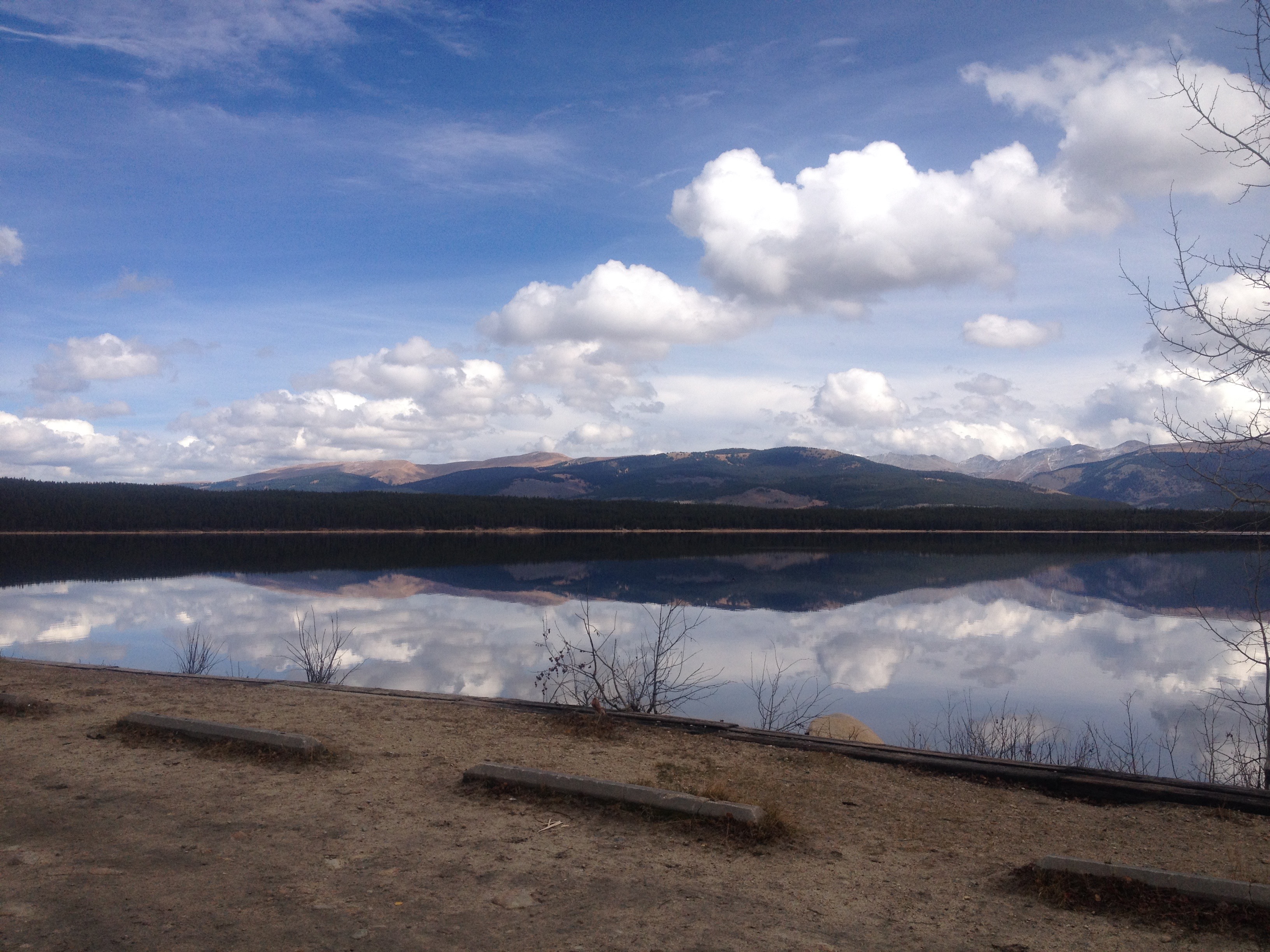
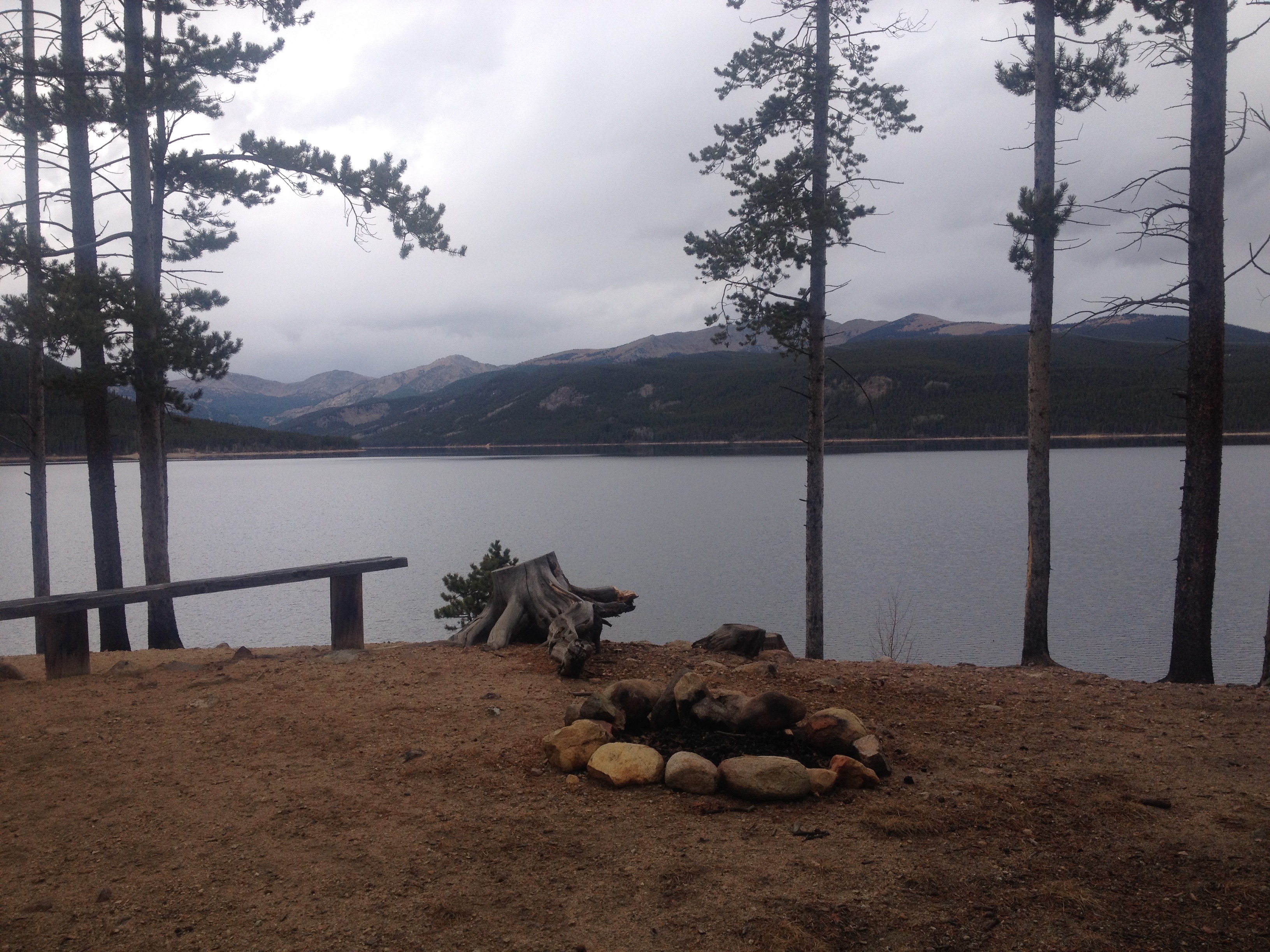
When I arrived at Turquoise Lake, a mere five miles outside of Leadville, Colorado, what I saw was a perfect place to put this advice into practice.  Simply put, it is quiet, but also very scenic.  I came to the lake not knowing what to expect.  I knew it was a Tuesday, and in the middle of October, and therefore would not likely be crowded.  But, with the exception of a storm headed into the area by later in the afternoon, the place was quite tranquil.  It is the kind of place people envision when they think about a quiet country mountain getaway.

I decided I would take five minutes, and force myself to do nothing- absolutely nothing!  I would not pick up a rock and start throwing it.  I would not walk down to the lake.  And I certainly would not even touch my iPhone, which was in my pocket at the time.  For five whole minutes, all I did was stare at the Lake, the trees, and the mountains in the backdrop.

IMG_4597

At the end of these five minutes, I picked up a rock, and wrote the following message.  Along with this overarching theme, a series of other ideas flew into my head.  For, in life, we all do things that makes us feel alive.  Unfortunately, we also have times in our lives when we simply don’t feel alive.  Choosing to live means something different for every person.  We all have our own individual passions and priorities.  But, one thing we all must do, in order to be true to ourselves, is overcome the fear of leaving our comfort zones.

IMG_4598 IMG_4599

As I watched the storm roll in, I realized that, for many, the first step towards overcoming this fear, and expanding our comfort zones, is exactly what I just did.  In our current culture, with TVs in every house, iPhones with music and games, and distractions everywhere, being completely still, completely silent, and without some external stimulation to occupy our minds is well outside the comfort zone for most people.

I have a friend from High School who has A.D.D.  And, I do not mean it in that manner in which we over-diagnose A.D.D. in our modern society.  He was diagnosed long before they started diagnosing everyone, and seriously has nearly no attention span without medication.  One day, we thought it would be interesting to see how long he could do nothing for- absolutely nothing.  We all just sat in chairs doing nothing.  After a minute or so, we could obviously tell that this was a painful experience for him.

However, for those of us without this issue, when was the last time we actually did spend a whole minute (or five) doing absolutely nothing?  How often do we, while waiting in line, or waiting for a train, or waiting for our friend to show up at a bar, instinctively take out our smart phones, and distract ourselves with a game, an unnecessary email check, or social media?  Have we all gotten to the point where we cannot spend a minute inside our own brains?

For what I realized is that when we “disconnect”, we are not just disconnecting from the internet, and other distractions.  We are actually reconnecting- reconnecting with ourselves.  For most of our days, in 2015, for better or worse, we are fixated on an external stimulant.  Our minds dwell upon something someone else has chosen for us to think about.  It is only when we shut those outside distractions out that our minds are free to wander.  It is then that we form our own thoughts, on our own terms.  This is something I fear we may have lost in our modern culture.  At Turquoise Lake, I found it.

Places that Used to Be

IMG_4573

Many different types of images come to mind whenever anyone talks about “ghost towns”.  I think of all of those images of abandoned, and partially decayed buildings that are pictured on the cover of books about ghost towns.  I think of that abandoned cabin you see while on a hike.

IMG_4329

Sometimes I think back to the recently abandoned town in West Texas I passed through a decade ago on a storm chase.  I even think of other, more recently abandoned, “21st Century” ghost towns.  Heck, sometimes parts of Detroit even come to mind.

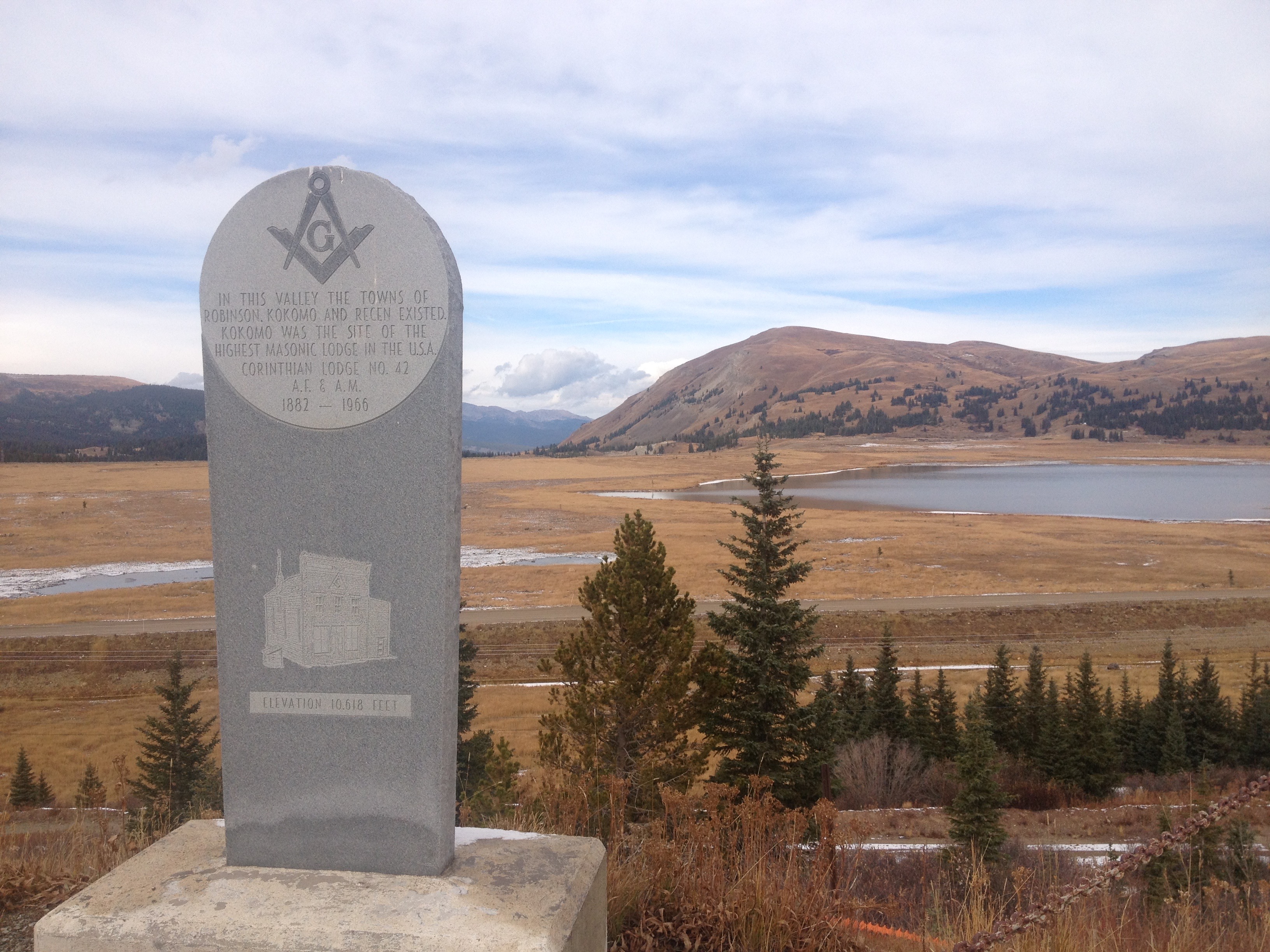
But something felt creepy when I came across the site of not one, but three towns that used to exist, as recently as the middle part of last century.

IMG_4574 IMG_4575 IMG_4576

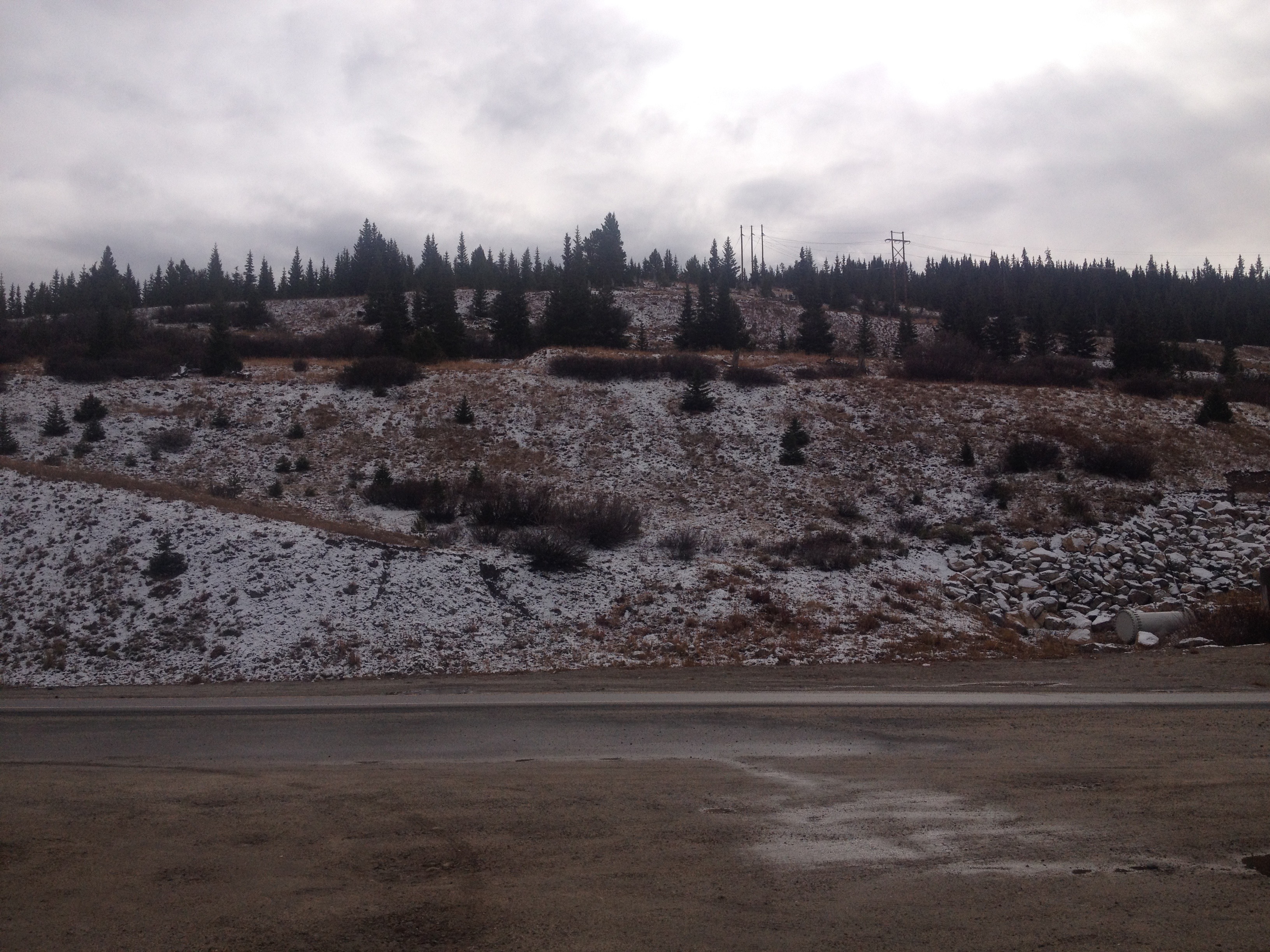
I looked around in all directions.  There were no buildings at all, not even one of those rotted out wooden buildings that appears to be on the verge of collapse due to neglect.  I looked far and wide along the valley for some sort of evidence that there were three whole towns in the area as recently as the 1960s.  Maybe an abandoned platform along the tracks.  Or even piles of wood, or rocks.  Nothing!  The only evidence anyone passing along this route would have that there ever was any human civilization in the area is a historical marker that marked what once was the site of the highest masonic lodge in the U.S.A.  It’s creepy enough that these towns appeared to be completely erased out of existence.  But, the only indication that these towns ever actually existed is due to the Masons, a secretive organization that many also find creepy.

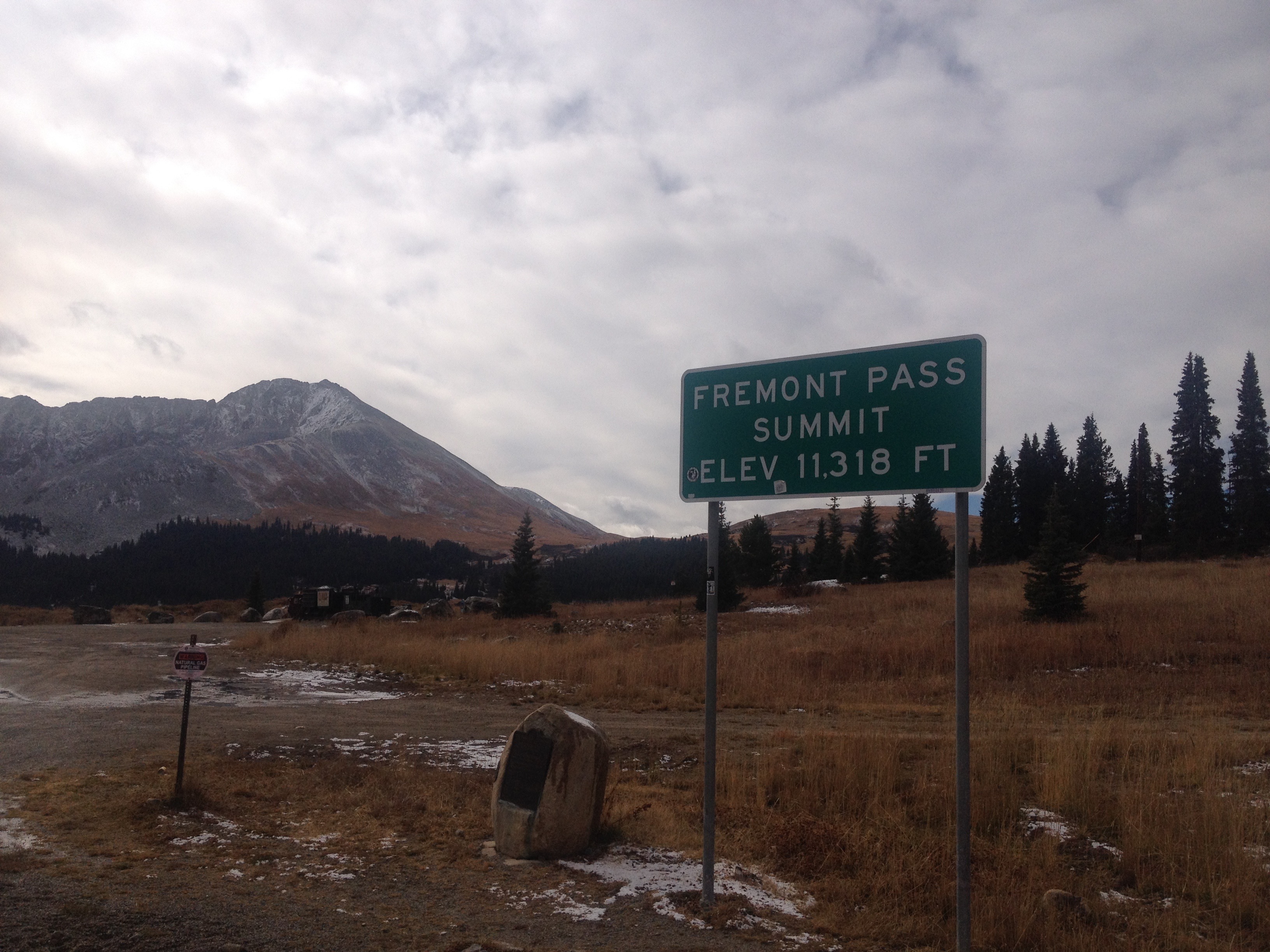
Three miles up the road, is Fremont Pass, another place with echos of the past.

IMG_4577 IMG_4578

Fremont Pass, it appears, is home to another “ghost town”, the town of Climax.  Here, I at least found some evidence of this town’s existence.

IMG_4579

This particular location played a significant role in history on two occasions.  As indicated by the historical marker, the Continental Divide is the western boundary of the Louisiana Purchase.  In fact, this very location was an international border from 1803, when the Louisiana Purchase was signed, until 1821, when the Adams-Onis Treaty established slightly different borders between U.S. and Spanish territory.  The border would remain in a somewhat nearby location until the conclusion of the Mexican-American war in 1845.

Later, the Climax Mine would play a pivotal role in the U.S. efforts in both World War 1 and World War 2, as it sits on one of the largest deposits of a little known substance of molybdenum.  To be completely honest, I have no clue what molybdenum is.  All I know is that it is one of those middle elements on the Periodic Table, which, I am guessing is more than the average person knows.

What I did gather, though, was that like the three other ghost towns in the area, this is a place that was significant, actually quite significant, at a point in our history, but now it is basically gone.  In fact, the only real reason I know about Climax is related to one of my other projects.  I recently created an algorithm to calculate seasonal normals at any given point in Colorado for the purpose of planning out activities across this beautiful state.  To develop this algorithm, I needed to find as many reliable weather observation sites in places with different geographical features as possible.  Climax, it turns out, is the site of one of the highest reliable CO-OP weather stations.

IMG_4580

Not only was this weather station particularly helpful in developing that algorithm, it is also a great source of information regarding snowpack conditions at high elevations for the purpose of avalanche forecasting, as well as determining where to hike or snowshoe.  So, although that molybdenum plant re-opened a few years ago, in my world, this weather station is currently Climax’s most significant attribute.

The fact that places both rise and decline in significance is not a new concept.  Places like Egypt and Sumeria formed the cradle of civilization, only to eventually cede that power to other cities and regions.  Similarly, in today’s United States, we are currently seeing places like Texas and Florida gain province, while parts of the Northeast and Midwest decline.

This particular situation is strange though.  When I think of the “Fall of Rome”, for example, I think of a process that occurred over roughly two centuries.  The ghost towns near Freemont Pass were culturally significant a mere half a century ago.  Today, they are all but vanquished from existence.

I am also not accustomed to seeing this process occur over such a small spatial scale outside an urban area.  Most of Colorado is thriving, particularly the mountainous part of Central Colorado.  These three erased towns are only ten miles up the road from Copper Mountain Ski Resort, a resort that is so popular that it one of only three ski resorts to receive its own detailed forecast from OpenSnow (the other two are Steamboat and Vail).

IMG_3204

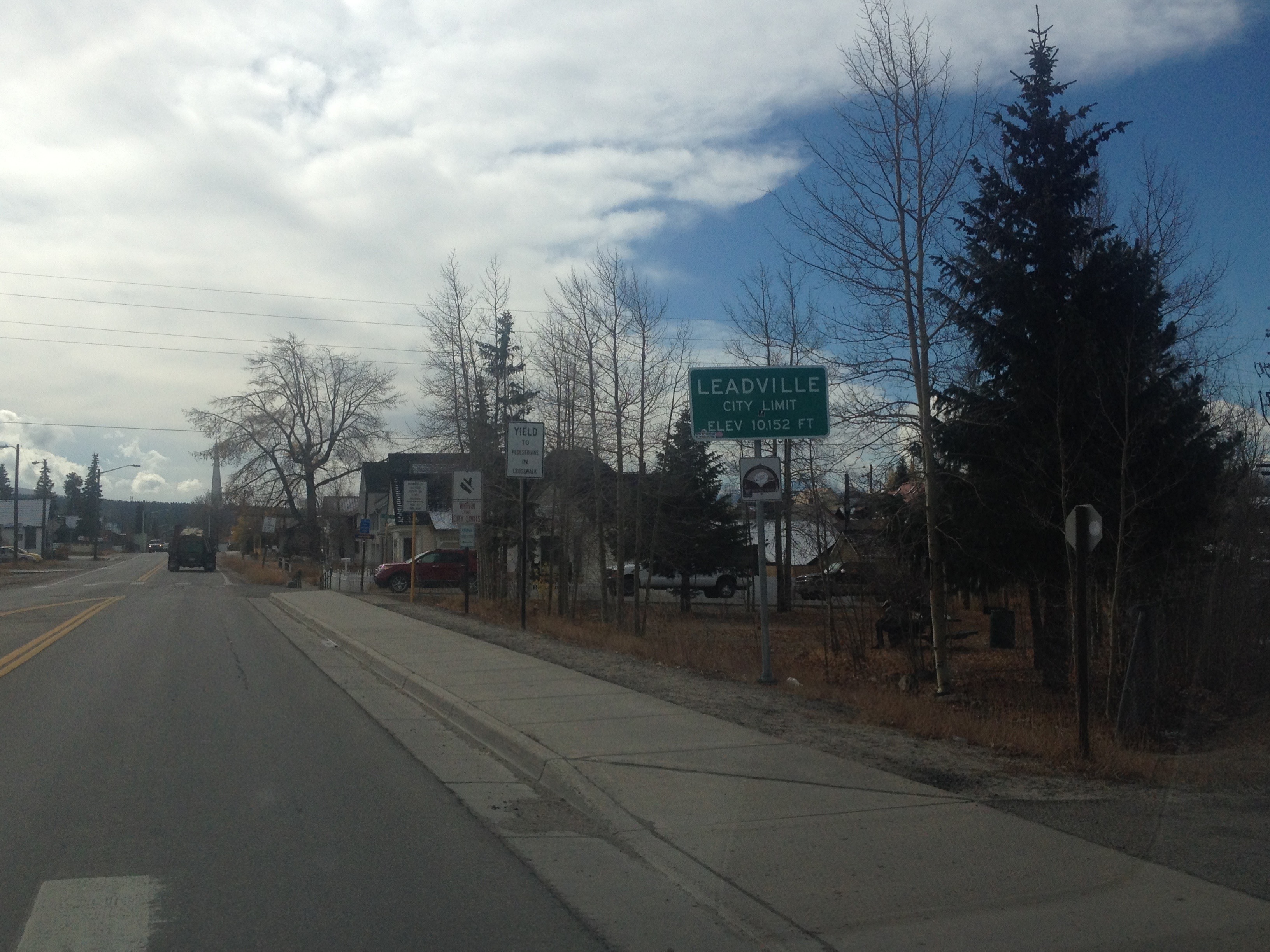
Roughly ten miles or so in the other direction, is Leadville, a former mining town that also appears to still be doing quite well for itself.

IMG_4581 IMG_4583

When I think this all through rationally, I understand why the civilization left the Fremont Pass area.  The economy was largely driven my one obscure material.  When the price for that one material declined, the entire economy left.  Sometimes, though, it takes some time for information to process through the logical mind.  My gut reaction was still one of disbelief, as it still definitely feels strange to see a set of towns decline so quickly to the point of non-existance in a region that as popular and ascendent as Central Colorado.
An Eerie Feeling on Guanella Pass

IMG_4557

Those that love to travel, whether they be the rare few, the people who get to travel for a living, or those who find a way to travel as much as possible, understand that Planet Earth is full of amazing places!  One of the things that makes traveling interesting is the wide variety of types of places to visit, all of which will produce different scenery, and different experiences.  It is nearly impossible to describe or capture the true range of experiences one could theoretically attain through travel, but the Discovery Channel’s Planet Earth Series does a pretty good job.

When people come to visit me here in Denver, I typically take them, in some capacity, into the mountains.  I will particularly ensure that a trip to the mountains gets on the agenda if I get visitors from places like Chicago, which couldn’t be further from any kind of mountain range.  After all, one of the reasons we travel is to see things we do not typically see.  From Denver, it doesn’t typically take too long to get somewhere spectacular.  About half an hour west of downtown, there is a segment of I-70 where the full prominence of the Central Rocky Mountains suddenly appears in quite spectacular fashion.  I remember being amazed by the view that pops out in front of me the first time I traveled up I-70.  Many photographs have been taken from this location, and it was even noted as a point of interest at the History Colorado Center.

IMG_4567

Now that I have lived in Denver for over three years, a short excursion into the mountains typically takes me to a place I have already been, sometimes even a place I have been numerous times.  However, as is noted by the Planet Earth video series, these places often look quite different during different seasons.  Those that visit Colorado in the winter or spring will see mountains covered with snow.  This view, from I-70 near Genesee, will look significantly different, likely in just a few weeks.

October is sometimes a tricky time of year to determine activities in Colorado’s Rocky Mountains.  It is that transition season where often times conditions are no longer favorable for summer activities (and many of the seasonal roads have already closed for the season), but a significant snowpack has yet to develop.  This fall has been anomalously warm here in Colorado, and the extent of the snowpack that has developed in the mountains appears in this picture below.

IMG_4566

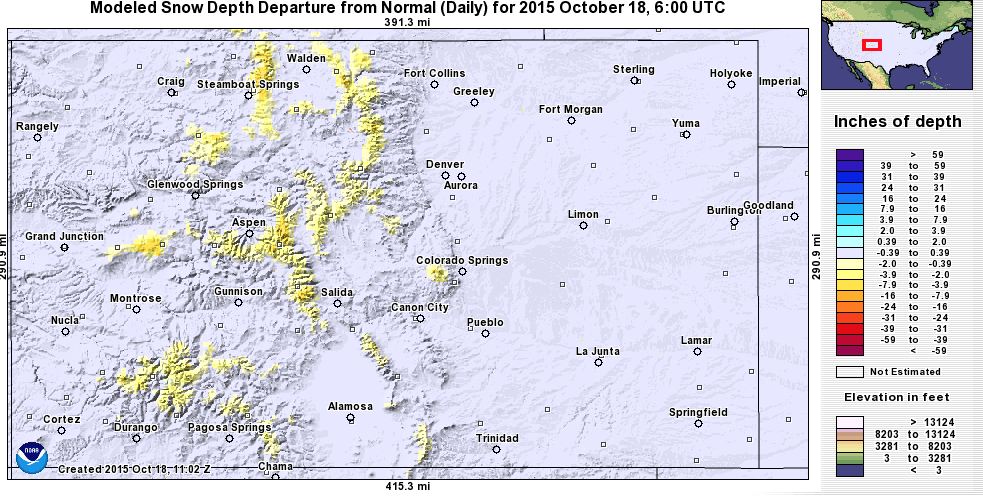
However, according to the National Operational Hydrologic Remote Sensing Center (NOHRSC), by mid-late October, the typical snowpack over the high terrain of the Central Rocky Mountains is still less than a foot (and not consistent year to year).

SnowDepth_Departure_20151008

This map displays snow depth anomalies for Sunday, October 18th according to the NOHRSC.  The actual snow depth, across the entire region, was zero.  The anomalies show just how far below normal this is, which, in the highest terrain on this map, falls into the 4 to 8 inch range, indicating that even at locations above 14,000 feet, there is typically not too much snowpack by mid-October.

Knowing that most seasonal roads would still be open due to the lack of snow, but with somewhat limited time for an excursion into the mountains, we opted to take a trip over Guanella Pass, which is still less than an hour’s drive from Denver.  Despite having been there several times, the experience for me was already new, as a new paved road had just been built, connecting the town of Grant, along highway 285, with Georgetown, along I-70.  This new road is likely to get mixed reactions, as traveling along it is now much easier (and now possible without AWD).  However, there are sections of this pass that are popular among campers, particularly people looking for a quiet camping experience.  On Sunday’s excursion, I encountered several groups of motorcycles.  The prevalence of motorcycles, and the noise they make, could possibly make some of the Guanella Pass campers seek a more remote experience elsewhere.

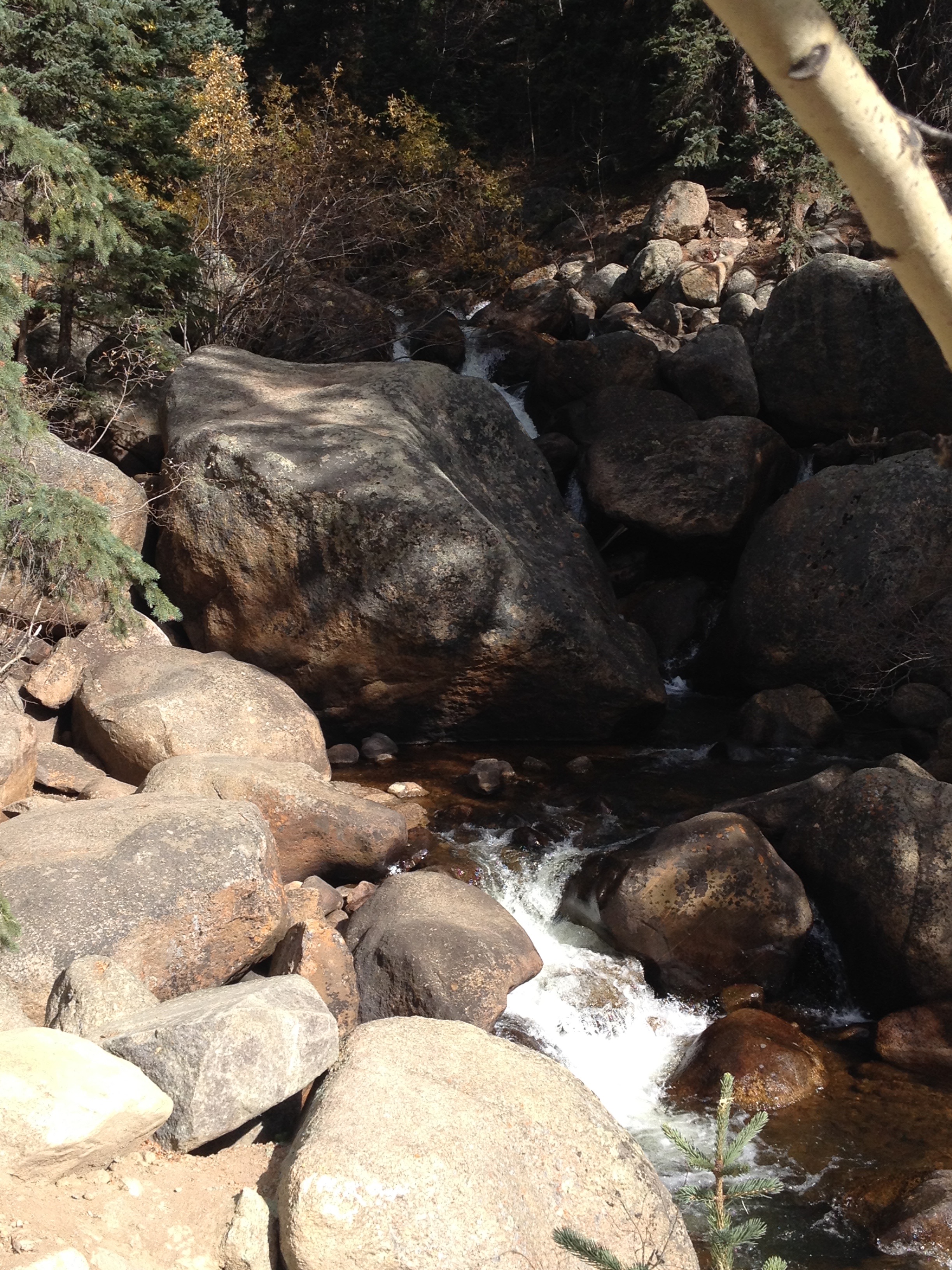
Without having to focus on driving over rocks and bumps, I noticed places I simply did not notice on previous drives up Guanella Pass, like this waterfall.

IMG_4556

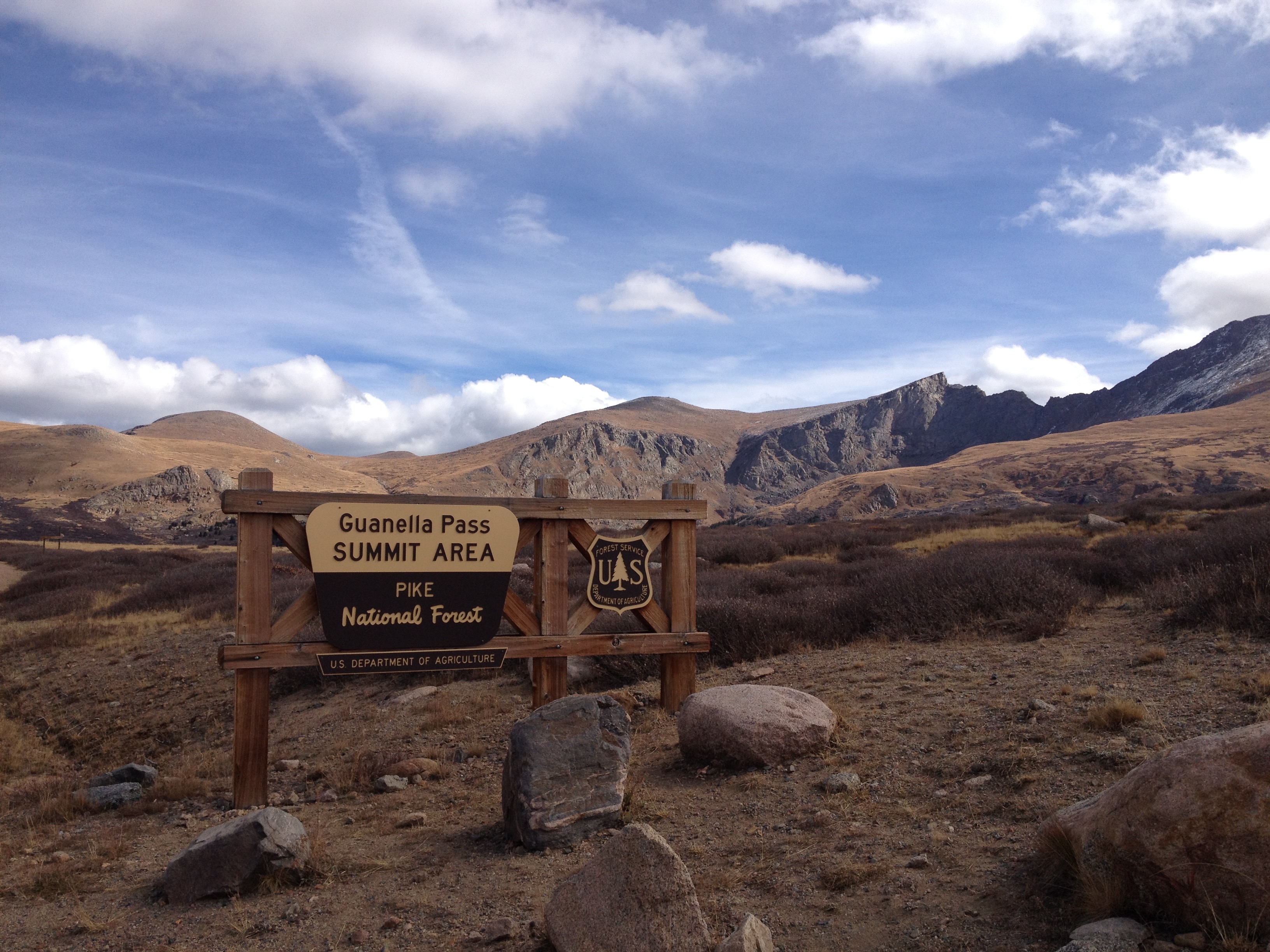
However, that was not the full extent of the new experience I had on Sunday.  The final approach to the summit took me above the tree line, where I suddenly got an eerie feeling from what was around me.

IMG_4558 IMG_4560 IMG_4563

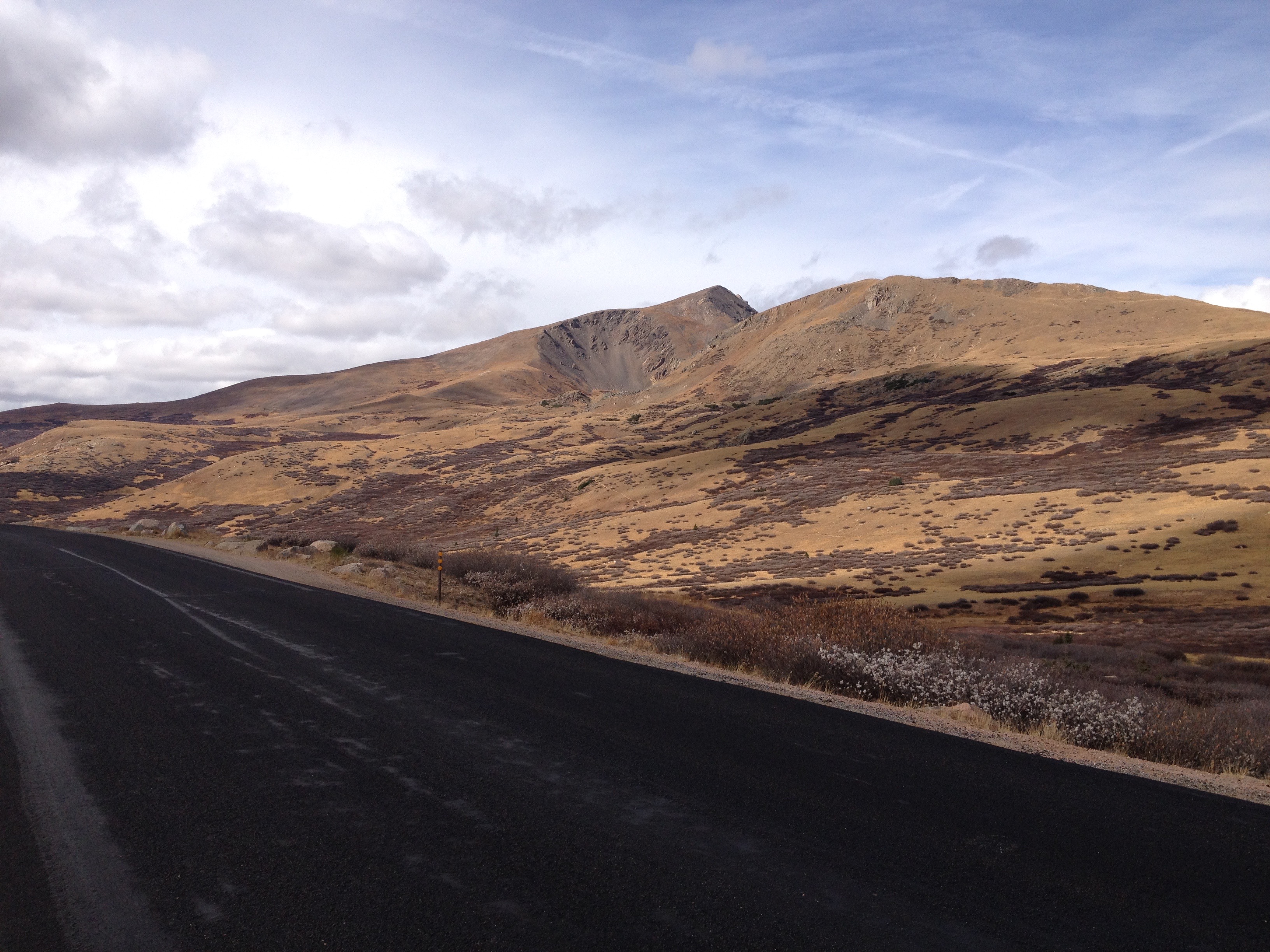
It’s hard to describe.  It felt almost like I was on another planet.  It was isolated.  Most of the time that we stopped at the summit, we were the only ones there, and my car was the only one on the road.  The sagebrush of the alpine tundra had taken on brown color that I am not accustomed to seeing.  Some combination of the sun angle, unusual ground color, and isolation definitely gave me a really strange feeling.  It was eerie, creepy, out of this world, I really did not know what to make of it.  It was just, well, strange.

However, I came back feeling glad that different seasons can create different experiences out of the same places.  Typically, when I make the trek up to elevations just above the tree line, there is one of two experiences.

IMG_2911 IMG_4245

The alpine tundra is white in winter (and often still white well into the springtime), and green and lush in the summer.  In October, though, it took on a whole new color, one I had not seen before.

This planet has plenty of places that are unique, unlike any other place on earth.  Some of them even feel out of this world.  Sunday’s experience at Guanella Pass reminded me of two things.  A lot of these unique experiences that we plan trips to get to are seasonally dependent.  And, sometimes these experiences can happen unexpectedly.

What to Expect from winter 2015-16 in Colorado

Forecasting the weather weeks to months ahead of time can often be problematic. Computer models that project atmospheric conditions into the future typically only provide utility out to 10-14 days, depending on who you ask. After that, forecasts often become erroneous due to what is often referred to as the “chaos effect”. In fact, there are many that believe that forecasting the weather for a specific day is only useful out to roughly 7-10 days. Most people manage their weather expectations beyond the 7-10 day horizon not by forecasting a specific event, but by describing more general expected trends.  It is more common to say something like “It is likely that the period from 14-21 days out will be warmer and drier than normal across much of the Western United States”.

Scientifically credible seasonal forecasts tend to rely on larger scale phenomenon that have been shown to impact our weather in the past. Luckily, for this upcoming season, the winter of 2015-16, there are two such phenomenon that could give us some significant foresight into what we could expect out of this coming winter.

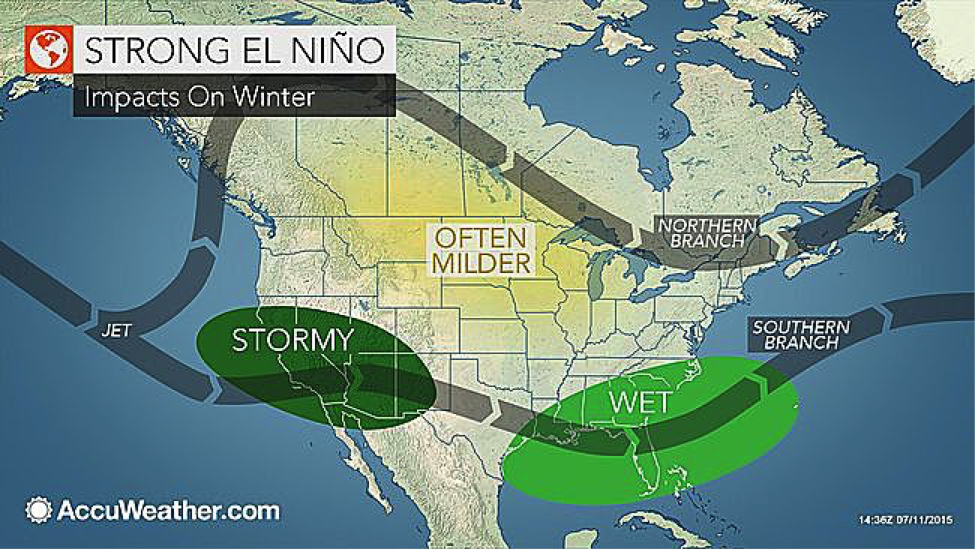
The first, and most obvious one is the strong El Nino that is already underway. Strong El Nino conditions typically bring wet weather to the Southern United States due to a strong sub-tropical jet stream. In particular, California can be the recipient of some heavy rainfall, which hopefully can help give the state some much needed relief from the extreme drought conditions than have been experiencing. The other major impact, on a national level, is that the Upper Midwest and Northern Plains tend to have milder than average winters during strong El Ninos.

El_Nino

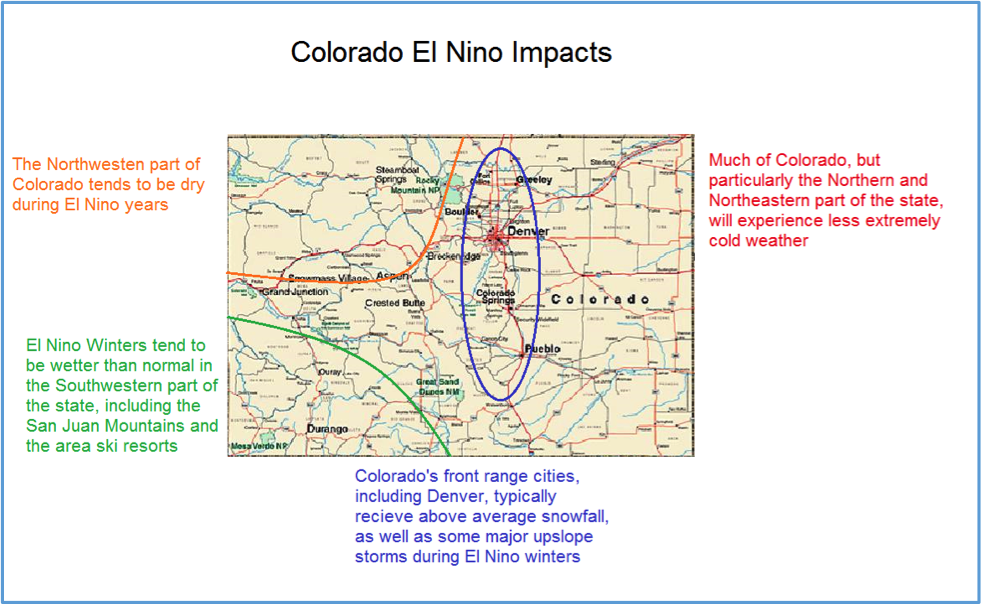
Unfortunately, maps like this one often make it ambiguous as to what impact El Nino typically has on the weather here in Colorado. On this map, as well as nearly every map of El Nino impacts, Colorado is in kind of a neutral zone, where areas to the south are wetter than usual, and areas to the north are drier than usual. However, as any resident of Colorado knows, Colorado’s rugged terrain has a significant impact on the weather here. Therefore, it is possible to discern some more local impacts that occur here in Colorado, as different large scale wind patterns are impacted by Colorado’s many mountain ranges. There are many sources of information regarding how Colorado fares during a strong El Nino year. Below is a graphical summary of these impacts.

ElNino_Colorado

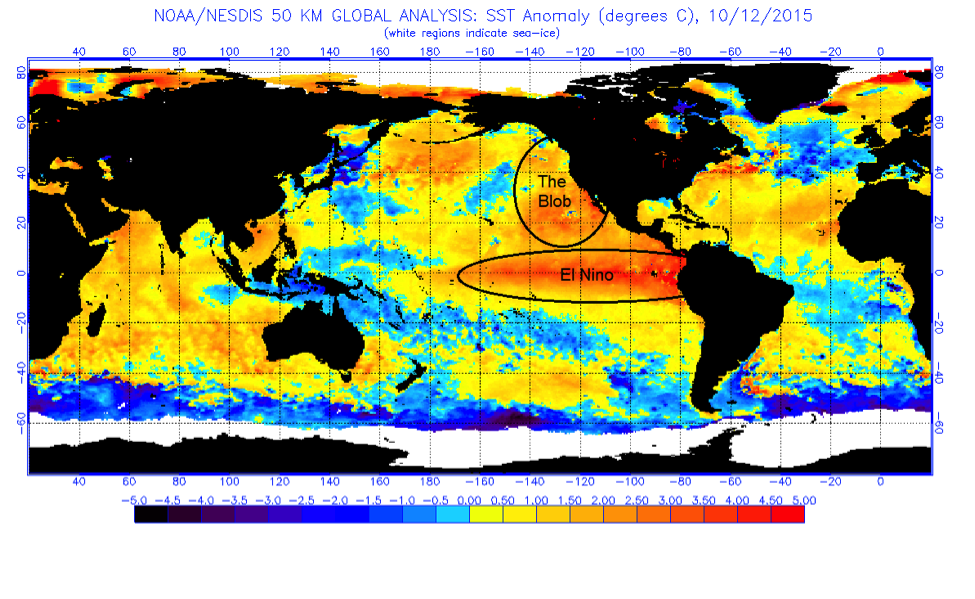
In addition to El Nino, there is another major weather feature that could have a profound impact on our weather this winter. Not only are there warmer than normal ocean temperatures along the equator associated with the strong El Nino, but there is another section of extremely warm ocean temperatures in the Pacific Ocean farther north. This section of warm temperatures off the west coast of North America is being labelled “The Blob”. “The Blob” formed due to a persistent period of warmer and drier weather over the past several years. This is the weather pattern that lead to the extreme drought in California in the first place, and, now threatens to keep much of California in drought conditions despite the El Nino.

Oct2015_SST

The easiest way to describe the impact “The Blob” is going to have on our winter weather is that it is going to try to produce conditions similar to last winter. Last winter was warm and dry over much of the West due to a persistent ridge, labelled “the ridge of death” by snow enthusiasts at OpenSnow, which is often associated with warmer sea surface temperatures off the Pacific Coast of North America.

While it is hard to imagine “The Blob” completely overwhelming the impacts of this historic El Nino, it does have the potential to modify them. Firstly, it could make the Pacific Northwest drier, and reduce the amount of rainfall California receives, particularly Northern California. Over Colorado, more frequent ridging, and/or dry Northwesterly flow aloft will reduce the likelihood of major Front Range upslope snowstorms, and increase the likelihood of a drier than normal winter over parts of Central Colorado, including many of the major ski resorts such as Vail, Breckenridge, and Copper Mountain. Those who hate extreme cold, though, will be comforted by the fact that the likelihood of sub-zero conditions across most of the state will be significantly below average this season.

Summer Persists

IMG_4449

I have been fascinated by the weather my entire life.  When it comes to our atmosphere, there is always something interesting going on.  The weather seems to find a way to continue to surprise people, behaving in different interesting ways each season, each year, each decade.  Our lives are impacted by the weather every day.  It is something that is impossible to ignore.  It is always on our minds, particularly for those that of us that love travel and outdoor activities.

At times, our plans can be frustrated, or even cancelled by changes in weather conditions.  It is the early season baseball game that was cancelled due to a freak April snowstorm.  Or the ski resorts in Lake Tahoe that had to close due to the lack of snow.

At other times, unexpected opportunities can arise.  I remember one year, when I was in college in Northwest Indiana, a place that is typically quite chilly in the wintertime, we had a series of unexpected 60 degree days in late January.  I unexpectedly found myself in Lake Michigan (albeit only knee-deep) on the 27th of January, a time of year I could normally expect to be huddled indoors.

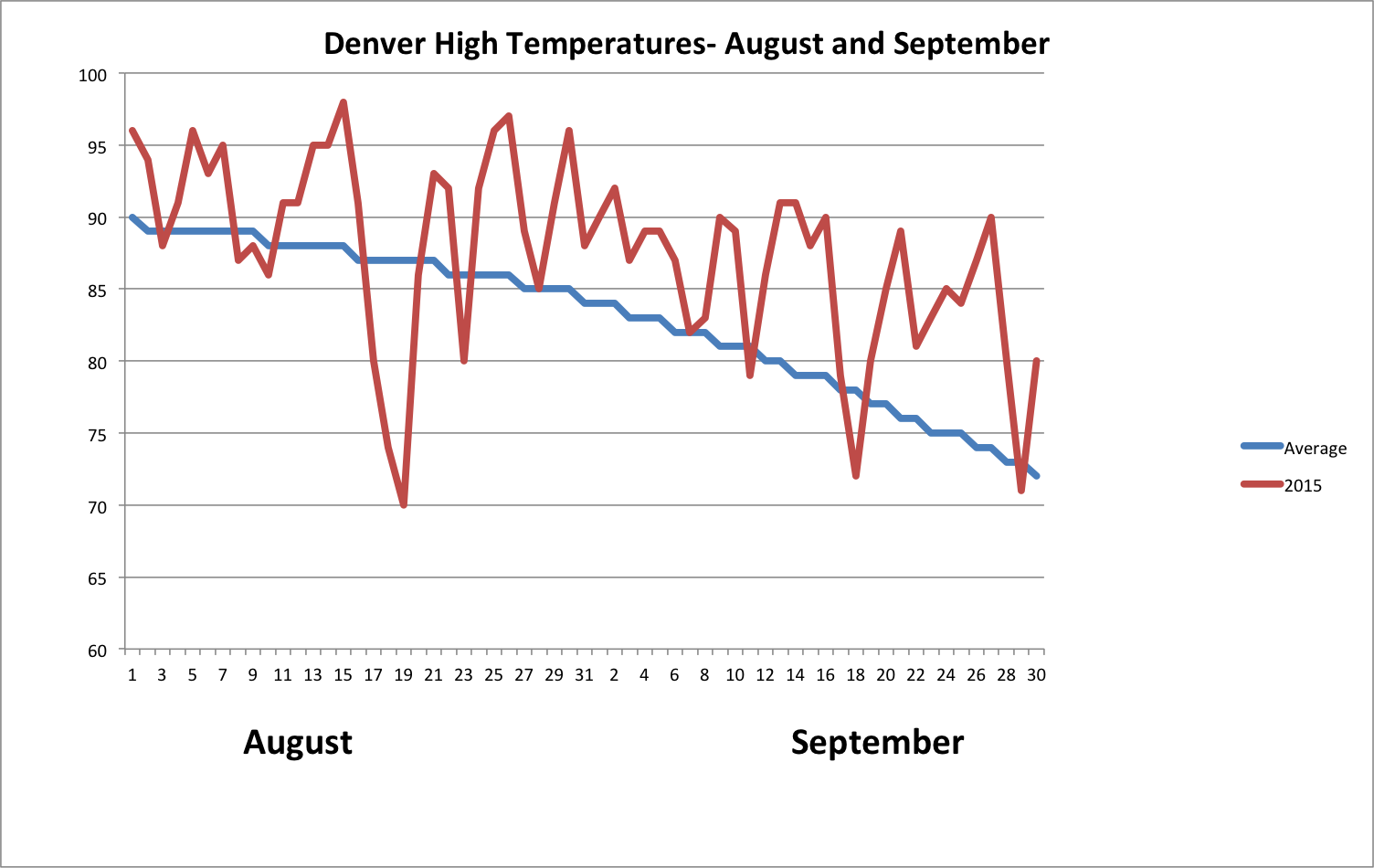
Across much of the country, the story this September was the persistence of summer.  Some places are experiencing one of to their warmest Septembers on record.  Here in Denver, it has been the same story.  September’s temperatures this year, largely resembled what is typical in August.

Denver_Aug_Sept_2015

A sensible response to hot weather in Denver is to travel up to the mountains, where it will be cooler and more comfortable.  So, in addition to my hike near Breckenridge on the 11th, I made trips up to the mountains both of the following weekends.

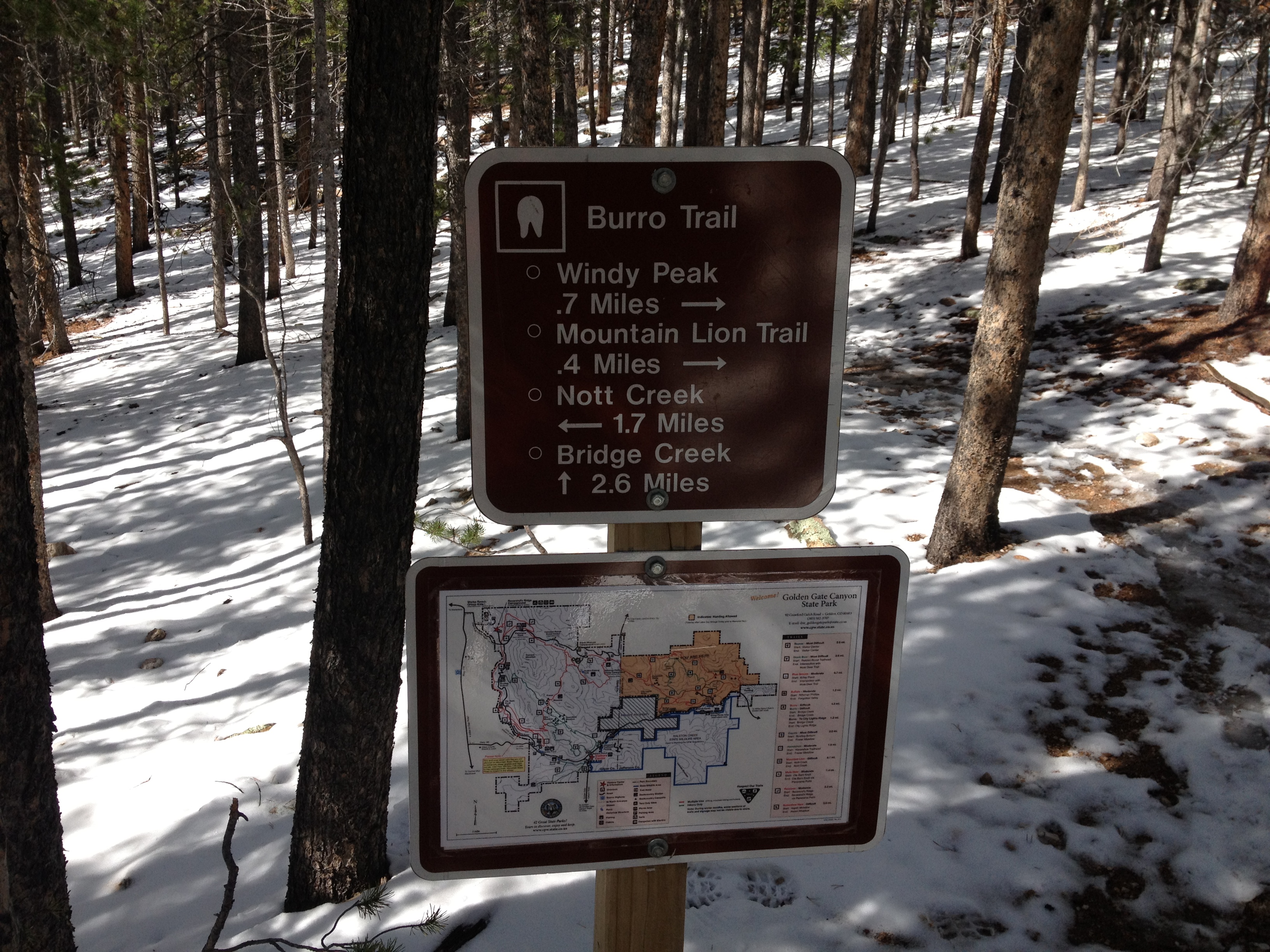
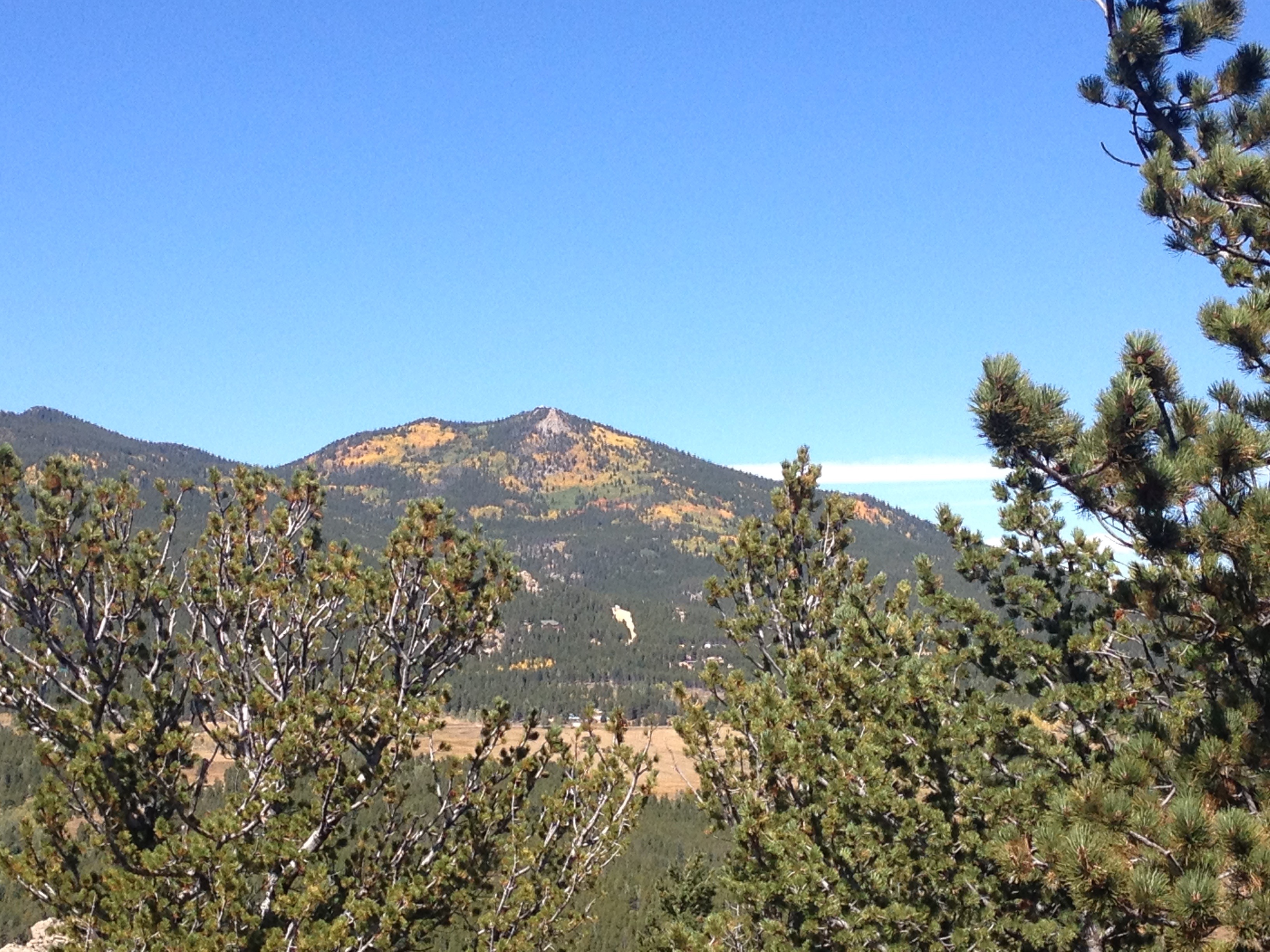
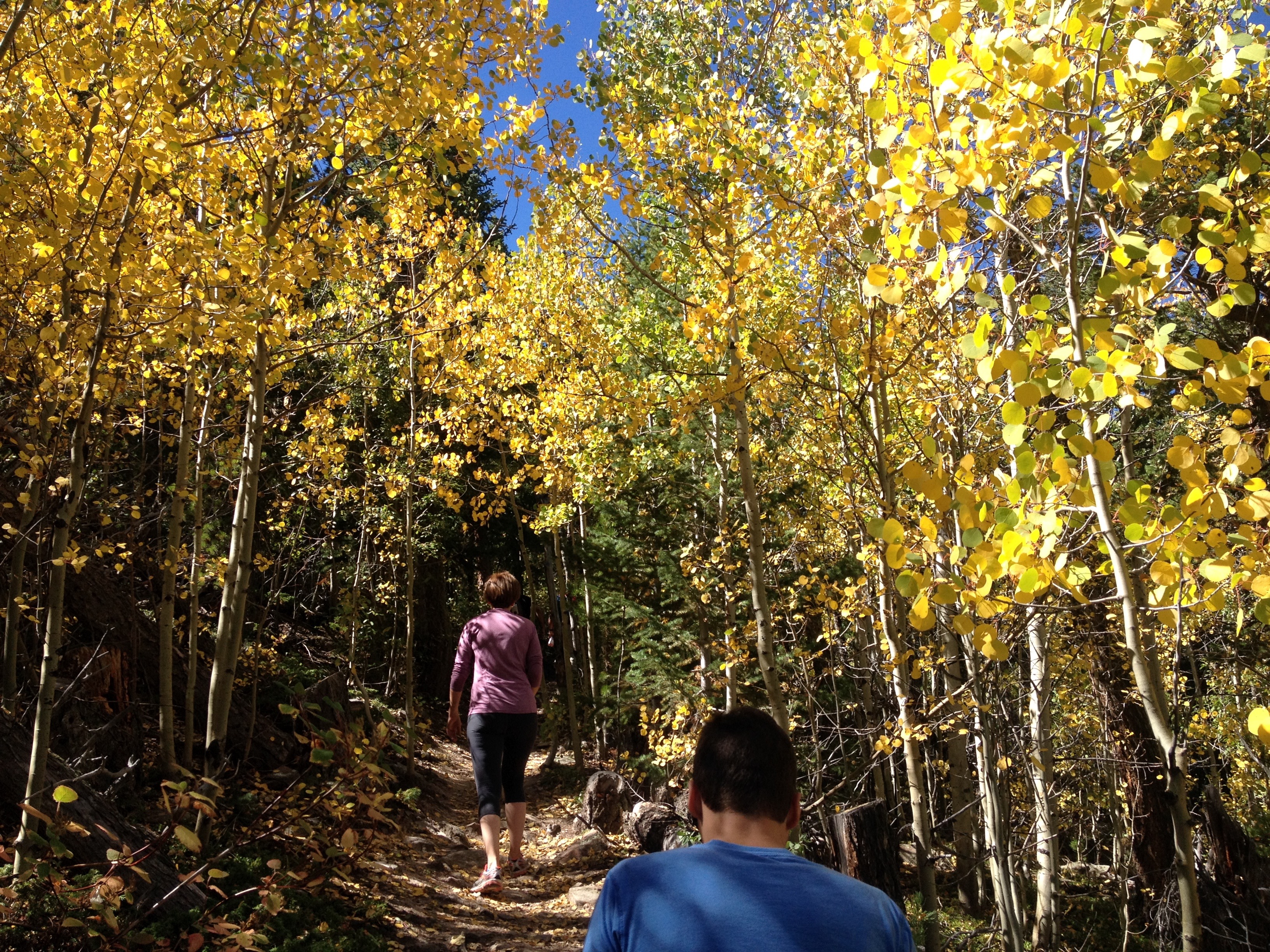
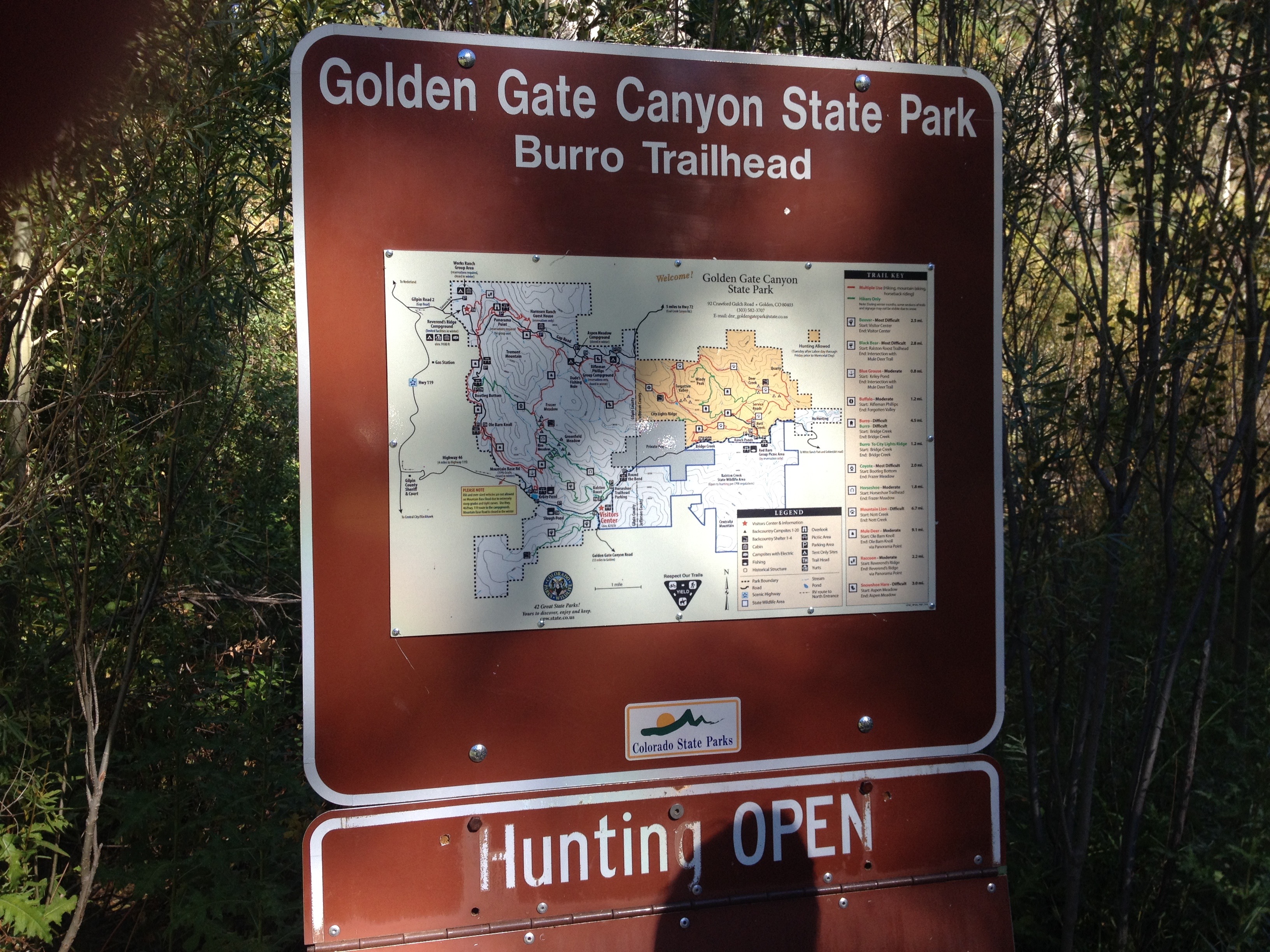
September 19th was a repeat hike, to Windy Point at Golden Gate Canyon State Park, which is actually less than an hour’s drive from Denver.  The first time I hike this particular trail, in October of 2013, the upper portions of the trail were already covered with snow.

IMG_1163

This time, I got to experience the trail without such snowpack.

IMG_4435 IMG_4430 IMG_4429 IMG_4414

My other late season hike in the mountains involved a trip to a place I had never been before, but had been meaning to check out for quite some time, the Fourth of July trail outside of Nederland.

IMG_4467 IMG_4465 IMG_4474 IMG_4478

This hike in particular, on September 26th, represents the kind of opportunity that would not have been available had it not been for the unusual resistance of summer.  This trailhead is at an elevation of just over 10,000 feet.  By late September, one would expect high temperatures only in the mid 50s at this elevation, and not the warm conditions we experienced that day.

IMG_4477

One thing I have come to notice during periods of abnormal weather is how the trees never seem to be fazed by the abnormal conditions.  In the Midwest, when we would have a mid-winter thaw, like the one I had perviously mentioned, none of the trees would start growing leaves or anything.  They would continue to stay the course, knowing what to expect from the rest of the season.  Here in Colorado, the trees are still changing colors largely on schedule, with the later part of September being peak season for fall colors at these elevations.

IMG_4483

I have actually come to realize that the most magnificent fall colors occur when there is a warm and dry fall.  As it was last year, without windy, rainy, or even snowy weather early in the year, the leaves stay on the trees longer.

IMG_2733

In a month where we sweated through 90 degree weather for Tour de Fat,

IMG_4372 IMG_4391

And one could attend a concert at Red Rocks without needing a jacket,

IMG_4442 IMG_4448

It is hard not to feel as if summer just has’t ended yet.  We simply got to experience summer longer than anticipated.

Whether it be a season of the year, like winter or summer, or a chapter of our lives, we all anticipate change.  We know that a change is destined to occur, and often have an idea in our heads as to when that change is destined to occur.  However, sometimes, changes do not happen at the time they are anticipated.  Sometimes in life, we are caught off guard by an unexpected change before we had fully prepared.  We all have heard of at least one person who had endured an unexpected layoff, or an unplanned medical emergency.  Other times, as is the case with the switch from summer to autumn across much of the United State this year, it takes longer than anticipated for the next chapter of our lives to begin.

As someone who loves hiking, cycling, and water sports, and is generally not too negatively impacted by hot weather, it is easy for me to welcome the unexpected extra month of summer.  It is easy for me to say, in this case, that the best way to handle this delay, in the transition from summer to autumn, is to go out and enjoy it, take advantage of the opportunities, and be patient for the next season to start.  But, I know that this is not the case for everybody.  I also remember being the one frustrated by the lack of change.  I remember one March in particular, when I was living in Madison, Wisconsin, that winter just seemed to never end- and I was beyond sick of it!

Fall is going to come.  According to the weather report, by this coming weekend, October 2nd and 3rd, most of the country will be experiencing weather more typical of fall.  Those that have grown tired of the heat, although they had to wait longer than expected for the cooler air to come, knew all along that it would, and that the changing of the season is inevitable.

IMG_4490

At some point in time, we all end up in a place where we feel our lives have stagnated.  We enter a place where our current situation, whether it be our job, or what we are doing on a day-to-day basis, has simply run it’s course.  We have gotten what we need to have gotten out of the experience.  Maybe it has become frustrating, or maybe it is just simply not inspiring to us at all.  In these situations, the cycle of winter-spring-summer-fall we all live through on an annual basis serves as a reminder that the change we desire is inevitable.  Sometimes it just takes longer than we had hoped.