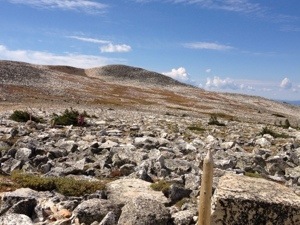
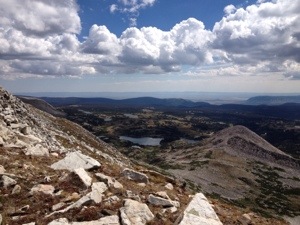
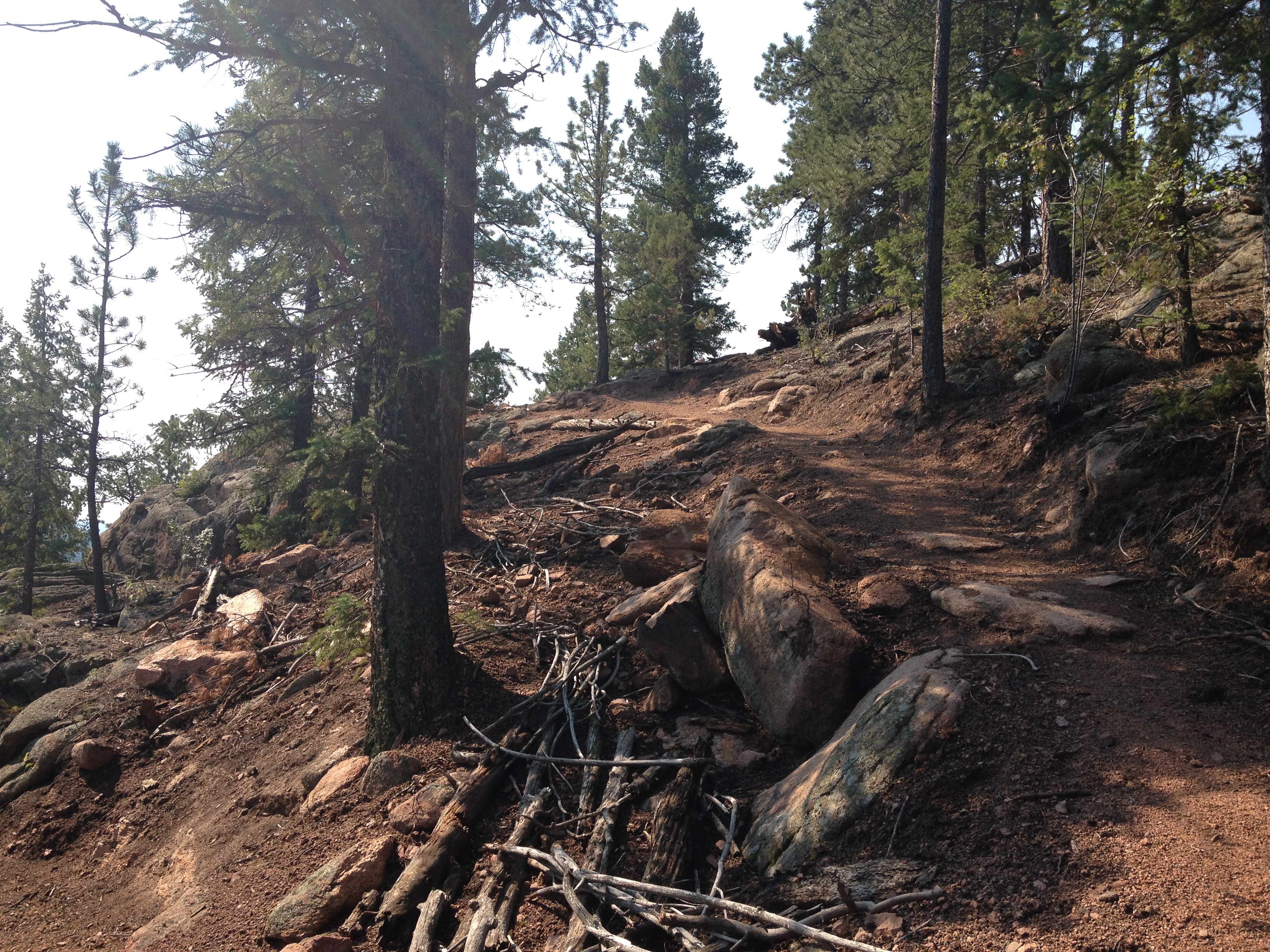
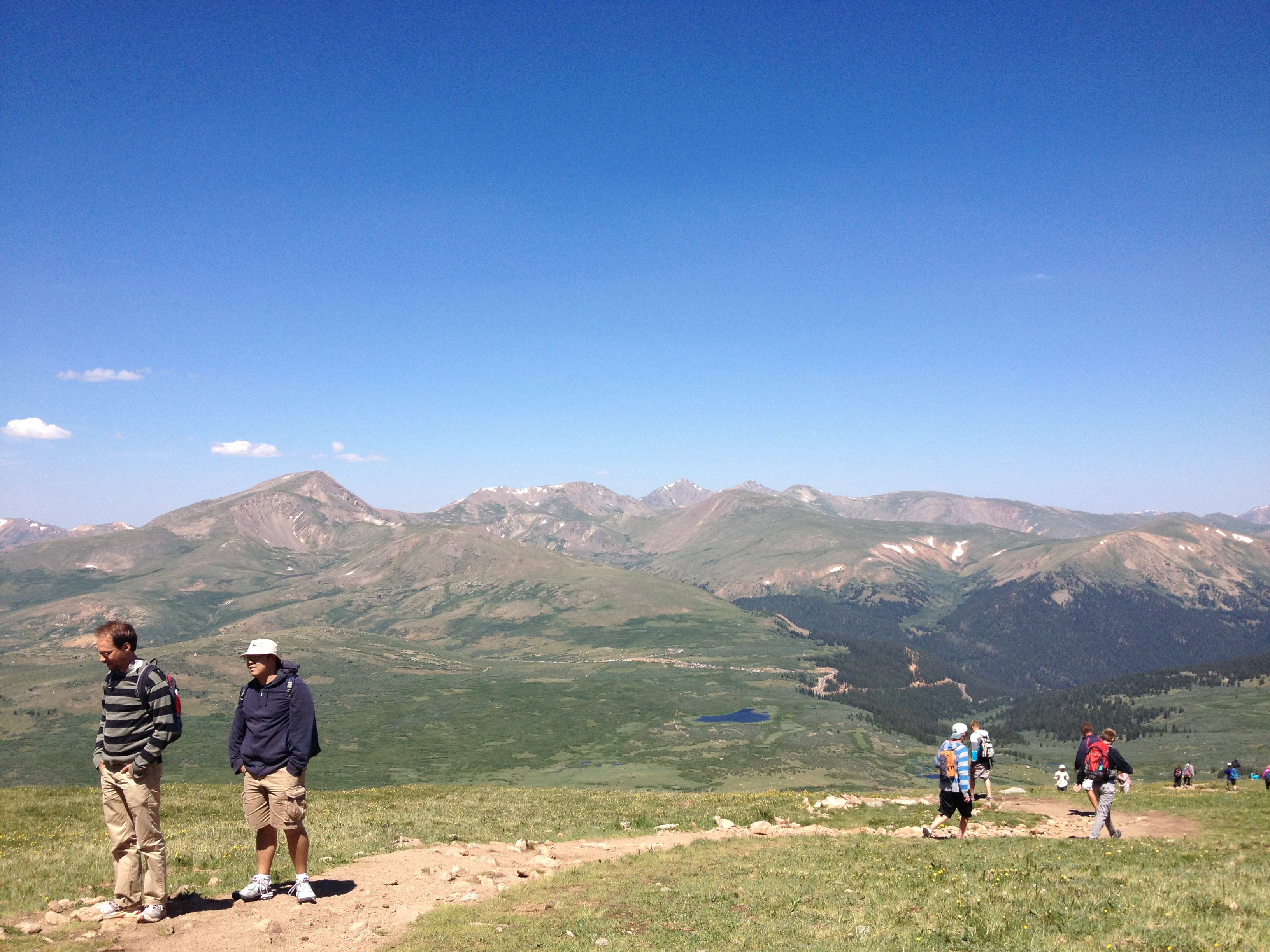
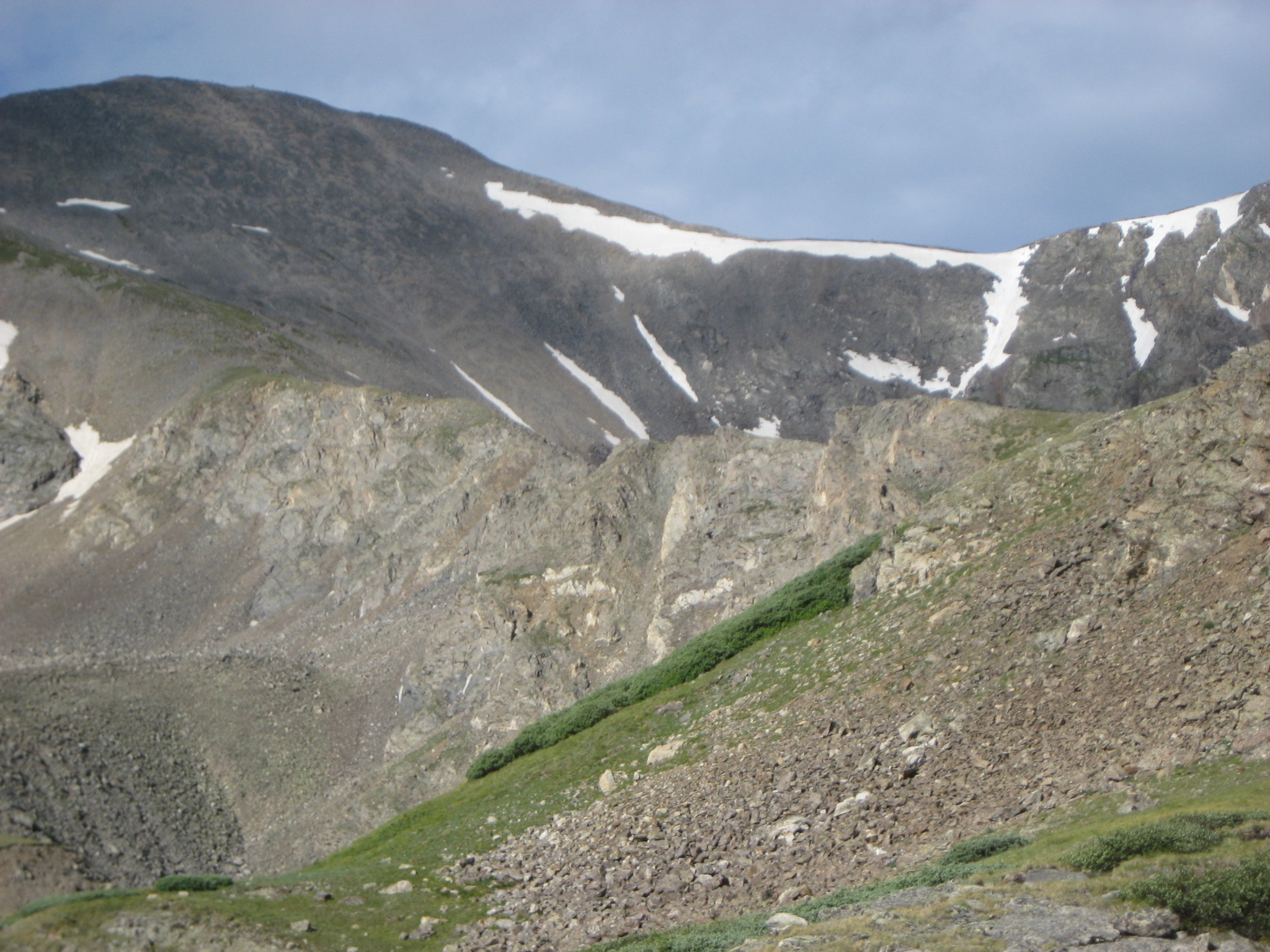
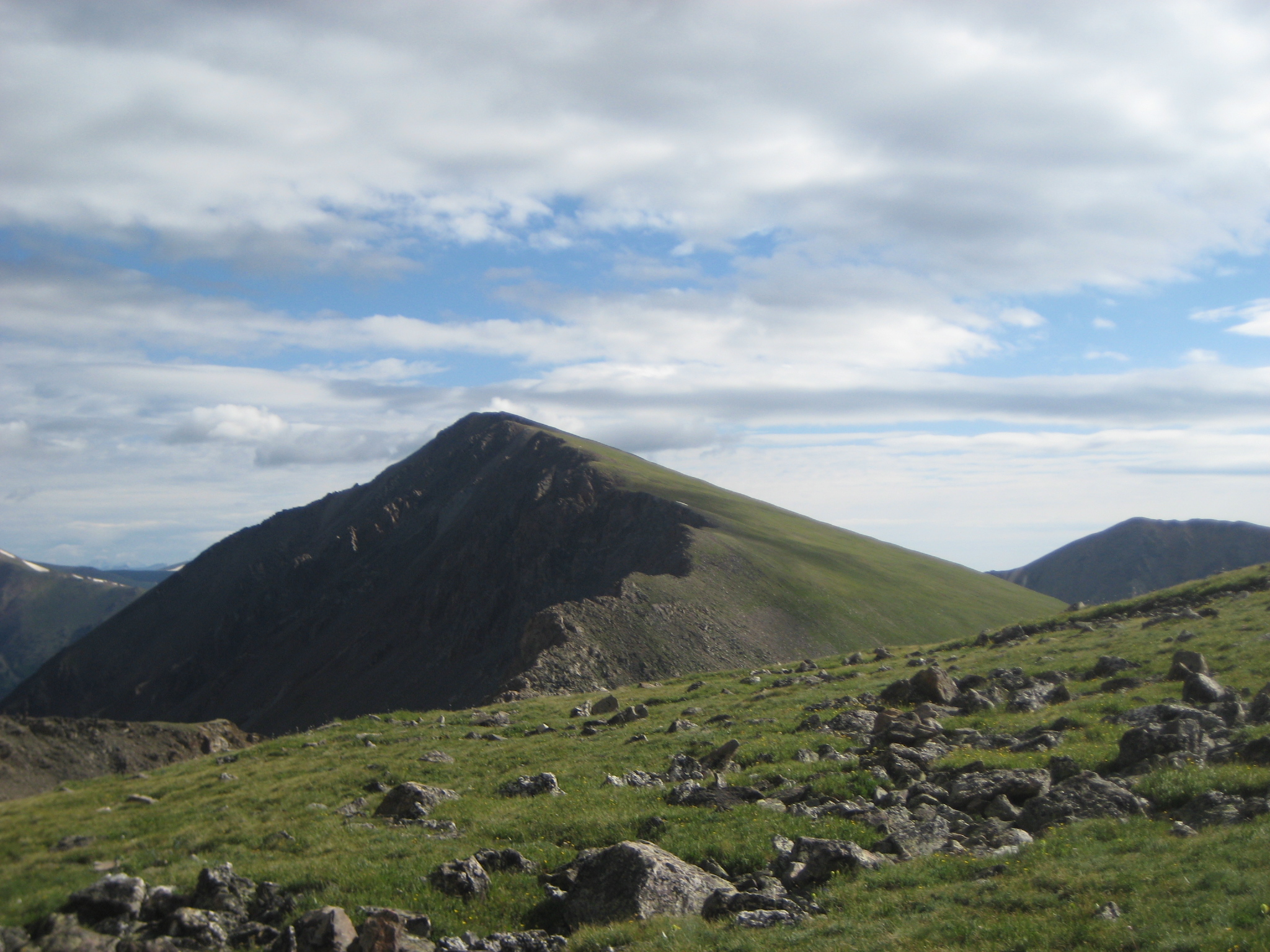
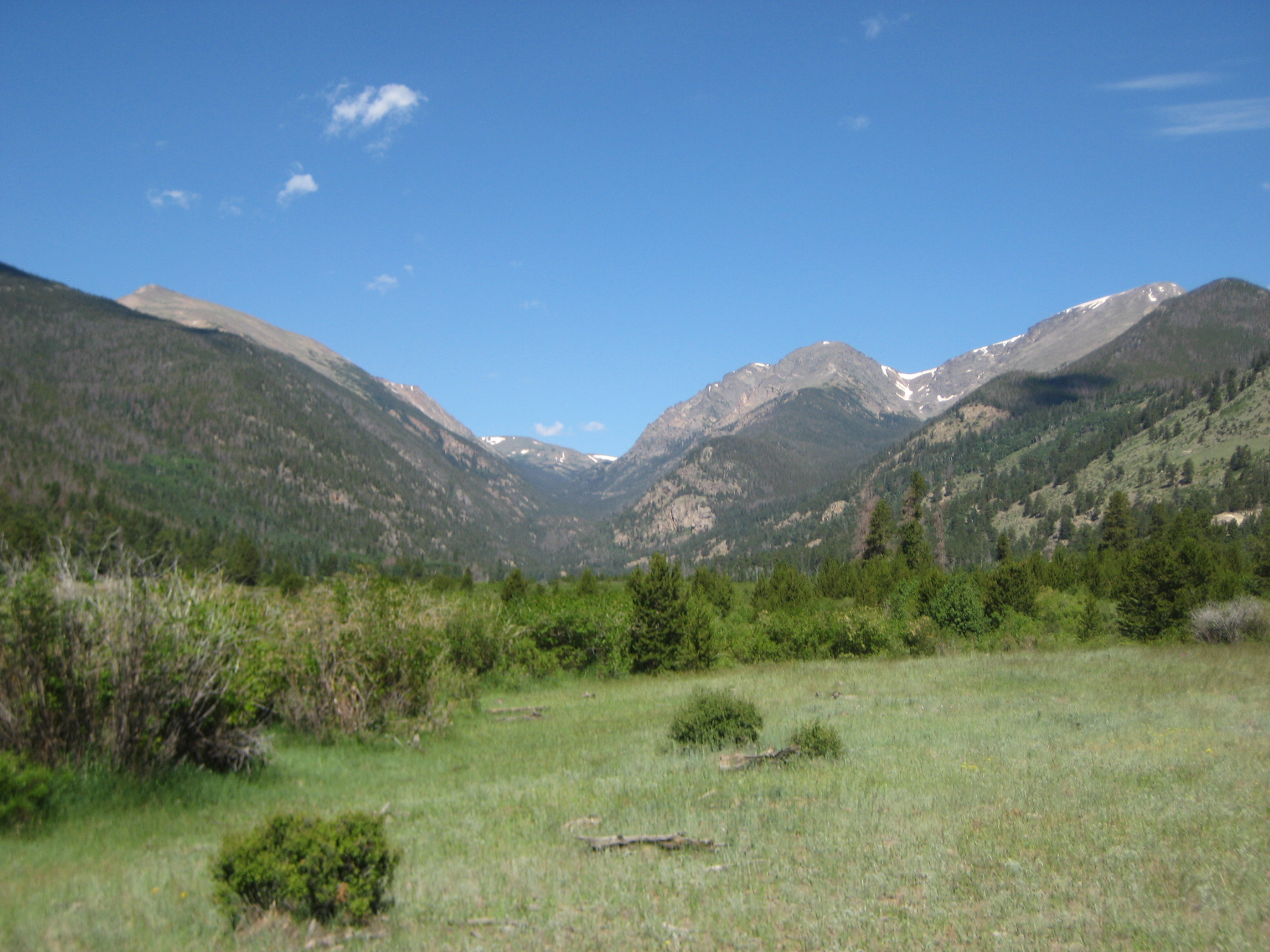
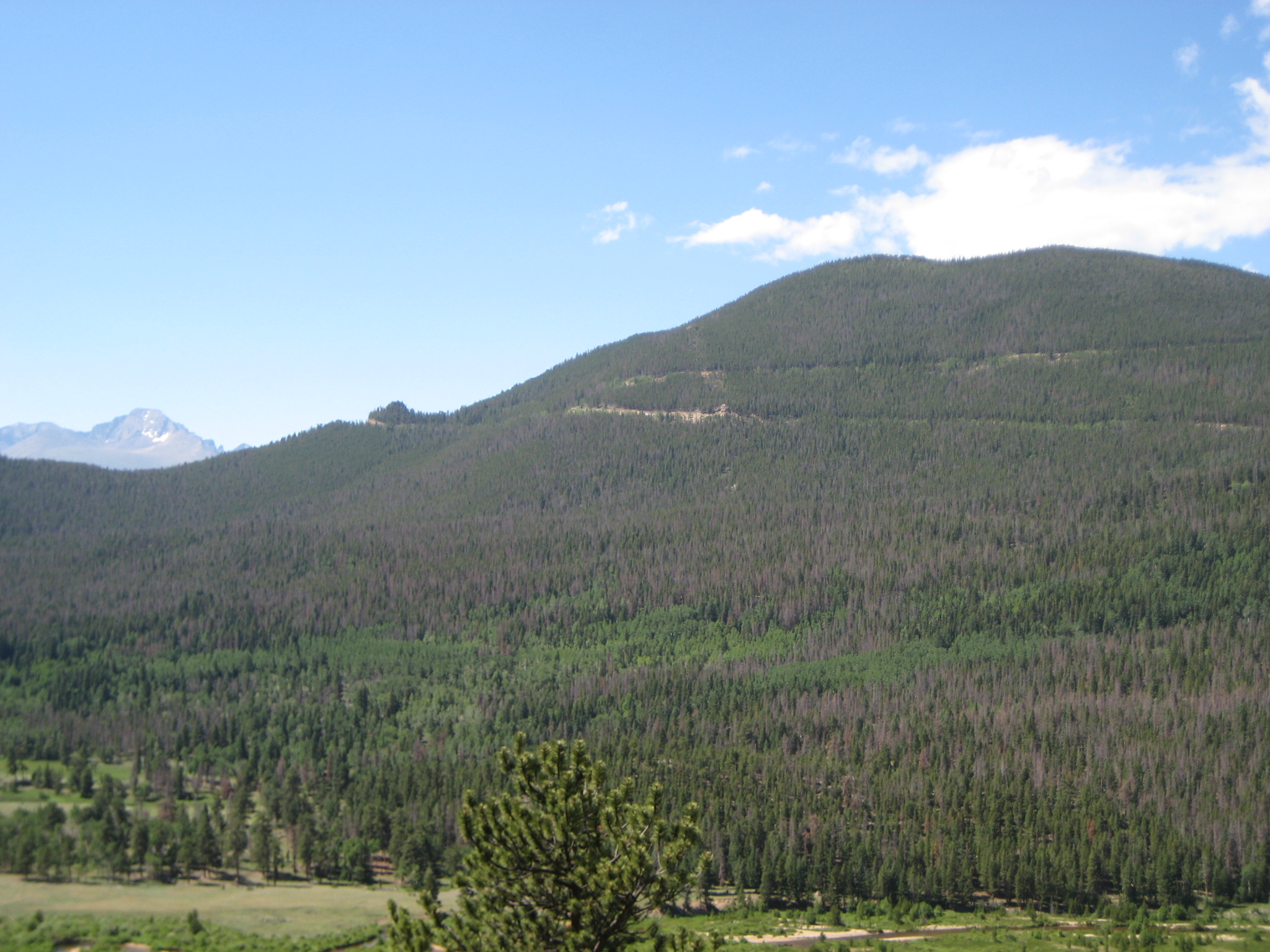
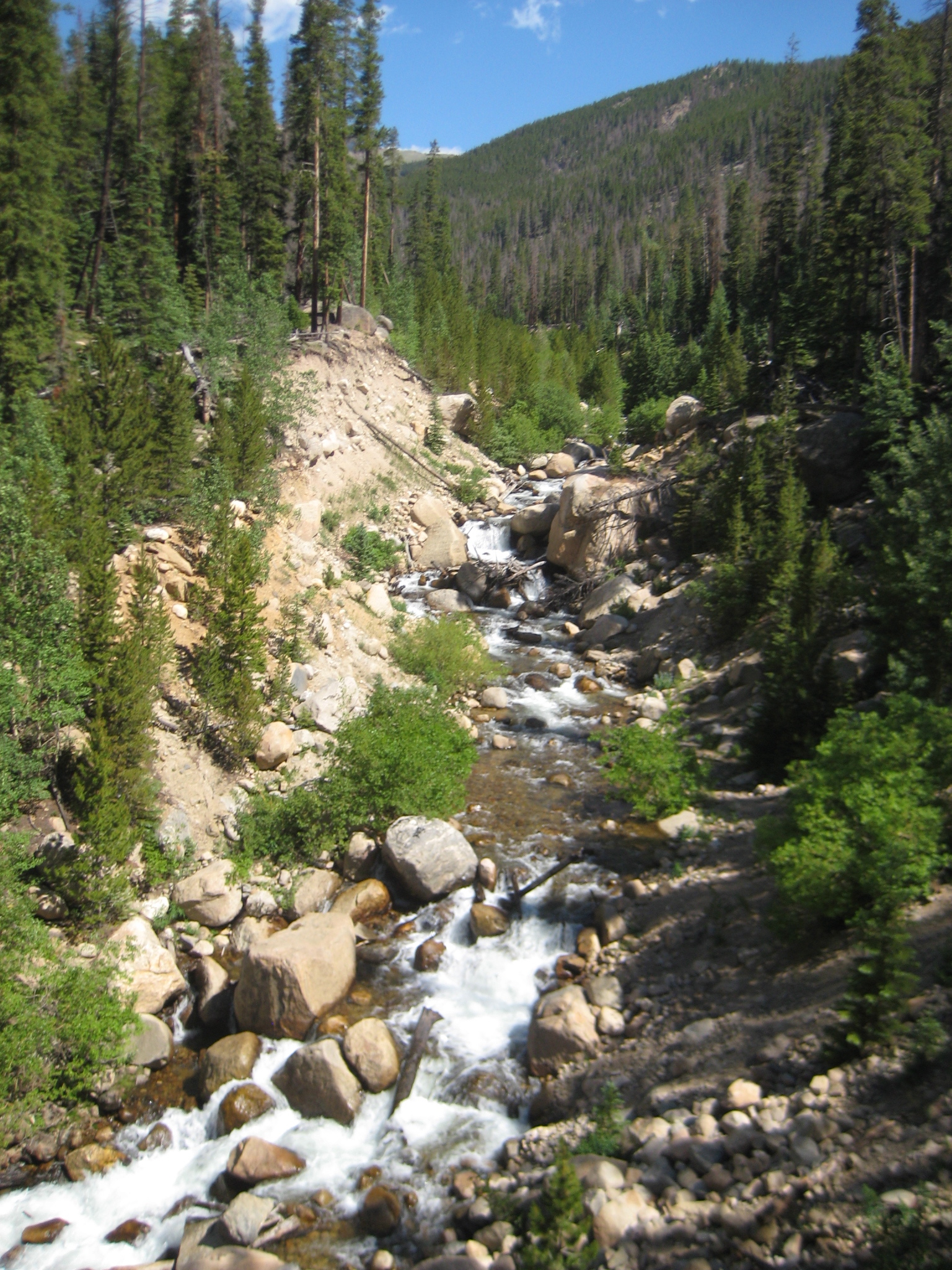
Category Archives: hiking

Golden Gate Canyon State Park

IMG_1152

Only half an hour outside of Golden, Colorado, Golden Gate Canyon State Park represents one of the easiest hiking places to get to from the Denver metropolitan area.  It is definitely a lot shorter of a drive then Rocky Mountain National Park, but is probably a little bit longer than The Flatirons in Boulder.  My visit to this park was not in peak season, on the 19th of October, but it was on a weekend.  Based on what I saw today, it appears that this park is significantly less crowded than both Rocky Mountain National Park and the Flatirons, and therefore may represent a more tranquil alternative to those two destinations for day hikes.

Yesterday, we visited the east side of the park, parking in the first parking lot in the state park off of Crawford Gulch Rd.  At this parking lot, our elevation was just short of 7,800 feet.  I have to admit, I was a little bit apprehensive about doing a hike this high in elevation well into October.  Last spring I came to the conclusion that the in-between seasons, when it is not warm enough to for activities at high elevations, but not quite ski season, are the best times of year to explore areas at lower elevations.  But, I knew that it was going to be a warmer day in Colorado, with southwest winds, and highs in the 60s in Denver, which would mean temperatures could be tolerable at this elevation.

IMG_1153 IMG_1154

Upon exiting the car, I immediately noticed two potential hazards.  One was the wind, which was quite strong that day, and made the temperatures, near 50 at the time, seem quite a bit chillier.  It did not help that our hike’s destination was a place called “windy peak”.  I kept thinking to myself, if it is this windy at the trailhead, I am in for an unpleasant summit.  Second was the fact that hunting is permitted in pretty much the entire area where we would be hiking.  Most likely, this is one of those irrational fears that we all seems to have.  It’s kind of like all of those posts we see that indicate that more children get injured by trampolines and swimming pools than by strangers, yet, most parents seem way more afraid of their kids talking to strangers than using their backyard trampolines and swimming pools unsupervised.  But, for some reason I did get a little nervous when I saw this sign.  Luckily, I was able to put this out of mind pretty quickly.  We would only see one group of hunters on this hike, and they seemed like they knew what they were doing.

IMG_1155 IMG_1156

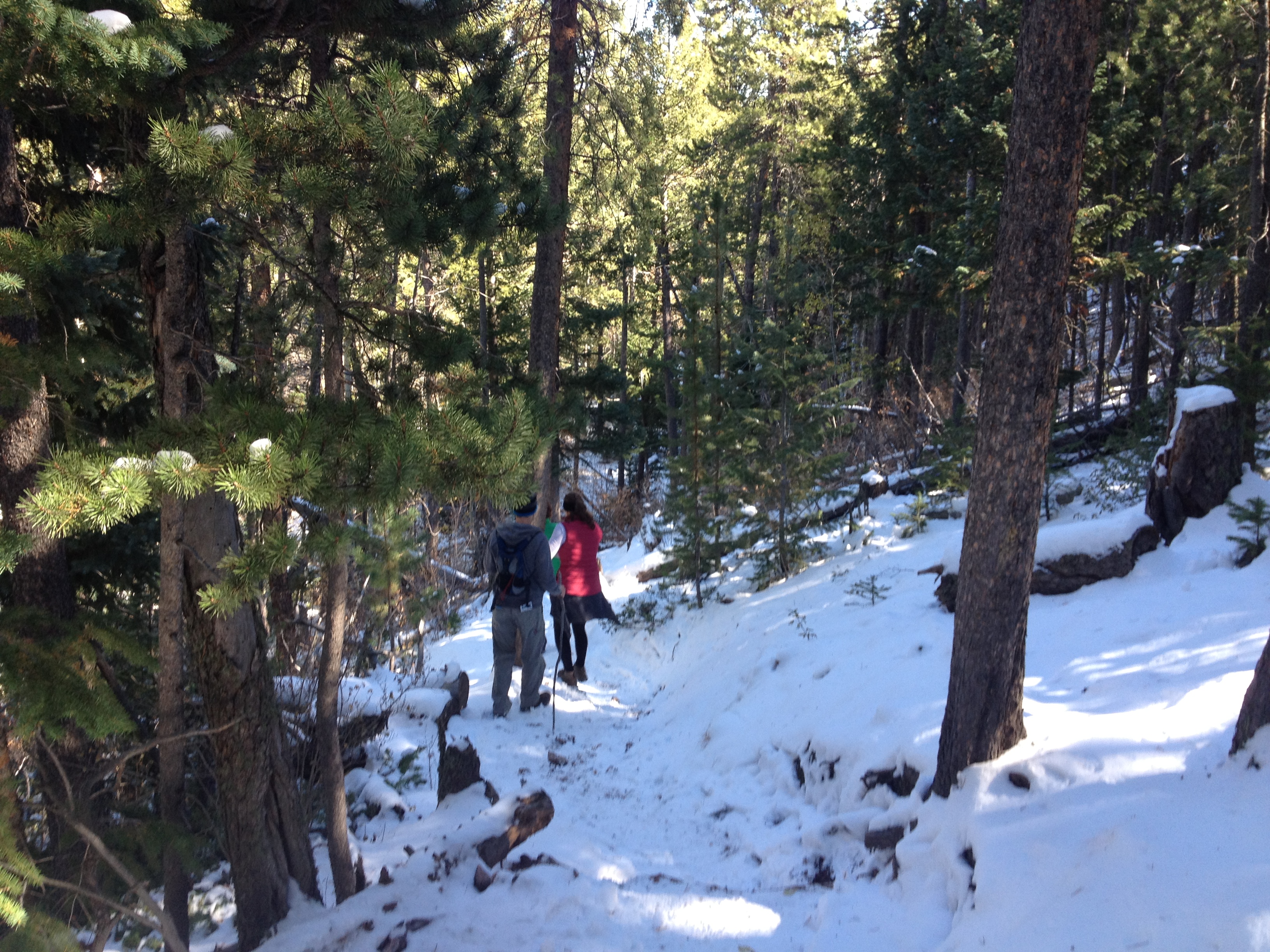
On this hike, we dealt with the remnants of two recent weather events.  First was the major flooding event last month.   In fact, one of the roads to the trailhead was washed out by this flood and closed.  We had to park right by the main road, and hike a little extra to get to the trail.  This was no big deal, and based on this, we could see why repairing this road would be a relatively low priority for the State of Colorado (compared with, say U.S. highways 34 and 36 near Estes Park).  We also had to traverse through some snowy areas.  Friday morning, Denver actually received it’s first snow of the year (which seems really early to me).  There was more snow in the mountains, and parts of the trail, especially those in the shadowy areas, and near our highest elevations, were snowpacked.  The snowpack, however, did not exceed 6″, where it would start to make the hike tougher and eventually impassible.  It did, however, make some downhill stretches a bit slippery and more hazardous than normal.

IMG_1158 IMG_1159 IMG_1160

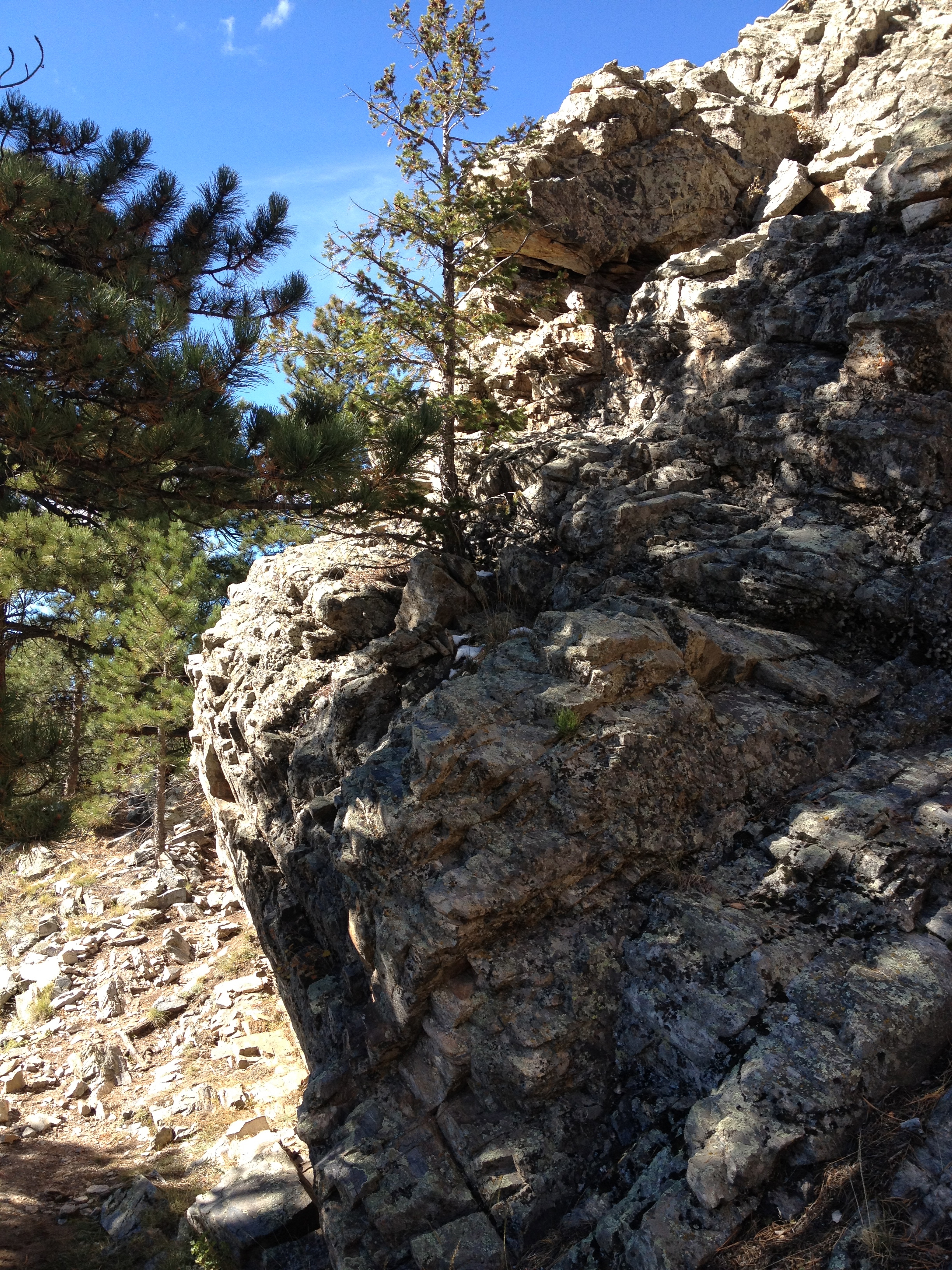
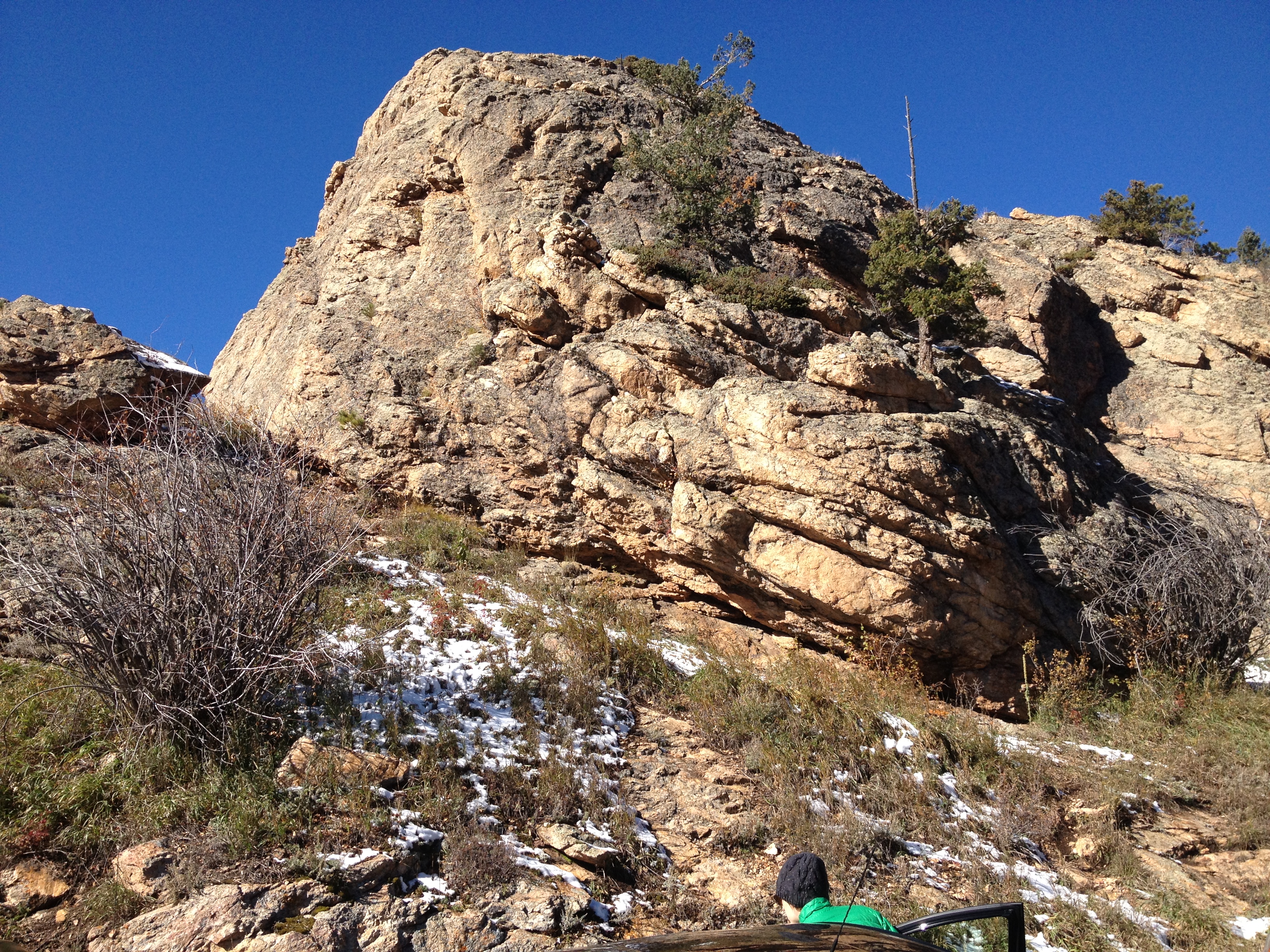
Somewhere between 1/2 and 2/3 of the way up, we saw a couple of neat rock formations, like this one, and decided to go off trail and take a few side excursions.  This mostly meant physically climbing up the rock, and then rejoining the trail the next place we see it.  It’s the kind of thing I periodically do with hikes that are not going to completely exhaust me (like a “14er”) to add a little extra spice to the experience.  Upon completion of the second of these side excursions, I saw the tall peaks in the distance for the first time.  These peaks, which I would later be able to identify as Mt. Evans, Mt. Bierstadt, Gray’s and Torrey’s Peaks, showed up in the southwest sky.

IMG_1162 IMG_1161

The end part of the hike involved traversing through a fairly uniformly snowpacked and fairly dense forest.  We arrived at Windy Peak, whose elevation is just shy of 9,100 ft.  The views from windy peak are pretty spectacular, but, as promised, it was quite windy here, and quite chilly.  It was definitely windier than it was at the trailhead, and this hike seemed to follow the similar pattern of the summit being significantly windier than even places a mere 50-100 feet down the mountain.  Due to the conditions, we did not remain at Windy Peak too long.  Basically, we remained there long enough to eat a cliff bar without feeling like we were rushing through it, and to take a few pictures.

IMG_1163

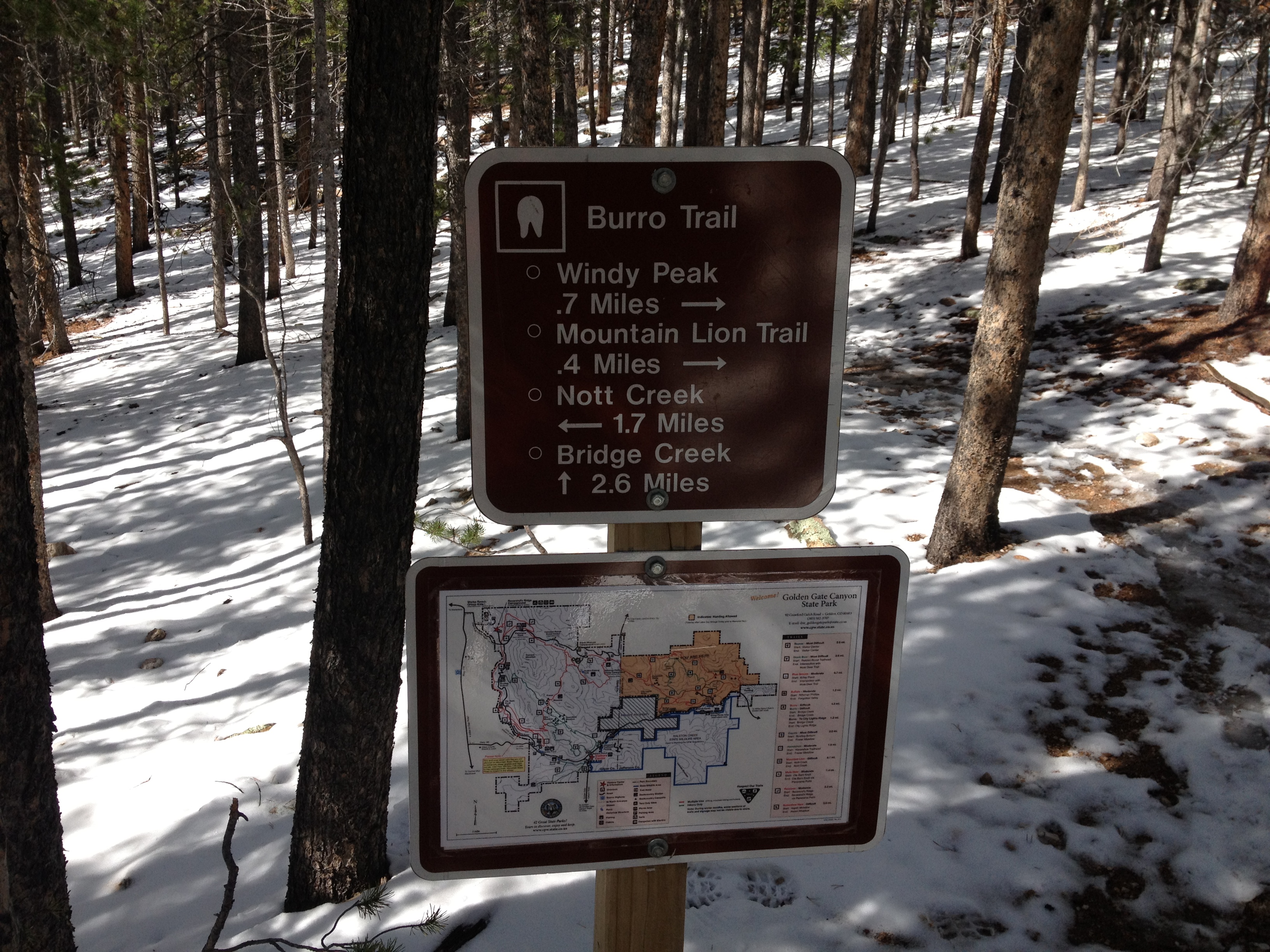
On the way down the mountain, we actually noticed significant snowmelt.  In fact, the road to the park was icy in the morning, but clear in the afternoon.  We also came to the conclusion that Golden Gate Canyon State Park is one of the best signed hiking destinations we had ever been to.  Every trail junction has signs like these, with a complete map of the park, and arrows pointing to where to go.  I’d say getting lost at Golden Gate Canyon State Park is next to impossible!

Colorado is full of places to explore.  In fact, as a relative newcomer, it is somewhat overwhelming.  I think I am finally well versed on all of the skiing options in the state, and I am getting a handle on all of the whitewater places.  But, hiking, climbing, and bicycling, it seems like can be done almost anywhere.  And nearly every trail area seems to have trails varying from easy to very difficult like this one.  How any Coloradan chooses where to go on a particular day remains a mystery to me

An Unexpected Glacier

IMG_1103

It’s the first of October.  The temperature is around 60 degrees, and the sun is shining.  It is the type of weather that would have certainly depleted 6-12 inches of snow back in any East Coast or Midwestern city.  And that is with a wintertime sun angle, and much more atmosphere to obstruct the sun’s impact on the snow.  With this weather being possible on the first of October, it is quite likely that many warmer days occurred on St. Mary’s Glacier during July and August.  Despite all of this, the Glacier still sits here, occupying the little piece of ground in the mountains of Central Colorado that it occupies.

Part of me is actually bothered by it’s existence.  At roughly 11,000 feet in elevation, and at about the same latitude as Denver, it feels like it needs to be either higher or significantly farther north to exist.  Most other glaciers in Colorado are significantly higher in elevation.  So, knowing it is at a latitude an elevation that produces so many 60 degree+ temperatures, how does St. Mary’s glacier exist?

IMG_1094 IMG_1095 IMG_1096 IMG_1097

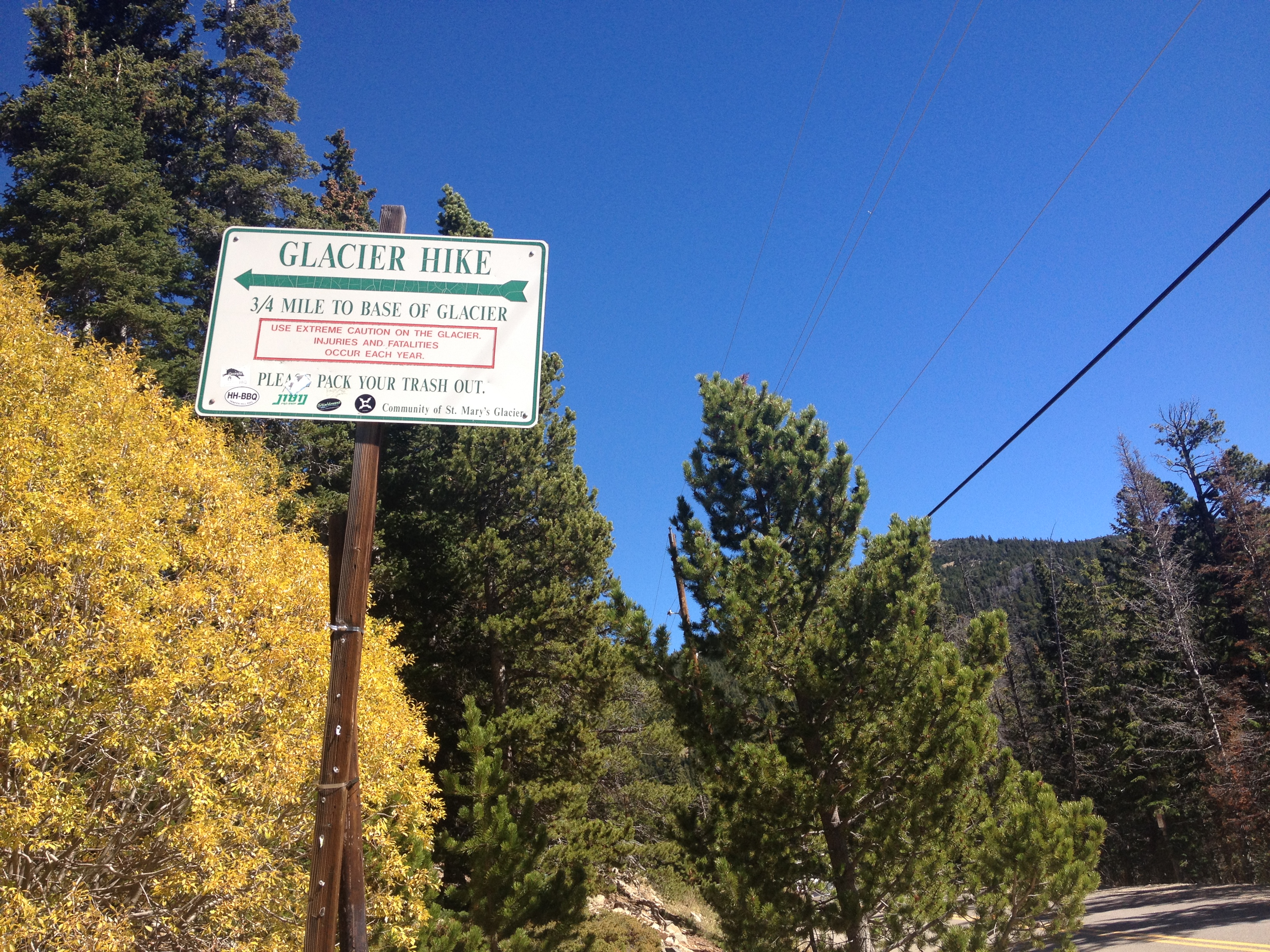
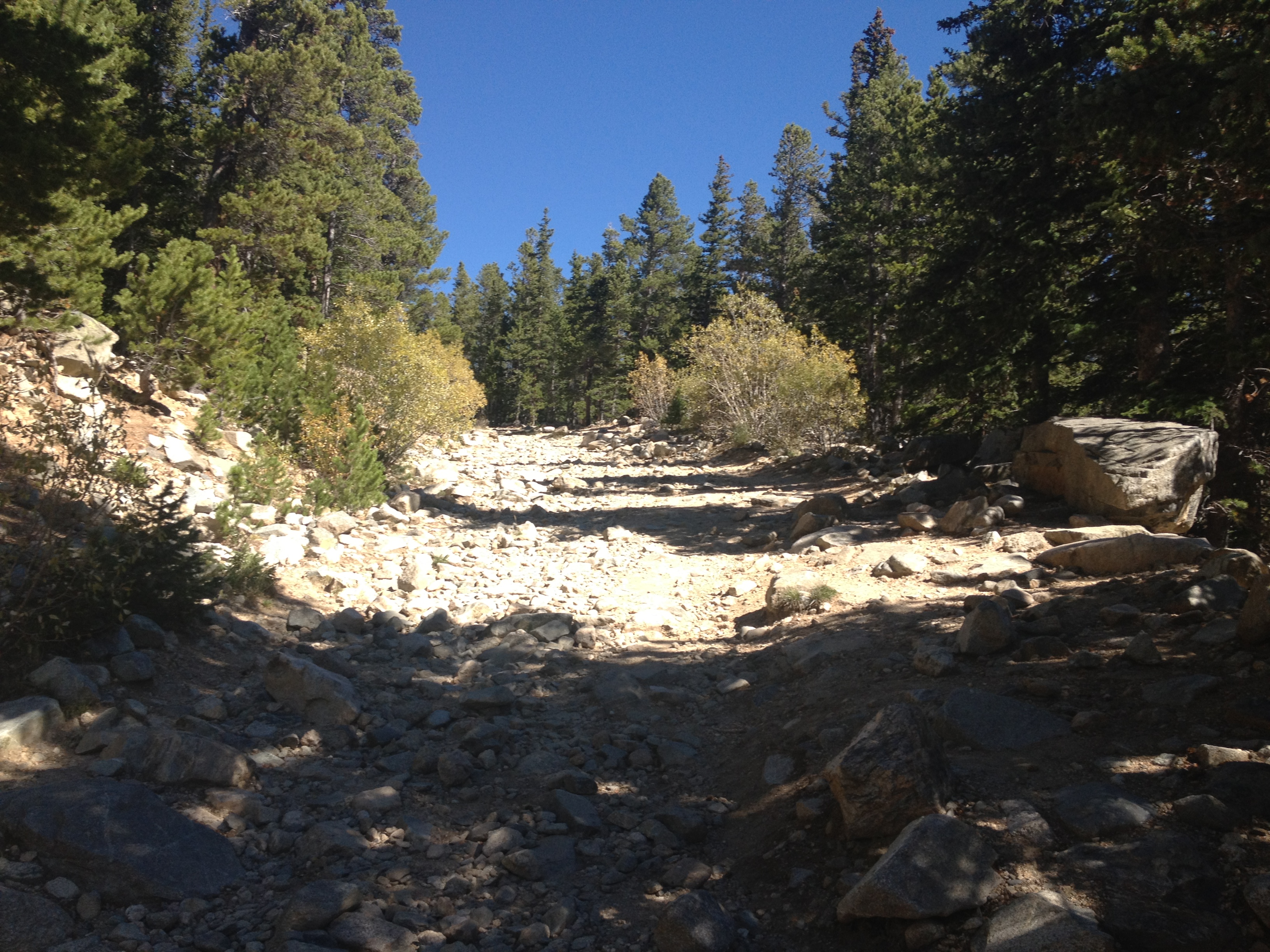
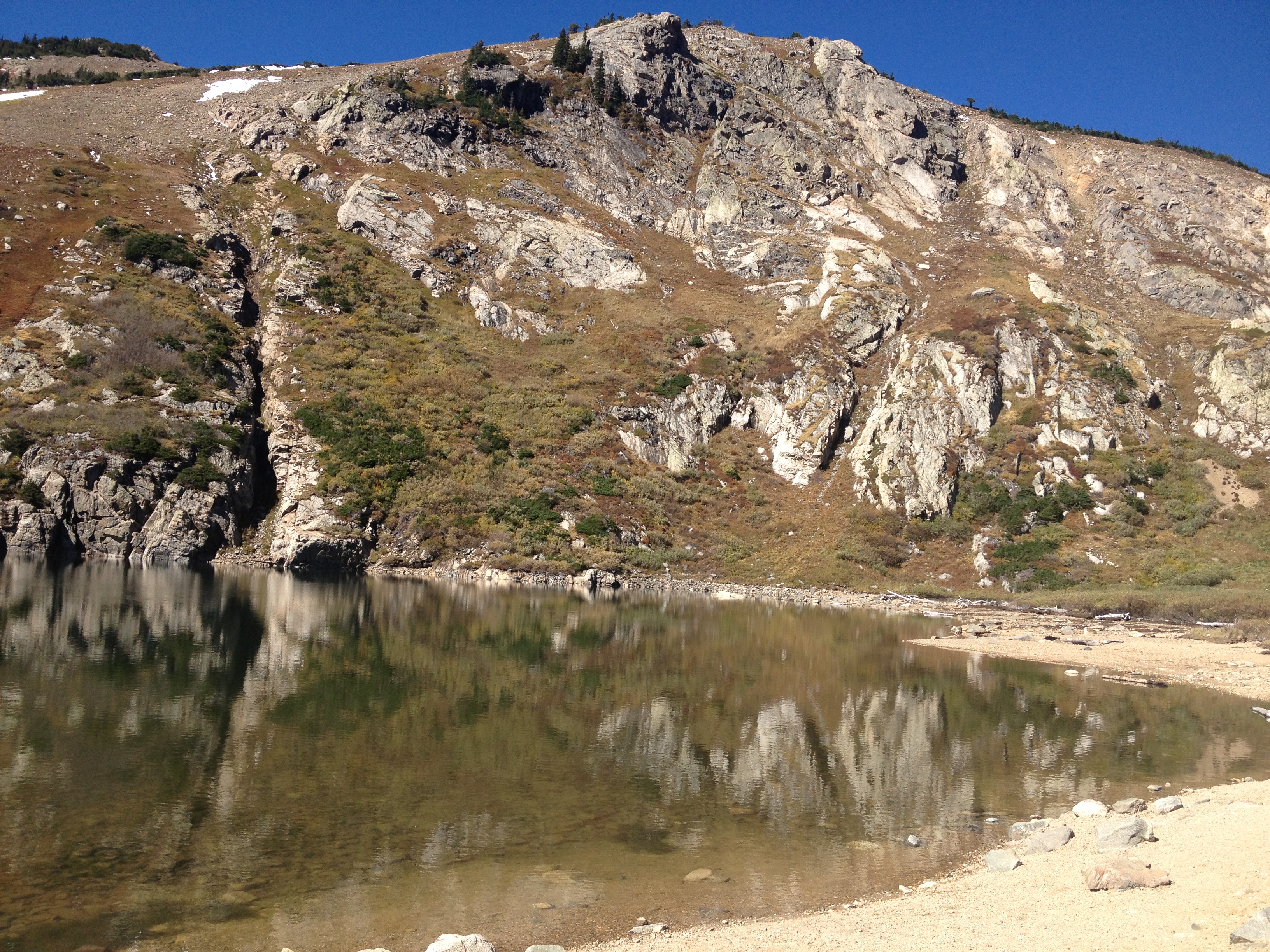
That is the question I pondered today, after driving past some of the best fall foliage I had seen thus far in Colorado, and climbing a rocky 3/4 mile trail to the base of St. Mary’s Glacier.  Before getting to the glacier, the trail meanders by St. Mary’s lake, a lake pretty much produced by melting glacial waters.  I would not recommend going into this lake, as the water is really cold!  However, it would be really dumb of anyone to not realize this, as the glacier is in clear view, along with the water running off from it.  It is clear for anyone to see that the water in this lake was recently part of that glacier 100 feet or so up the hill.

IMG_1100IMG_1101

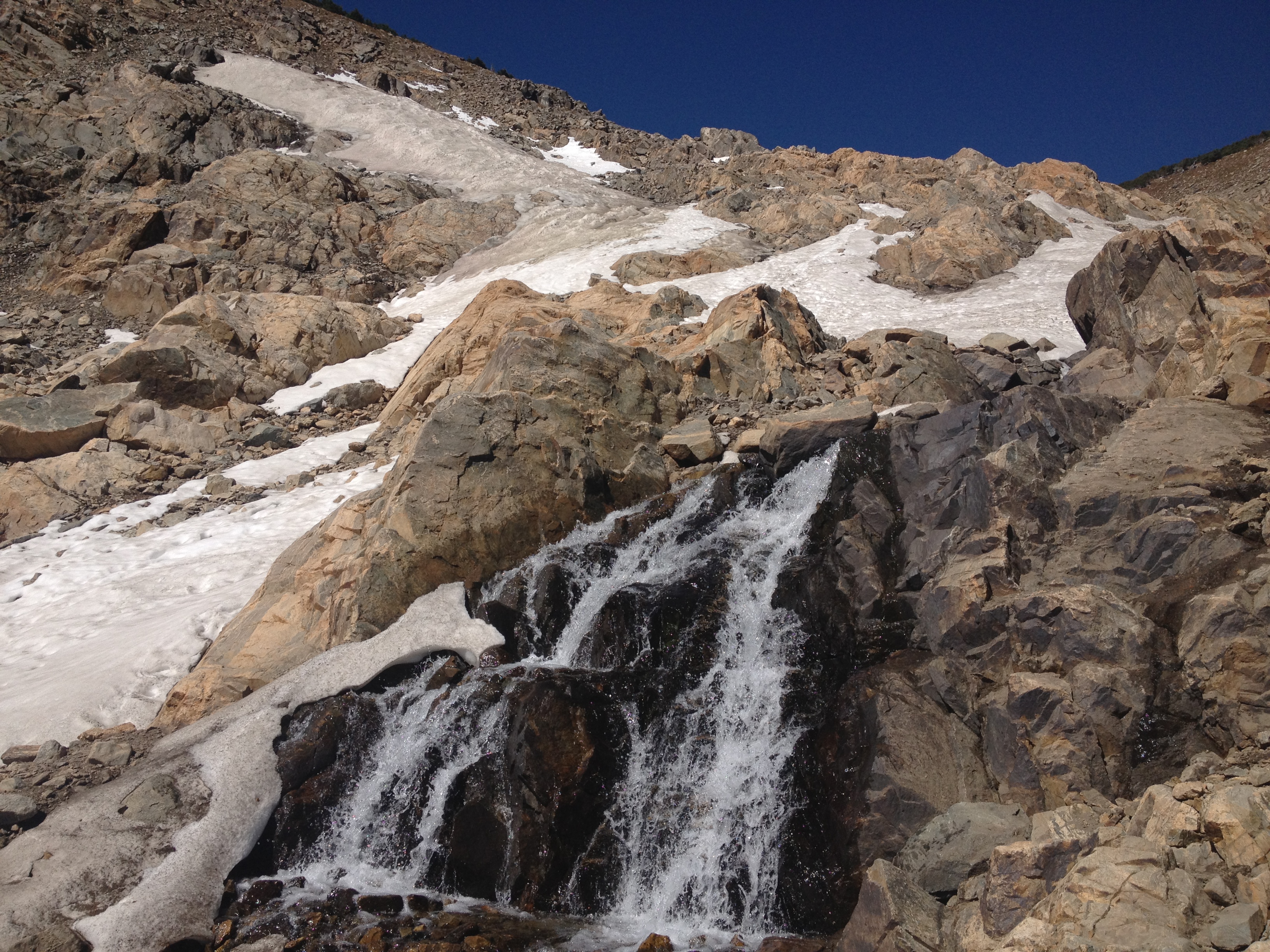
The cascades of water along the trail were moving quite fast on this day.  That made sense, given the warmth and sunshine.  But, it still seems to me that 4 months worth of weather like this would eliminate any snow and ice remaining on the surface.  So, what is going on?

Well, the weather in Colorado is actually quite complicated, and highly dependent on local terrain features.  Snowfall rates can vary significantly from location to location in the mountains depending on the wind pattern and terrain.  In fact, this variance caused enough frustration to motivate a local ski enthusiast to create a web page dedicated to finding the best snow and snow conditions in the area.

The terrain features at this particular location must cause snowfall to be significantly higher here than at similar locations I had previously visited.  Earlier this summer, I climbed Gray’s and Torrey’s Peaks.  The trailheads were at about the same elevation as the base of St. Mary’s Glacier, maybe even a little bit higher.  Yet, no glaciers existed.  Another possible part of the explanation is cold air funneling between the two mountain peaks that surround the area.  Unfortunately more detailed observations would be needed to actually conclude that this is why this glacier exists at an altitude where it shouldn’t.

Another conclusion that cannot be made simply from my observations today is the long-term (decades) fate of this glacier.  With the current heated debate about anthropogenic global warming, it is easy for one to view how rapidly the glacier is melting today and consider it evidence that the earth is warming, and that this glacier is melting.  However, the melting of some of the ice and snow on the glacier during the summer months is actually part of a glacier’s annual cycle in which snowfall in the cold season adds to its’ mass and melting in the warm season reduces it’s mass.  If there were no mass reduction of a glacier in the warm season, they would ever expand at the expense of our oceans.

IMG_1104 IMG_1105

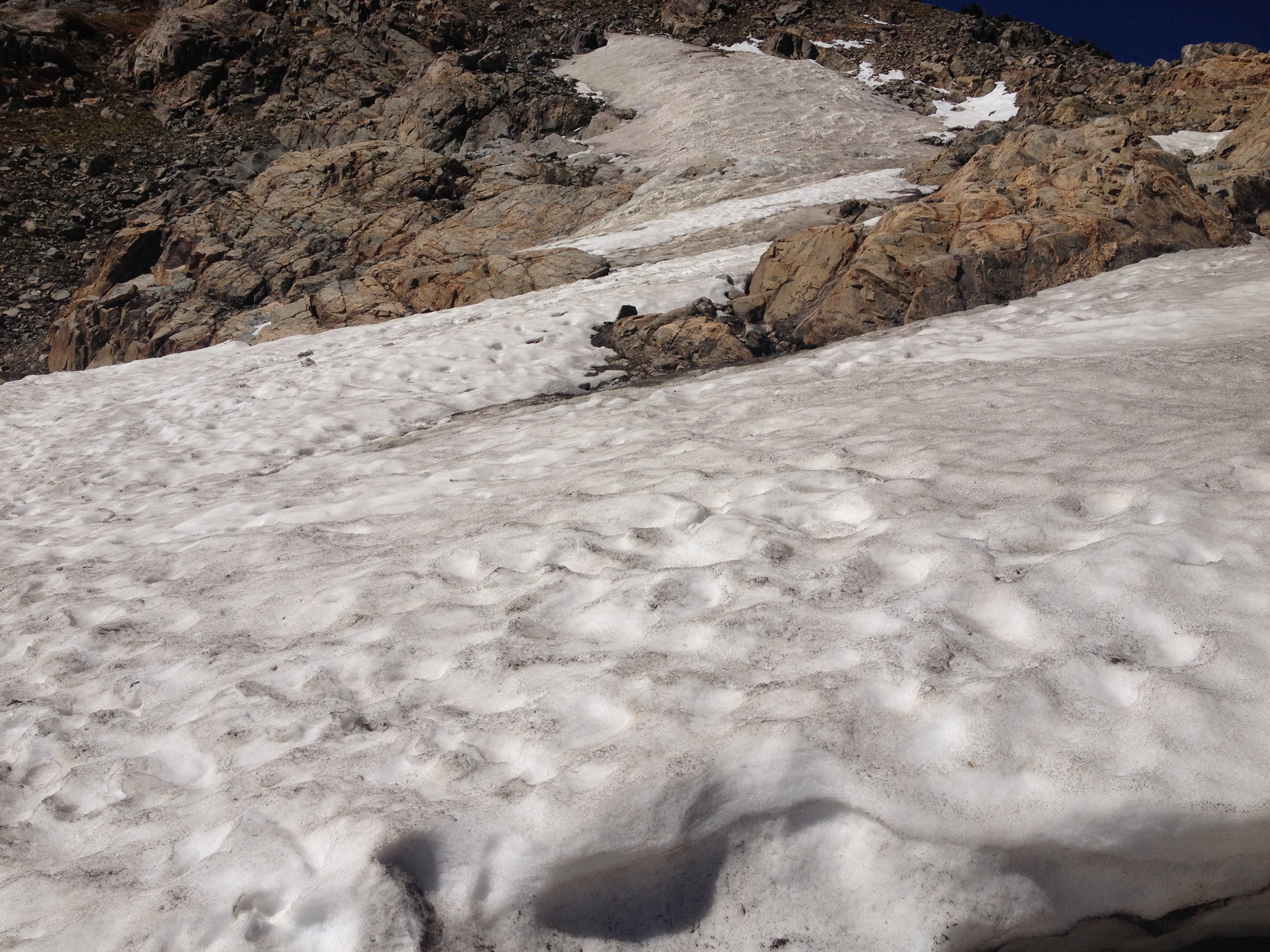
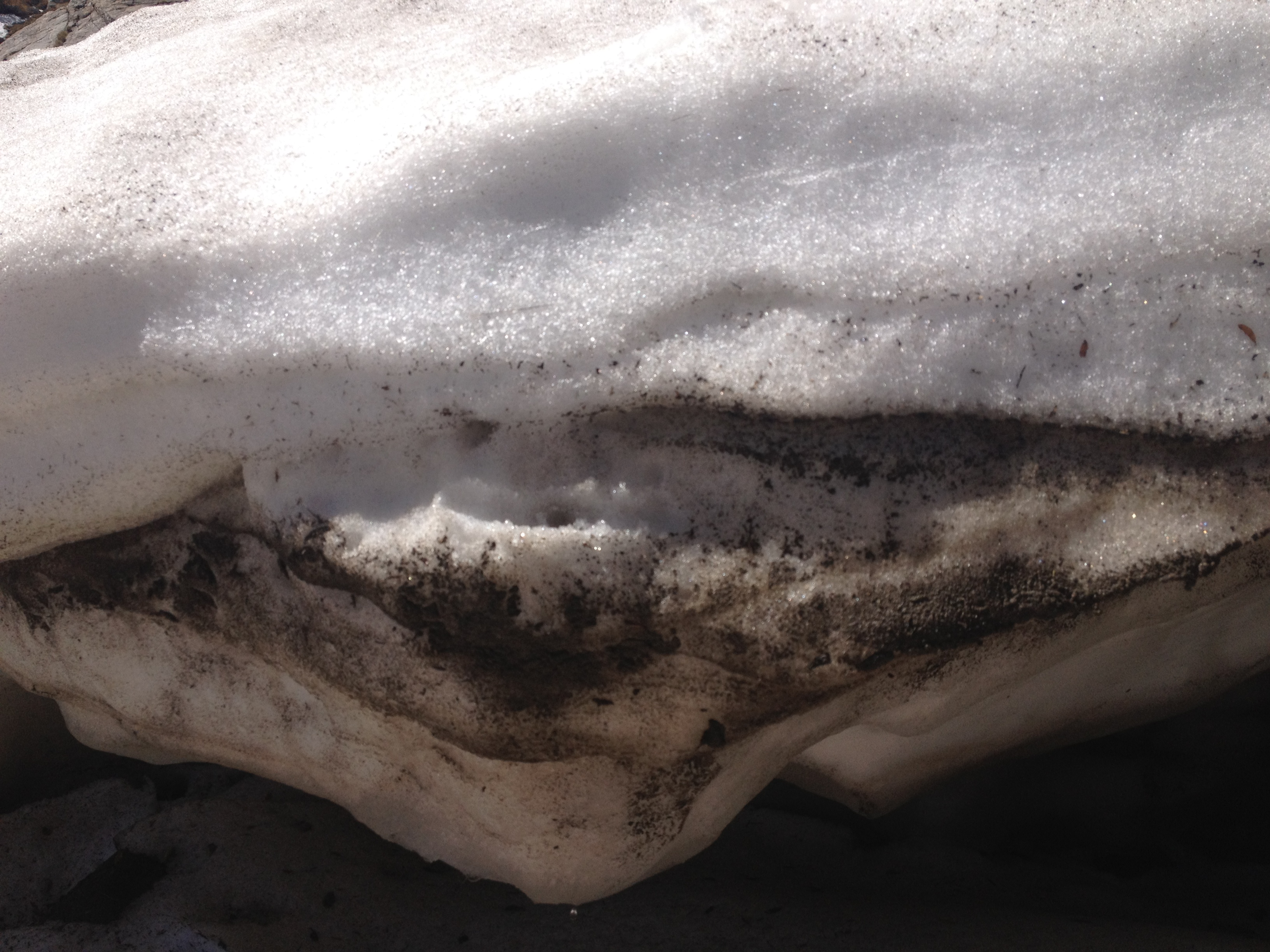
In fact, a close up view of the glacier’s ice shelf showcases this annual cycle.  This ice shelf has very white looking snow on top of a darker layer of snow.  The snow on top is newer snow, most likely from the most recent snow season.  On a warm day like today, it had the consistency of wet, snowball making snow.  However, the dark layer of snow underneath had a much icier consistency, indicating that it had survived multiple summers.  This is, in fact, an easy way to verify with no other observations or knowledge that the snow field you are looking at is indeed a glacier (as opposed to just residual snow from last spring).  Some of the ice in this middle part of the glacier has likely been around for decades.

The bottom layer of the ice shelf was dripping pretty rapidly from the melting.  There may be some really fun icicles here on some cooler days.  Given that melting is occurring this rapidly October 1st, it is possible to speculate that this glacier is losing mass over time, but that can only be concluded with more observations.

With it being warmer here than at most glaciers, it makes sense to me that this would be a popular attraction.  What makes less sense to me after today is why people seem to prefer to drink water from glaciers.  At least I see it all over advertisements for bottled water (i.e. the Evian Logo).  Today I saw ice and snow in constant direct contact with dirt and rocks, walked on by humans and dogs, melt and run off into cascading streams where the water is also consistently in contact with dirt, rocks, and possibly more dog pee.  This did not feel to me like the cleanest water I could be drinking.  I guess there are no chemicals.  Still, I think I will trust my city’s water purification system.

Maybe rather than being bothered by this glacier’s existence, I should be inspired.  This glacier has managed to continue to exist despite not so favorable conditions.  It is much like the one remaining factory in a decaying rust-belt town, or that tree in Wyoming the grew out of a rock.  They later built Interstate 80 around this tree, further disrupting it, but it still persists to be alive.  Like that tree, St. Mary’s glacier, and that one person you know who doesn’t seem to have any bull-shit at their job, evidence that bucking the trend is possible is still out there.  It is just a matter of finding out how they did it, and how much of it is luck.

Green Mountain; The Edge of Two Worlds

A lot of rivers, mountains, and land features are named for the color in which they appear.  According to the Wikipedia disambiguation, there are eight land formations, and three towns named “Green Mountain”. This, in addition to the “Green Mountains” in Vermont, which refers to the entire mountain range.

The Green Mountain I am referring to here is the one in Lakewood, CO, inside William F. Hayden Park.  What makes this particular mountain so special is it’s location.  At 6,855 feet, it is not particularly tall, but it is amongst the first actual peaks that one would come across as they travel to the West.  At least geographically speaking, it marks the border between the Great Plains to the East, and the Rocky Mountains to the West.

GreenMountain_Lakewood_Map

It is also only 12 miles from central Denver, and is known to be one of the places that dries out the quickest after a precipitation event.  So, if there is a place to check out on a nice sunny day only half a week after one of the worst flooding events in Colorado history, this is the place.

To get to William F. Hayden, I rode my bicycle, as it is only 12 miles away from my apartment, and I found a route through Lakewood, mostly on 1st Avenue that did not involve the bicycle trails, most of which are in river valleys in this area, and could still be muddy or sandy from the recent floods.  Most of this route, heading to the west through Lakewood, is a steady but slight uphill climb.  However, after I cut over to Alameda Ave. and followed the path alongside that road to the West and Southwest, the climb got steeper.  By the end of this climb, I was already at an elevation over 6100 feet.  This means that I had already done most of the climbing on my bicycle, before I even started this trail.

IMG_1040 IMG_1041Upon entering the parking lot, I was surprised to see that the trail conditions were still labeled as “Very Muddy”, and that they were still not recommending use.  I am assuming that these ratings were designed mostly with mountain biking in mind.  Still, the idea of a “very muddy trail” does not appeal to me for hiking, and I traversed the parking lot expecting not to be able to hike at all, but prepared to be satisfied with my bike ride.  However, I saw a lot of people, both hiking and biking the trails, and they appeared fine.  Two mountain bikers, who appeared to have already used the trails, confirmed that the conditions would be fine, so I decided to assume that the sign above was not updated, and hike the remaining 700-ish feet to the top of Green Mountain.

IMG_1043

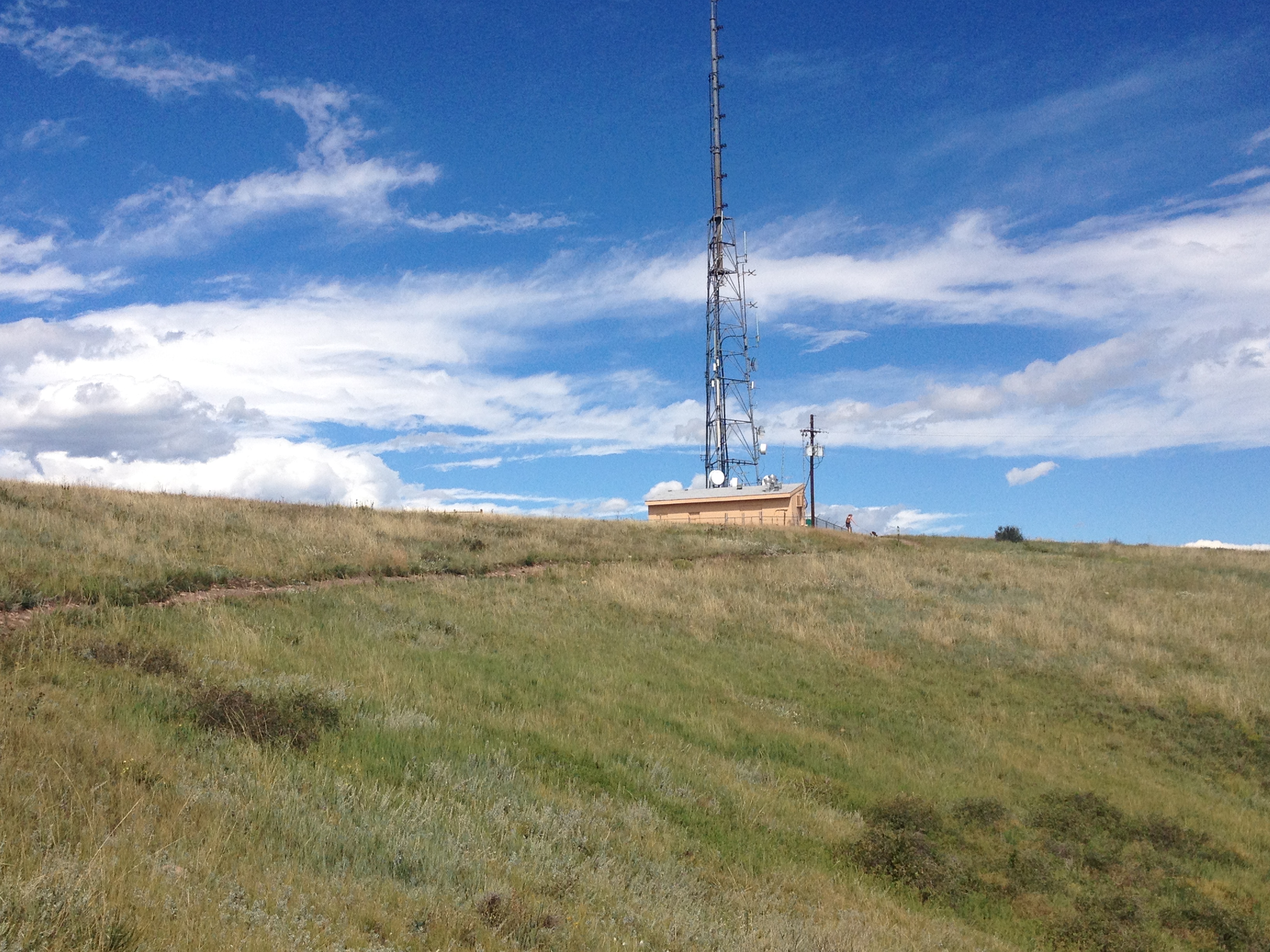
There are several routes to the top of this mountain, but the best option for someone who really wants to do some uphill hiking, traverses a radio tower, which is near the top.  Although this may take away from the pureness of a hiking experience, it seems to me like a good idea, from a scientific perspective, to have a radio tower on top of a hill, where it can reach more people.

IMG_1044 IMG_1046

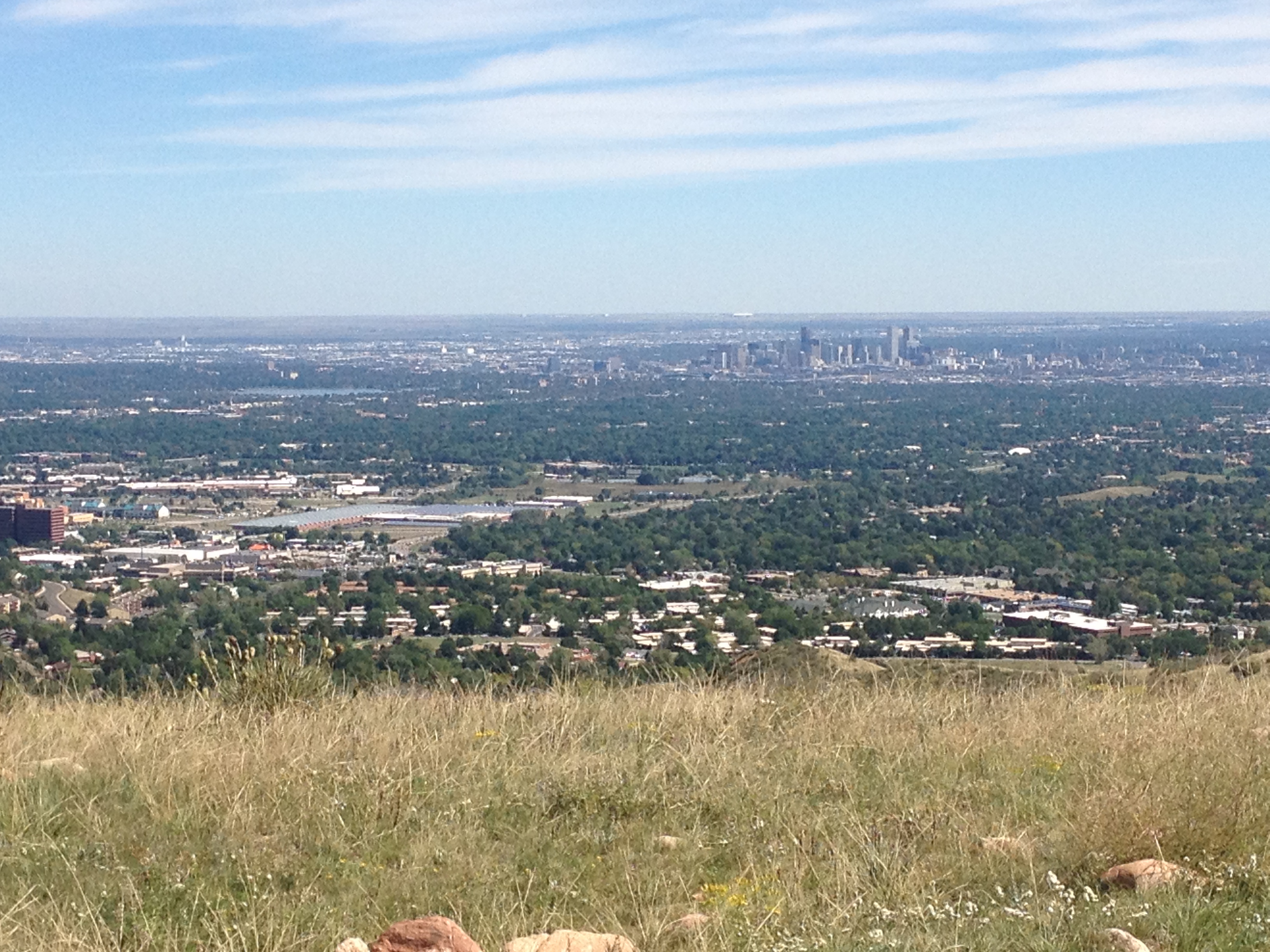
The top of this hill did feel like looking at the edge of two worlds.  Looking to the West, one could see the Rocky Mountains, well, mostly the foothills, but it was clear that anyone headed west would encounter taller and taller peaks.  Gazing Eastward there is a pretty good view of the skyline of the city of Denver.  In fact, observing the skyline of Denver from Green Mountain kind of reminded me of all of those iconic movie and T.V. show scenes where a small group of people would drive up to somewhere like the Hollywood sign and gaze at their city below them.  This would usually involve some kind of deep moment, either someone contemplating their life, kissing for the first time, or reminiscing on something.  Either way, I have this idea that major moments occur at places like this.

I hung out at the top of this mountain for a while today.  For a while, I switched back and forth between looking west and looking east, pondering what each direction meant.  To the west, the mountains represent excitement, challenge, and dreams.  A lot of people think of the glory of living the good life in a town like Vail, or Aspen.  To the east, I initially thought of Denver, but then started to look beyond Denver itself, towards what lies to the East of Denver, toward an area that is periodically overlooked and ignored.

If the west view at this peak represents challenge, dreams, and the possibility of achieving the good life, the east view represents being ignored, overlooked, and stagnation.  In fact, if I had not become interested in storm chasing, I might still have no idea what this place is all about.  The cultural centers of this country, primarily New York and Los Angeles, do not think about this area too much.  People from large cities either just fly over this area or resentfully drive across it.

There have been periods where people in large urban areas achieved greater and greater economic prosperity, while the people of the Great Plains continued to struggle.  Politicians routinely ignore people living outside the urban centers as there are fewer votes to be won there.  In fact, there are some people in the Great Plains portion of Colorado feel so ignored, they are developing plans to secede from the state.

As I leave the mountain, I think about how I am lucky to have had the experience of storm chasing, an interacting with all of these people.  Their lifestyle is not one that I would want, but what they do is still important.  People don’t think too much about the farmer and the rancher when they buy their food, but they are benefiting from what the people in this forgotten part of the country do.  Most of the interactions I have had with the locals while storm chasing have been positive and friendly.  In fact, one time in Sublette, KS, our entire chase group got free hamburgers, as they were having a celebration for the opening of their new co-op gas station, and let us join.  One of the great things about this country is that we do provide a variety of lifestyle options; something for everyone.  Hopefully one day, we will heal this urban-rural divide, and come to appreciate one another as parts of the complete social and economic system that makes all of our lives richer

Medicine Bow Peak

Labor Day Weekend represents somewhat of a rare occurrence in our modern world. For many with standard salary positions, Labor Day Weekend, along with Memorial Day Weekend and sometimes the 4th of July, are the three times of year in which a three-day weekend occurs automatically at a time of year with reliable weather. It is the rare opportunity to embark on certain adventures without having to dip into what is a precious commodity for many; vacation days. With how little chance many people have to go out and enjoy our natural world, see new places, and find new experiences, it is hard not to feel some kind of pressure to take advantage of weekends like these. Many even plan their excursions months in advance.

I come from this world. And, no matter how independent-minded I try to be, I find it hard not to feel this same pressure. There is some kind of pull on me, some strange aspect of my subconscious, my psyche reminding me of this scarcity. A voice in my head will actually tell me that not having some kind of an adventure on one of these “major weekends”, which includes Labor Day Weekend, is a waste of a resource more precious than anything monetary. It engulfs me, telling me that a mediocre Labor Day Weekend could possibly indicate that I am no longer an interesting person, regardless of what kind of activities I had been involved in the pervious weekends, or have planned for the coming weekends.

I bet this same pressure is felt by many. Therefore, I am told that on Labor Day Weekend nearly all of the popular recreation destinations in Colorado are “crowded”. But, I still really do not know what that means. Everybody has different thresholds for what constitutes crowded. And, part of me still suspects that to the average Coloradan, still not really that terribly used to the idea of Denver as a large city (or at least significantly larger than it used to be), the threshold for a place being considered “crowded” is much lower. Despite the fact that part of me reasons that being told something is “crowded” in Colorado is not something I need to concern myself with, I heed the advice given to me and head up to Wyoming, where I am told crowds are significantly less, even on a weekend like this one.

20130831-210404.jpg

20130831-210415.jpg

Today I headed up to Medicine Bow Peak, which is about 35 miles west of Laramie, Wyoming, basically in South Central Wyoming. And, well, the advice I was given actually turned out to be correct. The hiking trail, from Lake Marie to the top of Medicine Bow Peak, the highest peak in the region, is actually surprisingly not crowded. The crowd is probably less than half the crowd I encountered both times I climbed “14ers” earlier this summer, and probably comparable to what I would encounter on day hikes in Colorado on weekdays! Amazing for a holiday weekend like this one.

20130831-211950.jpg

Today’s hike began at Lake Marie, at about 10,500 feet in elevation, but started out climbing rapidly up the side of the mountain. This is actually something I was quite prepared for, as the mountain itself looked quite steep from approach. Today’s climb would only take me to slightly over 12,000 feet in elevation, a roughly 1500 foot climb, but the first half of the climb occurred quite quickly, and it did not take long for the lake, and the parking lot to appear significantly below us.

20130831-212334.jpg

20130831-212346.jpg

The next part of the hike, however, did take me by surprise. After climbing nearly 1,000 feet in the first mile, and feeling like I was actually on the verge of completing the hike, the trail flattened out. On the way to Medicine Bow Peak, there are several closer peaks that some would consider “false summits”, because they blocked the peaks behind them. We would hike around each peak in a semi-circle, the trail being either flat or having some minor rolling hills. This even included some downhill sections on the hike up the trail, which made the hike overall somewhat more challenging than other 1500 foot climbs.

I referred to this as “orbiting” these peaks. After each “orbit”, a new peak would appear, showing itself to be 100 feet or so higher than the pervious one. Each time, we would reason that the new peak was the one we needed to summit, only to be surprised to find the trail meandering on to the left of the peak once again, and another peak appearing in the distance.

20130831-213040.jpg

20130831-213048.jpg

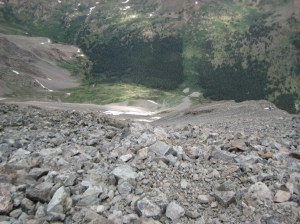
After four of these peaks, we finally encountered the peak we were destined to summit. After another steeper section, summiting this peak involved 100 feet of “scrambling”, which basically means climbing up a fairly steep vertical on rocks, with no one intended path. However, before the “scramble”, I was able to look down and see kind of an overview of the land I had already traversed. WIth all of the smaller peaks we had “orbited” around, we actually made some significant progress in the horizontal direction, and were quite far away from Lake Marie. A series of lakes near the trailhead appeared on the horizon looking down. The true beauty of the area could be seen from above, but did appear significantly different from it’s view from below.

20130831-213757.jpg

20130831-213803.jpg

The trek up this mountain actually reminded me of climbing “14ers” earlier this summer in a few ways. First of all, most of the trail was above the tree line, and had a similar feel to it. Secondly, despite the fact that this peak barely rises over 12,000 feet in elevation, it is the tallest peak in the region. So, the top of the mountain had a similar “on top of the world” feel to it. And, of course, the rock and the scrambling.

I would say overall that this particular hike would be a great warm-up for those planning to hike “14ers”. It has a similar feel, is also in the arctic tundra at high altitudes, but is less challenging with less vertical climbing. The “14ers” I climbed earlier this year were similar in length (7-8 miles total), but were steeper climbs in general, without the flat-ish section. They also generally contained longer and steeper scrambles at the top. For the purpose of working up to the challenge, I would recommend this hike for anyone that is looking for a good warm-up for a “14er”.

A New State Park

IMG_0939IMG_0940

Back in May, a new state park opened up in Colorado; Staunton State Park, near Conifer, which is just under an hour Southwest of Denver along highway 285.  I started hearing the buzz about this new state park during the springtime, just before and just after the park’s opening in mid-May.  The manner in which people talked about, and anticipated, the opening of a new state park in Colorado reminded me of how people would respond to the opening of a new restaurant, particularly by one of those celebrity chefs, in Chicago.

Through this, I came to the conclusion that the opening a new state park is the Colorado is the equivalent of the opening of a new restaurant in Chicago.  So, I applied the same crowd-avoidance rules to visiting this park that I would have applied to visiting a new restaurant in Chicago.  I waited a few months (until August), and I went on an off-peak day (today is Wednesday).  And, it worked!  It was not too crowded today at Staunton State Park.

I decided to check out a few different parts of the park, as well as a few different types of trails. Most of the trails in the park, or at least most of the trail length, permits mountain biking. The first mile or so of the trail was actually smooth enough that I would have felt comfortable riding my cyclocross bike on it.  A little bit farther up the road, a few rocks did begin to appear on the trail, but the trail still seemed quite smooth for a mountain biking trail, especially compared with the Apex trail near Golden.  For people who are thinking about getting started with mountain biking, or with little experience looking for something not too intimidating, I would definitely recommend Staunton State Park.

IMG_0941 IMG_0942

These trails also have a very moderate grade, making the hiking not too strenuous.  However, the few mountain bikers I saw traveling uphill on this trail appeared to be going rather slow.  So, it was probably steep enough to produce strain on a biker, but not a hiker.

I decided to check out one of the hiking-only trails.  A vast majority of the park is open to mountain bikes, with trails  that look like the pictures above, but there are a few places where only hikers are allowed.  The one hiking-only trail I took actually had a fairly strenuous section, with switchbacks and steep grades.  This strenuous section only lasted about 3/4 of a mile, making the hike overall significantly less strenuous than what would be labeled “strenuous” at a place like Rocky Mountain National Park, but it was not trivial by any stretch of the imagination, and would seriously challenge anyone that is not in shape.

IMG_0944 IMG_0945

Even these trails open to hikers only were quite wide and well-marked.  They reminded me of what I would refer to as “luxury hiking” back in the Midwest.  Well, without the restrooms and benches along the way.  But, the trail seemed to be laid out in a manner with greater comfort in mind than in many of the other places I have hiked in Colorado.

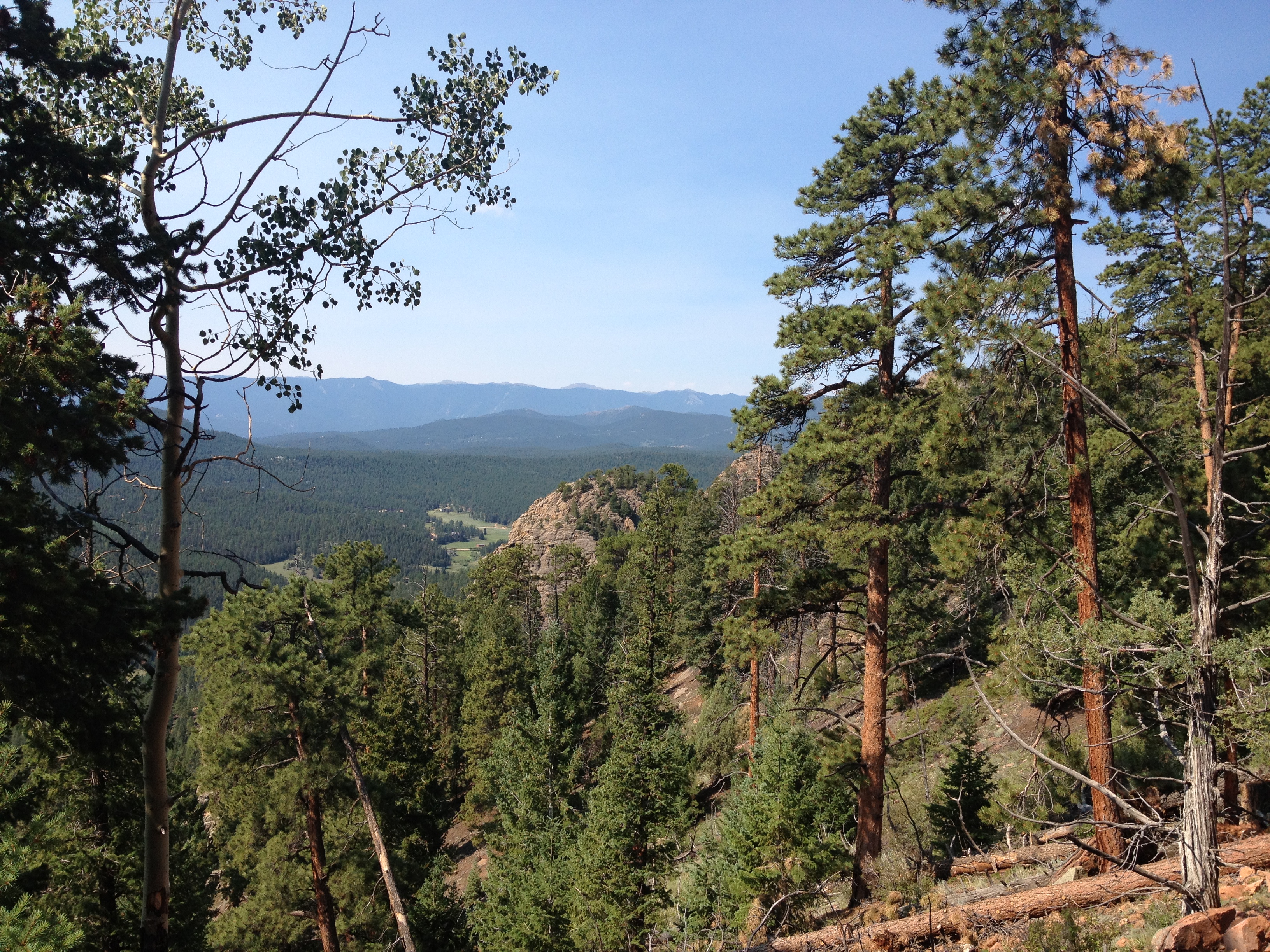
At the top of the ridge, I could not help but reflect on this view, as well as the views I had encountered at the top of the 14ers (14,000 ft. + mountains) that I had climbed last month.  The more I encounter views like this, and compare them with views like the one at the top of this page (photo taken near the park entrance), the more I begin to think that the best mountain views are taken somewhere between the base and the peak- basically somewhere in the middle.  This is kind of why the view of the Front Range mountains from the hill between Boulder and Louisville is so scenic.  At the top of the mountain, some of the features are a bit tougher to make out.  I guess it took me a while to come to this conclusion.

I did not get to view one of the park’s defining feature, Elk Falls.  The map I was handed at the park’s entrance indicated to me that the trail to these falls was not opened yet.  I guess this park is still a work in progress despite the fact that it is already open to the public.  I could have followed a series of trails to the Elk Falls Overlook, but I figured that with this park’s proximity to Denver (home), I would have plenty of chances to get back here after the trail to the falls directly opens.

IMG_0947 IMG_0948

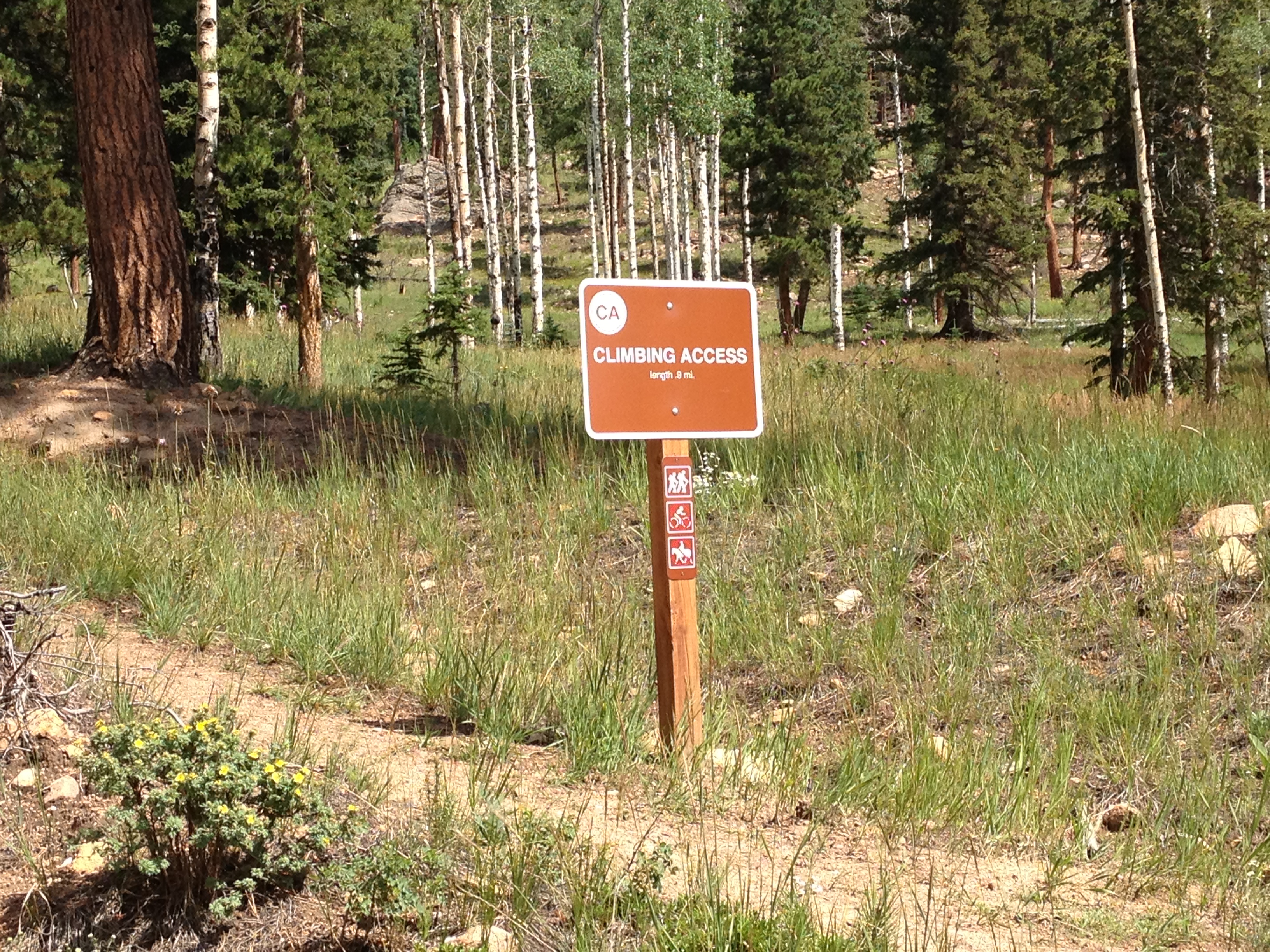
I did, however, get plenty of views of the park’s other defining feature, the rock formations.  These rock formations appear to make it a great place for rock climbing.  In fact, the park even put together a climbing guide, and specifically labelled the trail that leads to the climbing area “Climbing Access”.  So, it appears to me that this would be a great place for rock climbers, but I would not know for sure.  I have never been rock climbing.  As a matter of fact, I am a bit unsure of whether or not I want to add this activity to my repertoire.  On one hand, people I know who climb appear to love it.  And, it would add an upper-body intensive activity to supplement my current activities, which are mainly lower-body intensive (mainly biking, hiking, and skiing).  However, rock climbing appears dangerous to me.  I am somewhat hesitant to take on a dangerous activity like this when I am perfectly happy with the less dangerous activities I currently do.  It’s just one of those decisions I will likely put off for a while and then make based on something arbitrary, like someone’s fairly ridiculous line of reasoning at a bar one night.

Overall, Staunton State Park appears like a good place to go for mountain biking and climbing, that still offers some fairly good hikes.  I look forward to checking this place out next year, hopefully with the Elk Falls Trail open, and seeing everything it has to offer.  However, I am thinking that for someone whose primary interest is hiking, the options for hiking that does not resemble walking down the road may run out pretty quickly.

The Lifeblood of the West

IMG_0920

The Colorado River is often referred to as the “Lifeblood of the West“.  Recent estimates place the number of people dependent on water from the Colorado River at close to 30 million.  This is a number that is likely expanding, and expanding fairly rapidly, given that water diverted from the Colorado River supplies water to some rapidly growing metropolitan areas, including Denver, Las Vegas, Phoenix, and Salt Lake City.  Most of the areas dependent on the Colorado River for water supply are deserts that receive precipitation irregularly.  These cities would not have been able to grow into the large cities they are today without this water source.  Without it, our country, and it’s population distribution would be quite different.  It made an entire region the powerhouse it is becoming today.  The importance of this particular river to the United States would be hard to over-estimate.

It is also one of the most iconic rivers in the United States.  Along it’s course, it carved out some of the most scenic canyons in the world.  This includes the Grand Canyon, a location iconic enough to make it into Arizona’s state motto and attract five million tourists a year.  The Colorado River not only conjures up images of all of these iconic canyons, but also images of rafters, kayakers, and other water sports enthusiasts.  And, of course, one of the most iconic images of the Colorado River is the Hoover Dam, over 700 feet tall, one of many dams that supplies both water and power to the Southwestern United States.

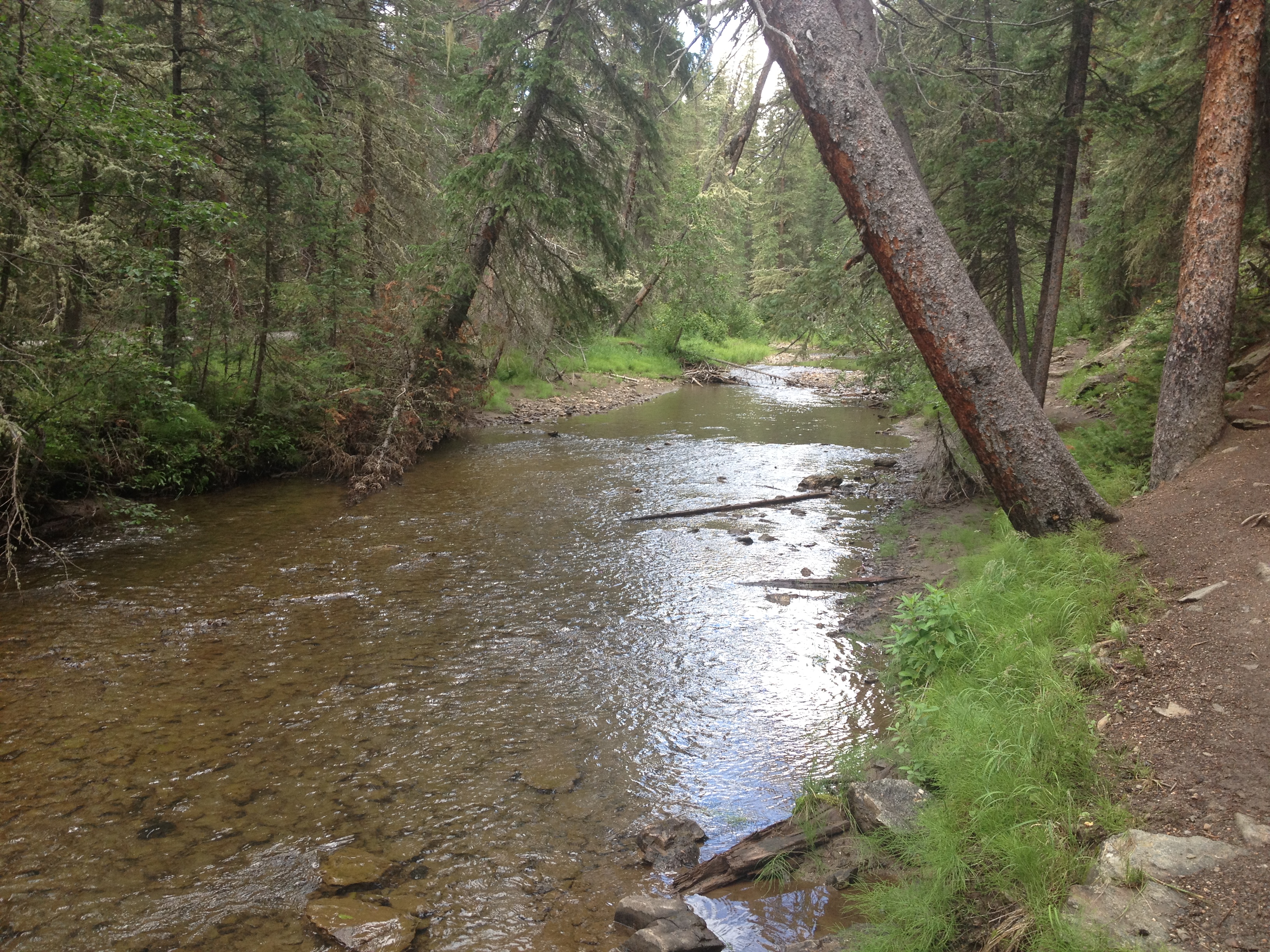
This gigantic cascading of water has it’s origins in Rocky Mountain National Park, near the Continental Divide.  The headwaters are not accessible by road.  A several mile hike is required in order to reach the headwaters of this iconic river.

This particular hike was not especially physically challenging.  Nearly every hiking guide rates this hike as “easy”, as opposed to “moderate”, “strenuous”, or Long’s Peak, which needs a category of it’s own.  Being a trail that follows a river valley, it is not surprising that the hike is easy, as steep grades are not common along river valleys.  This is why many trails follow rivers.  In the pre-automobile days following a river was often the safest and most direct route for fur traders, settlers, etc.  The automobile came along and made travel quite a bit easier, but many of today’s roads still follow these trails.

One interesting exception is Trail Ridge Road, the road I took to get to the Colorado River Trail.  This road traverses Rocky Mountain National Park, but it climbs to a peak elevation of over 12,000 ft. along a ridge in the north central part of the park, as opposed to following one of the river valleys like many other roads do.  It is also the route of U.S. highway 34, a route that proceeds eastward through Estes Park, and then towards Loveland, CO via the Big Thompson canyon.  The road follows a trail through a river valley east of Estes Park, but not west of town.  I wonder if that has anything to do with the fact that Rocky Mountain National Park was established in 1915, after the automobile had already been invented.  So, the people who planned the park could plan around visitors with cars.  Had it been established earlier, like Yellowstone, would the road follow one of the river valleys to the north or to the south, as opposed to it’s route up Trail Ridge?  Historical what-ifs are always fun to ponder, but never verifiable.  At least we know that as things actually are, visitors to the park can enjoy a scenic drive up Trail Ridge Road from mid-late May through the end of September.

IMG_0922 IMG_0924

Whenever a trail follows a river, there is an enhanced risk that the particular trail will be muddy.  The last couple of weeks have been rainier in North Central Colorado, and therefore, it was no real surprise to me that there were many places along this trail where the entire trail was covered with standing water, requiring hikers to either wade through it, or walk around it.  Anytime hiking, or bicycling along a dirt trail next to a river, one should prepare for such conditions after rainy days or rainy periods.

IMG_0925

I was expecting humble beginnings, and even considering titling this blog entry as such, but that is simply not true.  A mile or two into the trail, which is only a couple of miles from the source of the river, it already looks quite a bit wider than many rivers in this region.  Although the Colorado River gets a lot of additional force, and water flow, farther downstream, when it is joined by large tributaries, particularly the Gunnison, Green, and San Juan Rivers, seeing the river here it almost seems like this particular river stands out against every other river, creek or stream that flows off of the continental divide in this region.  Like that one child in grade school already reading at high school levels with a curious mind and appetite for learning, it seems destined for greatness at this early stage.

IMG_0927

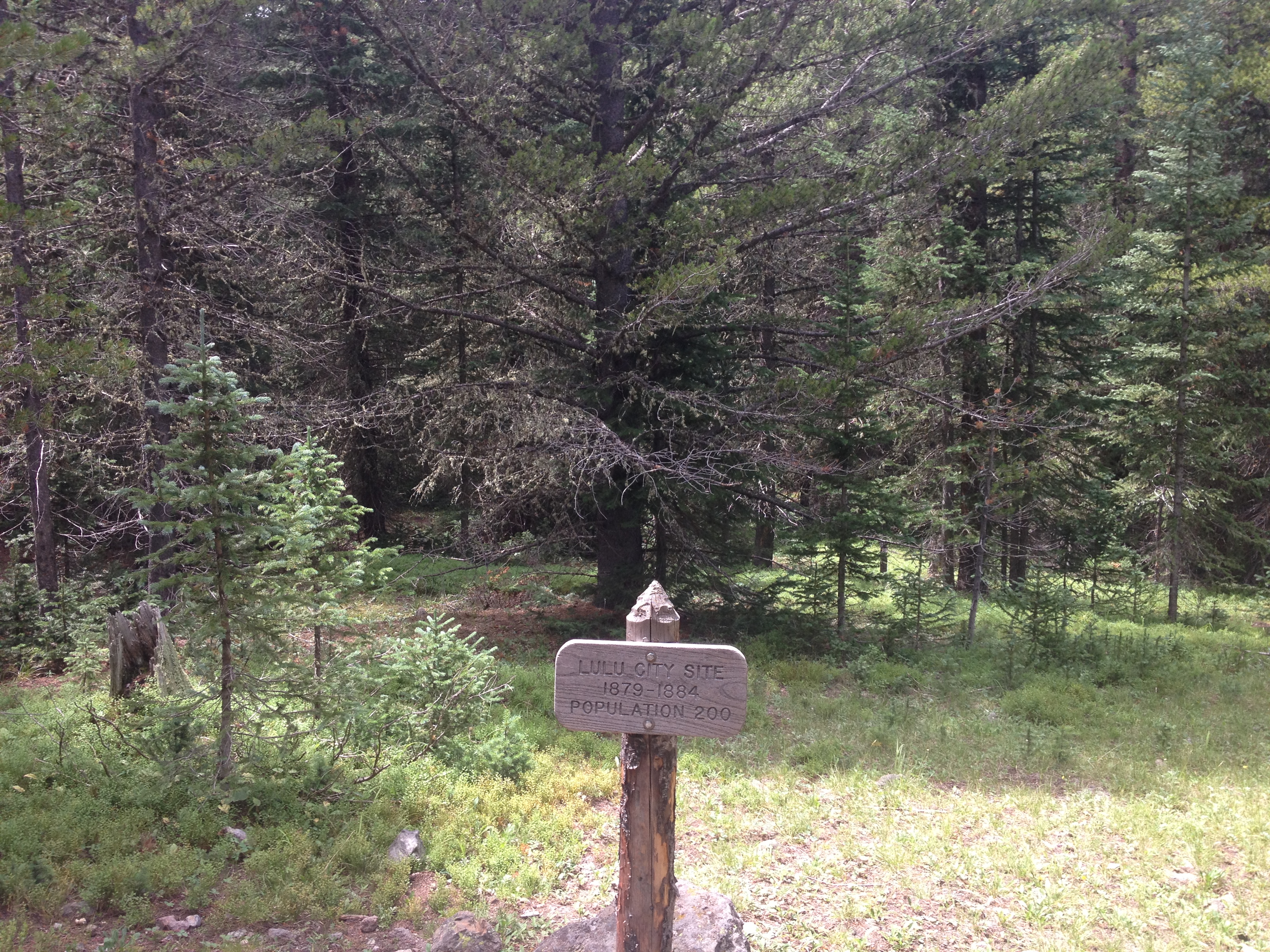
One interesting thing about this particular trail is that it passes through a ghost town.  3.5 miles from the trailhead, is a place called Lulu City.  In my DeLorme Colorado Atlas, it receives some fairly large lettering, so I was expecting the ruins of a town of sorts, similar to what you see on the Plains, or in the Rust Belt when you drive through a town that has been abandoned.  However, it was nothing like that.  All that is there is this sign, stating that a town of 200 people existed here for a total of five years.  Only five years!  I wonder what the story of this place is, and why it even warranted this major mention both in my atlas and on the Rocky Mountain National Park trail maps and signs.

IMG_0929 IMG_0931 IMG_0933 IMG_0934

After another mile or so of not too strenuous hiking, I arrived at the headwaters of the Colorado River.  The hike took less than two hours, and that was after going out last night and getting about three hours of sleep, so I was not exactly in top condition today.  Anyone wanting to view the Colorado River’s headwaters should actually stress the drive there more than the hike.  From Estes Park it is at least a half hour drive as the road traverses the park up and down a windy road.  Usually, it will take longer, as travel through the park slows down at nearly every scenic overlook, as well as anytime wildlife is seen and people stop to take pictures.

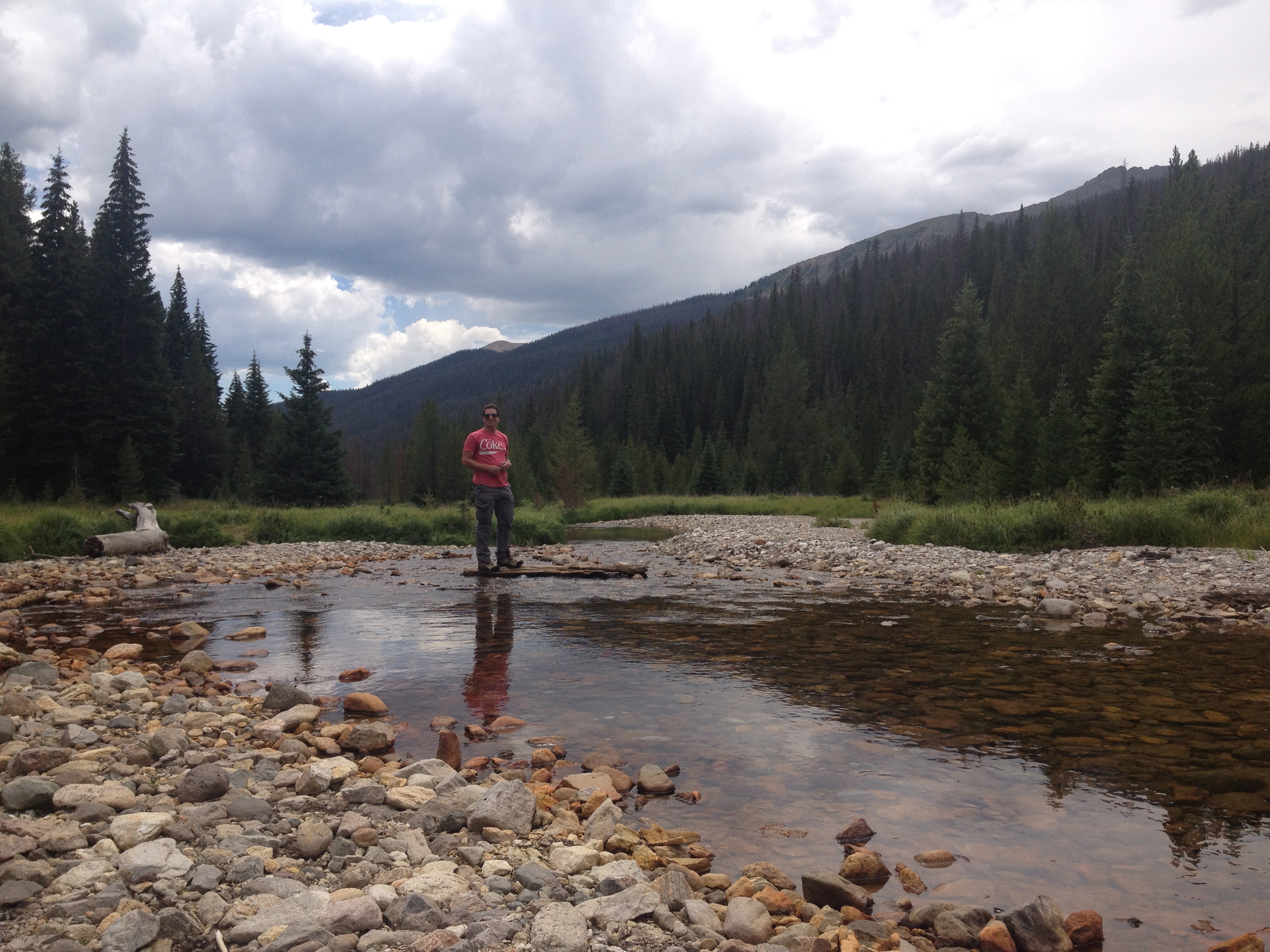
And of course, I can now forever say that I have walked across the Colorado River.  And I really walked across it, as opposed to when I walked across it on the bridge at the top of the Hoover Dam seven years ago.  That does not count.  But, when I get to the Grand Canyon, Moab, or any other place where the Colorado River has carved out an iconic scene, I will know that I have actually traversed across this very river with the assistance of nothing other than two logs, probably placed in the river earlier this year by someone with the same wacky idea and reasoning that I had today.

IMG_0935 IMG_0937

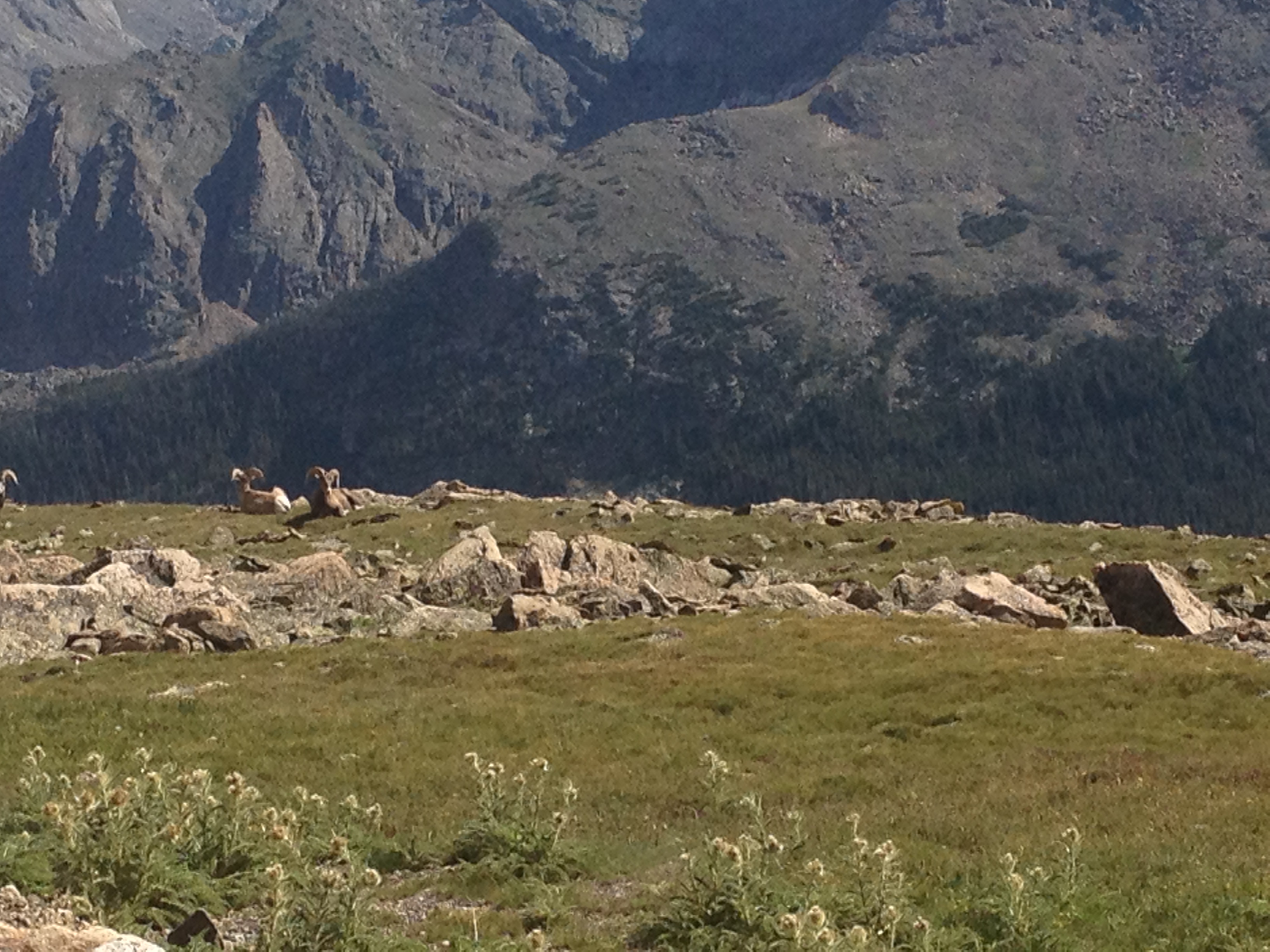
Oh yeah, and I cannot claim the higher ground with regards to everyone stopping to take pictures of wildlife and causing delays getting across the park.  This was only the second time I have ever seen moose, and this bighorn picture could not be passed up.  Five and a half hours of driving, and three and a half hours of hiking later, I can at least take solace that I rode my bike 39 miles yesterday and therefore did not really need a lot of exercise today.

Mount Bierstadt on a Windy Sunday

One of the hardest truths to accept in life is that you never know when opportunities are going to run out.  There are all kinds of reasons life gets interrupted; new job, new city, new responsibility.  And, before you know it the opportunities for certain activities have come and passed.  This is why I embrace opportunities when they come about, unless I have a good reason not to.   In other words, I make yes a default.  It’s kind of like how in the United States, when you are on trial, you are considered innocent until proven guilty “beyond a reasonable doubt”.   I tend to say yes to things unless I have “reasonable doubt” about them for one reason or another (or another prior engagement, which is actually by far the most common reason I refuse invitations to anything).

Consistent with my desire to fully embrace the Colorado Rocky Mountain experience, when I got invited to climb another mountain, Mount Bierstadt, eight days after hiking my first 14er (peak whose elevation is greater than 14,000 feet), I accepted.  Although, the more I think about some of the interactions I have had with people around town, the more I realize that climbing mountain peaks at this frequency is far from unheard of.  I think I remember hearing about people climbing 10 in one year, which would have to involve at least 5 days (most likely more) of climbing, or 5 weekends, out of about 15 weekends from June to September where climbing these mountains does not involve trudging though excessive amounts of snow.

IMG_0893 IMG_0894

This particular trip came about when one of my friends wanted to take a friend from out of town on her first “14er”.  Despite this being her first climb above 14,000 feet, with more hiking experience than me, she is a stronger hiker than me.  Mount Bierstadt is actually one of the easiest “14ers” to climb, and it is also fairly easy to get to from Denver.  So, we were actually able to sleep relatively late, leaving Denver just after 6:00 A.M., not arriving at the trail head until about 7:30.

I already notice a few differences between this hike and the one I did last weekend.  This hike seemed to be about the same difficulty as the last one (Gray’s and Torrey’s Peak) minute for minute, but it lasted less time.  It took us only two hours and fifteen minutes to get to the top, and that is with me slowing my more experienced hiking partners down.  There was also not as much of an intimidation factor as there was at Gray’s Peak.  In fact, I was not even able to point out which mountain we would be climbing at first glance,  which I most definitely was able to at Gray’s and Torrey’s.  I had heard that this mountain was known for having “false summits”, where it looks like you are reaching the top of the mountain based on your viewpoint, but aren’t actually at the top.  There were a couple of places on this hike where I felt that way, but I still think there are more “false summits” at Rocky Mountain National Park, possibly because all of those hikes are mostly below the tree line, and therefore are in the woods where you can’t see as far.

The other thing I encountered on this mountain were guys, mostly by themselves, and mostly wearing headphones, practically running up the mountain.  My guess is that they are quite experienced with these types of hikes and were trying to make the best time possible.  I wonder how long it took them to get to the top, because I considered 135 minutes to be a decent time.  I really don’t see myself ever getting to this level.  In fact, seeing this does give me reasonable suspicion about going on a hiking trip like this with some of the most hard core people I know.

It reminds me of the saying that no matter how good you get at something you will always encounter someone better (although there are exceptions; Michael Jordan, Usain Bolt, etc.).  It is impossible to fully enjoy any activities like this without accepting this fact, and learning how to be satisfied with your own progress (as long as you find it acceptable) regardless of what you see from others around you.  This is the only way a beginner can get on that mountain, basketball court, or ballfield, knowing they’ll look a bit silly the first couple of times, but that even those most experienced participants around them were also once the newbies in awe of the performance of others, insecure about whether or not they truly belong.

IMG_0896

I decided not to take a picture with that sign that they pass around, with the name of the mountain, the elevation, and the date.  Maybe I was a bit scared to hold the sign, as it was significantly windier on this hike than it was on the hike I did last weekend.  While on the mountain, I wondered if this mountain tended to be windier than the others, as Colorado’s terrain causes a lot of small scale variations in weather.  However, on the way back to Denver, I noticed it was still windy.  So, I am thinking that Sunday was just a windier day, which makes sense because Friday and Saturday were stormy in the mountains.  This picture, I think, makes it pretty clear that we were  on the top of the mountain.

IMG_0897

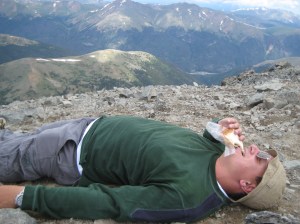
Another interesting occurrence was what happened with the sandwich I packed in Denver, and ate at the summit of the mountain.  I guess this photo above proves that I pack my sandwiches well, as the bag expanded significantly due to the pressure decrease of being at a higher altitude.  Denver’s atmospheric pressure is around 850 millibars (sea level is just over 1000).  At 14,000 feet, the pressure is only about 600.

IMG_0900 IMG_0901

The trip back down the mountain was somewhat treacherous.  The part near the top is something often referred to as a “scramble”, which basically means that rather than a clear trail, it is mostly just rocks that you just kind of self-navigate the best path up.  This was the hardest part on the climb up the mountain, as it is pretty steep, at a high altitude, and required me to do a bit more with my upper body to propel me around the rocks.  Somewhat lower on the mountain, there are several areas with little streams that actually made the trail a bit wet.  On the way up the mountain, I did not care about this, but on the way down it did kind of worry me a bit.

Additionally, the time we were descending the mountain, from roughly 10:20 to 12:20, there seemed to be an even mix of people traveling in both directions (upwards and downwards).  I am guessing that since this hike is somewhat shorter than most “14ers”, it is more acceptable to get a somewhat later start here.  All of these factors probably made the trip down the mountain take nearly as much time as the trip up the mountain.  I really need to stop expecting the downward trip to take too much less time as the upward trip, but these are the kinds of things that we all learn through experience.

The only real annoyance on this particular trip was the traffic on Interstate 70 on the way back to Denver in the early afternoon.  I was told that is to be expected on any summer Sunday in Colorado, but for some reason all of us had just simply forgotten about this, and not really planned for it.  They are widening part of the road to three lanes in each direction, and the construction may have made the traffic worse.  Hopefully the additional lanes will make traffic move faster in the future.

I spent most of the day today (Monday) being worn out, but was back to my normal energy level sometime in the afternoon.  Maybe I am lucky that my energy recovers quickly, but I think part of the reason for it is that I embraced an active lifestyle long ago.  I started making yes a default long before the Jim Carey movie Yes Man came out, and, as a result, I have been on top of the world three times this month.

A Rite of Passage

IMG_2367 IMG_2376

Birth to roughly age 22 is an endless barrage of rites of passages.  There is birth itself, first steps, first words, first day of school, learning to ride a bike, first kiss, then high school and college are one eight year long rite of passage into adulthood which includes learning to drive, and then all of the other things you can legally do at age 17, then 18, then 21.  Due to the ridiculous drinking age in this country, many of us end up going a little bit overboard somewhere in there.  On top of that, there are a bunch of rites of passages in there that are specific to each individual, like first baseball games, or learning musical instruments.

The final rite of passage in all of this is graduating and getting a job (or, for some people graduate school).  At this point in time, most of us are quite sick of rites of passages.  This is especially true for some of us that went to graduate school.  The time has just come for us to stop preparing for our lives and live our lives.  However, the transition is quite abrupt.  We go from being in a near constant state of flux and trying to figure out where are lives are going, to a quasi-steady state, where day in, day out, week in, week out, year in, year out, has the potential to follow some routine that never changes, and never progresses.  After a few years of this, it is natural to get a bit restless.  Before long, we see American Pie, or Superbad, or Clueless, or whatever movie reminds us of that time in our lives, and almost become nostalgic for the time in our lives when the future, heck, the next week, was an open book, as opposed to a likely mirror of the last.
IMG_2347 IMG_2349

In Colorado, it is considered somewhat of a rite of passage to climb to the top of a “14er” for the first time.  A “14er” is a mountain whose peak is more than 14,000 feet in elevation.  The selection of the number 14,000 seemed a bit arbitrary to me at first.  It seemed like it just happened to be the nearest round number, and that it would be different if the U.S. were on the metric system.  But, this demarcation of peaks exceeding 14,000 feet seems useful to Coloradans for two reasons:

1.  With a total of 54 “14ers”, it gives Colorado hikers a large enough variety of places to go and hike these peaks, but not so many that climbing all of them is out of reach.

2.  With a total of 54 “14ers”, Colorado has significantly more of these peaks than all other states, including Alaska (14) and California (12).  So, despite the fact that those states have the tallest peaks in North America and the lower 48 respectively, Colorado has a basis to claim the top position in the country with regards to mountains and mountaineering.

This is why yesterday I woke up before sunrise and made the trek to Gray’s Peak in order to accomplish the feat of climbing my first “14er”, and becoming a true Coloradan (in the eyes of some).

IMG_2393

Gray’s peak is actually the highest point on the Continental Divide, and the trail up to the top of this peak (as well as Torrey’s Peak) is part of a national scenic trail that follows the continental divide.  This trail is only about 70% complete.  If someone wanted to traverse the entire trail, they would have to do some road-walking.  This is most likely why we don’t hear about this trail as much as the Appalachian and the Pacific Crest trails.
IMG_2354

I was lucky enough to go with a group of people that included three first timers (including myself), and a mixture of people who had varying levels of experience climbing “14ers”.  A couple of people had been up over ten of these peaks, some others had done only a couple.  It is also just fun for me to do activities in groups like this, and I am glad I got to share this accomplishment with them.
IMG_2355

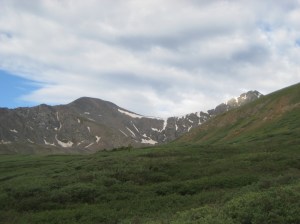
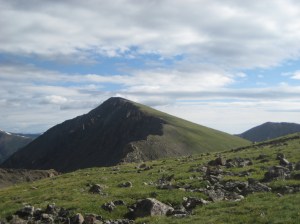
Whenever attempting something that requires physical strength or endurance, part of the battle is always mental.  Seeing Gray’s Peak (left), and Torrey’s Peak (right, partially hidden behind the hill), toward the beginning of the climb definitely created an intimidation factor that somewhat reminded me of the first time I went skiing in the Rocky Mountains, at Steamboat Springs, and looked at the ski mountain, after having only seen ski mountains in the Midwest.
IMG_2358

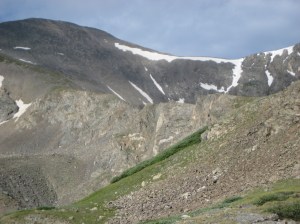
The trail up the mountain follows a path that has been mapped out for some time, and has been improved and preserved by the Colorado Fourteeners Initiative.  It is likely the safest way to hike up the mountain, but it follows a ridge that looks a bit scary, as the thought of being on a small linear feature like the one seen in this picture can be somewhat frightening.  Luckily, when we got there, it was actually less scary up close than it was looking at it from afar.
IMG_2361 IMG_2362

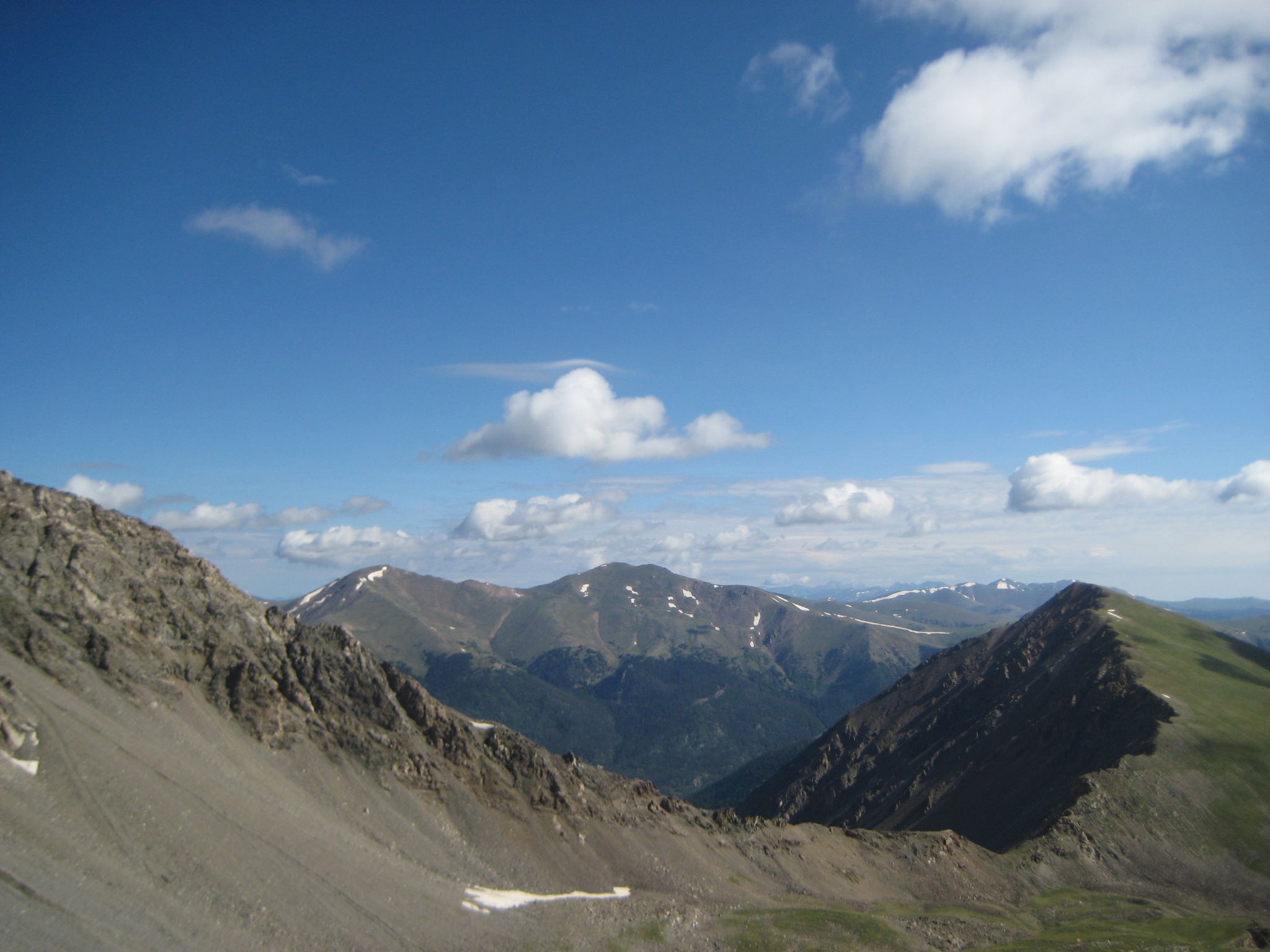
With pretty much the entire hike being above the tree line, I began to get some pretty scenic views only halfway up the mountain, which is already above 12,000 feet in elevation.  It was quite interesting to see some of the other peaks looking away from the top of the mountain, to the north.  As a scientist, it is hard not to be intrigued by seeing a mountain where one side is getting a significant amount of sun and the other is not.  It appears as if grass grows on one side but not the other, which indicates a different ecosystem and a different climate, all within the arctic tundra, dependent on local topography.

IMG_2363 IMG_2365

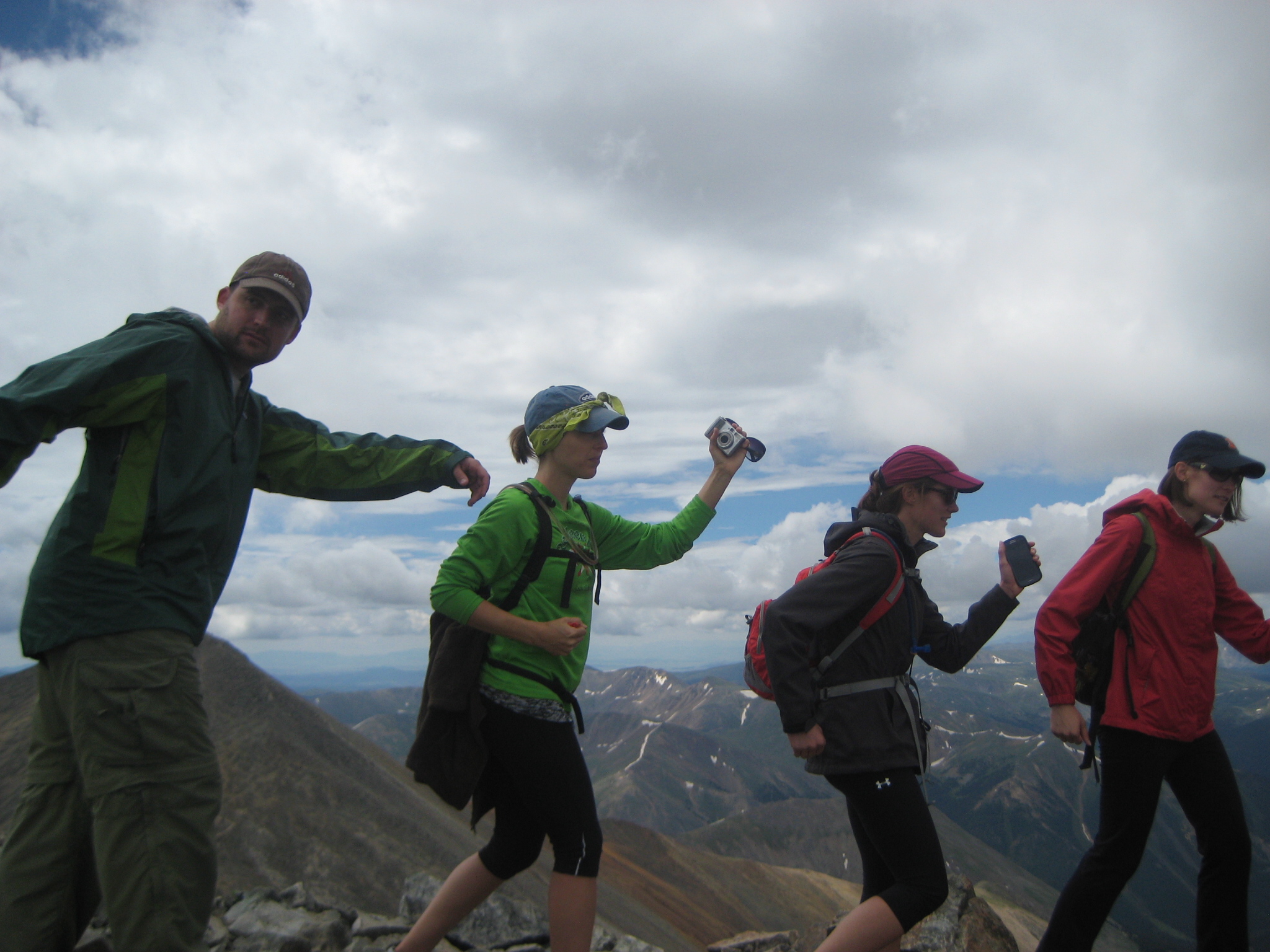
For roughly the first two thirds of the way up the first peak, I was actually able to keep up with the fastest people among the group.  However, having less experience climbing at these altitudes, it was inevitable that I would eventually drop back.  I took this opportunity to get some image of the others in the group hiking, as there was a switchback zone after the ridge we had previously followed.  Hiking trails like these definitely involves a significant amount of looking at the ground, as there are a lot of small rocks, which need to be approached somewhat carefully.  Even after I let everyone know I was taking pictures, some people still did not look up.

It took me about three hours to get to the top, and I summited just after 10 A.M.  The feeling of getting to the top is hard to describe, especially for a first timer like myself.  It is definitely a feeling of accomplishment, and a really good confidence builder.  It is also mixed with this feeling of being on top of the world.  All of the mountains, the ones that I typically view from Denver as towering over the city from the west were all below me.  I had climbed to the top, conquered it in a way.  I may never look upon these mountains the same way again.  The very scenery that I can see on all non-cloudy days from the back window of my apartment has been suddenly transformed from symbolizing what is challenging, wild, and untamed to symbolizing that all things are possible, and that challenges can be met with determination and proper planning.

IMG_2370 IMG_2369 IMG_2368

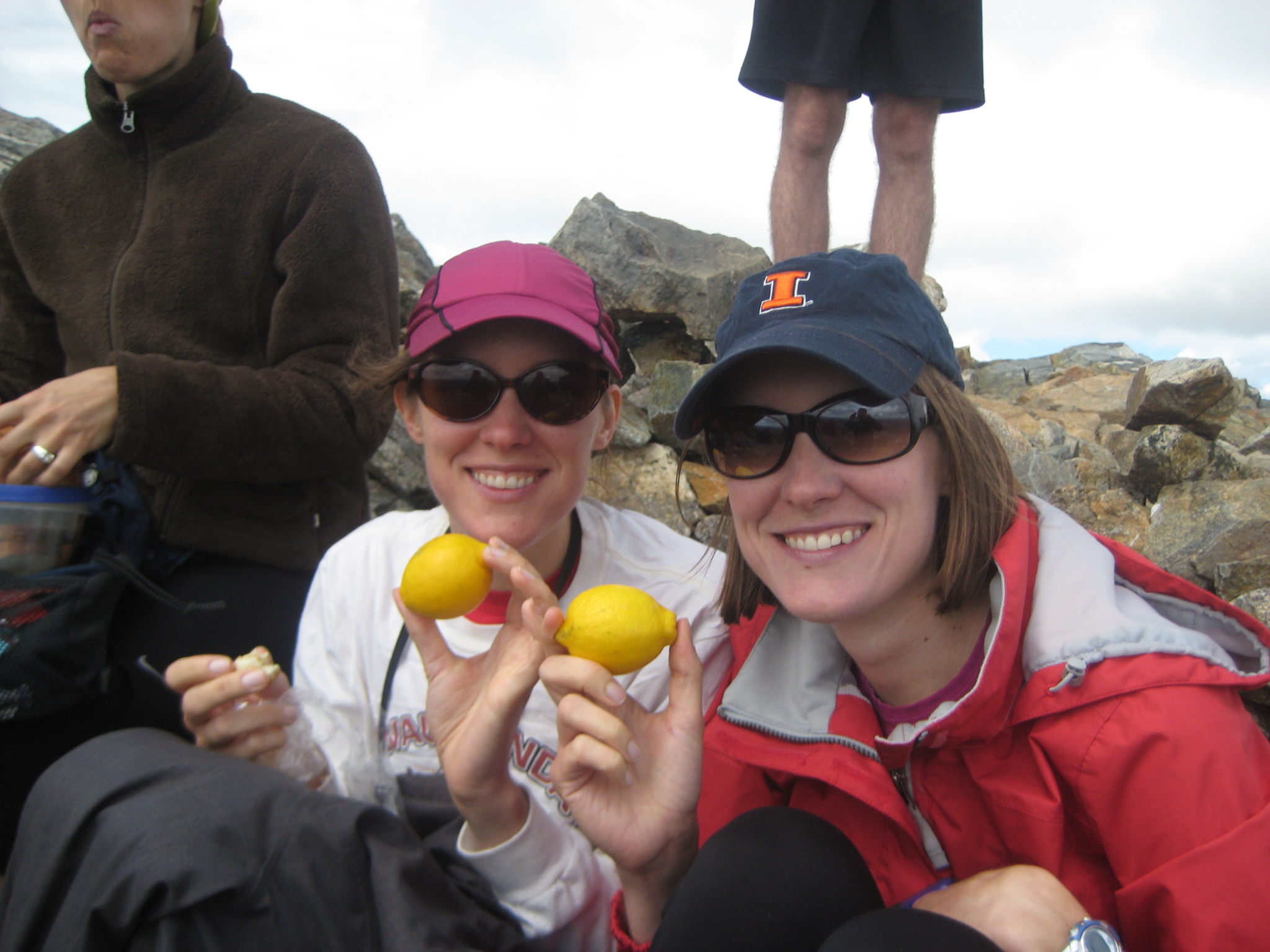
At the top of Gray’s Peak, we actually found a pretty nice place to sit, where the rocks somewhat shielded us from the wind.  For some reason, it is always significantly windier at the top of a mountain peak than it is just a mere 100 feet lower.  I have noticed this before, but wondered if it would feel different on this hike, which was pretty much all above the tree line.  It wasn’t, it felt more than twice as windy at the top of Gray’s peak.  I also learned something very surprising about hiking yesterday.  On the way up to the mountain, I was told that all hikers should bring a lemon with them on their hike.  This made absolutely no sense to me, as I was under the impression that I should stick with sandwiches and power bars to avoid carrying excess weight.  Liz and Laura (pictured above) followed by this advice, brought the lemons, and actually let us have some.  I had one lemon wedge, so I probably did not receive too much impact from it, but it did seem refreshing and energizing.  Who would have thought.IMG_2372

I also brought Bigfooting to new heights, doing my pose at 14,270 feet above sea level, and on the Continental Divide!  The scenery behind me is looking in the other direction (South), where I could see more gigantic mountains from above- exhilarating!

IMG_2375 IMG_2379

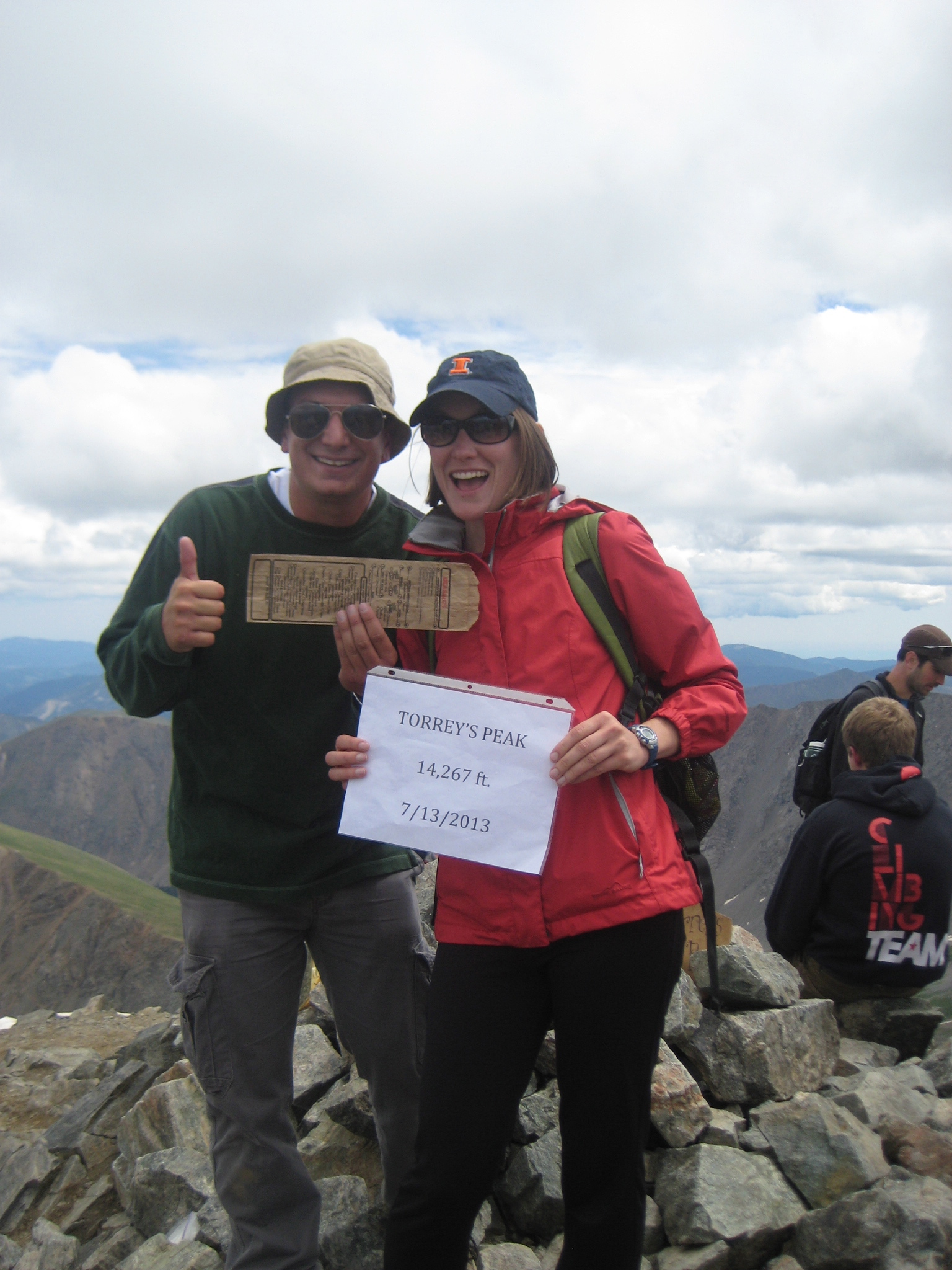
From Gray’s Peak, it is possible to “saddle” over to Torrey’s Peak.  To do this, I had to descend 575 feet along a ridge between the two peaks, which actually follows along the Continental Divide, and then climb up the second peak.  Apparently, this picture taken at the top of Torrey’s Peak, with a Which Which bag in the photo, entitles me to a free sandwich at Which Which.  I wonder if I can upgrade to a large size sandwich for posting this picture here.

Climbing up Torrey’s Peak was harder than climbing up Gray’s.  The trail up was steeper, and, possibly because I was already tired from climbing the first peak, I had to stop and catch my breath several times.
IMG_2382

When I reached the top of my second “14er”, I was quite worn out.  This is how I knew that I had given it my everything, and truly pushed my limit.  I could have stopped after peak #1 already having accomplished my rite of passage.  But, I decided I wanted to leave with absolutely no doubt that I had pushed my body as hard as it was willing to go.  I even had to leave the Bigfooting up to others on this peak.

IMG_2381

Going down was scary, especially this second peak, which was steeper than the first.  I don’t know how I feel about it.  I had become accustomed to having trees to hold onto in a pinch, but this hike was all above the tree line.  I actually went pretty slow at first, but then started resorting to descending the mountain using some of my skiing techniques, primarily facing my feet sideways and turning back and forth.
IMG_2384 IMG_2385

To get down from Torrey’s Peak, one must return to the saddle area between the two peaks, and then follow another trail down towards the parking area.  This lead us down the mountain on a slightly different path.

IMG_2390 IMG_2391

We actually had to trudge through an area with residual snowpack.  While I do find it interesting to ponder why part of this mountainside still has snow and other parts, facing the same direction do not, this was my least favorite part of the hike.  It was real slippery and we were descending.  I consider hiking and skiing (or snowshoeing) to be two different activities, and usually plan to avoid hiking on too much snow.  This snow is still melting obviously, and some small streams of water from this snowmelt were observed further down the trail.

After another area of switchbacks, the descent got less steep, and the rest of the hike was somewhat uneventful.  We got back to the parking lot around 2:30 P.M., about an hour before thunderstorms erupted in the area, but apparently there were already storms elsewhere in the area.  What was amazing for me to see, were people starting their ascent up the mountain after noon.  We wanted to tell them to turn back and wait for another day, but I am never sure what to do about that.  As someone who is typically not a fan of unsolicited advice, I am hesitant about giving it to people, even in the case where their idiocy is blatantly obvious.  A general rule about climbing “14ers” is to get there as early as possibly, preferably before 7 A.M. (which we did not quite make).  If arrival before 9 A.M. is not possible, it is probably not worth it to go.  I learned this within a month of moving to Colorado, without even seeking this knowledge.  So I find it hard to believe that someone would try to scale this mountain starting at 1 P.M. on a day with greater than normal monsoonal thunderstorm likelihoods.

IMG_2387 IMG_2388 IMG_2389

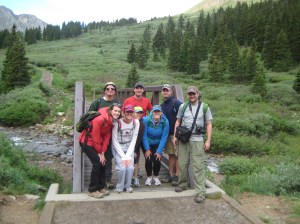
It was wonderful to have completed this, my first “14er”, and traversed this rite of passage.  Having done this will give me something akin to the Colorado version of street-cred.  With two other first timers amongst us, we took some “graduation photos”, with the mountains we had climbed in the background.  I actually billed this the “14er Class of 2013”, but I was possibly a bit warn out and light-headed when I came up with that one.  At this level (still over 13,500 feet), there is 35-40% less oxygen available than at sea level.

Does this make me a true Coloradan now?  No.  It actually makes me something more akin to a true Colorado transplant.  One of the things I have learned over the past year is that it is the transplants that are the ones obsessed with skiing, hiking, and all of the mountain activities in general.  The only people I have met over the past year here that do not ski have been Colorado natives.  But, what makes someone a true Coloradan?  One could argue that those of us that are going out and experiencing what Colorado has to offer are the truest Coloradans there are.  It is in the same vein that some argue that some immigrants can be counted amongst the truest Americans there are.  Of course, there are valid arguments on the other side, but as I have viewed tons of Colorado Native bumper stickers over the past year, I do find it hard to accept that being born in a certain location is a prerequisite for belonging there.

Regional Familiarity

IMG_2317

Within only a month or so of moving to Colorado, one of the things I missed quite a bit about the Midwest was the familiarity I had with the region.  After 19 years in the Midwest, I had grown quite familiar with the area.  I knew the traffic patterns of Chicago, as well as all of the good alternate routes.   I knew what areas were popular in which situations, and therefore knew where to expect crowds.  I knew how much time to allocate for driving between any area in the Midwest, allowing me to allocate my life quite efficiently.  I also knew about restaurants, bar specials, people’s typical behavior patterns, and, well a host of other little intangibles that help an individual operate their lives smoothly.

I suspect many people begin to feel this way when moving to a new place.  Although it is important to embrace a new experience, in order to get the best result possible, it is hard not to long for that familiarity.  Different things are important to different people.  But, after living in a place for a few years, most people will have gradually obtained the knowledge that is important to them.  However, that first year or two always involves a scramble.

Yesterday, I learned a lesson about Colorado.  I had decided I wanted to go to Rocky Mountain National Park for two reasons:

1.  I decided that it was a good time to do a hike that contained a vertical climb somewhere in the neighborhood of 2,000 feet at a fairly high elevation.  This, of course, is mostly me wanting to fit in here, with the activities that a lot of people in my age group like to do.  At the University of Wisconsin-Madison, fitting in involved developing an alcohol tolerance.  Here it means being able to physically handle terrain, by hiking, biking, climbing, skiing, etc.

2.  Last month at Badlands National Park, I bought an annual pass to the National Parks for $80, with the specific intention on using the National Parks here in Colorado.

What I found out was, leaving at 7:30 A.M. was not early enough.  Well, not to do what I wanted to do, which was hike the Lawn Lake Trail, a 6.2 mile trail with a 2,450 foot accent to Lawn Lake, in the Mummy Mountain Range, and return to the car safely before thunderstorm chances increase in the afternoon.  My problem was that I departed right around the height of the morning rush hour, and, decided to take U.S. highway 36 through Boulder.  Not only did I encounter traffic before even getting out of Denver, but I encountered the usual Denver to Boulder traffic, and the usual delays in Boulder, where traffic is quite lousy for a city it’s size.  After all of this, I did not arrive at the entrance to the park until just after 10 A.M.  Luckily, I had learned from all of my recent travels that traveling within a National Park can be slow going, and therefore had selected a trail not too far from Estes Park, where I had planned to enter the park.

IMG_2318

By that time, all of the parking spaces at the Lawn Lake Trailhead parking lot had been taken, so I had to park across the street.  This was somewhat fortunate, as one of the best pictures I got from the area actually came walking across the street to get to the trailhead.

IMG_2319

On some hiking trails, it is surprisingly easy to take a wrong turn.  But, not on this one, as the trail was well marked by rocks the entire way, and even had periodic signs pointing the way.

IMG_2320 IMG_2321

As was advertised, the trail was quite steep.  In fact, it began with several switchbacks, and it was less than half a mile into the trail that some meaningful uphill progress began to appear.  That was when I saw another reminder that I am still a Colorado novice.  On one of the trail markers, I saw someone had actually left a hoodie on the post.  My first instinct was that having just worked up a sweat climbing the initial few switchbacks, the person had overheated a bit and decided to take their sweatshirt off.  But then, I thought to myself, why would anyone want to dump off a layer of clothing when going uphill, where it will only get cooler with elevation.  I also wondered if this was any kind of a signal that Coloradans know about that I do not.  Could it be similar to someone tying a tie around the door knob of a college dorm room to signal to their roommates that they have company and need to not be disturbed?  Only walking in on your roommate, as scary as that sounds, sounds less scary than being suddenly attacked by a bear, or giant falling rock because I did not understand this signal.

IMG_2322

I also seem to always happen upon waterfalls at Rocky Mountain National Park.  And, happening upon a waterfall I was not expecting kind of also made me reflect on some major differences between living here and in the Midwest.  I happened upon a waterfall when my destination was a lake.  This feels like the opposite of the way it would occur in the Midwest.  In the Midwest, waterfalls are hard to come by, and it is not uncommon to travel hours to encounter a good waterfall.

IMG_2324 IMG_2325

Knowing the thunderstorm threat at this time of year, and the amount of time I had, I had to change courses and chose to hike the shorter trail, Ypsilon Lake.  This trail, however, is also rated as “strenuous”, and at Rocky Mountain National Park, when they describe a trail as strenuous, they mean it!

IMG_2326 IMG_2328

I knew I had made some significant uphill progress because the density of the trees had begun to thin out.  From viewing the area around me, I concluded that I was roughly 1,000 feet below the “tree line”.  Later, after consulting my fabulous Colorado DeLorme Atlas, I determined that I turned around only about a mile and a half from the end of the trail, but that I had done pretty much all of the climbing.  From a base elevation of 8,540 feet, I had reached somewhere in the vicinity of 10,500 feet, leaving something in the neighborhood of 200 or 250 feet of climbing remaining.  I still wonder if I should have continued the rest of the way to the lake so that I could have completed the trail, but I guess I need to chalk the whole experience up to just not quite having the feel for how Colorado works yet.

IMG_2332 IMG_2333

Additionally, despite the fact that clouds seemed to be building on my decent, the thunderstorms actually held off.  So, I ended up deciding to do a little bit of driving along the famed Trail Ridge Road, which actually ascends up to nearly 12,000 feet.  On this road, one actually ascends above the tree line.  According to the Alpine Visitors Center, the tree line in Northern Colorado is at 11,400 feet of elevation.  Above this elevation, few trees are found, and pockets of residual snow can actually be found.

IMG_2335 IMG_2342

Overall, I guess I still had a productive day at Rocky Mountain National Park, but I still wish I could have traversed the entire trail to Lawn Lake.  I pictured myself getting there significantly earlier than I did.  I learned that Rocky Mountain National Park is farther away than I think of it in my head.  For some reason I always think of this place as being right in Denver’s backyard, because, from the point of view of 1,000 miles away, it kind of is.  But, it does take nearly two hours to get there from Denver.  Perhaps it would be faster to follow I-25 to Longmont, cutting over to Lyons on route 66?  I’ll probably try this next time, as Boulder does not do a good job of accommodating traffic.

I also learned not to expect this place to be much less crowded on a Tuesday than a Saturday.  This is because most of the people here are actually not from Colorado.  I actually saw a ton of Illinois plates here.  People come here on vacation, and, with the kids out of school for the summer, they are likely to be vacationing for a whole week.  If I really want to find a less crowded place to hike on a Tuesday, it would probably be best that I look somewhere completely different.  These are all things that people who have lived in Colorado for several or more years probably know and understand well.  And, over time, I will gradually get the feel for.  For now, I must learn all of this, either through experiences like this one, or through solicitations of advice from others.
Red Rock Canyon Open Space

Two miles south of Garden of the Gods, a place called Red Rock Canyon Open Space offers some of the same natural features.  Red Rock Canyon Open Space is a city park, belonging  to the city of Colorado Springs, but it is actually kind of halfway between Colorado Springs and Manitou Springs.

IMG_0830

There are two main differences between the Red Rock Canyon Open Space and the Garden of the Gods.  The most important difference is the density of the rock features.  The rock features at Red Rock Canyon do look similar to those at Garden of the Gods, but, these features are much farther apart than the features at Garden of the Gods.  This is most likely the reason that Garden of the Gods is more popular than Red Rock Canyon.

The other main difference is the hiking (and mountain biking).  Although Red Rock Canyon Open Space does not offer hard core hiking, there is more terrain here to climb than there is at Garden of the Gods.  Garden of the Gods can be thought of as more of a scenic walk than a hike, Red Rock Canyon does offer “strenuous” trails, that do have a little bit of grade.

IMG_0827 IMG_0825

Based on a previous understanding that the ratings assigned to hiking trails were relative, we decided to find the most strenuous set of trails possible in the park.  This actually took us on a mix of trails that were open to mountain bikers and trails that were labelled hiking only.  The trails we took wandered through some of the rock formations in the park, which, up close looked a lot like they did from up close at Garden of the Gods.  Oddly enough, one of the trails we ended up on was actually labelled the “Contemplative Trail”, which is odd because my previous post about Garden of the Gods was actually titled “Garden of the Gods, A Place to Collect Thoughts”.

IMG_0826 IMG_0829

We actually hiked far enough to leave the technical boundaries of the park, which took us a bit higher in elevation than those who remained within the park’s boundaries.  This is something I would definitely recommend to anyone else that is planning on hiking at Red Rock Canyon, as it provided us with some of the best views of the day.  From here, we could once again see the effects of last year’s major wildfires, which charred up all of the trees over a large segment of the mountainside.

IMG_0831 IMG_0833

At this location, the trail actually meets up with something called the “Section 16 Trail”, which appears to be a hike through the forest/ foothills with more elevation gain.  I still wonder what it is section 16 of, but my initial research, which primarily involves searching on Google, has not provided me with an answer as of yet.

The second half of this day will eventually feature thunderstorms over the higher terrain, west of both Denver and Colorado Springs.  This is actually a common occurrence, as air is compressed by the mountains.  On days like these, thunderstorms form in the mountainous part of the state, but not in the plains.  Occasionally, the thunderstorms do track eastward, affecting places like Denver and Colorado Springs, but not always, and it always takes quite a bit of time.  Although these storms did not form until afternoon, we could sense these storms were going to form because the wind was blowing up the mountain and already starting to form cumulus clouds.  Pictured below are the cloud formations at 10:30 this morning, and the RADAR image from 3:30 P.M.  Notice how the storms are only present in the mountainous part of the state.

IMG_0832 Screen Shot 2013-07-04 at 3.43.05 PM

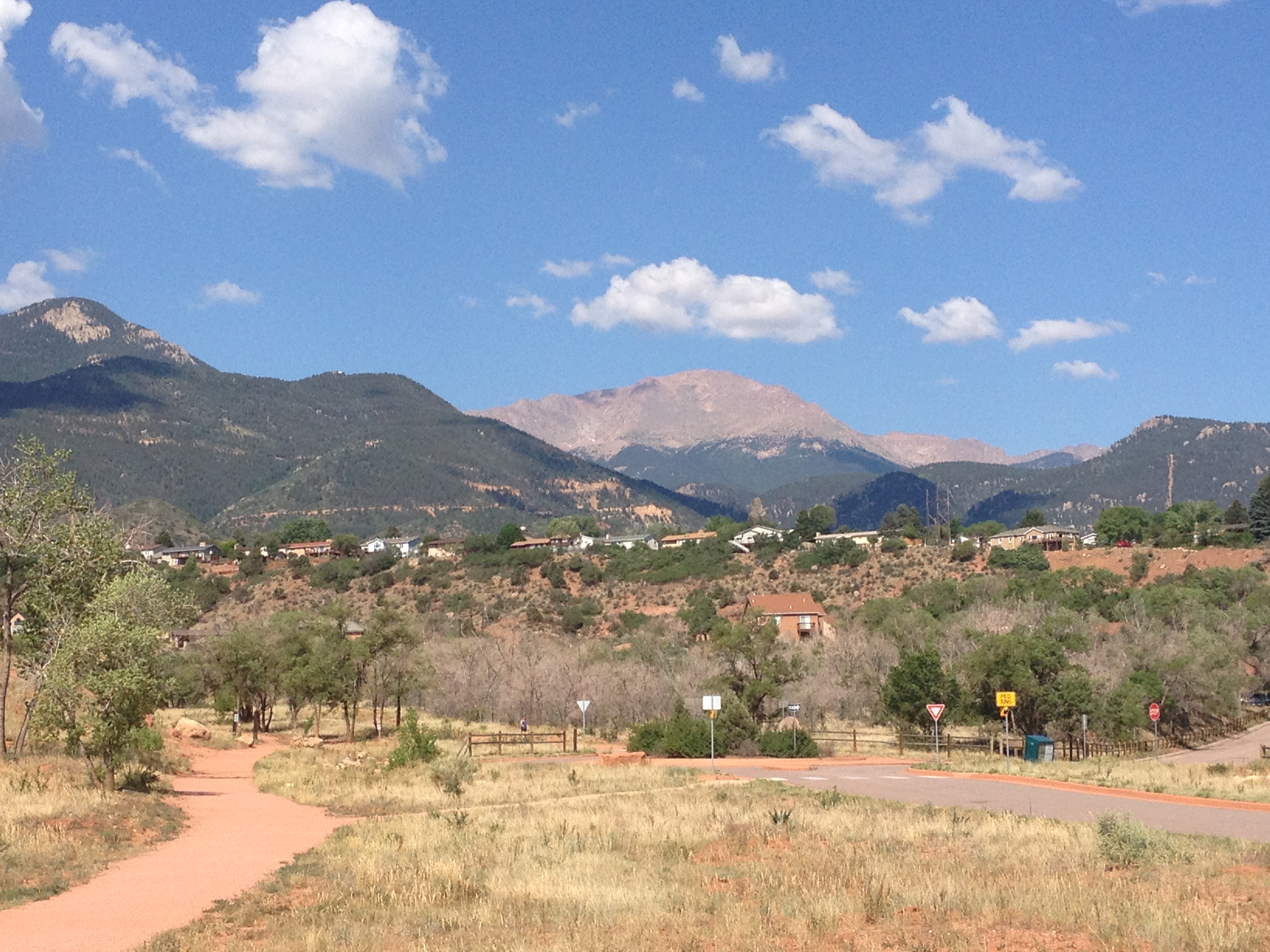
Pike’s Peak, the defining feature of the region, was only visible for part of the hike.  In other parts of the hike, it was hidden behind other terrain features near Red Rock Canyon itself.  Of course, almost anywhere within Colorado Springs, Pike’s Peak can be seen towering over the city.  However, Pike’s Peak had a significantly different look this time up than last time.  Last time, in mid-May, Pike’s Peak was snow covered above basically the tree line.  Since then, all that snow has melted and the mountain is pretty much bare, making for a completely different look.

IMG_0377 IMG_0824

My May 16th photograph of Pike’s Peak, compared to the one taken today, July 4th.

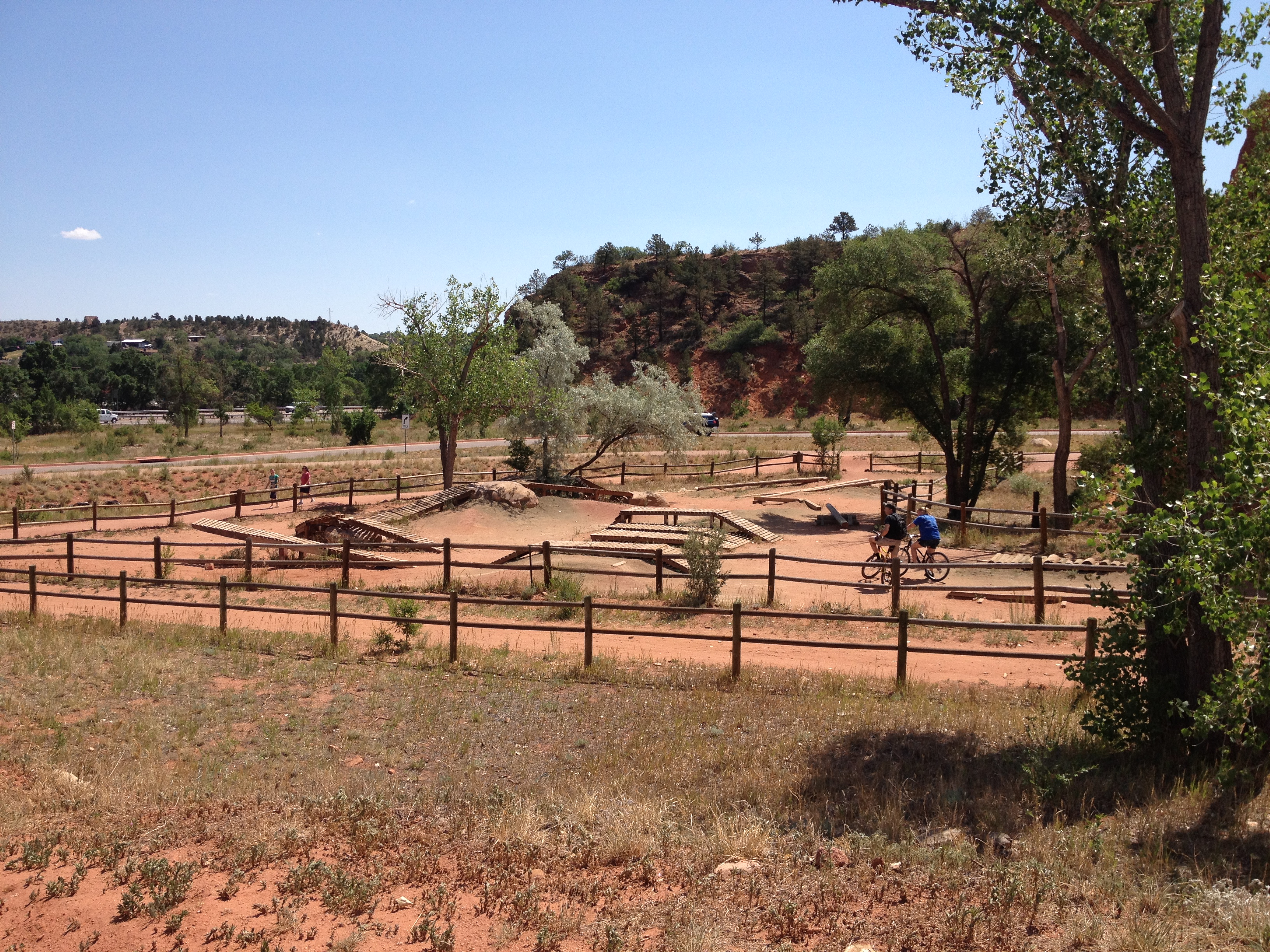
Finally, as we finished up our hike, we encountered an unexpected feature.  It was one of those terrain park areas for mountain bikes.  I had never really seen any of those before, and I actually saw a few people riding their bikes around, up and down the railway and sea-saw features.  It seems like a neat thing to do, albeit somewhat scary.  I think I am personally going to stick to long-distance road biking.
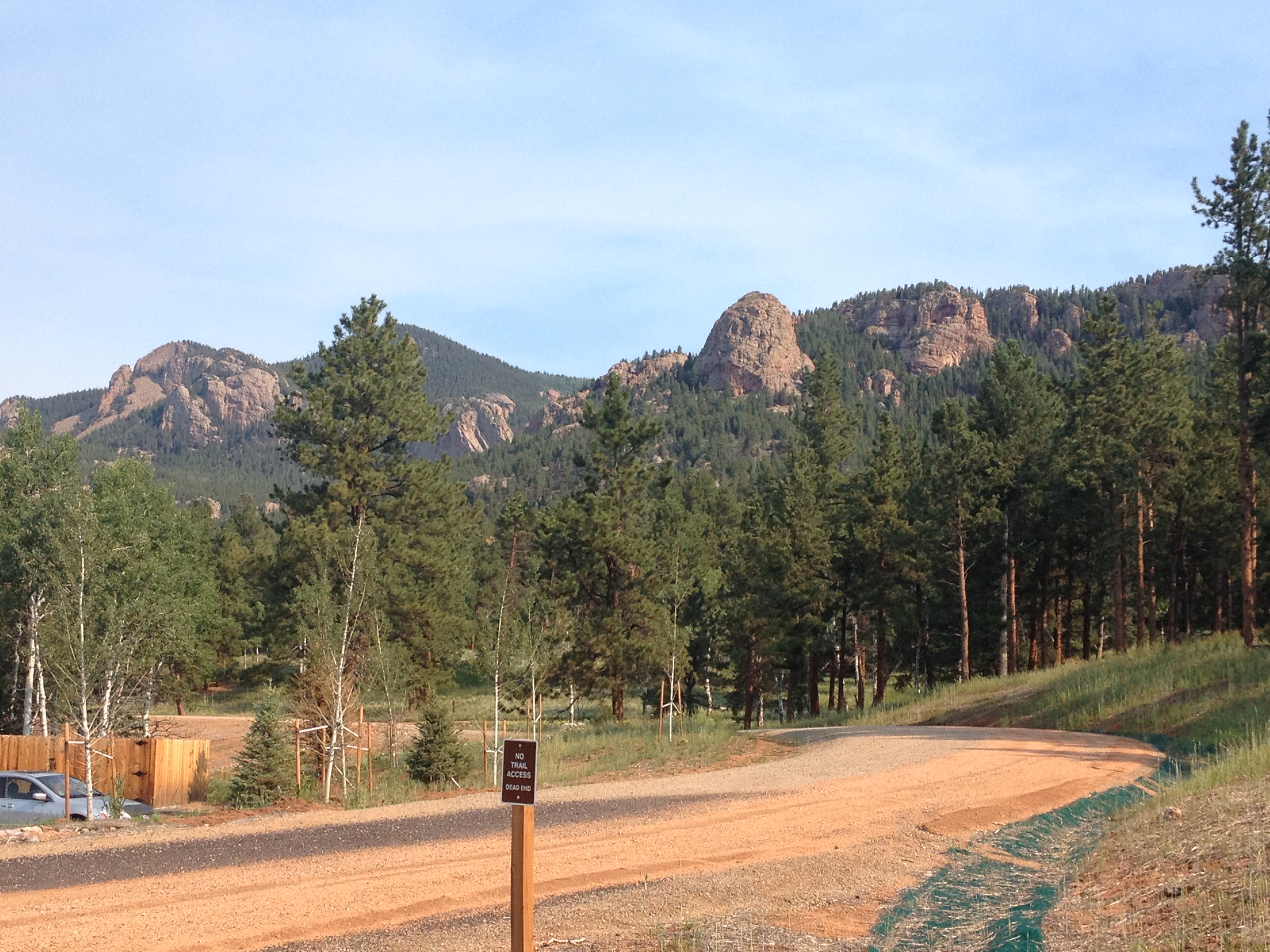
IMG_0834

Today’s hike had a surprisingly southwestern feel to it.  And, the whole time it made me wonder, where does the southwest really begin?  The south-westernmost part of Colorado, Durango and the Four Corners region, I can imagine, definitely is part of the southwest the way we know it.  Northeastern Colorado is definitely the plains, but North Central, like Fort Collins and even Denver do not particularly feel southwestern.  They feel basically central Rockies.  Maybe all red-ish features just make me think of all things southwestern, and I am getting it all wrong.  But, still, I wonder if I am entering an entirely new region every time I drive south on I-25 over Monument Pass.