Category Archives: Outdoor Activities

A Full Moon Hike to Jefferson Lake

img_5532

Hiking at night is something I had never really thought about doing. As is the case with the majority of the people who go hiking, my primary motivations are scenery, connection with nature, and exercise, most of which is far more compatible with daytime.

Most of my nighttime hiking experiences have been in cases where I remained on a trail until just after dark to watch a sunset…

IMG_9277

Backpacking….

IMG_4281

Or starting a hike early due to time constraints or goals, all of which involved reaching a specific place in daytime.

This particular nighttime hike was organized by a group called Mappy Hour. With the motto, “Live in the city, love the outdoors”, they bring together outdoor adventurers of all levels who live and work in cities. Sometimes the input of others helps expose us to activities we would not have otherwise done. Like a lot of people in Colorado, wintertime for me can end up being mostly just skiing. Going on this event exposed me to something different.

Jefferson Lake is outside of a tiny town called Jefferson, in Colorado’s South Park region.

IMG_5499.jpg

This hike started in late afternoon, before sunset. As we approached the trailhead, I was somewhat concerned that the high clouds would detract from the experience of a full moon hike.

IMG_5506.jpg

Jefferson Lake is accessible by road during the summertime. However, during the winter, the road is closed off right after entering the Pike National Forest, where the wide open ranch land of South Park’s high plains meets the densely packed trees associated with some of Colorado’s highest terrain.

In winter, the final four miles of the road to Jefferson Lake can be hiked or snowshoed, depending on conditions.

Most of this winter hike (3 out of 4 miles) is a very gradual climb, passing by campgrounds, as well as the Colorado Trail. It is a great trail for someone who is new to snowshoeing, however, conditions must be considered, as even in mid winter, there is no guarantee the road will be snowpacked for the entire four mile length.

IMG_5517.jpg

The road also passes by another wonder of nature I often fail to consider, a beaver dam. Apparently, we humans are not the only ones capable of using trees to create infrastructure.

The final mile before arriving at the lake is a bit steeper, but still not overly strenuous. However, for those not accustomed to hiking in snow, or snowshoes, it can be a bit exhausting.

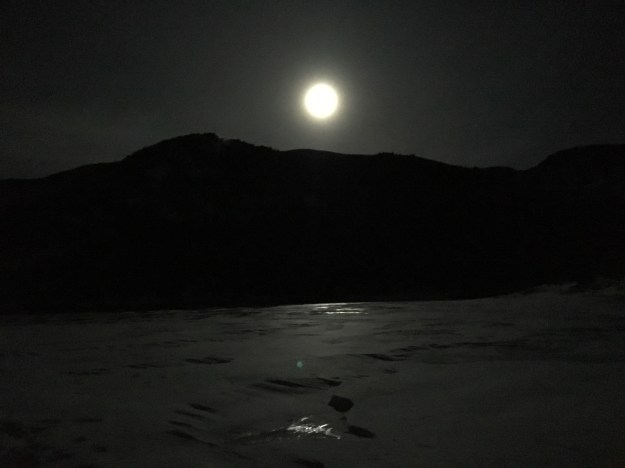
We watched the moon rise over the mountains to the East.

img_5524

Gradually lighting the lake up, one segment at a time.
img_5526

By the time the moon had fully risen, the entire lake, as well as the entire forest surrounding it, was noticeably lighter.

img_5532

The amount if light the moon can provide is something that those of us who spend most of our lives in cities often fail to appreciate. However, on this evening, the difference between an evening with full moon light and one without would be on full display. The evening of January 20, 2019 was a lunar eclipse, which began to manifest a few hours after sundown.

img_5535

Lunar eclipses occur at a much slower pace than solar ones. This lunar eclipse began to show just before 8:30 P.M., but would not reach totality until 9:41 P.M. in Central Colorado. During the lunar eclipse, the sky grows far darker, the way it appears during a new moon, and the moon itself takes on a red color, whose true beauty can only be truly appreciated in person. This National Geographic photograph, taken by professionals with professional equipment, would come closest to giving it justice- way closer than any photo I could take!
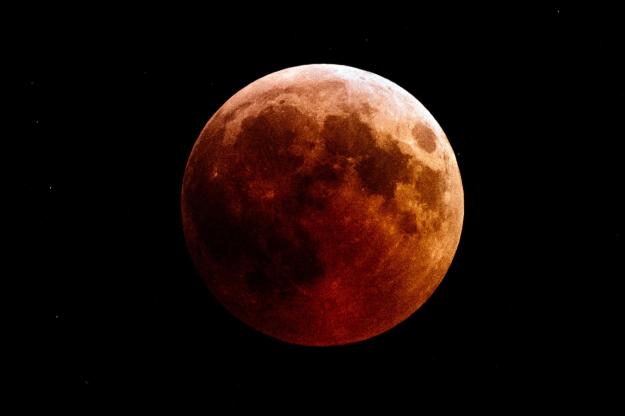
redmoon_natgeoPhoto credit to National Geographic

The event was nothing short of amazing, in a manner that cannot be properly expressed through words or even pictures. At the end of the hike, I felt content in a manner that is rarely achieved in day-to-day life, due to the combination of being in motion, observing spectacular scientific phenomenon, and being in a social setting.

Hiking at night in the middle of winter is something I have never done before. However when it comes my primary motivations for hiking, getting exercise, scenery and connection with nature, this activity met all three criteria. There are plenty of times in life when we focus too much on a specific solution, activity or procedure, rather than the overall motivation. This causes us to narrow our options too much. This event reminded me how important it is to stay focused on the overall motivation rather than one specific activity or solution. This goes for all areas i life, not just outdoor adventures and weekend activities. As long as we stay open-minded, pay attention, and keep our overall goals in mind, we can find some amazing experiences!
Opening Day At Breckenridge

Breckenridge, Colorado – November 7, 2018

IMG_5092.jpg

It was the first time I ever went skiing on Opening Day. It’s not that I don’t get excited about the ski season, but Opening Day at any ski resort typically does not have a lot to offer, other than saying you were there on Opening Day and often a celebration. Typically, it is one or two runs open, wherever the resorts decided to focus their snowmaking operations.

For some reason, resorts in Colorado are always in a hurry to open, most opening before Thanksgiving, some before Halloween. Resorts in places with even colder climates, like Sun Valley Idaho and Big Sky Montana, simply open on Thanksgiving. I guess in Colorado, there is pressure to open earlier, given its popularity as a ski destination and significant competition.

The problem is, some seasons start with a bang, some with a whimper. Last year, in early November, there as very little snow at most major ski resorts in Colorado. In fact, there was little to ski on well into the season, even past the New Year.

Snowpack Nov. 7 of 2018 vs. 2017

What a difference a year makes! Whereas 2017-18 started off with a whimper, 2018-19 started off with a bang! Snowpacks at this point in the season are over three times what they were last year. Most people at the resort cannot recall a season that started off with this much snow for over a decade!
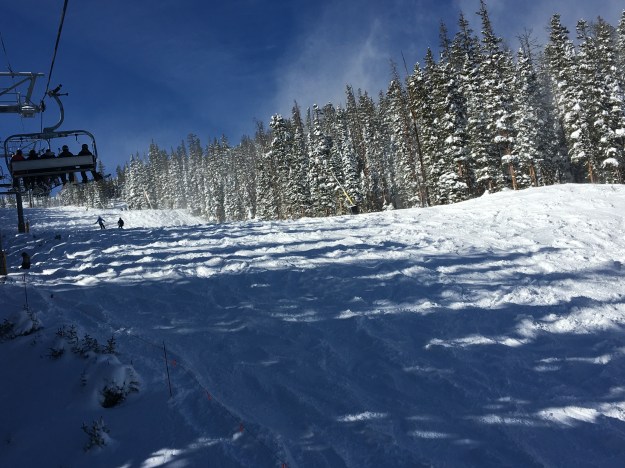
The result is starting the season off, not just with a few good runs, but with a powder day!

IMG_5094.jpg

Of course, even with this much snow, only one part of the resort, and only one major lift, was open. So, despite the fact that it was a Wednesday, there were still significant lift lines to contend with.

IMG_5095.jpg

Everything about the experience was odd, but in a good way….

It was odd to start the season, on the very first day, with over a foot of fresh powder.

It was odd to ski on a Wednesday in the middle of what feels like a work week, as opposed to as part of some kind of a weeklong trip.

It was also odd, because the makeup of the crowd at the ski resort seemed somewhat different than usual. Maybe this is a result of the specific circumstance. The fact that Breckenridge would open early, on a Wednesday, as opposed to the following weekend, was only announced at the end of the prior weekend’s larger than expected snowfall. It was also only announced the prior evening which runs would be open. The result was that the crowd tilted significantly more towards what appeared to be college students. It seemed like young men aged 19-25 made up almost half the skiers and snowboarders on the mountain that day. I saw a lot of fast paced skiing and boarding on challenging powdery trails, and heard that “woo” noise when someone hits a jump or a key area more frequently than I had ever before!

I also came into the ski day in an odd place from a personal standpoint. For a variety of reasons, I had a lot on my mind. On days like this, truly immersing oneself in an experience can be a battle inside one’s own mind. How can we stop ourselves from thinking about whatever is confusing us? The events of the prior few days? An upcoming event that we are anticipating with nervousness? Or even that existential question, about life, existence, the battle between good and evil?

What I found to be the key is noticing what is physically there, in front of me. It came in kind of an odd way. The view from the top of the ski lift is something I had seen before, many times, having held a pass to this resort for the past six season. What caught my eye, and got my mind off everything else, and onto the amazing experience I was having skiing, was the clouds!
img_50981.jpg

Specifically, while riding the ski lift, I looked up and noticed these cirrocumulus clouds, in a pattern that seemed like a series of lines, broken up just enough to display patterns on scales both large and small. They identified patterns, hidden in plain daylight, related to the transition that the Central Rocky Mountains had just undergone, from a snowy period, to a dry one. They were the balance of order and chaos we often seek in our day to day lives, and, for several minutes on a ski lift, they were all the stimulation I needed. I was content, and living in the moment.

Fall Camping at Cottonwood Lake

IMG_4837

This fall has been one of the most exhausting periods of my life in a long time. There is a reason I am writing this blog, in early November, over a month after this experience. Life is rarely constant. Sometime we are up, sometimes we are down. Sometimes we are comfortable and sometimes we feel everything is spiraling out of control. There are also periods that are slower and periods that are busier.

Exhaustion often has a variety of sources. Sometimes it does happen simply because someone is doing too much. However, I have seen tons of people who are extremely busy manage to have what appeared like really good energy levels. I have also seen people with little on their schedule appear extremely exhausted.

At this current moment in time, both personally, and throughout my country, there are other sources of exhaustion that are quite prevalent. Our news is often sensationalized and our political climate is downright toxic. We also have yet to incorporate new technologies into our lives in a healthy manner, leading to large-scale mental health issues which are beginning to manifest in horrible ways.

IMG_4685

The amount of time we spend in front of screens continues to increase. It is now over 11 hours per day. This has caused people to interact less and less with one another, leading to loneliness. The number of people who said they have nobody in which to confide in, about deeply troubling personal matters, has tripled in the last three decades.

I may have personally created additional exhaustion, in my life specifically, by taking on more work and over-doing some other endeavors. Seriously, I had no idea those tomatoes would grow so well!
When exhausted, we often have the instinct to stay home, rest, do nothing for a while. However, this is not always the best course of action. In my case, it would not have removed me from some of the sources of stress and exhaustion. How often, in today’s culture, does “resting”, really mean watching something on television, while also scrolling through news and social media on our phones. This form of “resting” still involves some amount of mental energy being dedicated to the very things that are causing many of us stress, which appear in the news, on social media and frequently on the television as well.

Sometimes, it is far better to power through the exhaustion for a little bit in order to get away from all this.

IMG_4834.jpg

Going camping takes work. It requires preparing meals, gathering supplies, picking out a location, traveling there, then setting up camp and building a fire. This is far more effort than it takes to turn the television on, or grab a smart phone while laying in bed. However, there is far more reward: actual relaxation.

Cottonwood Lake is about ten miles west of Buena Vista, Colorado, right in the center of the state, in the San Isabel National Forest.

IMG_4828

The campsite we found, a couple of miles further up the road, turned out to be one of the greatest places ever for viewing fall colors in the Rocky Mountains in Late September.

IMG_4831.jpg

It was amazing not only to see the colors at this one particular spot a couple miles west of Cottonwood Lake, but to see them at all different times of the day. In particular, at times around sunrise and sunset, the orange color in many of the leaves appeared deeper, and even more vibrant and colorful!

Most importantly, after finding the ideal camping site, getting the tent set up, starting the fire, and cooking dinner, the experience was far more relaxing than anything I would have done at home.

IMG_4874

Despite the full moon, I was able to get to sleep not too long after 9 P.M. With no lights, televisions, or random noises interrupting, it felt like I slept off all the exhaustion of the previous weeks. With the feeling of being rested, and my mind completely disconnected from all the stresses of back home, the return trip felt even more beautiful.

IMG_4881

It was like some kind of opening of the mind was needed to fully take in what was in front of me.

IMG_4878

The life I returned to was not too different. I still have the same ambitions. Smart phones did not become any less addicting, and world news and politics did not become any less depressing. We can escape from our lives, but we cannot escape forever.

Plus, it is not always bad. People that are busy, and even sometimes exhausted, can also be happy, if their mind is on the right things and they find themselves in the right environment. Sometimes it is the ones that are idle, not having all the experiences life has to offer, trapped in fear and “analysis paralysis”, that are the most prone to depression.

More importantly, all activities have busier and calmer periods. Jobs have busier and calmer periods, and there is not too much for me to do in the garden in November. It is easy to interpret a month or so with little to no rest as evidence that one has taken on too much in their lives. This may or may not be the case, and when the activities someone is involved in are generally making them happy, it is far better to endure a busy and stressful season than to give up on activities that are producing a sense of fulfillment.

The Colorado Classic

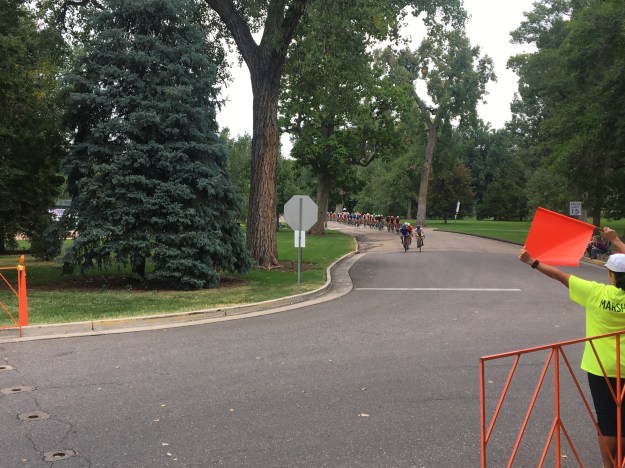
71 cyclists, all averaging a speed right around 30 mph, somehow ended up within 12 seconds of each other 2/3 of the way into an 8-lap 72 mile race. The strange thing is, this was the only time for the entire duration of the final stage of the 2018 Colorado Classic where all the riders were packed so closely together. Earlier in the race, a few riders would pedal ahead of the pack, forming what is referred to as a “breakout group”.

IMG_4637.jpg

Having not watched too much professional cycling, I am not familiar with the complicated scoring system, or how cycling teams work together. However, in what I have watched, from the perspective of mostly just monitoring who wins each race, it rarely seems beneficiary to form one of these breakout groups, especially early in the race. Seeing a few cyclists pull ahead near the beginning of a race always reminds me of when I used to bet on horse races. At first, I would get excited when the horse I bet on started out leading the pack. Experience would later teach me that that horse that jumps out ahead at the start of the race almost never wins. With rare exception, some other horse, usually one of the ones favored to win, would make a move about 2/3 of the way into the race, while the initial leader would run out of steam, finishing near the back of the pack. I’ll often joke that if I see the horse I bet on in the lead at the start of the race, I can all but throw that ticket away.

That is exactly what I tend to see happen at bike races. The cyclists who “breakout” put themselves at a disadvantage as they face more air resistance than those who stay in the main group, often referred to as the “peloton”. Time and time again, I have watched a breakout group form a lead, sometimes several minutes, just to see that lead slowly evaporate just in time for the end of the race. I would imagine all the riders trying to sprint to the finish line at nearly the same time, but with those that formed the breakaway group far more exhausted as they pushed against more air resistance all day long.

In a depressing metaphor for life, the breakaway group represents those that chose to take a different path, other than the tried and true. Like the 90% of Startups that fail, their path is tougher, and also a lot less certain.

IMG_4887.jpg

However, as discussed in detail in Bicycling Magazine, breakaways can be successful, when done…

  • Under the right conditions
  • Intelligently
  • With the right mix of people

The same is true for startups, as well as anyone else trying to “break away”.

Being back in Denver the weekend of the Colorado Classic, I got to witness the final two stages.

Stage 3, I got to watch from Lookout Mountain, which is outside of Golden about 15 miles west of Denver. It is Denver’s version of the mountain that overlooks the city, and is actually quite popular for cycling. The 1800 foot climb is a great after work workout, I have done many times.

Watching professionals ride a road you commonly ride is both exciting and humbling, as they do in 25 minutes what takes me 35-40.

Stage 4 was a very different experience. As is the case every year (for the Colorado Classic), the final stage is a series of laps around town.

IMG_4642.jpg

Cyclists rode down 17th Avenue in both directions during each lap, meaning it was possible to see them pass by the same exact spot 16 times! It is here where spectators witness, in person, breakaway groups get slowly caught up to by the pack.

There was even a bike shop, along 17th Avenue, that set up a set of bleacher seats for fans. Pro cycling, obviously has a smaller fan base than major sports like baseball and football. However, smaller groups often feel far more like a community than larger ones, and there is a kind of comradery between cycling fans that does not always exist at other sporting events.

IMG_4667.jpg

Watching multiple groups of people try to “breakaway” from the pack, but fail to win the stage reminds me of my own personal struggles. Like many people, I struggle with issues of individuality vs. conformity. It definitely had a negative impact on my high school experience, where there is a lot of pressure to conform. I still feel it now from time to time.

As is the case with pro cycling, there is a time to break away and there is a time to stay with the pack. The same is true in our other life pursuits. We all would prefer to stay true to our individual selves all the time. However, there is a often a cost for refusing to conform, sometimes legal or financial, but often in terms of lost opportunities and relationships. The challenge is to know when that cost can be endured so that we continue to feel like we are living our own lives, while also knowing when we need to be patient and flexible.

WE Fest and the Culture of Northern Minnesota

IMG_4339.jpg

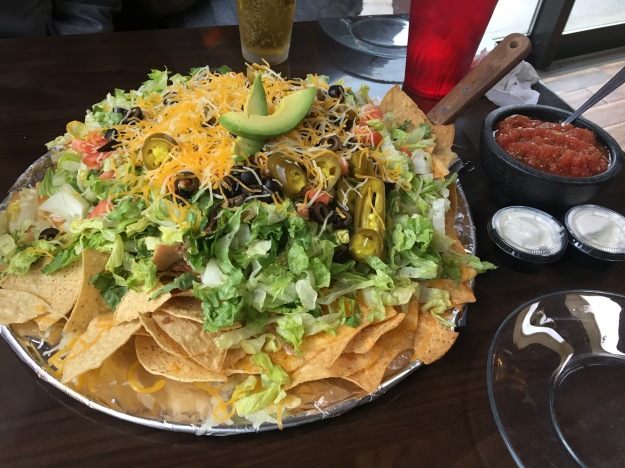
What is American Culture? This is a much tougher question to answer than most people would want to admit. Sure, there are those things about America that foreigners notice right away. For instance, the portion sizes.

IMG_4354

But, large portions of food, large amounts of soda, big cars, loudness and exhibitionism are not the only things that define American Culture. In fact, they do not even unite the entire nation, as there are places in the United States where these are not the customs.

American Culture cannot be described in one sentence, one paragraph, or even one page because of how far from homogenous it is. Traveling within the country, one would find many different sub-cultures. It is even possible to argue that every state, every city, and sometimes every neighborhood, has its own unique traditions and customs.

Of course, to claim there are thousands of sub-cultures in the country would be, in a way, getting too hung up on minor details. However, there is definitely grounds on which to claim there are several dozen cultures with significant distinctions from one another.

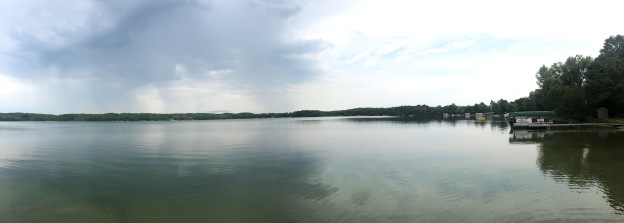
The culture of Minnesota can generally be thought of as in the same category as Wisconsin and Michigan. The entire region has an abundance of lakes. Minnesota is “The Land of 10,000 Lakes”. This culture seems to revolve around going to the lake, being on a boat, fishing, and drinking beer. People from the metropolitan areas often own second homes or cabins along a lake and travel there on the weekends. This seven week old infant living in Saint Paul is already preparing for his third trip “up to the lake”.

IMG_4426.jpg

Northern Minnesota specifically is fairly sparsely populated, putting it one one side of the most obvious cultural divide in the U.S.; urban vs. rural. Generally speaking, on either side of this divide between large metropolitan areas and places more sparsely populated. The expectations are different, the attitudes are different, and, the music is different. There is perhaps no better way to get immersed in the culture of rural America than to go to a country music festival.

IMG_4363.jpg

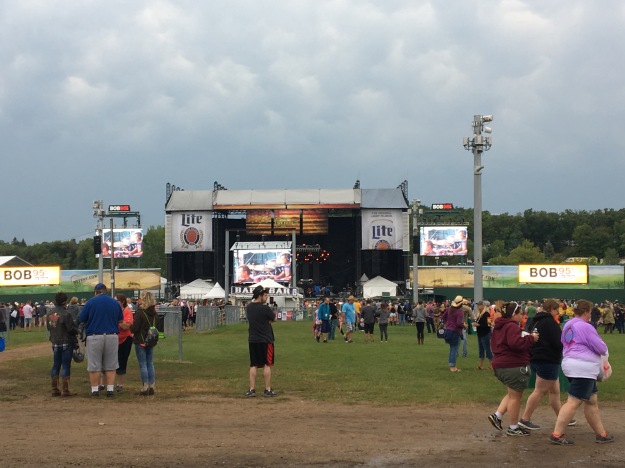
WE Fest is a major country music festival in Detroit Lakes, MN. The attendance, in 2018, was said to have topped 65,000. Here, the different customs and attitudes were on full display.

The U.S.A flag was everywhere! So were messages, from performers and attendees alike (often on their shirts) showing support for the American way of like, the military, and other mainstays of American culture.

This is not to say people in the cities do not love their country. But, there does seem to be significantly less exhibitionism about it. There is also, in some sub-cultures, particularly the ones centered around major academic institutions, a greater willingness to criticize actions taken by the United States of America. In some cases, this comes across as downright cynicism.

To be honest, there is something about the flag waving, proud, traditional rural culture that feels warmer …  happier. It feels far better to believe in something and take pride in it than to succumb to cynicism and long for something else. Cynicism can feel quite cold at times, and self-loathing creates sadness.

Yet, the more traditional culture can also feel unnecessarily restrictive.

IMG_4349.jpg

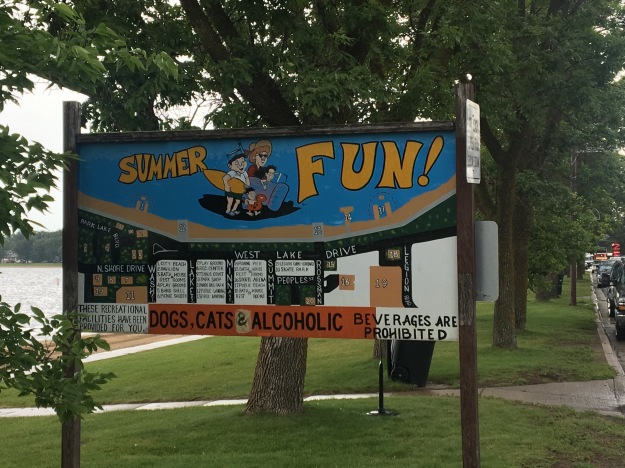
Seriously, let the dogs and cats have fun too!

While exhibitionism can be annoying to some people, taking excessive pride in one’s country truly only becomes harmful when it leads to one of two outcomes.

First is the hostile treatment of outsiders. In the case of National pride, this would be treating non-Americans as lesser human beings. This is not to say that most, or even one-in-ten flag waving rural Americans have ever advocated treating outsiders poorly. It is to say that, excessive pride in a group of people, whether it be a nationality, a gang, or even something like a personality type, can lead to some form of non-beneficial disconnect from those with different traits.

Second, is when pride leads to an attitude where no criticism, even if constructive, is tolerated. Not all decisions are good decisions.

IMG_4408.jpg

Loving another human being can sometimes mean needing to tell that person when they are choosing the wrong course of action. Loving oneself means seeking ways in which to improve. The same can be said for a nation. Like an individual, a nation needs to try to avoid poor decisions and seek ways in which to improve. Pride can lead to avoiding all criticism and seeing no need to take suggestions or improve, which is detrimental.

Maybe this nation, like every nation, needs people to remind them that the nation is great, with a great culture and heritage. But, also needs people to point out some shortcomings, help it avoid repeating past mistakes, and point out areas where improvements can be made. These are the traits of a balanced individual, and hopefully, going forward, can be the traits of a balanced nation.

A Weekend in Nature 90 Minutes from Denver

IMG_4190.jpg

One mistake I witness quite often is people constantly turning their getaways into some form of challenge of their own. There is probably nobody more guilty of this than me; always seeking the far away destination, wanting to climb the tallest mountain, cycle over 100 miles a day.

Challenging ourselves is important. We all build character by challenging ourselves, especially outside of work. However, we also all sometimes need a break that is a genuine break, not stressing ourselves to get to a faraway destination with no spare time, exhausting ourselves physically, creating an alternate form of stress- “vacation stress”.

IMG_4179.jpg

Summer in Colorado began with an extreme drought, large wildfires all over the state, and restrictions on fires in nearly every county.

CO_Fire_EndofJuly

Fire restrictions across Colorado July 28, 2018

With some rainfall in the mountains, in the past week, some counties in Central Colorado began to lift these fire bans, permitting fires at campsites.

One of the problems we have here in the United States is limitations related to time. According to Project Time Off, an organization whose mission is to remove the stigma around taking time off from work, the average American takes less than 20 days of vacation per year, and Americans collectively forfeit over 200 million days off due to concern for how they will be perceived at the office. Therefore, it is not all that common for Americans to feel the need to maximize their vacation time, utilizing every precious hour.

This stigma will not go away overnight. Most likely change will be gradual, and considerations related to time limitation will still be a factor in the coming decades. However, given our recent mental health challenges, and recent research pointing to the psychological benefits of being in nature, trips like these are probably more important than ever.

IMG_4193

Georgia Pas is one of several areas about a 90 minute drive from Denver, right in the middle of the Rocky Mountains, with dispersed camping, meaning camping without the amenities of a campground.

IMG_4161.jpg

These camping areas are nearly always within a short drive of the kinds of places where the high peaks of the Rocky Mountains can be seen in all of their majesty. Georgia Pass, less traveled than mountain passes along paved roads, like Hoosier Pass and Guanella Pass, offers the same panoramic views but with less people.

It also, based on this one trip, feels like a place with more wildlife.

IMG_4186IMG_4163IMG_4168

However, sometimes the camping experience is not about the feeling of being on top of the world on a mountain pass, or overlooking a photogenic lake, as is commonly shown on the cover of travel magazines. Sometimes, camping is about being in a strangely calming place like this, with trees, bushes, other random vegetation, and a creek moving fresh mountain water along to a gentle rythm.

IMG_4194.jpg

There is something about this specific scene, deep in the forest, surrounded by nature. It feels in a way, like the exact opposite of stress. There is no hurry here, nobody is causing unnecessary anxiety, and the only abrupt changes in plans occur when a thunderstorm pops up unexpectedly.

There is, however, work. Camping isn’t just sitting around the fire. The fire must be started and maintained. Meals must be cooked. Tents need to be set up, and dishes washed manually. It isn’t a resort vacation. In fact, while camping, far more work goes into filling the basic human needs of food, water, and shelter than it does back in the city, even on the most stressful day.

There are ways to relax that require little to no work. Watching television only requires owning a television and selecting a program. Laying at a beach only requires finding a way to get to the beach. Yet, sitting around a campfire with loved ones, looking at the stars and watching the full moon rise between alpine trees, then waking up to the alpenglow hitting the tops of the trees, somehow actually feels far more relaxing than just laying around at home or nearby.

Or maybe it is about getting away from all of the things that are currently creating anxiety in our lives, which include TV (mostly the news), our phones, work, and, competitiveness in general. This takes work. It takes work to get away from life’s pressures. However, it is good for us, regardless of our situations, to occasionally escape our stress sources, without substituting them with “vacation stress”. Unfortunately, many of us in the United States still find ourselves in situations where we feel our time away is so precious, taking part in activities that create this “vacation stress” is the only way to get meaningful experience out of the limited time we have to vacation.

The Courage to be Radical

IMG_4106.jpg

A modest sized cabin in the woods, surrounded by nature- trees, and wildlife. These cabins, often surrounded by a lake, rolling hills, or some other form of natural beauty, represent a lifestyle, a fantasy. Many people dream of this kind of life, but few act on it. Most of the time, like the Staunton Family, who owned this ranch before they willed it to the State of Colorado, these places are used as second homes, for summer and weekends.

Last weekend, the sequel to MAMMA MIA, presented the story of a person who actually acted upon a kind of fantasy life.

Mamma_Mia!_Here_We_Go_Again

Together, this movie and its predecessor present the story of a young woman who, on a whim, decides to travel to a remote island in Greece. She decides to stay there rather do what is expected of her, meaning returning to the city, to what one would assume to mean a more “normal” life. The plot of these films indicates that making a radical decision like this has the potential to be quite fantastic, fulfilling, and impactful. But, it requires both courage, as well as some form of hard work and sacrifice. The main character’s life is not presented as easy.

Nor are the lives of the people in real life who make similar radical choices. Those that actually move to a small cabin in the mountains, a tropical island or a bustling beach, as well as those who start their own businesses, pursue careers in acting, or do whatever their version of being radical is, all toil away for some period of time.

There tends to be a similar general story. First, they have to have the courage to actually pursue their preferred path. This means ignoring the fear inside, as well as advice, and even pressure from others. This advice could even come from people who are genuinely caring and well-meaning, which makes it harder to ignore.

They also had to endure, at least a period of time, where life is harder than it would have been at that standard 40-hour a week job, receiving a steady paycheck. Businesses take time to become successful, artists take time to get noticed, and many ideas are rejected dozens to hundreds of times before they are finally embraced.

This blog should have actually been titled The Courage and Determination to be Radical

Those with the courage (and determination) get to be surrounded, every day, by what inspires them.

The landscape that inspired a successful family of doctors to build a summer home 50 miles outside of Denver can now be visited by the general public, as part of Staunton State Park.

IMG_4095.jpg

Hiking around the park is relatively easy. Most of the trails are not too steep. They are, however, fairly long. They are also astonishingly well marked.

IMG_4141.jpg

Not only does every trail have a two letter identifier, but each trail has regular markers, including one marking the halfway point on each trail.

IMG_4097.jpg

Hiking from one end of the park to the other is a good amount of anticipation. From the trailhead, rock features, some of which are actually climbed on, appear in the distance, periodically peaking out from behind the trees. This can actually go on for miles, so hiking at Staunton State Park teaches hikers to learn to enjoy the journey.

IMG_4130

In addition to the Staunton Ranch, which resembles the cabin in the woods so many dream of, Elk Falls Pond is one of the top destinations at Staunton State Park. The journey there is about 4.2 miles.

IMG_4134

Monday’s hike turned out to be a chance encounter with a thunderstorm, one that required taking refuge in a relatively safe and relatively dry spot for about 25 minutes.

IMG_4136.jpg

Hiking in the rain actually turned out to be refreshing. This summer in Colorado has been HOT. Of the first 22 days of July, Denver’s official high temperature has reached or exceeded 95°F (35°C) 13 times. Much of the state has been in a drought all summer, and, with the exception of the Northeast, there are fire restrictions in place through much of the State.

DroughtMap_July2018

So, the rain turned out to be a welcome change of pace.

Hiking through the storm, in a small way, felt radical, as it is generally not advised to pursue outdoor activities on days, particularly afternoons, with thunderstorm chances. Storms find everyone in life, regardless of how courageous, resilient, and true a person is being. As the movie indicates, those that have chose to courageously live a radical life may encounter a few more storms. These storm will eventually dissipate. The clouds will gradually disperse, and the sun will emerge, revealing, once again, something beautiful and inspiring, whether that mean a spectacular landscape or a spectacular human being!

IMG_4137


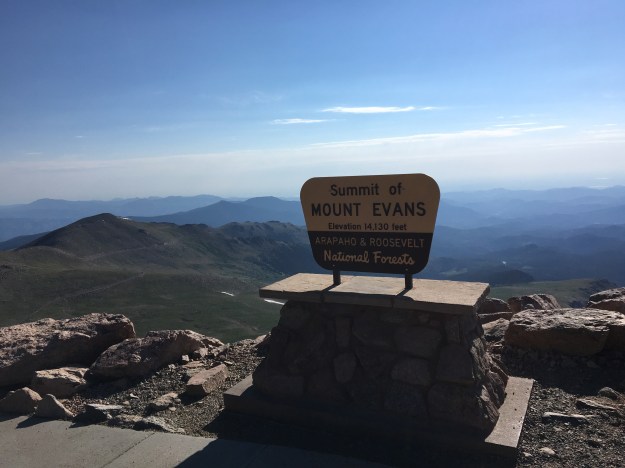
A July 4th Hike Up Mount Evans

IMG_3942.jpgThis Independence Day was a strange one. It was a day with all sorts of mixed feelings. The first is related to the holiday. I love the United States of America, and feel extremely blessed to have been born and live here. However, something just feels a bit off right now. Without getting too into it, as travel and adventure is supposed to be an escape from all of this nonsense, I do not feel that our current political climate is in line with what this country was originally intended to be about. Based on the values of the Enlightenment, we escaped from tyranny and intended to set up a nation where the impact of politics and government on our lives is limited. People feeling that government is important enough that they will de-friend and even act violently towards those that support a different political party just doesn’t feel like America to me.
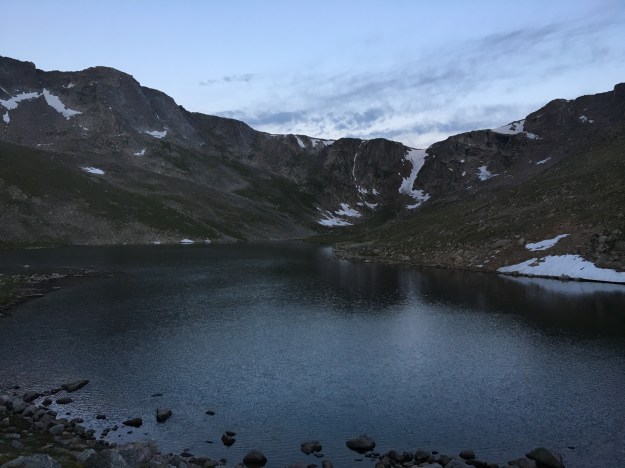
I was also somewhat mixed about the event. Mount Evans is one of two 14ers (peaks over 14,000 feet in elevation) with a paved road to the top, meaning that people can get to the top of this mountain in their cars (or on a bike). In fact, I know someone who drove to the very same peak on the same day.

IMG_3946.jpg

I also wasn’t too crazy about leaving Denver at 4 in the morning to arrive at the Summit Lake parking lot just before sunrise.

IMG_3914.jpg

14ers close to Denver are quite popular, and there was concern about parking availability. In many of my social circles, I find myself among the least cautious. It’s not that I want to go around being reckless, taking risks for the sake of risks. I would just rather deal with things occasionally going wrong than all the missed opportunities and additional stress that comes from being averse to risk.

However, the big picture is that I am hiking to the top of a tall mountain. Waking up two hours earlier than I wanted to guarantee a parking spot at the trailhead is a small compromise, and not one that takes me anywhere near a place where risk avoidance is costing me opportunities. There were also some benefits from starting that early, as each hour of the day is unique in the mountains, and the time around sunrise can be quite magnificent.

IMG_3915

Less than twenty minutes into the hike, the sun emerged from behind both the clouds and mountain peaks on the horizon.

IMG_3918

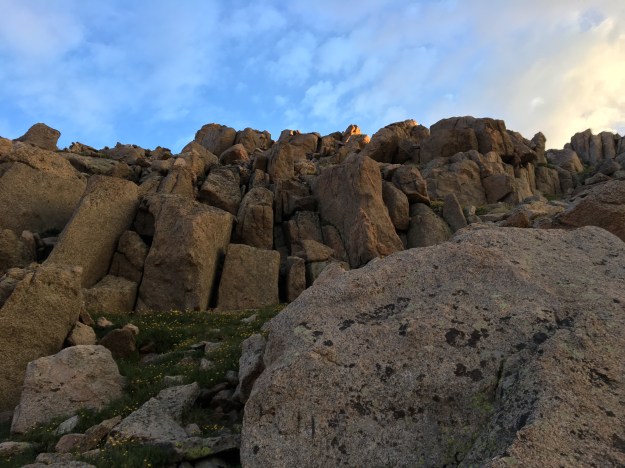
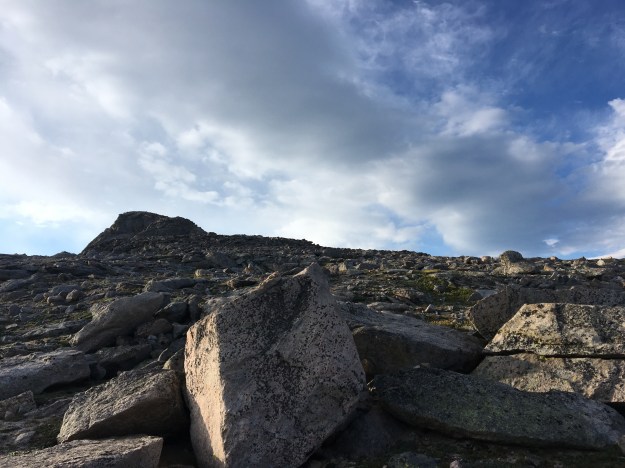
They do not call these mountains the Rocky Mountains for nothing. Many of these high elevation hikes are both steep and rocky.

IMG_3920.jpg

I would definitely recommend some form of hiking boots or trail shoes to traverse terrain like this.

IMG_3925

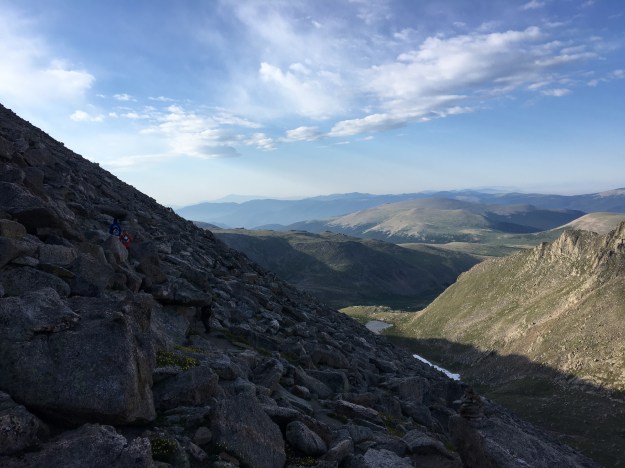
The trail climbs pretty quickly right from the start. Less than an hour into the hike, which is a slow hike, averaging little more than a mile per hour, I began to see Grays and Torreys Peaks, the first 14ers I ever climbed, five years ago.

IMG_3929.jpg

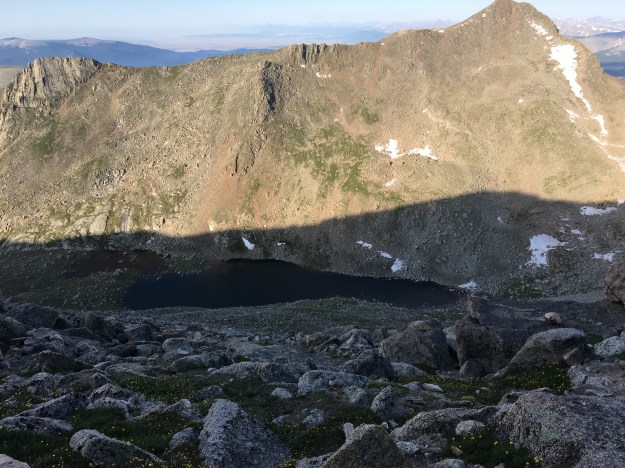
It wouldn’t be long before that top of the world feeling emerged. This is because, the trek up Mount Evans from Summit Lake is actually two peaks. The first one, Mount Spalding, is only 158 feet shy of being a 14er itself, and has its own scramble to the top.

IMG_3930IMG_3931

Like Grays and Torreys, there are many places where hikers conquer two peaks at once. This hike felt very much like this, despite the fact that Mount Spalding does not count as a “14er”.

IMG_3936IMG_3937

Saddling between the two peaks was rocky, shaded, and breathtaking. It may have been my favorite part of the hike.

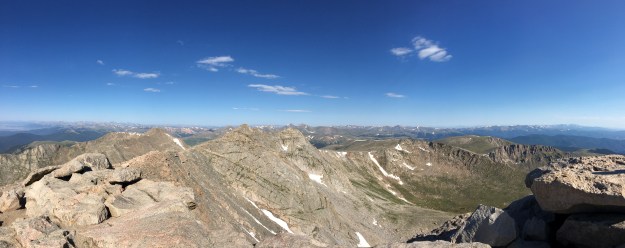
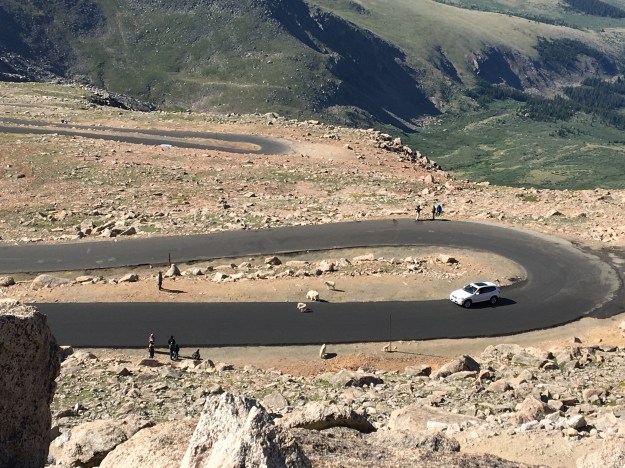
It was kind of strange to reach the summit only to see all the people who had just driven all the way up. We were also able to look down upon the lot where we had parked a couple of hours earlier.

From the top of the road, there is actually an additional 134 feet of climbing to the peak, at 14,264 feet.

IMG_3950.jpg

We also got a chance to get up close and personal with the mountain goats, who seemed strangely inclined to hang out relatively close to the road.

IMG_3961IMG_3965

With the steep rocky sections, and the climb back up Mount Spalding, the return hike was only slightly easier than the climb.

We also encountered a crew of trail maintenance volunteers. I cannot overstate how much I appreciate their work. I had not previously seen them working, but I know they work hard on behalf of the Colorado outdoors, and are an important part of the mission to encourage others to get outside, get active, and enjoy nature.

Then, at the bottom of the trail, we encountered more wildlife- sheep.

IMG_3972.jpg

I am somewhat in awe of these animals, both the goats at the top and the sheep near Summit Lake. They live their lives on the steepest of all hills. I wonder if they ever fall over, but it feels like they don’t. I spent half the downward trek grabbing onto rocks with my hands for balance, despite having a good pair of hiking boots. The goats and the sheep, they just walk up and down these steep, slippery, and rocky hills like it’s nothing.

IMG_3939.jpg

We got back to the car before noon. By the end of the hike, I really did not know what to feel. Hiking to the top of a tall mountain is no longer a new experience for me. It’s beautiful but familiar. 2018 so far has been quite emotional for me already, dealing with issues related to our mean spirited and way to identity-driven political climate, as well as drama related to my career, social standing, and even identity. Maybe, at this point in time, I do not need some kind of grand emotional response to my activities. I just need to enjoy them, laugh with friends, and see nature for the majesty that it is. That was good enough for me before I started writing this blog, and some things are indeed true regardless of time, place and culture.

An Intense Hike Outside of Boulder

IMG_3892.jpg


Colorado has some really intense hikes! Places like these, where steep terrain features rise up out of the ground like gigantic walls, are breathtaking beyond belief, but also intimidating for hikers. Most people commonly think of places like these as being tucked away in the densely packed mountains of the Central Rockies, hours away from Denver and Boulder, or even further away, in the canyons of the West. However, there is a hike, a challenging hike, with just this kind of feature just outside of Boulder.

Bear Creek is a hike that, in some way, feels similar to hiking up a 14er (A peak whose elevation is greater than 14,000 feet). Its total elevation gain is right around 2800 feet, and the hike up Bear Peak, along with its neighboring peak, South Boulder Peak, has frequently been described as a great way to train for a 14er. It can be accessed from two points, both just outside of Boulder; the Mesa Lab and Eldorado Canyon State Park. The later has a $5 parking fee, but offers a somewhat more pleasant hike.

IMG_3876.jpg

From a distance, the flatirons have some amount of intimidation factor, particularly for those who are relatively inexperienced with respect to hiking. It is, after all, a fairly abrupt transition between the flatness of the Plains to the East and the rugged terrain of the mountains that are a near constant feature for miles to the West.

From Eldorado Canyon, the hike has two parts to it. The first part is relatively easy, and actually persists for a somewhat surprisingly long distance, just over two miles.

Deer run through a gently sloped field jumping in and out of the bushes. Flowers of all colors appear alongside the trail. The mountain features gradually get closer. However, this is all just a set-up, kind of a prelude. It turns out to be a warm up that lasts nearly half the hike. After that the trail runs right into Shadow Canyon, where everything changes quite abruptly.

IMG_3888.jpg

All of a sudden, the wide open trail and wide open spaces all collapse into densely packed trees and rocks, shade, and a tight single-file tail.

It also becomes quite steep!

Over a 1.2 mile stretch, the trail gains 1600 feet in elevation, going pretty much straight up most of the way. Only towards the top are there any switchbacks. In this case, the switchbacks actually make it easier. The slope of the trail becomes far less intense, than the stair-steps that are nearly constant for about a mile. It ends up being a good reminder of why switchbacks are commonly used on roads and trails.

There are two peaks at the top, less than a mile apart, Bear Peak and South Boulder Peak. Getting to both peaks involves a sketchy, rocky scramble.

This is only the last few hundred yards. On both peaks there is reasonable cause to be nervous. The rocks can be both slippery and unstable, and the terrain is steep in all directions.

Both peaks also offer views of both the mountains to the West and Boulder and the Plains to the East.

Bear Peak is a little bit closer to town. It may be one of the best places to overlook Boulder and the surrounding area in its entirety. One thing that can almost always be observed when looking at some of these Colorado towns from above is how many trees are planted by people in cities. Just east of the Rocky Mountains, trees do not naturally grow. The distinction between what is natural and what isn’t can be seen quite clearly. It is almost more evident than any of Boulder’s actual features, such as downtown or CU campus.

IMG_3900IMG_3903

The view of the mountains from South Boulder Peak is not all that different from Bear Creek, but still feels like the better view.

IMG_3907.jpg

Looking in the other direction from South Boulder Peak, as the day wares on, a reminder appears, as to unique of a year 2018 has been.

IMG_3909.jpg

According to the Colorado Division of Fire Prevention and Control, several major fires are ravaging the state, leading to fire restrictions in all but some of the northernmost counties and even some prolonged closures on major Colorado highways.

By the start of July, the haze from these fires had become a near permanent feature of the afternoon sky. The appearance of a thick low cloud with an orange tint on an otherwise perfectly clear day serves as a reminder that no two experiences, even if in the same place at the same time of day and year, are exactly the same. The weather, just like many other aspects of our lives and culture, is always changing. There are times that are considered “normal” and other times that are considered “abnormal”. Sometimes what is considered “abnormal” beings to appear more frequently, or persists longer than expected. In these cases, it is natural to speculate, but only the future will truly settle whether what is normal is shifting, or whether the world is destined to shift back to what was previously considered normal.
Cycling from Colorado Springs to Denver

COSprings_to_Denver.png

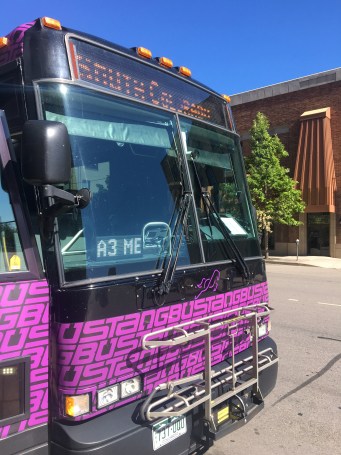
It started with a two hour bus ride, from Denver to Colorado Springs, on something called the Bustang. Bustang is a pretty good service for cyclists in Colorado, as each bus has bike racks on the front. It would be a great service with more schedule options. For anyone thinking of making this journey, the only real option is the 7:35 A.M. departure from Denver, which arrived in downtown Colorado Springs just after 9:30.

IMG_3821.jpg

Colorado Springs is an interesting town. People who think about Colorado Springs often think about one of two things; its affiliation with Christian conservative causes, as it is where Focus on the Family is headquartered, and Pike’s Peak, the mountain that towers over the city to the west.

IMG_3824.jpg

Pike’s Peak is actually only the 20th tallest peak in the State. Yet, it is often amongst the most visited and talked about because, compared to many of Colorado’s other mountains, it is relatively isolated.

14ers_PikesPeak

Perhaps most importantly, Colorado Springs is among the most active and fittest cities in America.

This was apparent as I began to pedal north from downtown Colorado Springs. The Pike’s Peak Greenway, was quite crowded for much of the journey, with joggers, packs of runners, and other cyclists.

At the northern border of Colorado Springs, the Pike’s Peak Greenway connects to the New Santa Fe Trail. Both of these trails are part of a long term plan to create what is being called the Front Range Trail, a network of trails that will eventually cross the entire state from the Wyoming border to the New Mexico border, through many of Colorado’s most populated cities. Sings for the Front Range Trail have already been put in place here.

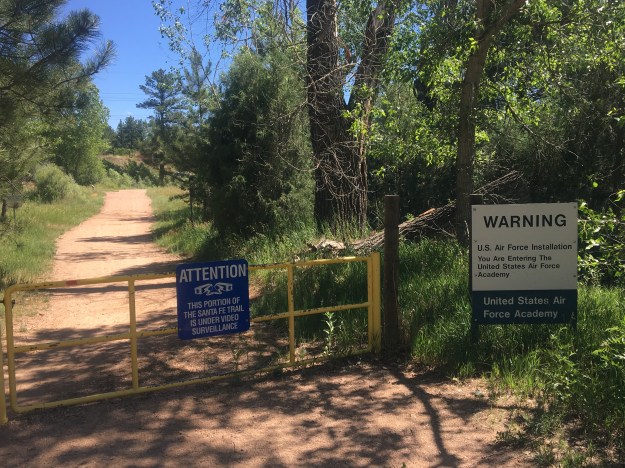
For some riders, the New Santa Fe Trail has the potential to be the roughest part of the ride. Much of it is both uphill, and unpaved. It also runs right through the property of the United States Air Force Academy.

IMG_3835.jpg

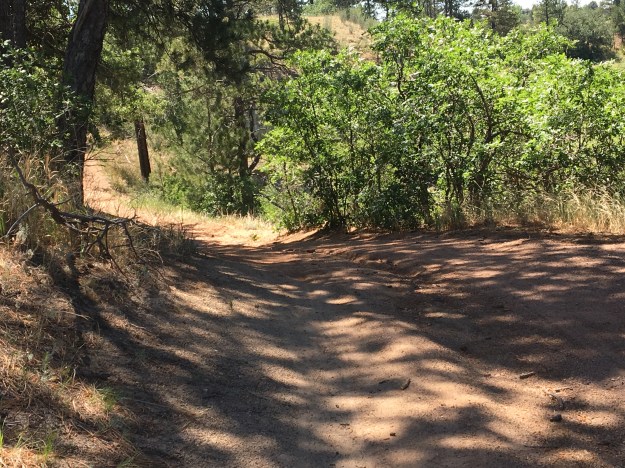
Many sections of it are quite rough, probably more suitable for mountain bikes than road or touring bikes. Along this stretch, there were about half a dozen instances where I had to dismount and walk my bike for a short distance.

IMG_3837.jpg

It was still a beautiful place to bike. The trail cuts through fields of Piñon Pines, and Monument Creek creates some picturesque mini-cliffs in front of the mountains.

However, although the journey up the hill is actually quite subtle, with no switchbacks or steep climbs, it did take more time and energy than anticipated to get to Palmer Lake, the high point of the trip, at an elevation of about 7,300 feet (2225 m).

IMG_3840.jpg

The next part of the ride was my favorite, north along Perry Park Road. This section is mostly downhill, but with some rolling hills. It was a wonderful 25 mile per hour ride on a smooth road, with bright blue skies, wide open spaces, rock formations popping out on both sides around every turn, and a light cooling breeze.

IMG_3843

There are a few route options at this point, and following Perry Park Road as long as I did, a little over 10 miles to Tomah Road, does bypass the town of Larkspur. I found it worthwhile, as I was enjoying the ride, but it does mean a total of about 20 miles between towns.

IMG_3846

Turning East, Tomah Road was actually the most challenging climb on the entire ride. The total climb is pretty small, from about 6200 feet to just over 6800. However, that climb occurred in less than two miles, and can be unexpected, as Castle Rock is at 6200 feet and this climb came from one of the subtle terrain features east of the Rocky Mountains.

After climbing and descending Tomah Road, the route was follows the Frontage Road along I-25 for about four miles into Castle Rock. Despite it being right next to the interstate, the road was quite crowded, and with no shoulder. It was probably the least enjoyable part of the ride.

IMG_3848

This was also where I struggled the most. It was the hottest part of the day, and after the unanticipated challenges, I began to doubt whether or not I could complete the ride. In these situations, it is usually good to stop and take a rest. The additional time it took on the unpaved trail up Monument Hill had set me back at least half an hour, but I definitely needed a rest, a snack, and, most importantly, I had a coke.

Maybe it was the caffeine, maybe it was the sugar, but the coke re-energized me, and I was back on my way.

Crawfoot Valley Road, the road that connects Castle Rock and Parker was surprisingly crowded. It is a good thing there is a wide enough shoulder for bikes. This area is growing quite rapidly, and seems to get busier every time I ride this segment.

My next burst of energy was actually mental, which is usually the battle we are actually facing when we decide to undertake physical challenges like this. In Parker, the route connects to the Cherry Creek Trail, an amazing trail that is fun, well kept, and mostly flat.

IMG_3853.jpg

From here, it is 30 miles to downtown Denver. This sign (the Cherry Creek Trail has one every 1/2 a mile, but this is the first one I saw when I joined the trail) felt like a welcoming of sorts, to the home stretch. The final 30 miles of the trip would feel like a victory lap.

I knew there was only one real climb remaining, the part where the trail goes around the Cherry Creek Reservoir.

IMG_3855.jpg

It reminded me of this weird place we often find ourselves in life, where we know some sort of “victory” is coming. We can sense it on the horizon. We are anticipating it. However, it is not there yet. There is still some amount of work that needs to be done, and there is still some things that can go wrong.

Is it too soon to start feeling good about ourselves? Can we start celebrating something that is “about” to happen? Or, do we remain cautious and diligent, understanding that although we feel we deserve this victory, it has not yet happened, and it is still not yet time to celebrate?

That was how the final 30 miles felt for me. The first half went by fast. However, as I got closer and closer, anticipation increased, and this “homestretch” seemed to drag on.

IMG_3857.jpg

At that point, there really is no choice but to pound out that final ten miles, with those mixed emotions. I knew I had persevered, ended up having to take on more than expected, and would arrive at home triumphant that I had ridden my bike from Colorado Springs to Denver. However, I would have to keep pedaling those last few miles before I could check that box off my internally kept bucket list.