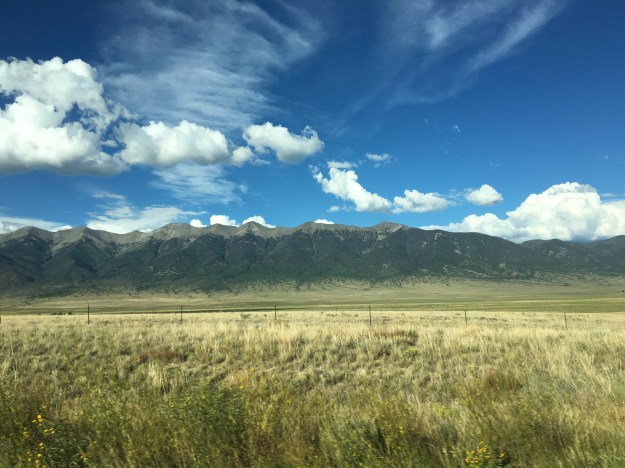
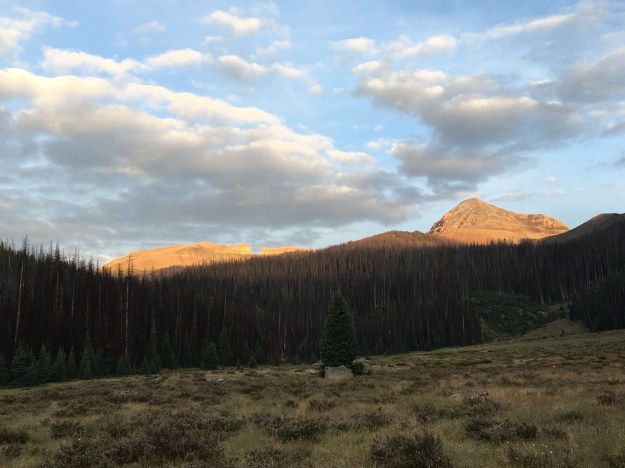
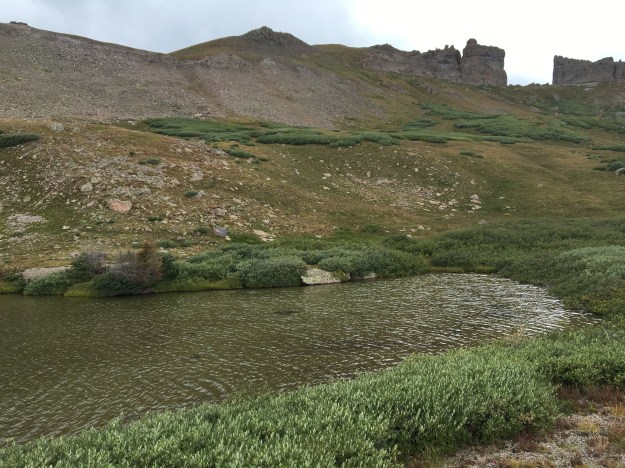
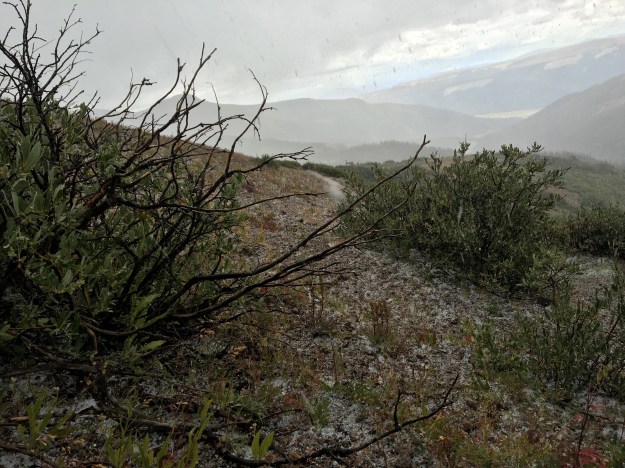
Pure Instinct

Day-to-day life over the past month or so had left me kind of burnt out.  I was inexplicably feeling exhausted.  I was not at my best- which I truly hate.  I’d realized weeks ago I would eventually need a day to disconnect.  We all need that every once in a while.  I figured out that I would not want to hear everybody’s recap of the election (regardless of the result), and Wednesday’s weather was forecasted to be unseasonably warm.
IMG_7976.jpg

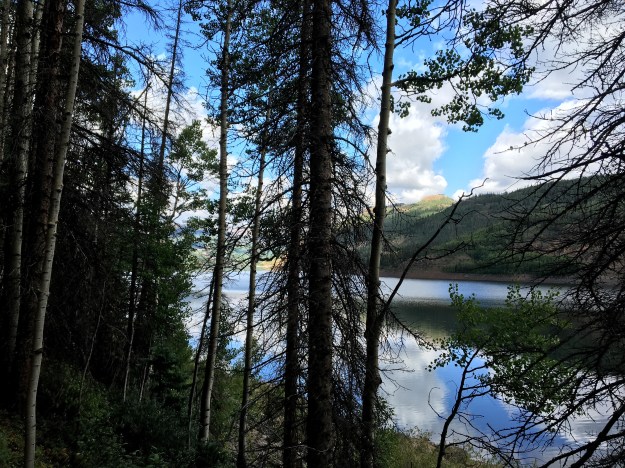
So, I took Wednesday off, got in my car and just started to drive.  I had no plan, no idea as to where I would be headed when I left.  I purposely refrained from making a plan.  I didn’t look into options, or pre-meditate in any sort of way.  I wanted to try something different than what we all typically do when we travel.  I wanted to lean simply on my instinct, and just let it determine where I should go as I go.  Everywhere I went, every decision I made regarding when and where to turn, I made on the fly, just based on what felt right.

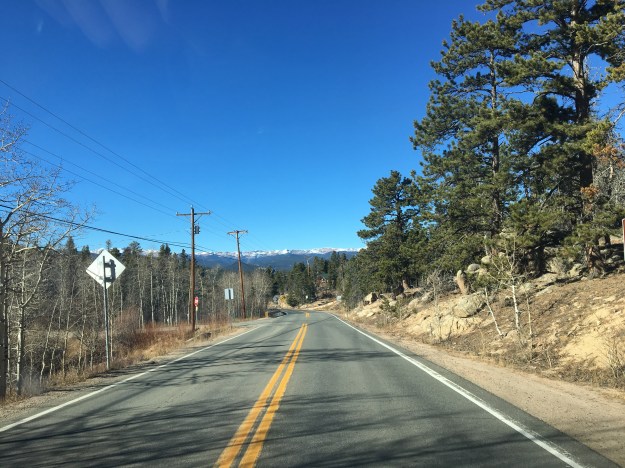
I went west out of Denver, following highway 6 through Golden, than 93 north, and 72 west towards Nederland.  I continuously resisted the urge to pull out my map book, or my phone, or turn to any other source of information to achieve a welcome break from one of the things that may be exhausting all of us in the mid-2010s.  This is the process of gathering information.  In this era, often gather way too much of it, agonizing over it, to the point where we delay actually making the decision, sometimes far too long!

Along the way, I experienced this strange hyper-emotional calm.  I began to tear up.  I was breathing heavy.  But, it felt really good.  It felt as if for the past couple of months, emotions were one by one filling up inside my head, bouncing around like molecules until they gradually started to reach a critical mass, where there was no longer room for them to move around.  They had just become jammed .  And, now, with whatever barrier that was keeping them inside removed, I was suddenly free to just let them out, and let them all out at once.

IMG_7983.jpg

As I continued along this windy path, this strange hyper-emotional calm became accompanied by a feeling of optimism.  I felt like I knew I was in the right place, doing the right things, and making progress toward where I wanted to be.  I’d freed myself from all the data, all the second guessing that gradually erodes away at our confidence.  I knew that, both that day, and in life, I was moving in the right direction even when I didn’t see the destination.

For a while, I had no idea as to why I was experiencing burnout.  The term typically conjures up images of someone working long hours into the night, neglecting their friends, their families, and other areas of their lives.  Burnout is people working 70+ hour  weeks, which I most certainly had not been for the duration of 2016.  So, why was I burned out?  Why did I feel drained so often?

Having searched for answers regarding this, through reading, conversation, and observing people, I came to a series of important realizations about burnout, which run contrary to the image of long nights with pots of coffee.

It’s not the amount of work that burns us out.

Workload can contribute, but more important is how we feel while we are doing our work.

The primary source of burnout is feeling as if we are being phony, or fake.

Pretending to be someone else, for whatever reason we do it, is exhausting.  It is not sustainable.  The only way to be is our true selves.  That is what our instincts tell us to do.

Negative energy in all forms leads to burnout.

One of the nastiest forms is fear, trying to prevent some sort of bad outcome such as loss of job or status.  When we act out of fear, or anger, hate, etc., everything we do is significantly more draining.

One of the most exhausting things we do is try to prove ourselves.

I’ve seen plenty of instances where someone is working long hours, but is not burned out because they are doing what they love and they feel confident while doing it.

img_7989

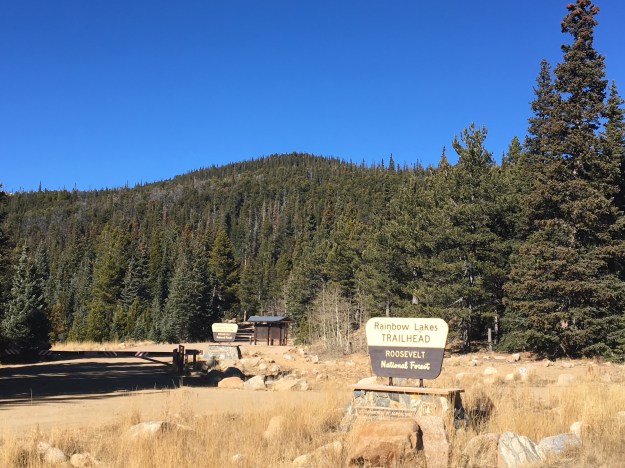
My instinct even took me down a random dirt road, something I otherwise never would have done if it were not my previously specified destination.
img_7990

I ended up at a place called Rainbow Lakes, part of the Indian Peak Wilderness.

img_7996

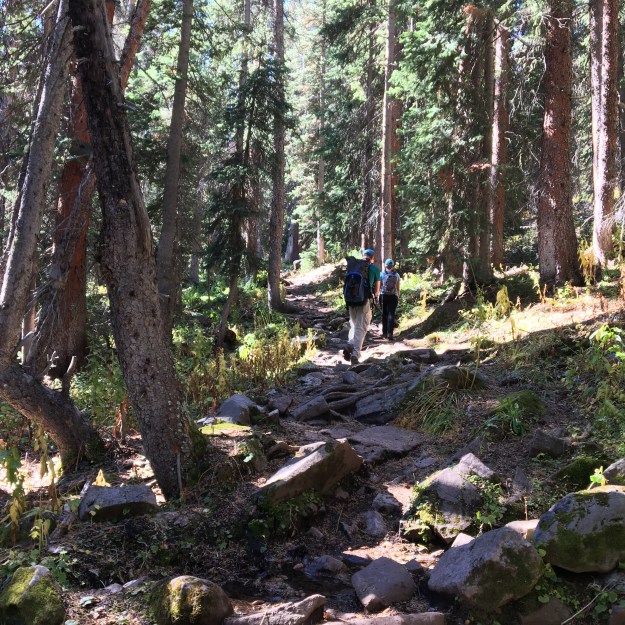
I hiked roughly 2.5 miles, getting to the treeline, which was surprisingly nearly snow free!  This is definitely not encouraging for fans of winter sports.

img_7997

As, well, as can often be the case in our lives as a whole, the change of season that winter sports fans are waiting for is simply not happening yet.  This hike, on Wednesday Nov. 9th, felt shockingly similar to the way it would have felt in the middle of the summer.

img_7998

Just over the ridge, I got myself to a place that was extremely inspiring.  Unfortunately, I did not get a photo, as, well, my phone died.  It was a sign that what I needed to do was disconnect, and, once again, connect to my own thoughts.  Just for good measure, though, here’s a pic I found of the exact place where I sat.

rainbowlakes_20161109

I actually stared at that one little gap in the rock straight ahead.

Our subconscious thoughts do take into account recent information, even as our conscious minds look for more info and don’t know what to make of it.  My subconscious mind, my instinct, though, processed all of this; the election, interactions with people, my own feelings, and summed it up neatly in one sentence, a sentence that simply popped into my head…

The age of deference is over

Make what you want of that.

I also came to another revelation regarding a matter that is more specific to my life.  I had been thinking a lot about the concept of acceptance.  It is why we are always trying to prove ourselves, and often exhausting ourselves.  Afternoon exhaustion, dissatisfaction, lack of inspiration, all of these concepts are inter-related.

We want to be accepted, and can only be accepted as who we are.

But, for each person individually, myself included…

If we want to be accepted as who we genuinely are, we must do so for others as well.

We’re all looking for acceptance, but if we make it easier on each other, as well as ourselves, we might all have a bit more energy leftover for other things.

The previous night’s election, regardless of how any of us feel about it, is yet another example where sometimes more information, more data, is not better.  The best models, based on every piece of data available, made predictions that were quite flawed.  My instinct, many months back, came to a more accurate conclusion about what was to occur.

In an era where we have access to unlimited information, and are often bombarded by it, sometimes we need to realize that less is more.  I, for sure, will, going forth, make a better effort to rely less on data and more on instinct.  After all, it brought me to Rainbow Lakes, without even so much as looking at my atlas, or my Google Maps App.


Looking Forward to Winter

img_1651

No season is the subject of speculation quite the way winter is.  Sure, people anticipate all four seasons, planning activities such as vacations, sporting events, and outdoor activities around each one.  But, there is something about the way winter is anticipated, as experiences can vary year to year in winter more than in any other season.  Every October, speculation begins to intensify.  Fear and dread clearly radiate from the voices of some, while excitement and anticipation come from others.  Most likely, this depends on one’s location, as well as preferred activities.

I spent a lot of years in the Midwest, and completely sympathize with those who dread winter, and hope for nothing more than to have their pain be as minimal as possible for the season.  Here in Colorado, on the other hand, enthusiasts of outdoor snow sports, mostly skiing and snowboarding, anticipate winter with great excitement, typically hoping that the coming season’s snowfall and snowpacks will be at least in line with seasonal averages, if not more.

As an Epic Pass skier who lives in Denver, my ideal winter would be one with plenty of snow in the mountains, particularly the resorts I ski near the I-70 corridor, but generally milder east of the mountains, where Denver is.  And, given this year’s setup, I may actually get this kind of winter that I want!

I have received quite a few questions, both from people local to Colorado, and those considering traveling here to ski in the mountains, regarding what kind of winter to expect.  Now that the National Oceanic and Atmospheric Association (NOAA) has released its outlook for the season, there is no better time to give my own take on how winter 2016-17 is looking.

First, I should note that, the NOAA forecast, as well as other forecasts already made for the winter season primarily focus on one phenomenon: La Nina.  This, of course is the inverse of El Nino.  So, while El Nino winters tend to be wet to the south and dry to the north, La Nina winters will tend to be the opposite.

winter_lanina

This is reflected in NOAA’s graphical precipitation outlook for the winter.

noaa_winter2016_precip

However, this year’s La Nina is likely to be a weak one.  Both El Nino and La Nina can be strong, moderate, or weak, and the predictive power of the phenomenon is limited in cases when the anomalies are weak.  In these cases, I find it useful to look at other patterns that are beginning to emerge when speculating about long-range weather patterns.

Anomalies in Sea Surface Temperatures are the most commonly used data point when predicting weather long term.  This is because the ocean retains much more heat than land or air, making it more likely that the current pattern will persist for longer.  Ocean temperatures can also have a major impact on atmospheric circulation, as is evidenced by the El Nino phenomenon itself.

When looking at current SST anomalies, three patterns emerge as having the potential to impact the weather Colorado and the rest of Western North America will experience this winter.

2016_1026_WinterOutlook.png

First is the weak La Nina, whose impact would be more precipitation for the Northwest, but less for the Southwest.

Second is the abnormal warmth off the East Coast of North America.  This pattern emerged at the end of a summer that was hotter and drier than normal across much of the Northeast, a pattern that generally has continued, although they are currently experiencing a cold snap.  This warm anomaly, if it persists, would mostly likely lead to frequent northwesterly flow over Western North America, as the predominant pattern in winter is one called a wave #3 pattern.  This means three ridges and three troughs over the globe, a ridge to our west and a trough to our east.

The final temperature anomaly that appears to be in a crucial area are the warm anomalies off the coast of Alaska.  These warm temperatures could strengthen a phenomenon known as the “Aleutian Low”, which would act to steer wet weather into the Pacific Northwest.  Under this scenario, Colorado and the interior west will likely be drier.

All three phenomenon point to, although not with too much confidence, more frequent northwesterly flow across the state.  This pattern tends to be dry in Colorado overall, but, as pointed out by Joel Gratz, is a favorable wind direction for upslope storms at ski resorts along the I-70 corridor, including Vail, Copper Mountain, and Breckenridge.

With La Nina being weak, and the other two SST warm anomalies (see map above) being in close proximity to areas of cool anomalies, there is low predictive power to this seasonal forecast.  Any scenario is still possible.  However, signs are pointing, generally, towards a dry winter for much of the west, particularly the Southwest, and a wet winter in the Northwest.  Locally, in Colorado, the most likely scenario is a mixed bag for the ski resorts, with the storms that do occur favoring the corridor of popular resorts near I-70 1-2 hours west of Denver.

IMG_5124.jpg

And a warm and dry winter on the East side of the Continental Divide.

IMG_5454.jpg

(Note: the two photos above are from the previous winter season)


The Quest for Freedom

img_7739

In a way, we all long for freedom.  Freedom from some form of restriction, some sort of pressure, mandate or expectation that we believe is holding us back.  The desire to break ourselves free from these restrictions, allowing ourselves to reach our true potential, or obtain a new level of self-awareness is ingrained in our culture.  Tales of striving for greater freedom can be found peppered throughout our literature, movies and music.  It is the underlying theme of the story of this nation, from overthrowing monarchy to westward expansion, ending slavery, and later the open road.  One could even view the baby boomer obsession with large suburban homes and the millennial obsession with authenticity and acceptance of individual preferences as simply the most recent chapters of a freedom themed cultural progression.

Cars have always been symbolic of freedom.  The mass production of automobiles in the early 20th Century made it possible for the average person to travel over large distances at the time of their own choosing.  Those who purchased an automobile were no longer subject to train schedules when making trips both short and long.

img_7741

“The Open Road” meant people now have the freedom to go when they want to go, where they want to go, and change their mind whenever they’d like.

img_7729

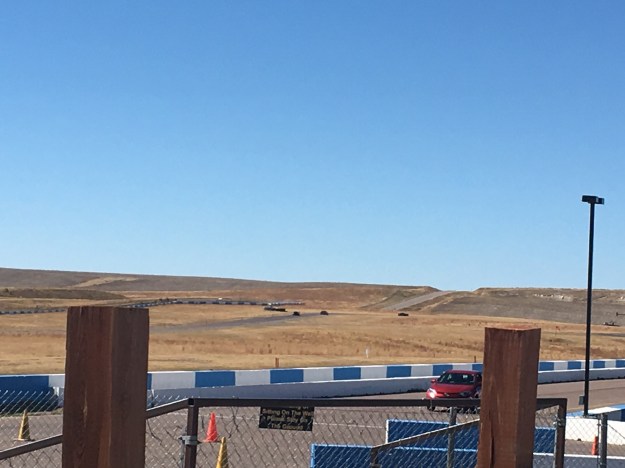
At the High Plains Raceway, this freedom is celebrated, and, well cranked up a notch.  Here, in a world where access to automobiles is now nearly universal, drivers free themselves of the few restrictions that remain.  For most, this primarily refers to the speed limit.  Here, for all practical purposes, there are no rules (in reality, there are a few for safety purposes, but they mainly revolve around how to conduct oneself in the event of an incident like a crash or a gasoline spill).  There is just how fast one can take the turns that make up the race course.

The feeling of having one of these inhibiting restrictions lifted, whether permanent or temporary, is hard to describe.  It’s joyous, almost in a jubilant manner.  It’s reassuring, anxious, and exhilarating at the same time.  I often equate it to a cyclist suddenly no longer having their brakes unnecessarily engaged while trying to pedal, or a runner no longer having 10 pound weights tied around their ankles.  Everything just suddenly feels like it is moving faster, and flowing more smoothly.

But, there is some level of risk one takes by coming to a facility like this.  Upon entry, every person, even guests who do not intend to drive a vehicle at all, must sign waivers, accepting the risks they take.  This includes understanding that there are dangers, both to life and property.  Crashes at high speeds can do damage to one’s life and limb in situations like these.  And, some of the vehicles at this raceway are valued at upwards of half a million dollars, assets that could be permanently lost when accidents render the vehicles irreparable (I am told that standard automobile insurance does not apply while on race tracks like this).

For these reasons, many will probably choose never to take part in this activity.  This is the case with many activities of this nature, from something as major as starting a new business to something as minor as stealing two sips of vodka from one’s parent’s liquor cabinet at the age of 15.  Some of us dive into the activity without thinking.  Some of us will shy away, and avoid the risk.

We all want freedom.  But, we all also want security.  Most of us also desire equality, justice, or some sense of “fairness”.  Most of our sociological conflicts come about when these desires are pitted against one another.  In this year’s presidential election, Americans have largely been denied a true discussion about what our priorities are, in this realm, and how they should be met.  But, that does not mean that determining how to free ourselves from our limitations, and how to prioritize this desire with other desires is not part of our lives every day, manifesting in the decisions we make and interactions we have.

Experiencing a Different Way of Life

img_7711

Most of the time, when we travel, we are touring.  We are visiting places.  We are going to specific destinations.  We are seeing landmarks, or specific points of interest.  Or we are going somewhere to take part in a certain event or activity.

Sometimes, we will speculate as to what it is like to live in a specific area.  Maybe we will even interact with some locals, and ask some questions.  But, even then, in a way, we are still touring.  We are getting some amount of information regarding what day-to-day life is like, but we are really only getting a snapshot of a specific point in time, and some verbal information about what may make that point different from typical day-to-day experience.

Sometimes, when we travel specifically to visit people, people we know, we get a little more of a window into what life is like in a different place.  For me, a metropolitan person, who has always lived in a city or suburban area, most of these kinds of trips involve traveling to a different city, or a suburb of a different city.  While each city, metropolitan area, and region are unique from one another, there are still some basic similarities.  I have a clear understanding of the differences between life in New York, Houston, Denver etc.  But, I also understand that there are many similarities that make life in all those places distinct from life in a more sparsely populated area.

Nederland, Colorado is not too far from home for me.  Nor is it your typical small town U.S.A.  Positioned along the scenic Peak to Peak Highway, at 8200 feet elevation, and only about 40 minutes West of Boulder, it falls into the category of one of those quirky types of small towns.

This weekend turned out to be a unique experience for me.  Sometimes when we visit people, we don’t really experience their typical life.  There’s a specific event, or destination, and, in a way we all become tourists.  This weekend, that did not happen.  I ended up genuinely feeling as if I had spent some time in the day-to-day life those that live here!

img_7705

The first, and most obvious difference living here is how we get around.  To me, getting anywhere, whether it be between neighborhoods or to the center of town, involved what resembled a short hike to me.  There was no driving, Ubers, light rail, or busses, just walking along a series of trails that felt, and also typically smelled as if I were on a camping trip.

I also began to notice, and even feel, a difference in energy.  Things feel calmer, less urgent, less competitive.  This, of course, is both good and bad.  The good is the ability to relax, not feel like you are competing with everyone you see, and take time to enjoy some of the things around you.  The flip side is that lines move slower, people move slower, and most things take a little longer.  Even while enjoying the reprieve from the stress of everyday life, I recognized that, given that I wish Denver were faster moving than it is, I could never permanently move to a place like this.  I did however, fully immerse myself in the experience while I was here.

img_7709

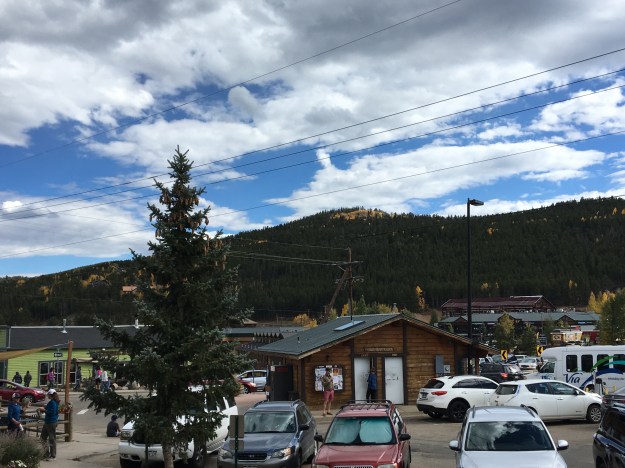
The strangest thing that happened was finally getting a good understanding of a different perspective on a common conflict.  The center of town was packed with what many people refer to as “leafers”.  These are people who drive from the city to some nearby forested area to see fall colors.  Living in Denver, I am technically one of them, as I had been nearly every year.

Immersed in the Nederland experience, I experienced this from the other side.  Feeling the frustration of people dealing with things they don’t normally have to deal with, like waiting for a table at their favorite restaurant, traffic jammed up on all of the main roads, and a significant number of people in the lake, I began to understand why people who live in places like this don’t immediately calculate the benefits of tourism on their local economy on days like this.

This month, and for the remainder of 2016, one of my goals is to try harder to see things from the perspective of others.  I just feel like a lot of things in my life, whether it be putting together a presentation with specific audience in mind, or interactions with people, will go a lot more smoothly if I genuinely make an effort to understand them from the perspective of others.

Travel has, once again, taught me a valuable lesson.  To fully immerse myself in this experience, I had to, in a way, let go, of what I know, what I expect, and even what I want.  If more of us, both in our travels, and in our day-to-day lives were to approach people, experiences, and issues, with much of this pre-concpetion taken out of our minds, we would likely have a more positive impact on the lives of one another.  This doesn’t necessarily mean giving up on what we believe in, especially strongly held conviction.  It means taking them out of our mind, for at the very least a few minutes, to hear what others have to say, and feel what others feel.

The Longest Day Hike of My Life

DCIM160GOPRO

Conundrum Hot Springs

The hike from the Conundrum Trailhead to Conundrum Hot Springs is roughly 8.5 miles.  Round trip is at least 17 miles of hiking.  I say AT LEAST as I have been on plenty of hikes where side excursions, both planned and unplanned, lead to covering a total distance that exceeded the official distance of the hike.

Due to the distance, and the destination, nearly all the people we encountered on this hike were backpacking.  This is an attractive option, as the trail is pretty long but not terribly challenging, and the hot springs are the kind of destination one would want to spend a significant amount of time at.  However, Conundrum Hot Springs is a popular destination, and there are limited camping sites in the immediate vicinity of the springs.

Conundrum Hot Spring is close to Aspen, which is three and a half hours from Denver.  Some of the people in our group, myself included, were not able to leave early enough on Friday for us to be confident that we could secure a camping spot.  We ended up deciding to find a campground somewhat close to the trailhead, and hike to and from the springs as a day hike.  As an added bonus, we would not have to bring, or carry nearly as much equipment, as we would be “car camping”.  The hike would be both easier and harder.  We would not be carrying nearly as much weight, but we would be cramming 17 miles of hiking into one day.

Up in the mountains of Central Colorado, trees change color earlier in the Fall than they do in many other parts of the Country.  In general, the second half of September, and maybe the first few days of October, is the best time to see the Aspen trees here change colors.  I was partially surprised by how vibrant the colors were, by September 16th.  For the first two hours or so of the drive, before sunset, we saw a preview of the kind of colors we’d be seeing during the hike, certainly early season, but vibrantly colorful, with sections of bright yellows and oranges periodically appearing in front of us.

To be sure we would have enough time, we had to wake up, eat breakfast and leave the campground at Lincoln Creek (dispersed camping roughly 40 minutes from the trailhead) all before sunrise.  We arrived at the trailhead and started hiking at roughly 15 minutes after 7 A.M.

The morning chill was both an obstacle and a boost.  Overnight temperatures dropped to roughly 30F (-1C) at the campground.  For the first 90 minutes of the hike, the ground was covered in frost.  In fact, the frost even made our first river crossing a bit slippery.

This morning cold made me cary several layers, adding a little bit to the weight of my backpack (although it was still way, way, lighter than it would have been had we been backpacking).  However, the cold weather motivated us to begin our hike at a rapid pace.

We would cover over four miles before we even reached the sun!

IMG_7577.jpg

I would describe at least the first five miles of the hike as “easy” from the standpoint of evolution gain.

img_7579img_7580img_7581

Many sections of the trail are actually close to perfectly flat, giving me plenty of time to take in the natural beauty that is around me, and also connect with my friends who I was hiking with.  When hiking, it is challenging to have a conversation when hiking up steep terrain, but fairly easy to do so in largely flat sections.

IMG_7582.jpg

The appearance of small lakes precludes the transition to the more challenging part of the trail.

This occurs somewhere around six and a half miles into the hike.  First of all, there are sections that are more technically challenging, including a couple of tricky creek crossings, and a section where one must scramble over rocks.

IMG_7589.jpg

There last two miles of the trail also includes some fairly steep sections.  I wouldn’t say they are overly challenging, but in the context of a 17 mile day that included hiking at a rapid pace towards the beginning, they ended up being fairly exhausting.

We ended up spending roughly two hours at the hot springs (including changing and eating lunch).  There were a lot of people in the hot springs, but it was not as crowded as some of us had feared.

img_7601img_7603

For a variety of reasons, the fall colors appeared even more magnificent on the way back down!  The most significant reason had to be the manner in which the trees appeared in the mid-afternoon sun.

img_7604

I was also pleasantly surprised to see a significant amount of deep orange shades.  In prior experience with fall in the Rockies, I had almost exclusively seen the yellow shade that seems to be the most common fall color for Aspen trees.  While “autumn gold” is pretty, I had, in some ways, missed wide variety of shades that leaves on maple trees take on during fall.

img_7606

I would definitely describe the color we enountered as “early season”.  There were still many Aspen trees primarily shaded green, particularly at lower elevations.  This indicates that the next two weekends could be just, or perhaps even more, colorful!  The colorful trees, the yellows and the oranges, tended to be those higher up.  The several patches of deep shaded orange I saw were nearly exclusively up closer to the tree line.

Conudnrum_FallCOlors_Sept2016.JPG

Both the hike up to the hot springs and the return trip took roughly four hours.

IMG_7607.jpg

We got back to the trailhead sometime just after 5 P.M., and, after the 40 minute drive back to Lincoln Creek, I finally got to see what the campground looked like.  And I got to do something I had not previously done.  I got to park my car with the rear left tire on top of a rock, showing off just how rugged my vehicle is.  Well, at least in an auto show pamphlet sort of way.

Capping off an exhausting day was a side excursion, to a waterfall, well, multiple waterfalls, that those of us in our group lucky enough to be able to leave early Friday had located roughly a quarter of a mile from the campground.  In fact, they hyped this place up over the course of the hike.  So, we had to go.  Additionally, this side excursion was enough for me to achieve something meaningless, but also something I am likely never again to achieve.  I recorded 50,000 steps on that step counter thing that comes with every iPhone6.  Yay me!

We would explore this likely unnamed waterfall area again Sunday morning before departing for Denver.

img_7631img_7636img_7641img_7642

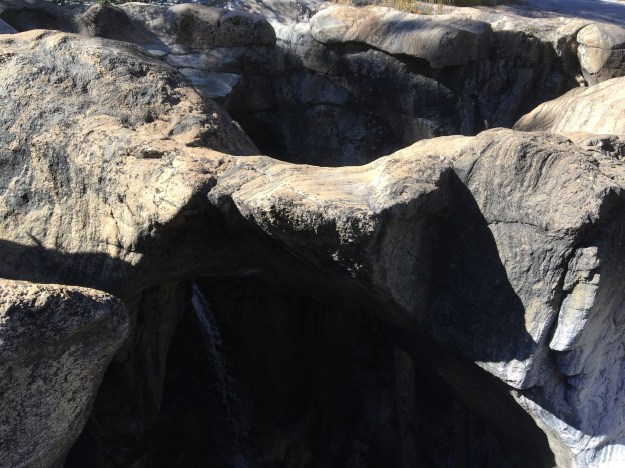
If you count all the places where water squirts out of random places in the rock, there are probably close to a dozen “waterfalls” in this area.  What a great unexpected treat!

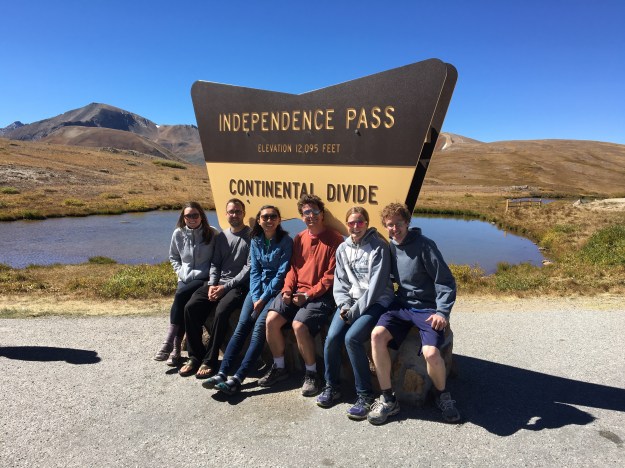
The return trip on Sunday was eventful as well, with some great stops at Independence Pass and Twin Lakes, both places I had driven by on Friday, but after the sun had already set.

img_7656img_7660

I titled this blog “The Longest Day Hike of My Life”, as, well, I can not picture a day where I hike more than 17 miles on a day trip.  However, I probably would have never imagined hiking 17 miles in one day a few years back, so there is no way to definitively say never.  I am prepared, though, for this to be my longest hike, and understand the significance of it. Like many of the adventures I had over the course of this summer, and in previous years, it was both exhausting and amazing.  But, most worthwhile experiences, from relationships to starting successful businesses and such, are.  Being exhausted after this experience should be a reminder to all of us that what is easiest is often the least rewarding, and that which is most challenging often comes with the greatest reward.


Pure Magic

Las Vegas, Nevada!  Magical!

IMG_7480.jpgWhile I am not sure everyone agrees, it is one of those rare situations where, at least from my perspective, one word can be used to sum up a place.
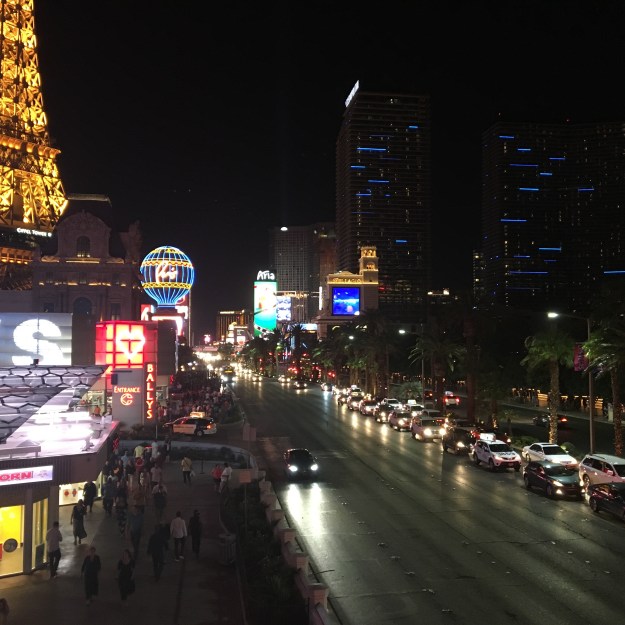
The word magic itself can be a tricky one to pin down.  Most people think of magicians pulling rabbits out of hats.  Some people think about some kind of supernatural force, something that cannot be explained by science and logic, which, for many, has a negative connotation.

To me, magic is the power to transform.  No illusions are necessary, nor are any supernatural powers (although, as an open minded individual I will not rule them out).  I find it “magical” anytime a specific situation has the power to transform something into something else, regardless of whether anything that can be considered supernatural is involved.  Magic can occur in the standard magician situation, like when one sits there wondering how the four of hearts suddenly became a mountain goat.  But, it can also happen when someone meets a new person, when a rainbow suddenly appears, or when a new experience leads to people viewing the world a different way.  All of these “transformations” occur well within the realm of what can physically be explained by either science or logic.

As soon as I set foot in Las Vegas, I see a world transformed into something completely different.

IMG_7483.jpg

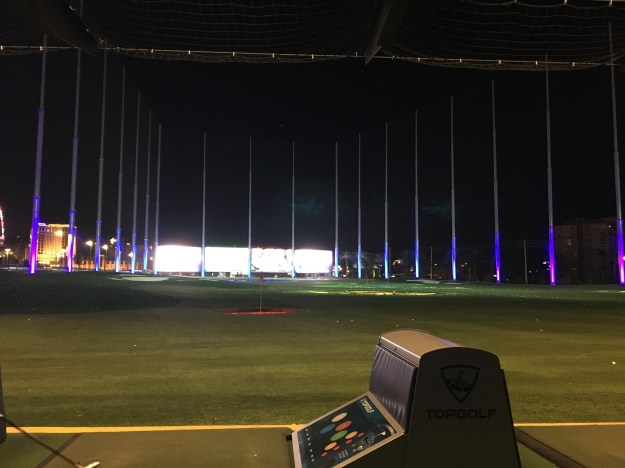
Paris is a mile from New York, and just across the street from Caesar’s Palace.  Less than a mile up the road is Treasure Island.

IMG_7509.jpg

Suddenly midnight is “early”, and 3 A.M. is not too particularly “late”.

IMG_7505.jpg

Money transforms from paper into little round discs.  Suddenly, $5 is a “nickel”, and $25 is a “quarter”.

IMG_7482.jpg

People are suddenly willing to take on all sorts of risks they’d otherwise be unable to fathom.

IMG_7495.jpg

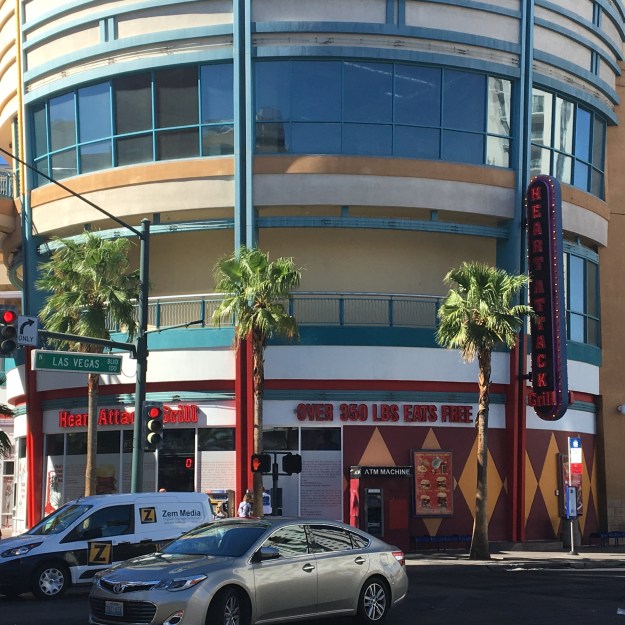
And, those weighing over 350 pounds, most likely typically shamed in their day-to-day life, can eat for free at a place called the Heart Attack Grill!

When I think of the people I talk to, or have talked to on a regular basis, I would say that Las Vegas appeals to roughly 2/3 of the population.  I do frequently encounter people who tell me they have no interest in visiting Vegas.  It is, after all, somewhat of a hyperbole for a certain aspect of adult life, particularly young adult life, that is wild and unrestricted, but also potentially destructive in multiple ways.

IMG_7488.jpg

Vegas got its start as a gambling destination.  Gambling is still probably the first thing anyone would think of when the think of Las Vegas.

Gambling in Las Vegas can be a number of different types of experiences.  There are plenty of different kinds of games and plenty of different kinds of experiences, from the fancier resorts, like Aria and the Wynn, to more affordable places like Casino Royale and Circus Circus.

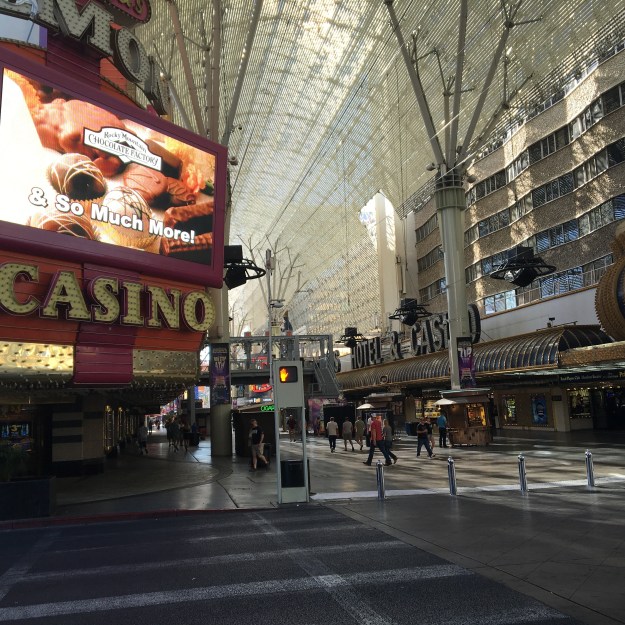
Those that prefer lower stakes can opt for a change of pace at the Freemont Street Experience.  This was the original Las Vegas, and some of these casinos, right in the heart of what is considered Downtown Las Vegas, a few miles north of the strip, are among the first ones developed here in the middle part of the 20th Century.

IMG_7492.jpg

The pedestrian mall in some ways is reminiscent of similar streets in other major cities.  The street almost becomes a non-stop party, with attractions, tons of places to drink (and in this case gamble), and areas where stages are commonly set up for bands to play.

My primary gambling mode is, and probably always will be, table games, usually black jack or craps.  On this particular trip, I found my sweet spot at places that fit somewhere in the middle of the spectrum, such as the Flamingo, Cromwell, Ballys and Treasure Island.

IMG_7504.jpg

But Vegas is more than gambling.  In fact, there are plenty of visitors that come and do very little gambling, preferring to spend their time at the clubs, at pools, shopping, or taking part in another activity altogether.

IMG_7486.jpg

The common thread to everything that goes on here is that people are enjoying themselves, embracing their wild sides, in their own way, and letting go of at least some component of the restriction they live under during their normal lives, even if it’s as simple as piling up large amounts of foods that do not typically “go together” at a buffet.

IMG_7500.jpg

As a single entity, Vegas makes me think of what it would be like to live in a movie, or on some natural version of a drug high.  Everything feels more significant.  The dull parts are cut out.  There is no doing laundry, ironing shirts or anything like that.  Heck, even sleeping is reduced.  Decorations and shows appear everywhere in a manner that stimulates all five senses until they are overloaded.

I’d say the “real world” (however you want to define it) is not magical, but whose fault is that?  Could I be missing the “magic” that does occur on a day-to-day basis?  As people become entrepreneurs, find new relationships, have the courage to leave bad relationships, discover who they truly are, and go on life changing trips.  Could I be failing to take the opportunities to create “magic” when they present themselves?  When someone needs help, when someone has an idea, or when a truly splendid rainbow appears in the sky, just begging me to stop what I am doing, forget whatever my mind is currently fixated on, and just allow myself to take in the experience.

The truth is, with a good enough imagination, enough confidence, and a willingness to act, any place can be “magical”.  But, whenever I lose sight of that, I know I can always go back to Vegas to reconnect with it.

48th State

IMG_7464.jpg

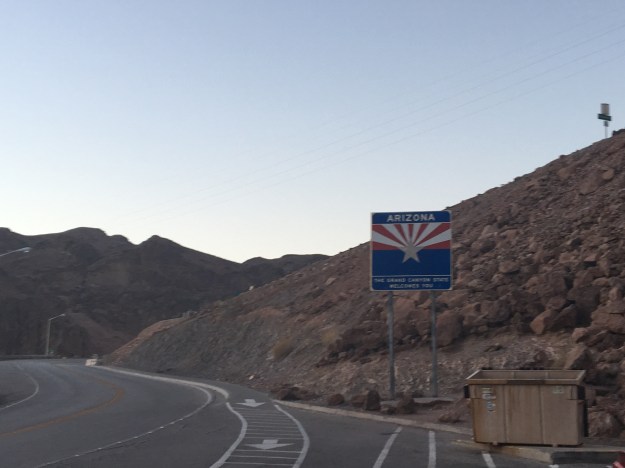
Arizona is the third most recent state to join the Union.  The only two states admitted more recently are Alaska and Hawaii.  This means that, when it comes to mainland U.S.A., this very much was the “final frontier”, an area that remained wild and unsettled for over a century while areas were being converted from frontier, to small villages, and eventually into powerhouses connected by networks of trails, ports, and railroads.

img_7422

The primary cultural image of Arizona is the “Old West”.  Cowboys roaming around wide open spaces.  Small isolated towns where outlaws and town sheriffs fight a continuous battle that resembles the internal conflict we all have between the innate desire for freedom and the desire for justice and order.  Crazy games of poker in whiskey salons that often end in guns being drawn.

Historically, it is correct that Arizona, like much of the west, is the site of many epic battles that often lead to gunfire.  This lead to places such as Tombstone, and Rawhide, being depicted in numerous Western themed movies and TV shows.  Tourists today can relive the experience of the wide open, unsettled, west by visiting these places.

However, movies and TV shows can frequently lead people to inaccurate perceptions.  Films and shows are designed for entertainment purposes, and therefore must focus on the interesting aspects of life in a specific place, like a shoot-out between two gangs.  Anyone that compares their lives to those of characters from TV and movies will often come out feeling that their life is uninteresting.  After all, no movie will show someone sitting at a cubicle for six hours, or doing laundry and ironing shirts.  They focus on the parts that will, well, entertain the people that watch them.

Recent studies have indicated that, while these high profile gunfights did occur in the old west, they were the exception rather than the rule.  Some studies (although not all) have even suggested that the western frontier of the later 19th century was actually a safer place than America today.  There is speculation as to why the “Old West” is depicted and thought of in the manner in which it is, leading some to entertain conspiracy theories.  Regardless of what the reality of what life in this time and place know as the “Old West” was truly like, it is encouraging to see people look at it statistically, as opposed to based on anecdotes and catch phrases.

IMG_7415.jpg

Arizona may have grown up late, but it grew up fast.  Based on the 2010 census, Arizona is now the fourth most populous state west of the Mississippi River.

IMG_7420.jpg

Growing up in the middle to late 20th century, Arizona grew up in a manner that is very car-centric.  Depictions of present day Arizona life, in movies like Bad Santa, commonly show life in car-centic suburbs, with winding subdivisions, malls and such.

img_7443

There is also no forgetting Arizona’s position along the famed Route 66, which took countless motorists between Chicago and Los Angeles during the middle part of the 20th century.  In popular culture, the Arizona stretch of this major historic thoroughfare is amongst the most celebrated, providing the inspiration for the setting of the Route 66 based movie Cars.

The most high profile destination in Arizona is the Grand Canyon.  After all, the state’s nickname, which is labelled on all Arizona license plates is “The Grand Canyon State”.  However, by taking a road trip from Phoenix to Las Vegas, one will traverse the landscapes that cover a much larger portion of the State.

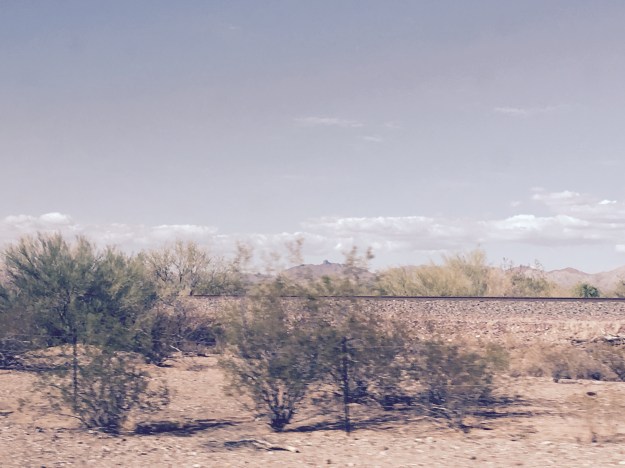
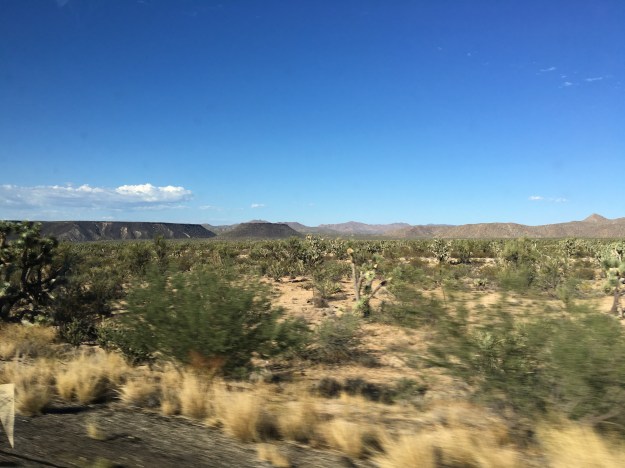
Passing through the Sonoran Desert, which includes Phoenix and much of the surrounding  area, one will encounter hills covered in sagebrush and cactus plants.

img_7441

Periodically, one will also encountered Joshua Trees, mountain ranges, and mesas.

IMG_7429.jpg

img_7431

Closer to Vegas, the landscape transitions to the Mojave Desert, which is sometimes even hotter, drier, and more baren than the Sonoran.

img_7447img_7450

Two developments made Arizona’s rapid expansion in population possible.  First, is the much discussed invention of, and subsequent proliferation of air conditioning.  This, of course, made living in places prone to hot weather more desirable.  The second is the creation of dams, canals, irrigation systems, and water pipelines, which facilitated supplying these dry regions with the water resources needed to sustain life.

IMG_7475.jpg

The Hoover Dam, located at the border of Arizona and Nevada, is one of many places throughout the west that diverts water resources from a major river (the Colorado River) to major metropolitan areas.


As is the case with the idealized image of the rugged individual of the “Old West”, present day life in Arizona, when discussed, elicits some divided responses, as well as some different interpretations.

img_7411

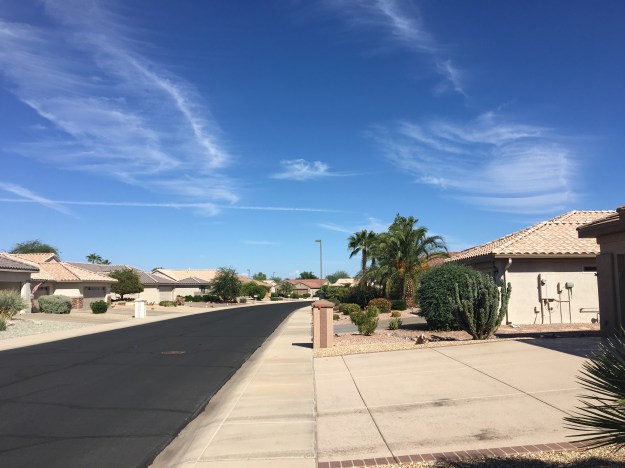
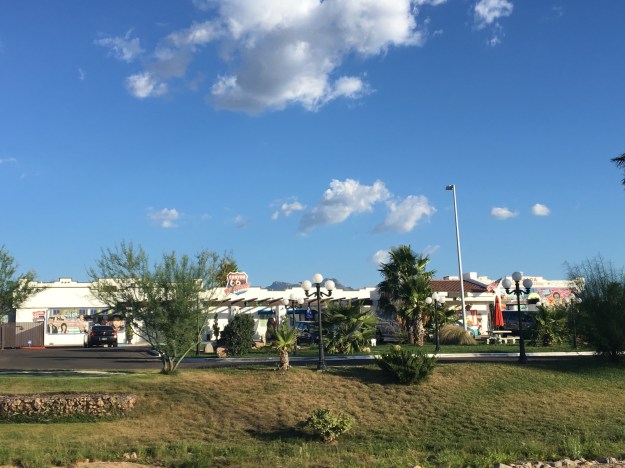
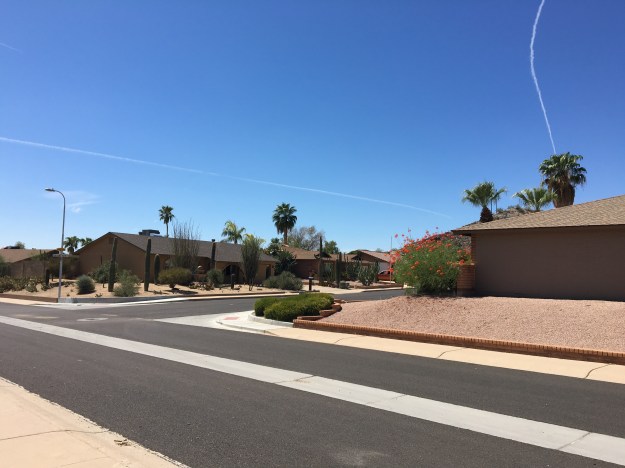
This is very much the image of standard life in Arizona.  A house in suburban looking neighborhood, a pool in the backyard, mountains, and, in many cases, golf.  Some love it.  Some see it as the natural culmination of the “American Dream”.  Some can’t wait to get away from the frigid winters many experienced in other parts of the country, move down here and enjoy the life.  Others, and particularly those concerned with the environment, feel it is irresponsible for so many people to be living comfortable lifestyles, with swimming pools, irrigated lawns, and golf courses in a climate this dry.  People here seem to adhere to the “haters gonna hate” mentality.  The knowledge that people in some distant land are disapproving of their living, eating, hiking, and golfing in the desert does not seem to phase them.

IMG_7413.jpg


Backpacking in the Weminuche Wilderness: Day 3

IMG_7252

The Weminuche Wildreness appeared to be particularly devastated by the recent Mountain Pine Beetle epidemic.  While a portion of the second day was spent above the tree line and in storms for much of the journey, we wound our way in and out of the forest, alternating between hiking through the forest itself, and hiking across an open meadow where we could gaze upon the forest to both our left and our right.

IMG_7229

Throughout the State of Colorado, and throughout the West, I observe areas where the Pine Beetles have decimated the forest, changing the ecosystem forever.  Nowhere, though, have I seen a higher concentration of dead trees.  I would estimate that, over the course of the trip, some 70-75% of all the pine trees I saw, were, in fact, dead.

IMG_7228

But I did notice some signs of life, particularly at the campground Sunday (Day 3) morning.  Tucked away amongst the densely pack forests of decimated trees, little signs of life seemed to appear.  It reminded me of many American cities, circa 1982, decay being the overarching theme but, signs of life and pockets of hope beginning to appear here and there for those willing to observe.  Maybe indeed, the worst has now passed for this particular forest.  As was the case for many of our cities, it is possible that in a decade or so, we will revisit areas like this, and see once again a thriving forest, albeit, as was the case with our cities, with a different character?

IMG_7246.jpg

As is typically the case on a three day excursion like this one, the last day was primarily a descent.  As we descended, we quickly reached elevations where Aspens, rather than Pine trees made up a significant proportion of the forest.

IMG_7267IMG_7268

Maybe it is different at this latitude, farther South than the Denver area, where I live and spend most of my time.  But, it feels as if in this wilderness, Aspen trees are able to grow at some pretty high elevations.

IMG_7302

We figured out the tree line here to be somewhere close to 12,000 feet in elevation.  When looking upon sections of forest from afar like this, it is easy to picture some of these Aspen trees living at elevations close to 11,00 feet.  Over the course of my four years in the Denver area, I had grown accustomed to them disappearing between 9,000 and 10,000 feet.

Sunday’s hike was a 7.3 mile trek along the Ute Creek trail (the East Ute Creek trail we had followed the previous day merged with the main Ute Creek trail).  The trail alternated a bit, climbing up and out of the valley formed by the creek for some sections, and descending back toward the creek for others.  Due to the previous night’s onslaught of rain, which likely impacted the entire valley, the trails on this, the final day, were at times even muddier than the were the prior two days.  At the end of three days, our total distance came out around 25 miles.  I speculated as to whether the extra distance we traveled stepping around puddles, and veering left and right to avoid some of the muddiest sections of trail, over the course of three days made this a mile or so longer than it would have been had the trails been completely dry.

IMG_7287

I personally added some distance on top of that.  I love side excursions, whether hiking/backpacking, cycling, or on a road trip.  And, in addition to the side excursion to the feature known as “the window” the previous day, I took one completely on my own the final day.  Roughly halfway through the hike, I saw a place where I could cut down to the creek, and see a mini-waterfall.

IMG_7291

The final part of the day consisted of a small climb out of the Ute Creek valley, followed by a descent back towards the Rio Grande Reserviour.

IMG_7299

It is inevitable that, on the last day of any trip, we all begin to ponder our return home, and a return to our “normal lives”, whatever they may be.  This return, though, is somewhat unique, as a trip into the woods is not just a journey away from our jobs, or certain responsibilities, it feels more like a complete separation from the modern world, or as some people refer to it, the “real world”.  All of us were separated, not just from work, but from TV, from the news, from Twitter, and even the manner in which society is structured in the 21st Century.

Since my return to Denver was a return to, after being completely separated from, the “real world”, I started to contemplate the “real world” as one big entity, which, even for a big-picture abstract curious minded thinker like me, turned out to be strange.  I feel like we often compartmentalize the “real world” into buckets; the working world, the relationship world, the school world, etc.  We will write blogs, have conversations, confide in others about our hardships, or celebrate our successes, with respect to one specific bucket of the “real world” at a time.  Some people will even chose to accept or rebel against the modern world on a bucket-by-bucket basis.  “I’m a freelancer, happily married with two kids and a picket fences house.”  “I work 9-to-5 for a large corporation, but I only eat organically certified food.”

I’m not saying there is anything wrong with any of the partially-rebellious lifestyles I am describing here.  We often try to oversimplify the actions and lifestyles of others as being either “conformist” or “rebellious”.  When I thought about life in the woods, and the few people that actually do it, live off the grid, and off the land, I think of those people as “rebellious”.  But, then I thought of human beings as part of the animal kingdom, and thought about what all non-domesticated animals do.  They live in the woods.  They hunt their food, many wandering around nomadically.  When thought of in that manner, it is us human beings, and our domesticated cats and dogs, that are rebelling against the way the rest of the animal kingdom works by farming our food and setting up permanent shelters.

IMG_7304

At the conclusion of our journey, we had to actually wade across the Rio Grand River to get to the car, as the trail ended abruptly at the river.  This likely explained why we did not see any other people the entire time we were on the East Ute Creek and Ute Creek trails yesterday and today.

IMG_7309IMG_7310

Shortly after leaving the trailhead, I saw what looked like baby mule deer living along the steepest part of the hill.

IMG_7323.jpg

Like the journey to the Wilderness, the journey home took us by some of Colorado’s highest peaks and most stunning mountainous features.  I thought of the “real world” I was gradually re-entering, the life I live and the journey I just took.  It is not important whether we are “conforming” or “rebelling”, because, like life in the woods, it can be thought of as conformist or rebellious depending on perspective.

Those of us that are honest with ourselves, and with those around us, will undoubtedly find ourselves in both situations.  We’ll find ourselves in a place where our choices are the same as those around us, and be suseptable to being labelled “conformists”.  We’ll also, at some point, find ourselves in a place where our choices are not those of the majority, and be met with skepticism, hostility, and possibly even pressure to change.  What matters most, is not fitting into an image we may have of ourselves, whether it be the upstanding citizen, rebel, outcast, or whatever, it is that we have the courage to be all things, depending on our setting, in order to be true to ourselves.

Backpacking in the Weminuche Wilderness: Day 2

IMG_7153

Before moving to Colorado, I experienced seasons in a completely different way.  While there would be some anomalies, for the most part, winter was winter and summer was summer.  Snow was something I experienced starting in November, through the winter, probably one last time in early April, and then not again for 6-9 months.  Likewise, heat would be primarily confined to the summer months.  In other words, I experienced being cold and being warm in two separate parts of the year.  The experience would generally only mix during the in between seasons; mid-spring and mid-fall.

In Colorado it’s all different.  In Denver I’ve seen temperatures reach the lower 70s (23 C) in the middle of February.  At higher elevations snow can fall nearly year round, and there are places where snowpack persists well into the summer.

IMG_7154.jpg

Saturday morning, the start of my second day in the Weminuche Wilderness, was a cold one.  The chill had awoken me at 3:00 in the morning, when I reached for my warm hat and for the zipper to zip my sleeping bag all the way shut.  At roughly 6:30 I woke up for good, and crawled out of the tent to find ice on the fly!  Frost was found on many of the items we left outside, including this bear cannister.

It warmed up fairly quickly at the campsite making me wonder why I did not simply stay inside the tent for another hour.  All the weather forecasts we had looked at prior to this backpacking trip had indicated that a wet period was coming to a slow end, and that each day would get progressively drier (lower probability of rain).  Yet, in the morning I saw something that would indicate differently; alto-cumulus clouds.  These are puffy clouds with a base somewhat higher up in the sky than the clouds we typically see.  On some storm chases, the presence of alto-cumulus clouds indicated the presence of moisture at higher levels of the atmosphere.  This was seen as a good sign on a storm chase, but, on a backpacking trip, is a bad sign.

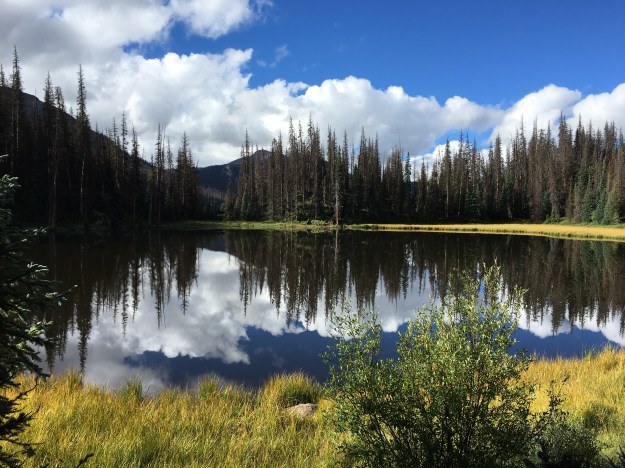
The first few miles of the day took us by a lake we are glad we did not chose to camp at the prior evening, and then back into the woods, where once again the trail was muddy kind of on-and-off.

Headed farther up in elevation, towards the summit of the day, we approached the tree line, encountering several waterfalls.  This one, by far, was the most pictureqsue.

IMG_7175.jpg

I did not even know the name of any of these waterfalls.  In fact, I did not even verify that they even have a name.  It didn’t even seem important at the time.  We just liked what we saw.  At that time, most of the conversation within our group revolved around whether we would see marmots in the nearby rocks, and speculation as to what elevation the tree line was at at this latitude.

We followed the Rincon La Vaca (Cow Canyon) trail, which is also considered a section of the Continental Divide Scenic trail, above the tree line, and approached a rock formation we had been looking at since early the prior afternoon, “The Window”.

IMG_7183

This is where we decided to stop for lunch, at a lake where we could safely refill our water bottles.

IMG_7188

It was noon when we finished eating lunch and, four of us (out of a group of six) decided, despite the potentially ominous weather, to make a side excursion.  We dropped our packs and hiked the 500-ish feet (and half a mile) up to “The Window”

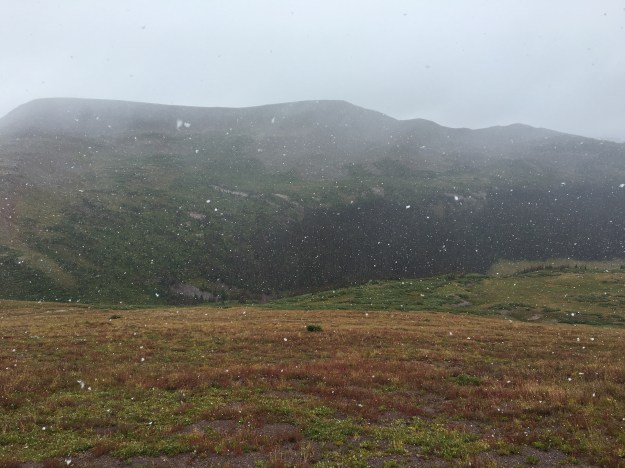
We got back to the lake, where our backpacks were, around 1:00.  As soon as we prepared to move, and catch up with the rest of the group, it started to rain.  A few minutes later, ice pellets began to fall from the sky.

IMG_7200

We briefly took shelter from the inclement weather, but eventually soldiered on through the not quite rain not quite ice, which would eventually change over to snow!

IMG_7203.jpg

I experienced a lot of this living in Chicago.  I called it “precipitation jambalaya”.  But, I never thought I would hike through it, and, well, am used to experiencing this in December, not late August!  Once again, that thing about the seasons!

IMG_7205

The precipitation stopped right before we turned off the Continental Divide/ Rincon la Vaca trail, and started looking for the trail we would take back towards the reservoir, the East Ute Creek Trail.

IMG_7207

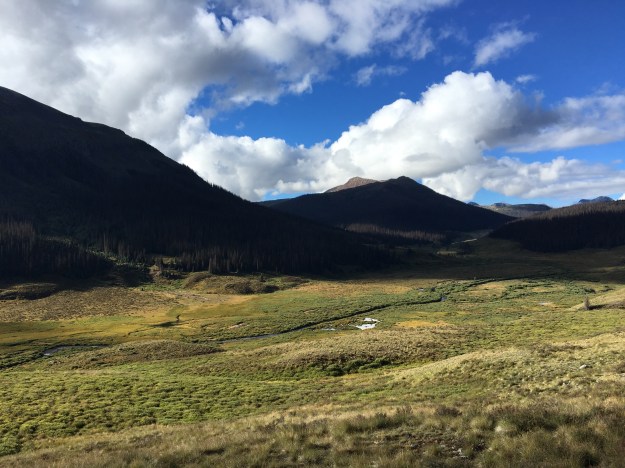
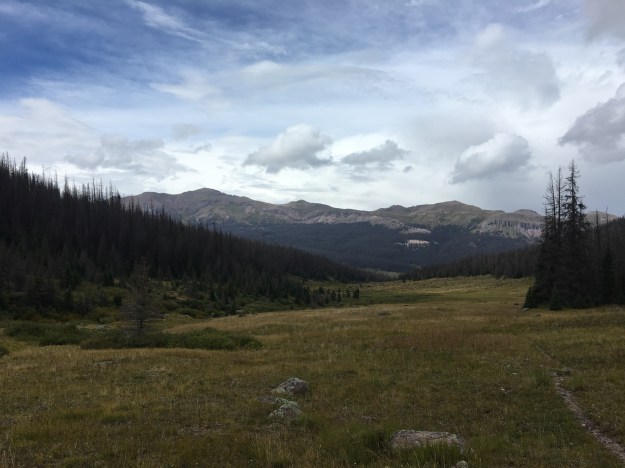
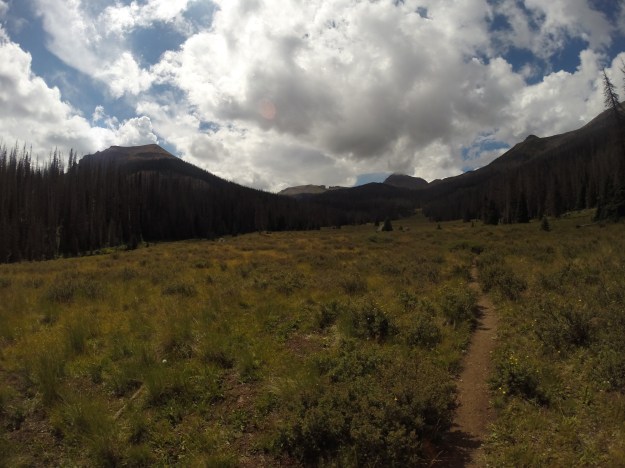
The scene looked familiar.  The shape of the Ute Creek Valley where we were headed, with an open meadow surrounded by mostly dead forests on either side looked quite similar to the Weminuche Creek Valley we had hiked through the prior day.  The trail, though, was hard to find.

For the first mile we kept losing the trail, or we just saw it show up only as a barely visible line in the grass.  We actually speculated as to whether or not this trail was so infrequently used and/or maintained that mother nature was basically starting to take it back!

IMG_7213IMG_7214

We hiked until roughly 5:00 P.M., and by the time the day was over we hike a total of 10.2 miles (11.2 for those of us that took the side excursion to “the window”).  The last hour featured two crazy river crossings where we actually removed our socks and shoes.

We found a campground near a small lake called Black Lake, where, once again, the weather took a turn for the worse.

IMG_2867.JPG

The rain started shortly after 6 P.M., and did not let up until after sundown.  I rushed back into my tent!  With all of the experiences of the day, the mixed precipitation at over 12,000 feet elevation, wading through water, and now, once again, more icy rain, I was cold!  I was way colder than I wanted to be, and way colder than I ever imagined being in the month of August.  For the first 20-30 minutes, I had to lie sitting still inside my sleeping bag, otherwise I would start to shiver.

All I could think of were things that were HOT and DRY.  I wasn’t even thinking of warm, pleasant experiences, like drinking rum on a beach in Puerto Rico at sunset.  I was thinking about things that would immediately heat me up and dry me off; sheets that were pulled directly out of the drier, a sauna, Death Valley!

IMG_7237

With the hard hiking parts over with, I had originally hoped to have kind of a party with the group on Saturday night.  We had even brought flasks, filled with whiskey for such an occasion.  But, the weather changed my plans, as the rain continued and I continued to periodically hear thunder through the 7:00 and 8:00 hours.

I also did something I never do on group trips; read.  I joke I often bring a magazine or even a book, places, but never touch it.  This time I actually read.  It was the July edition of Adventure Cyclist.  Fitting for the mood, thinking about warm places while trying to stay warm, I read full stories about cycling journeys through Morocco and Hawaii, both warm places!

I guess regardless of whether you are in an urban setting or in the wilderness, life has a way of changing plans.  In the city, it is some merger, or a random change in commodities prices.  In nature, it is the weather.  But, when it comes to rain, and anytime rain changes my plans, I always do my best not to complain.  Even while I was bummed that I was not partying with my friends and hating how cold I was in my tent, I was mindful to remember that rain is necessary for the food we eat, the water we drink, as well as everything that made this trip possible in the first place.  I do not want to be one of those people that fails to realize this, and cannot put up with a little bit of rain.


Backpacking in the Weminuche Wilderness: Day 1

G0141034.JPG

During the month of August I had fallen back into some bad habits.  In particular, I’d fallen into the very habit I often criticize my own generation for: scrolling.  I know the costs outweigh the benefits.  By gazing at the predictable content of our news feeds and customized social media echo chambers on our phones, we miss out on countless opportunities out there in the real world, all to avoid the discomfort of boredom, or a potentially awkward interaction with another human being.

It’s not just about scrolling.  Scrolling is what we all see.  It’s the same routine day in and day out.  It’s going to the same bars and restaurants over and over.  It’s watching movies and TV shows we have already seen multiple times instead of calling people up and organizing a social gathering.  It is all the things that we do because the alternative requires a greater amount of effort.  It’s low risk, low effort, and low reward.  Unfortunately, for me, it lacks stimulation, it lacks enthusiasm, and over time can even lead to depression.

I haven’t thought of a better word for it than “defaulting”.  I often feel as if there is some sort of invisible force always dragging us toward this kind of life, this “defaulting”.  There seems to be a constant struggle, to mix things up, to avoid the mundane, to avoid losing contact with people.  And, while I think my personal record is pretty good (i.e. all the things I write about in this blog), there are times when I get tired of the struggle, and times when I do feel as if this invisible force is indeed advancing on me.  At these times, it is good to have some sort of activity, or some sort of trip that helps us hit the “reset” button.

IMG_7091.jpg

For this purpose, there truly is nothing like going into the woods, away from it all, out of cell service, completely out of my comfort zone, and in a place where “defaulting” is not only no longer easier, but not an option at all!

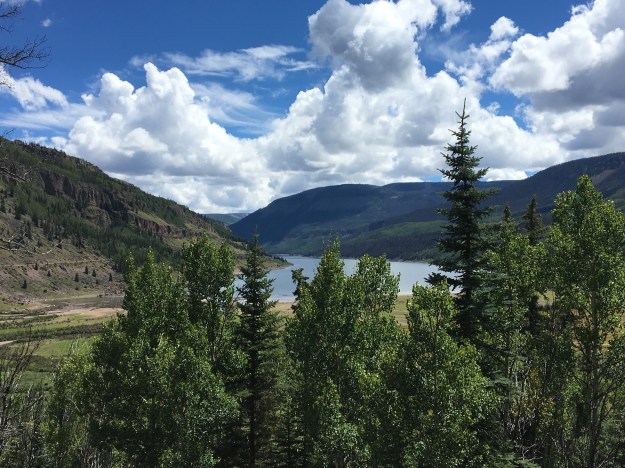
Our three day backpacking trip began at ThirtyMile Campground, just a mile or so east of the Rio Grande Reservoir.

After passing by a weather station, that is near and dear to me, as it is one of the stations that helped me calibrate the mean impact cold air funneling, in valleys throughout Colorado, has on nighttime lows, we encountered the Rio Grande Reservoir within the first mile of our trip.

IMG_7098.jpg

Going into this trip, which had been planned for several weeks ahead of time, we knew there would be muddy trails, and a heightened chance of rain.  Not only is Southwestern Colorado the most active part of the state during the late summer monsoon season, but this past weekend featured an active pattern in the region.

Friday was supposed to be the most active day, with regards to chances for precipitation.  Yet, we lucked out.  Leaving at 10 AM, after enjoying a nice relaxing morning at the campground, we hiked 7.5 miles, up the Weminuche Trail, dealing with very little rain, only with muddy trails.  Mindful of the storm threat, we stopped shortly after 3:00 P.M., having found a good spot to set up camp, near a stream and some trees.  Despite the periodically ominous looking skies, the storms held off until after sundown, giving us plenty of time to set up camp, cook a nice meal, and take in the wilderness, now being officially away from civilization.

I felt exhausted at the end of the day, as I had not gotten a good night sleep the prior evening at the campground.  So, I ended up going to sleep shortly after sundown.  With two backpacking trips behind me, I am starting to think that sleeping even more than the normal 7.5 hours per night is pretty normal on trips like this.

I spent the last waking hour of the evening inside the tent, listening to the sound of gentile rain tapping on the fly.  Under normal circumstances, many of us drown out these sounds, with TV, music, or some other sound.   Hearing this sound, for nearly an hour before falling asleep made me imagine a completely different life.

I imagined myself, as I often do, as a completely different person, with a completely different personality, upbringing, circumstance, and desires.  I imagined myself living in the woods, in a cabin of sorts, not too unlike the kind many people in Michigan, Minnesota, or Wisconsin have today.  It would be a modest sized cabin, with one main room, a bunch of bedrooms, a kitchen, and a closet, to keep things like cross-country skis, wet suits, and all of the other necessary equipment.  But, I would not have too many high tech or expensive toys.  It would be a life in a small community of sorts, where people know one another, spend a lot of time over at each other’s houses for dinner and games.  It would be a life way closer to, and way more connected with nature.  It would be a life that would never satisfy the real me, as restless as I get for one adventure after the next, one major social interaction after another, and testing limits.  But, for this alternate person I imagine myself being, as I drift off to sleep on a rainy August evening high in the San Juan Mountains of Southwest Colorado, it is perfect, cozy, and quaint.