Category Archives: Colorado

Ride the Rockies Day 2: Durango to Cortez

Day 2 would be a day of adjustments and surprises. The day started with a pretty significant hill climb.

Continuing the theme from day 1, much of this ride went through some very unpopulated areas. The only thing I remember about the towns of Breen and Klein were a fairly long descent and an aid station in a high school parking lot. This was followed by a gradual 17-mile climb on a dirt road.

I was somewhat confused as to why this ride incorporated some dirt road sections. Van supported rides tend to attract a lot of riders who like to ride fast. Apparently, cycling on dirt is a trend of some sorts. As someone who likes to determine for myself what to do, listen to and wear, trends have never interested me too much. However, I can see the appeal in some ways. On the transition from pavement to dirt, one cyclist announced that he was glad to finally be in a place where there would be little vehicular traffic and that he had become tired of riding on highways. I had felt the roads we were riding on were plenty quiet, but I have always lived in and around cities and know that experience is informing my perspective

Along this dirt road local ranchers came out to give us lemonade!

After talking briefly with the ranchers, I found myself wondering what life was like in a place like this. They are six miles from any paved road, ten miles from the nearest town, and thirty miles from Durango, the closest town of significant size. It must be so much different than anything I have ever known.

I feel bad because in the past I had cast judgement on life in rural areas as boring. Other metropolitan people can be harsher. While this is not likely the life I would prefer, we should all have the option to have the life we want. Being able to accept people having different preferences without feeling insecure about it is a sign of maturity.

Travel opens our minds to new perspectives. It makes us realize that the way we do things is not the only way. It gives us things to think about. Maybe these ranchers in the middle of nowhere have happier lives. Maybe they have better communities. Maybe, in a place like this, it is much easier to just enjoy activities like having a friendly conversation, reading a book or watching a movie without always worrying about what else is going on.

As the ride continued uphill on this dirt road, I found myself continuing to adjust to my surroundings. It grew hot and the next aid station had very little shade.

The people I was riding with represented a different type of crowd than the ones I typical find myself in. Mostly veterans of cycling trips of this type, many of them are accustomed to having better aid stations. I heard some grumbling.

Also, the crowd was significantly older than I had expected for a ride this intense. At this aid station, my first instinct was to joke that the aid station “throws as much shade as an episode of Mr. Rodgers.” I stopped as I suddenly realized that this joke would only appeal to a very narrow age range of people old enough to remember the children’s show that ended just after the turn of the century but young enough to appreciate the comparison between the literal and slang definition of the phrase “throwing shade”. The joke would not have landed.

After the dirt road segment, the route turned onto U.S. highway 160, an extremely busy road for a two mile intense climb to the top of Mancos Hill. This road was busy with both cyclists and cars!

Getting to the top was a little scary, as cyclists were commonly passing one another, requiring them to get closer to the vehicular traffic. Maybe the guy who was excited about the dirt road section had a point! He must have been less than thrilled on this part of the ride.

Somewhere on this climb, my body started hurting. Generally speaking, our lives in the early 21st century are quite sedentary. Most of our jobs involve sitting in front of a computer all day. In their spare time, many people chose to watch TV, read, or spend it in front of a different computer! Going from this to riding 70 miles a day on a bicycle is a transition for our bodies which is going to cause some pain. Whenever on a multi-day trip where the pain sets in I can’t help but lament how sedentary our lives are and how many people chose lives that are far more sedentary than mine.

We descended into Mancos, a town I had visited and stayed at years ago to visit Mesa Verde National Park.

I’d get a chance to visit the local bakery which had a message I could not help but get behind.

Mancos is the perfect kind of town for cycling trips to pass through. It’s big enough to have interesting places to stop but doesn’t slow the ride down too much.

While I was eating my sandwich, it got even hotter! We rode right by Mesa Verde National Park along highway 160.

The combination of prolonged physical exertion with hot, dry and windy conditions lead to salt slipping into my eyes. I was having some trouble seeing until luckily I was able to stop and get sprayed in the face with a hose.

By the time I arrived in Cortez it was 96°F (36°C).

The ride ended with burgers and music in a park where we all stayed in the shade.

Ride The Rockies Day 1: The Durango Loop

When I first got interested in cycling long distances I would never have imagined something like this existed. I thought it was too obscure of an interest. In High School, I recall enjoying using a very basic bicycle to go to friends houses, stores, restaurants and movie theaters. Then I thought it would be neat to travel from town to town by bicycle, go further and visit interesting places. As a map enthusiast, I was motivated by looking at a map and seeing the distance I could cover by bicycle.

Now, I find myself in an organized bike ride with over 2,000 other cyclists.

They talk about the same things. Places they had traveled by bicycle. Which “climbs” are the most challenging. Experiences like foul weather and flat tires, the kinds of things only people who have traveled by bicycle can relate to.

Unlike any other bike tour I had been on, this one was organized. Each day had an official start and end point. Aid stations were set up to provide cyclists with food, water and restrooms. Routes were planned and signed and there was a headquarters in each town where the rides began and ended every day.

The six day ride would also be the biggest challenge I had ever taken on when it comes to cycling. The official route was 418 miles with over 28,000 feet of climbing. However, there were many options along the route for people to shorten their ride. Day 5 was completely optional.

One thing I realized about cycling a long time ago is that it is a very individualized activity. Everyone rides at their own pace and has their own style. Some are in it for the speed, to achieve the fastest time possible. Others are more about the scenery and the experience. Some prefer to take frequent breaks, while others are more slow and steady.

Throughout the week, I would regularly encounter cyclists that I would pass on the highway repeatedly, as I would move at a faster pace but stop more frequently to take photos or just get my butt off the seat for a while. I also tend to be faster going downhill but am a slow climber. I encountered some cyclists that would pass me going uphill but I would pass on the descent.

Events like these cater to each person’s individual styles. There is no one start and finish time. There is a range of times. Even then, many cyclists leave outside that range. On day 1, the “rolling start” was from 7 to 9 A.M. Yet, probably due to the anticipated heat, I saw many cyclists leave before 7. Before the ride I signed up for “waves”, indicating my departure time each day. I forgot what “waves” I had signed up for and it did not seem to matter too much. I just left when I was ready.

Riding in the Rocky Mountains is challenging because you are pretty much always either going up or down a hill.

The hills on day 1 were relatively gentle. It took me 18 miles to get to my first climb. This part of the ride entered the Southern Ute Indian Reservation, and at about the halfway point I found myself in the tiny town of Ignacio.

The roads here were nice and it was interesting to encounter far more bicycles than cars for pretty much the entire route.

The town of Bayfield, where we left the Southern Ute land was also quite small. It was here I realized that these large cycling events have different implications than the self organized cycling I typically do. When biking alone or with a few other people, it’s advantageous to find towns with amenities like gas stations and restaurants to stay fed and hydrated. On this tour, the organized ride just needed to set up aid stations in large parking lots. It changes the dynamics and potentially alters which routes are possible and which places can be explored.

After Bayfield there was a climb that got intense for a brief period.

Still, on this day I did not feel as if I was in the thick of the Rocky Mountains. It felt more like rolling hills with the mountains off on the distant horizon.

The day ended with a major descent back into Durango and some pretty uncomfortable heat.

I ended the day feeling decent, but knowing that the hardest parts were still to come.

Peak to Peak Highway: The Perfect June Colorado Bike Ride

I started this ride just after 8 A.M. in Estes Park, Colorado, a town that has become so overrun with tourists due to Rocky Mountain National Park that they are now having visitors park at the visitor center and take a shuttle bus into town.

The town itself is surrounded by mountains still snow packed in the early part of June. Perhaps this residual snow at the highest peaks in the area is the reason this entire area would be less crowded than I had feared, and less crowded than it gets in July and August.

The first 8 miles of this 60 mile ride climb about 1700 feet (520 m), skirting by the Eastern and Southeastern edges of Rocky Mountain National Park.

There are even a couple entrance points to the park along the highway!

I liked the initial climb as a way to acclimate myself to the challenging ride and pace myself properly.

The ride as a whole does not have any flat sections. Some climbs and descents are long and others are short, but it’s always either up or down hill. The next part was mostly downhill, rolling through Allenspark and by one of the fastest sections of the highway (where I’d hit my top speed).

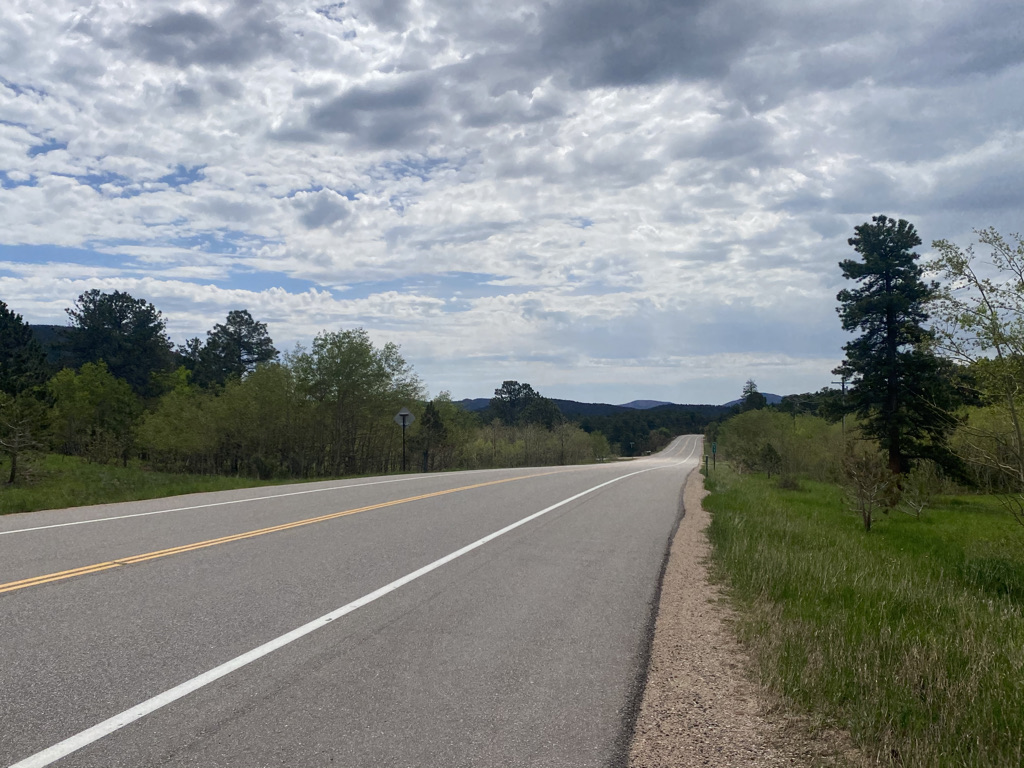
One of the things that makes this ride so close to perfect is the bicycle accommodations. With the exception of the first 8 mile climb out of Estes Park and another section of about 5 miles after Nederland, most of the highway has a shoulder so wide cyclists do not need to worry too much about interacting with traffic.

It is almost impossible to overstate how much this added to my enjoyment of this ride.

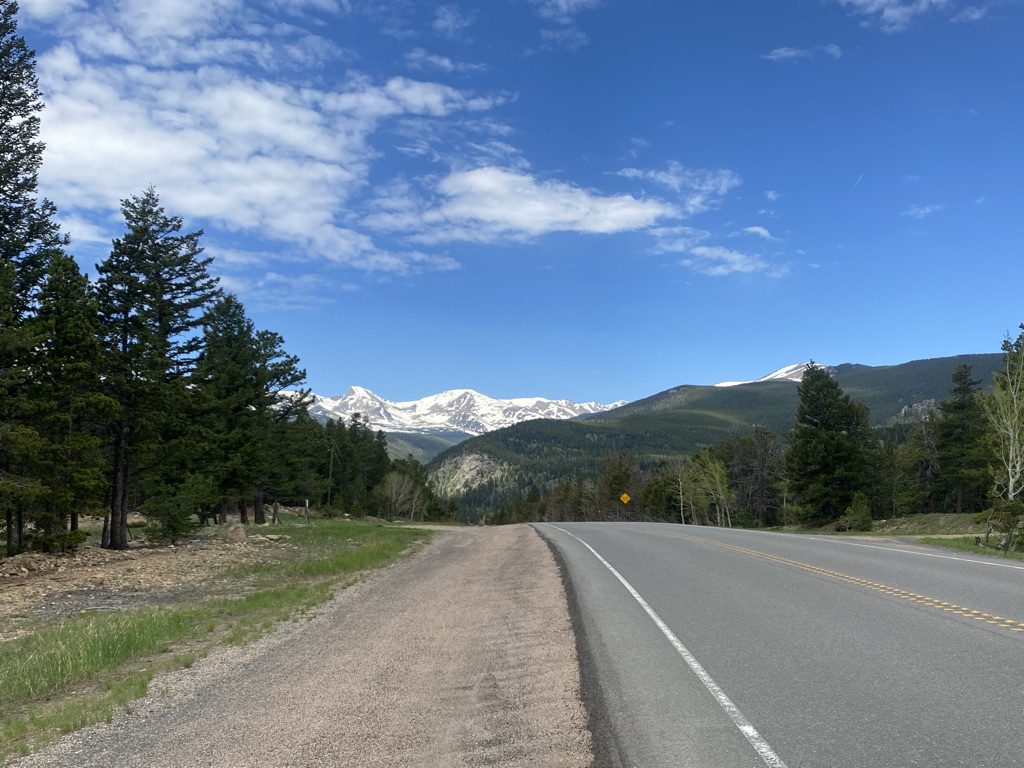
The entire ride is scenic in all directions. However, there are times when it is important to take a look back. The ride can be completed in either direction, from Estes to Blackhawk as I did or from Blackhawk to Estes. I decided to ride southbound, from Estes Park to Blackhawk to avoid afternoon crowds in Estes.

However, taking the ride in this direction did cause me to almost miss out on what turned out to be the best scenic overlook of the ride. Luckily, I stopped at the top of one of the many hills on the ride, this one about 20 miles in.

And decided to look back in the other direction, where those traveling in the northbound direction would be starting their approach towards Estes Park.

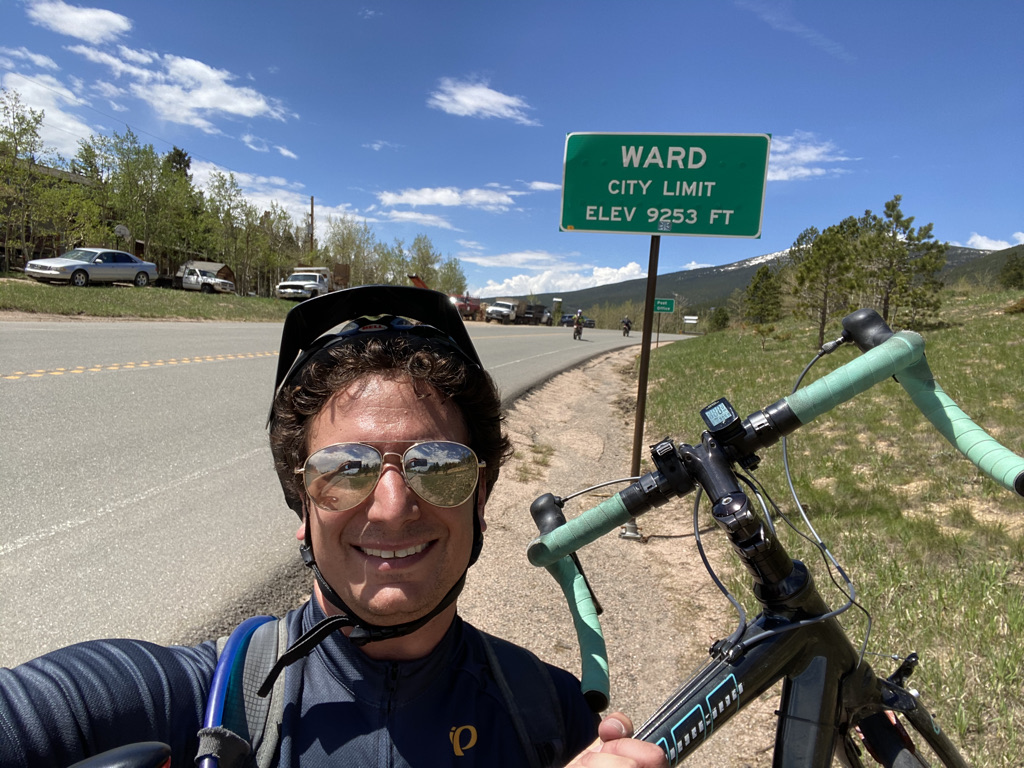
About 10 miles later and after another big hill climb, I would arrive at a tiny town called Ward.

It reminded me of a phrase I used to hear about smaller towns on road trips growing up, “You blink and you’ll miss it.” I remember sometimes being intrigued enough by such towns that I would follow along on the map and anticipate looking out the window at towns like these to avoid missing out on the momentary opportunity to see them. When traveling by bicycle, there is no danger of missing towns because I was reading, looking at my phone, or drifting off in thought.

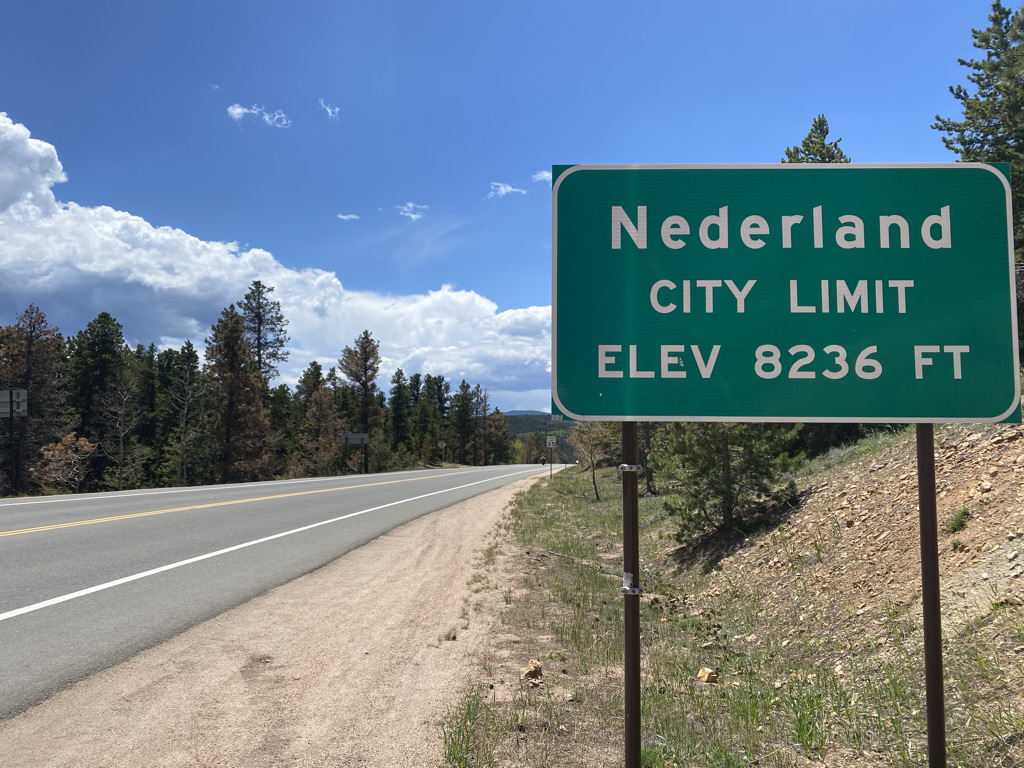
The next ten miles would be a series of rapid descents into the town of Nederland.

Having been to Nederland before, I expected to find crowds. There were people out and about, but perhaps because some of the trails were not yet opened up due to snowpack, it was significantly less crowded than I had expected. One other advantage to riding this highway from North to South is that I arrived in Nederland, the best place to take a break for lunch, a little bit after noon with 2/3 of the ride behind me.

Then would come the next most challenging climb (after the first 8 miles) and the only other section of road without a shoulder.

The open road returned alongside a series of hill climbs interrupted by short descents.

Throughout the ride I was hardly thinking of anything else besides what was in front of me. It reminded me of the state of flow so many people have been talking about during these somewhat psychologically challenging times. Most people enter this state of flow when they understand the task at hand, are sufficiently challenged, have sufficient autonomy and avoid distractions. Flow is said to accelerate both progress and satisfaction and the quest to reach the state of flow is an important component in many coaching services.

There I was, rolling up more hills until I finally reached the top of my final ascent.

Before I knew it I was flying down the final five miles into Blackhawk completing the ride.

After everything annoying about the past year or so, I have been working hard to clear as much negativity from my mind as possible. Apparently, I am not alone, as studies show 80 percent of all thought are negative. Even on a couple of my more recent bike rides, I struggled to avoid negative thoughts. I found my mind drifting towards conflicts with people, frustrations with recent events and the state of the world and such. It amazed me that on this day none of these thoughts entered my mind. I was present. I did not even come out of this ride with some sort of lesson. Those realizations would come days later. Maybe this turned into some kind of five hour long meditation session in nature. Either way I wish to have more experiences like this one.

Do We Have Too Many Updates?

Elk Falls, in Stauton State Park, is a fairly lengthy hike. The round trip from the main parking lot (called the Meadow Parking Lot) is about 11 miles, depending on where you park. It begins with a mostly flat, 3.1 mile section called the Staunton Ranch Trail.

The trail passes by areas of interesting rocks where people climb.

And even crosses a county line.

As is the case with most State Parks, this trail is part of a network of trails that connect several important features. Elk Falls just happens to be the most commonly discussed feature, as it is the tallest waterfall within an hour drive of Denver.

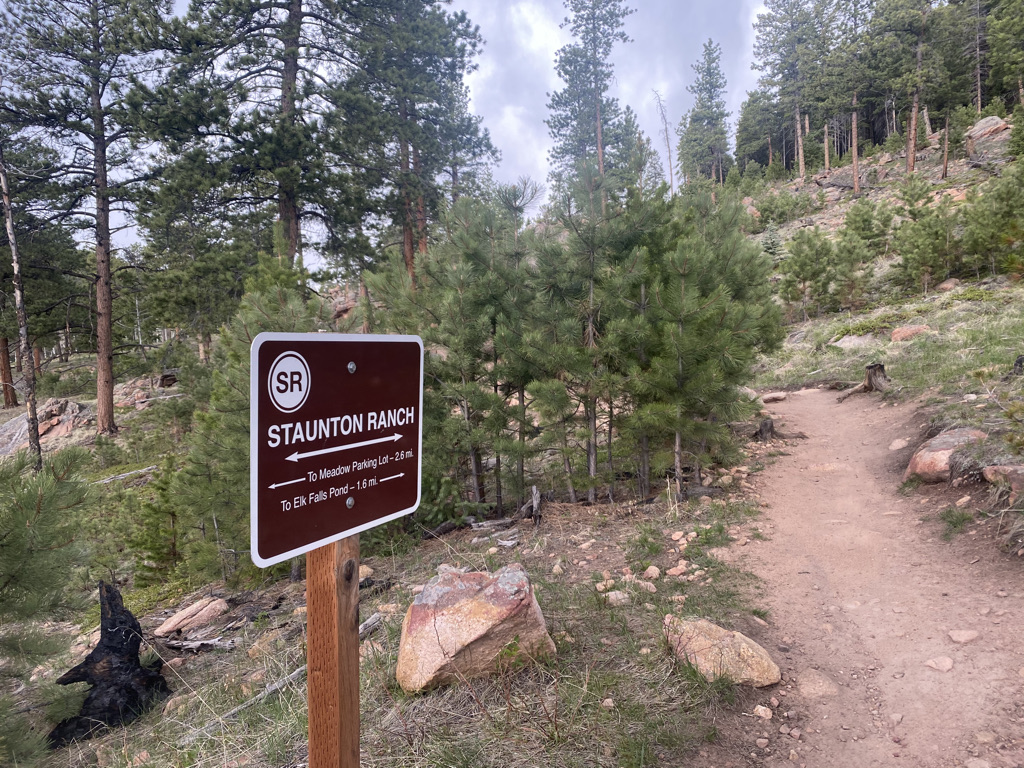
Staunton State Park is one of the easiest trail networks to navigate. At each trail junction, there is a sign that not only identifies the trails, but also serves as a mile marker.

At this point, I had hiked 2.6 miles and had 1.6 miles to the Elk Falls Pond.

With an additional 1.2 miles from the pond to the waterfall, this sign was quite close to the halfway point of the hike.

The hike from the parking lot to the falls would take just over two hours (the return trip would be about the same length). Over the course of the trip, the signage would provide me with a total of about five mileage updates. I actually found this to be quite close to the frequency I desired.

However, I wondered, how many updates we really need and what impact it is having on our experience. I thought about the explorers of centuries past, who would travel great distances using maps that, while state of the art for the time, would be considered woefully insufficient today. Lewis and Clark, for example, famously underestimated the length of their journey by many months. Yet, today we demand mapping software that estimates our time of arrival to the minute. These software packages, available to anyone who has a smart phone, even adjusts expectations for the one aspect of travel that still lead to uncertainty at the turn of the century- traffic. Now, at any moment in time, we can say exactly how much distance and how much time we have left.

Has this detracted from the experience? Are we bombarding ourselves with too many updates? Does checking the map on our phone for updates too frequently cause us to focus too much on the destination, preventing us from enjoying the journey? Could it even be causing anxiety? Elk Falls is the destination and the highlight of the trip, but while still over an hour away from the Falls, it is certainly better to enjoy what is in front of me than to spend the entire time anxiously awaiting the Falls. The same can be said for the trip back to the parking lot.

It makes me think of everything else in life we excessively look for updates on. How much is too much? How often do we check…

  • The number of likes our photo received?
  • The current status of our investments?
  • Whatever device is tracking our fitness goals?
  • The news?

And, what impact does it have on…

  • The experience we have in the places where we took those photos
  • How we think about the investments we chose to make
  • Our feelings about our bodies
  • How we feel about the state of the world

It feels like we’ve reached a point where we are updating ourselves too frequently on too many things. Maybe it’s time to back off all of it and try to be more present in the moment. Maybe this will require some degree of acceptance, of things how they are as opposed to how we wish them to be.

The Last Week of the Off-Season in Summit County, Colorado

Keystone Village Ice Rink three days before Memorial Day Weekend 2021

Somewhere along the line, a holiday set aside to remember those who had died serving in the U.S. military became the “unofficial start of summer”. This year the holiday also happens to coincide with many places lifting restrictions related to COVID-19, as a significant proportion of Americans have been vaccinated and case numbers have declined. In 2021, the contrast between Spring and Summer promises to be far greater than in any other year. It is a contrast between a “socially distanced” offseason and a fully re-open summer that unofficially began Memorial Day Weekend. The week before Memorial Day literally felt like the calm before the storm.

I spent most of the week riding my bike around the area. It felt like the last time in quite a while that these trails (the Summit County’s bike trail system) would be so quiet.

The weather was quite nice, although a bit chilly in the mornings. Yet, since it was still technically off-season, the crowds had not yet arrived.

Downtown Frisco Tuesday May 25th

Each season in the mountains is unique and as Spring transitions into summer, the sun is bright, but mountain tops still have a lot of snow on top of them. The middle part of a sunny day in May or Early June may be the brightest the area ever feels.

There are so many places of natural beauty and so many stretches of trail, throughout the county, where one can just be alone with their thoughts.

It’s hard not to feel spiritually refreshed after several days of cycling around the area.

The way the world is currently set up, cycling is by far the best way for me to process my thoughts. Almost anywhere else I find myself, there is the temptation to look at my phone or engage with some other distraction. Cycling, I need to have both hands on my handlebars. Therefore, there is a lot of value in riding long distances. It is on these rides that I process through life developments and often come up with ideas.

Wednesday was quite possibly the most significant day of this trip. The day started with the Super Flower Blood Moon, a lunar eclipse visible just after 5 A.M. It was visible for a while but then the moon slid behind the clouds as the sky started to brighten up. From a spiritual standpoint, I was told that lunar eclipses are a time for us to release things. So, at the time when the eclipse had peaked, although behind the clouds, I set the intention of letting go of a couple of things that were no longer serving me in life.

Later in the day I rode my bike from Keystone to Breckenridge, a 16 mile (25 km) ride (each way) with a moderate hill climb. When I arrived in Breckenridge, I randomly encountered a parade they were throwing for this year’s high school graduates, on Main Street.

Summit High School Class of ’21 celebrating on Main St. May 26, 2021

It warmed my heart. This year’s graduates in particular got a raw deal from the pandemic. It impacted both their Junior and Senior years. I was glad to hear them all happy, with many of them looking forward to the life they have in front of them. Written on many cars was the college the students were about to attend.

One of my favorite things about bike travel is randomly encountering events like this. They are much harder to miss riding a bicycle than driving on a highway. I even encountered the parade being staged, in the parking lot for the ski resort, which is empty because it’s off-season.

In a few weeks, this place will once again be active, with summer activities. Visiting the week before Memorial Day may have been the best of both worlds, nice weather but still not crowded. However, it is important to recognize it as a transition week, a time when one season ends and another begins. Many people fly from one activity to another, one endeavor to the next, not taking any time to slow down, process what happened and take in the lessons learned. The super blood moon was a time to let go of what isn’t serving us well. Hopefully, the entire week, as was the case for the graduates marching down Main Street preparing for College, was a time to reflect and prepare for what is to come. A time to close one chapter and enter the next.

Cycling up Mountains in a Storm

Loveland Pass on Sunday May 23, 2021

Colorado can be a pretty confusing and frustrating place in the Springtime. In most mid-latitude Northern Hemisphere places, Spring is a time of revival. It is the time of year where people who had mostly been indoors and inactive during the winter return to life. Here in Colorado, Springtime is a period of major weather fluctuations. In Denver, March and April are often the snowiest months. It can even snow in May. Sometimes it feels like we go from tracking the weather for snow to 90 degree heat with barely a week or two in-between.

Credit Channel 7 Denver

At higher elevations it snows quite a bit during springtime (Leadville is 10,200 feet (3.1km) above sea level), even as the snow melts into mud on most trails. It is probably the most inactive time of year in the mountains.

Image from Weather Atlas

Springtime in Colorado requires a combination of planning, adjustment and resiliency. The weekend of May 22nd and 23rd would test my resiliency because I kind of dropped the ball on planning.

On Saturday, I climbed Lookout Mountain, a ride in Golden, Colorado that climbs from 5500 feet (1675m) to 7300 feet (2200 m).

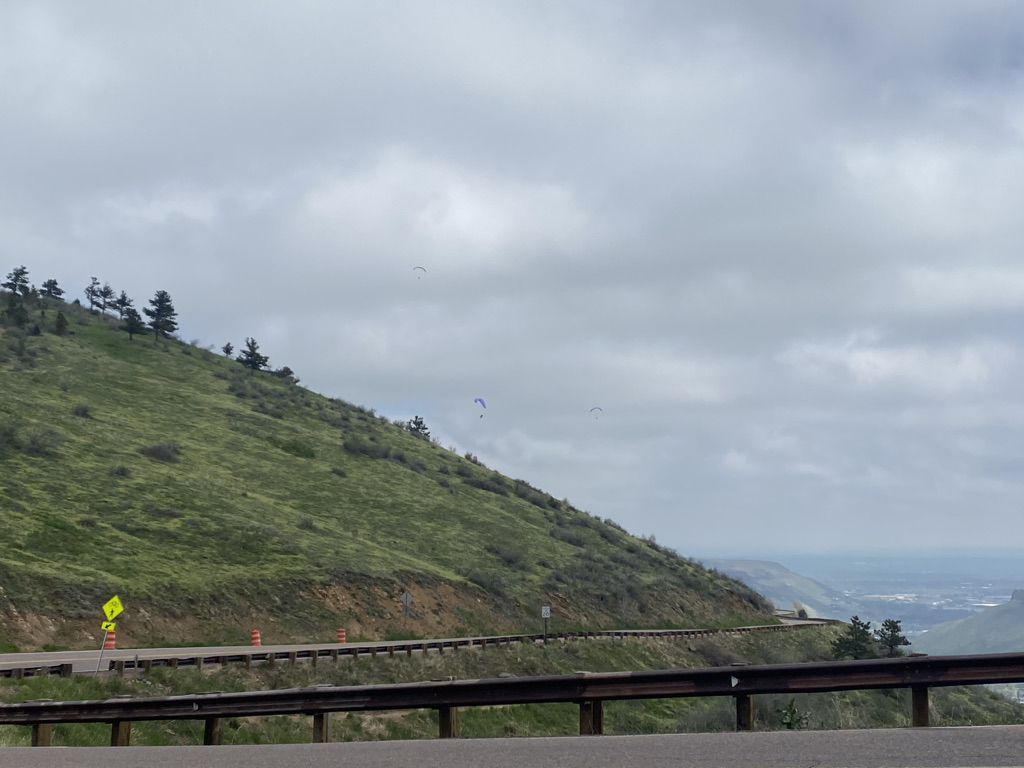
The day was somewhat stormy but also quite active. Paragliders took off from Lookout Mountain, flying over the town.

And the road was packed with cyclists. Only about 20 miles (32 km) from Denver, this is a very popular ride!

After noon, with even more paragliders taking off from the mountain, I encountered the storm.

Some cyclists chose to wait out the rain by finding a building to stand next to. I raced back home, into a fairly significant wind down the hill.

The next day, I went up to Loveland Pass to climb another mountain, this one at a much higher elevation. My ride began at the parking lot of Loveland Ski Area, which sits at around 10,600 feet (3230 m). I could already see that the storms had returned.

As is the case with going upwards in elevation, the weather was much colder, probably only around 45°F (7°C) at the start of the ride. From the very beginning, the ride felt like it was taking place in a different season.

Much of the ground was still covered with snow. Unlike on Lookout Mountain, I was the only one on a bicycle on the road up to Loveland Pass that day. The only other people I encountered were backcountry skiing. One joking asked me for a ride to the top of the pass on my handlebars.

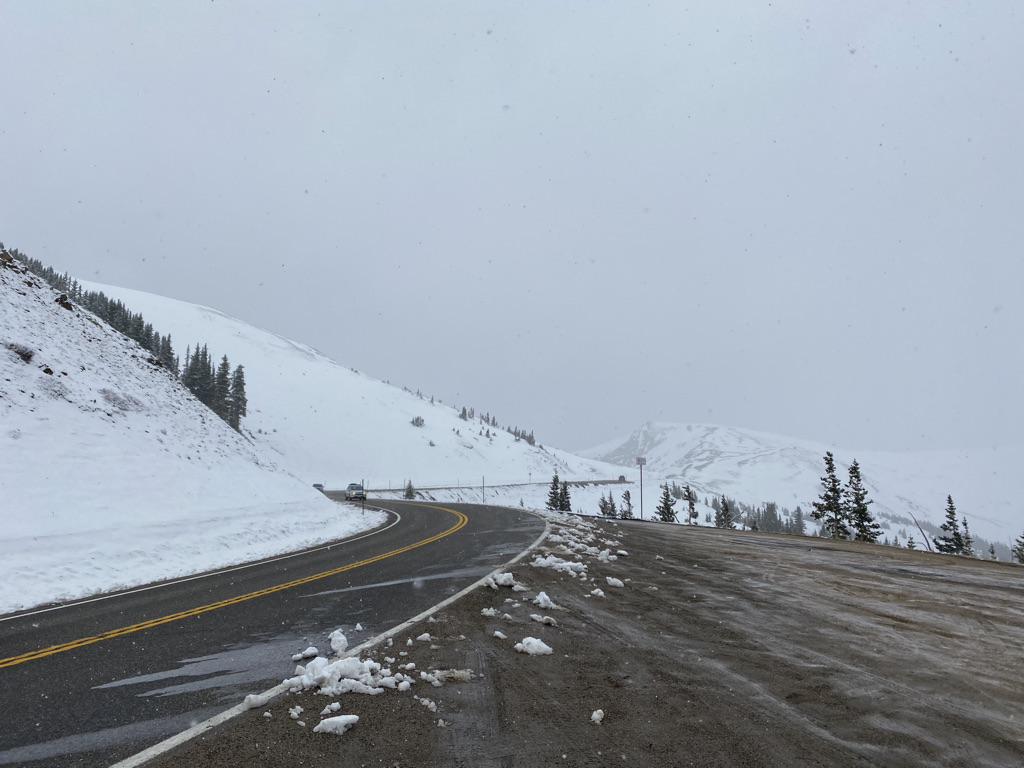
Higher up the mountain, I suddenly found myself doing something I typically try to avoid, riding in the snow. It became scary as it was obvious that slippery conditions existed.

Near the top visibility continued to decline.

Finally, just to be true to the cycling community I belong to, I took a photo holding up my bike in front of the sign that indicated I had reached the top of the pass at just shy of 12,000 feet (3650 m).

There I stood, the only cyclist, almost out of place, like I was suddenly in the wrong season. It reminded me of how often we forget that different people in different places are often having quite different experiences. Two months ago, towards the end of March, while most places in North America were seeing people emerge from their winter dormancy and return to life, life in the Central Rockies was slowing down as the ski season was coming to an end. Now, there could not be more contrast all around me.

As the United States has mostly put the COVID-19 pandemic behind us, countries with slower vaccine rollouts are dealing with some pretty bad case numbers associated with newer, more rapidly spreading, variants of the disease. This sits in sharp contrast to last summer, when other more prepared countries had much greater success in containing the virus through behavioral measures than we had. Heck, even the period of time westerners refer to as the “dark ages“, were not a dark time for everybody. The Tang Dynasty was remembered as a golden age for China. It was also a time of great advancement in the Islamic world. Finding myself on my bike in the snow in the second half of May reminded of the benefit of understanding that not everyone and not every place is having the same experience.

From Either-Or to Both-And

It feels good to be traveling again!

Here’s to more to come!

However, I must acknowledge that the middle of April is kind of a strange season to return to the world of traveling. It is not a very popular time to travel. Part of it is the school schedule nearly all families are subject to. Spring break is over and nobody finishes their school year before May. Mid-April is also a weird in-between season. In many active northern and high-altitude places, it is referred to as “mud season.” When people think of this time of year, they think of it as some abyss where conditions for activities on snow and ice deteriorate but the air has not warmed quite enough and the ground has not dried up enough for summertime adventures. I often specifically tell people not to come to Colorado in April because other months offer so much more.

And, thus, it is a great time to travel elsewhere.

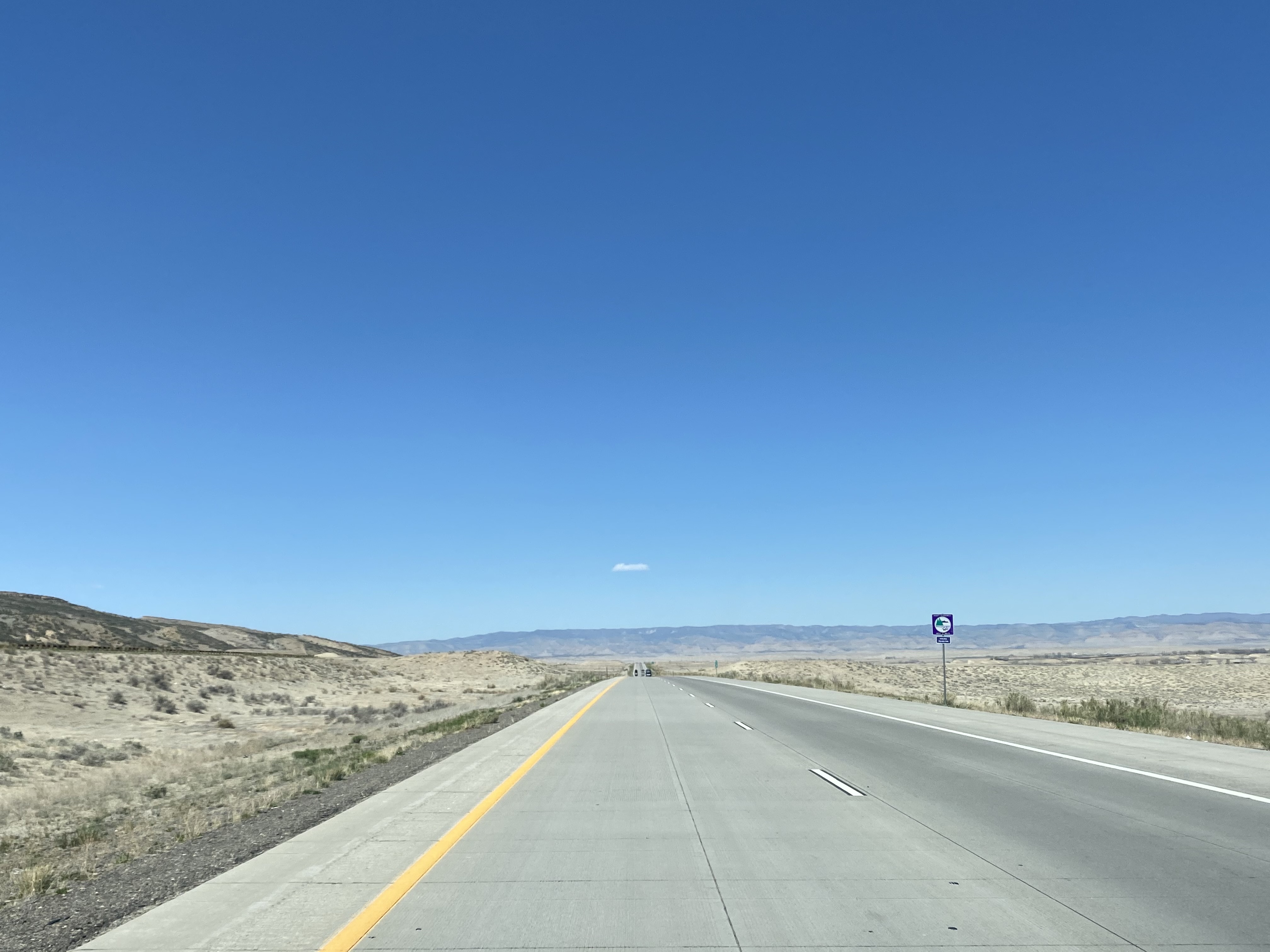
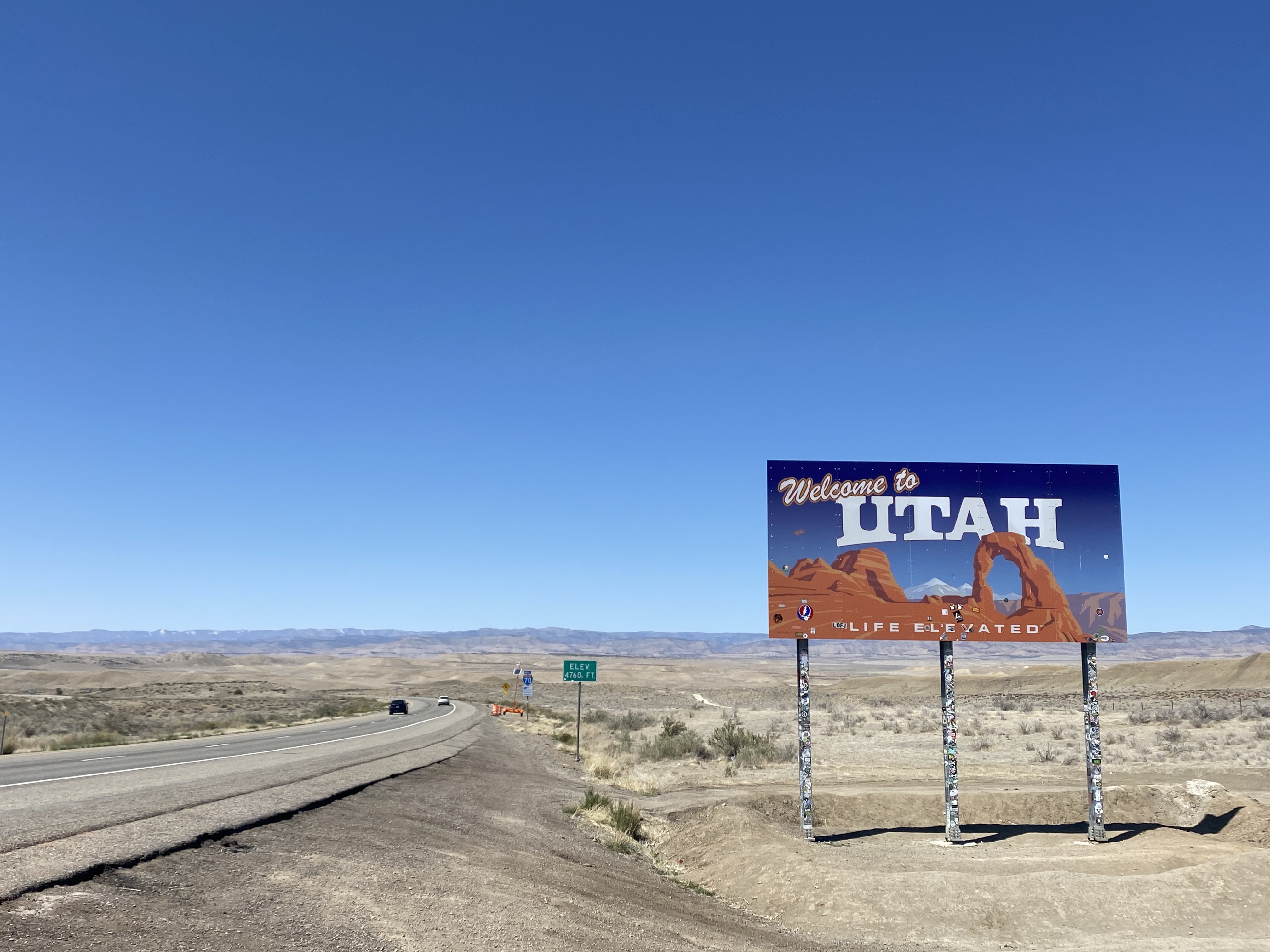
It was the very first part of the first adventure in a new post-pandemic world. It was an opening act, a preview of what world we will all be re-emerging into. And, this drive from Denver to Moab (Utah) ended up providing some interesting hints as to how our thinking is being transformed.

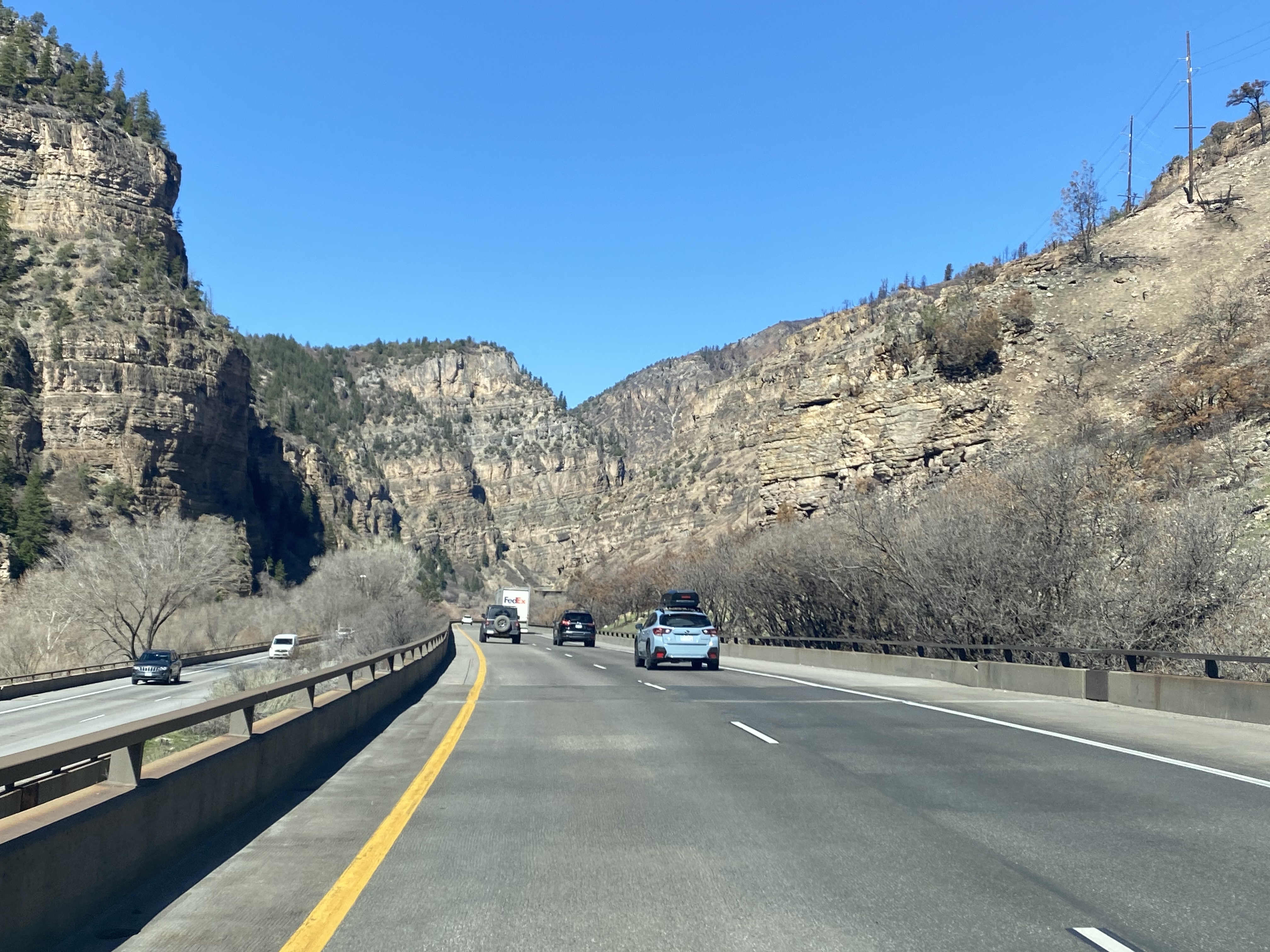
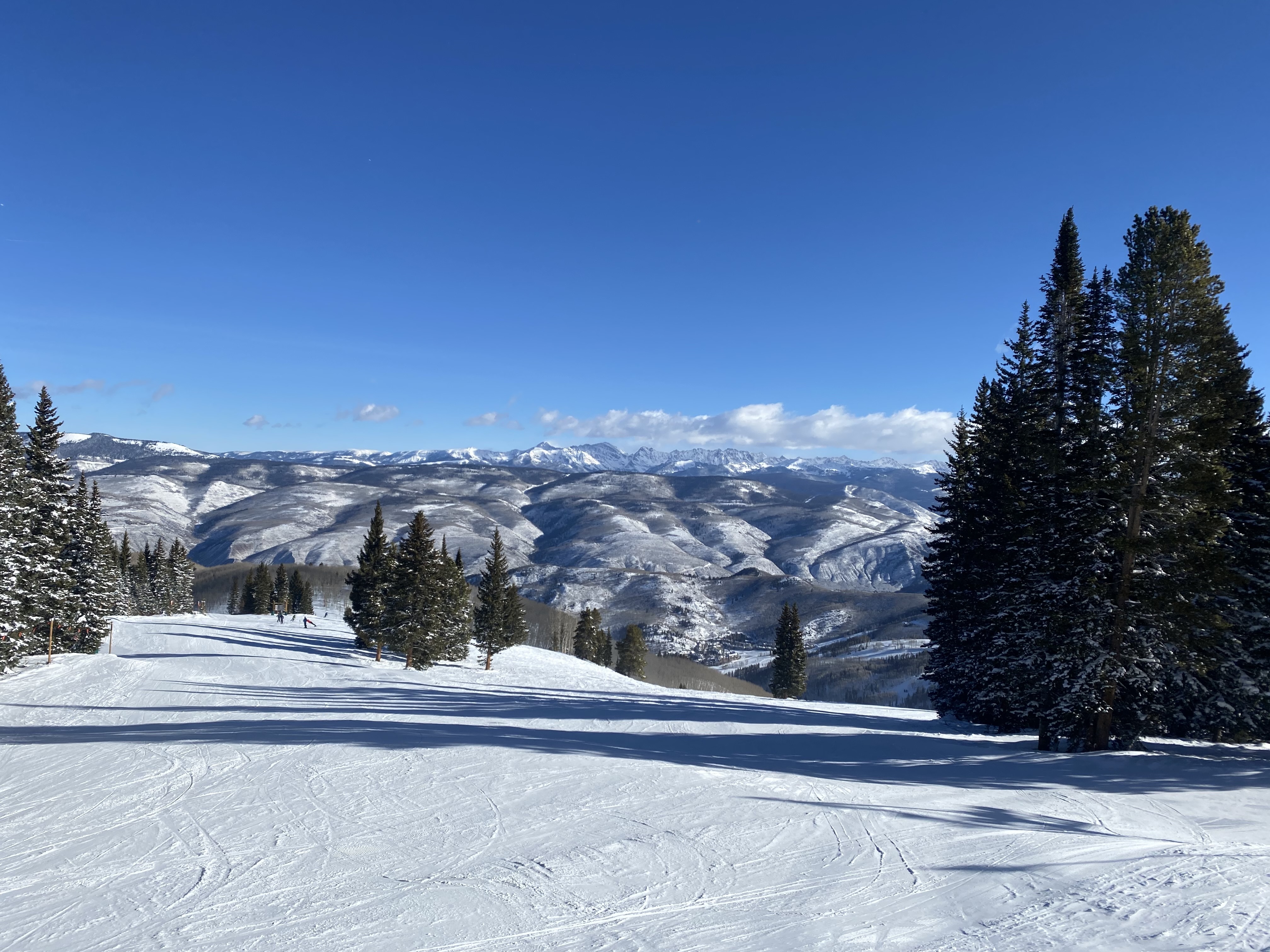
Loveland, Copper Mountain, Vail and Beaver Creek ski resorts are so close to I-70 motorists can see people skiing from the highway. That is, if the ski resort is still open. Not only were all four ski resorts still open, but the all had plenty of people still skiing.

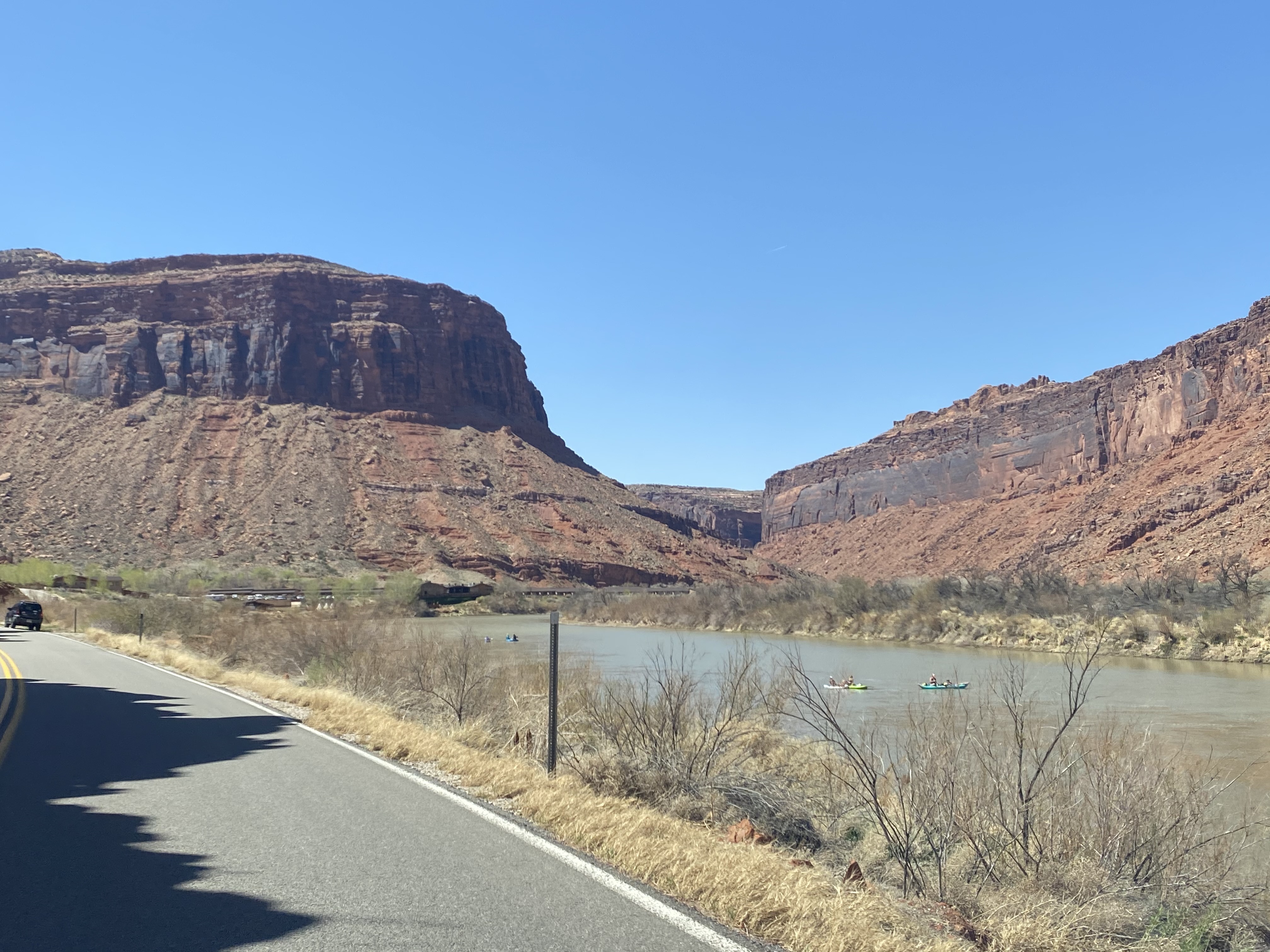
Two hours later, across the border and down the slope near Moab, it felt like a completely different season.

Kayaks, canoes, rafts- people are already in the water. Could it be that a time of year many people had come to associate with boredom and few opportunities actually presents a plethora of opportunities for those willing to expand their view?

For some specific points on the map, especially some of the highest rated ski resorts, this is a time of year with little opportunity. The snow is melting and the ski season is coming to an end.

However, people looking to ski this late in the year can often still find some good skiing at lesser known higher elevation resorts. At lower elevations, like Moab, the weather is already ideal for some activities associated with summer. In fact, this is one of the best times of year to head there, as the middle of summer often gets quite hot.

What is interesting to imagine is someone either choosing between hitting the slopes or getting their canoe out. Or, even doing both!

One of the most profound ways that our world is shifting is a move away from an either-or to a both-and method of thinking. It has the potential to help us clarify our goals, live more balanced lives and more effectively settle arguments. For example, either-or thinking has always lead me to believe that my desire for community and to preserve my individuality are at odds with each other. Both-and thinking would encourage those of us with the same two needs, which is nearly everybody in reality, to develop a solution that considers the two truths about human nature.

Finding solutions using this new both-and mindset requires creativity and widening our view. At one specific spot, it is either ski season or summer, and sometimes neither. If we expand our range to include Loveland Ski Area (base elevation 10,800 feet) and Moab (elevation 4,028 feet) it is currently both! Perhaps, with this new way of thinking, an an expansive and creative worldview, we will design communities that give people a sense of belonging without having to surrender their individuality. Perhaps, with both-and thinking, we will also make headway on all of the other tug-of-war issues that have been driving us apart.

The Search for the Most Ideal Conditions

The lift lines at the ski resorts were so long that images of them made the rounds on social media, and the news even reported on how long these lines were. They were the longest lift lines I ever waited in. And, I was at Vail, a resort where lines tend not to be too long, as skiers have so many places to go!

What happened? And, what does it mean for the near future?

With restrictions related to COVID-19 being in place in one form or another for close to a year, there is a lot of pent-up energy all around us. Even some of the most introverted people are at the point where they are craving a return to many of the activities that we all, in one way or another, took for granted before the pandemic hit. Outdoor activities like skiing have been identified as relatively safer, when it comes to potentially spreading the virus, than large indoor gatherings.

Also, the snow season got off to a slow start. Before the national and local groundhogs predicted six more weeks of winter, the snowpacks in the mountains were running close to 30% behind seasonal averages.

It appears right now that the groundhogs turned out to be correct. In some places, several feet of snow would fall during the first week of February. This would inevitably lead to many “powder chasers” coming to the ski resorts. For those that love fresh powder, Thursday and Saturday would represent the most ideal conditions possible.

The problem with the most ideal conditions is that they also commonly lead to crowds. This is especially true on weekends. Since the predominant work schedule is still Monday through Friday, for many, having an event occur on a weekend makes the conditions even more ideal. Never will there be a day with bigger crowds at a ski resort than a powder day that happens to occur on a Saturday.

Oh, if life in general were just about finding the most ideal setup for anything, how much simpler it would be. Unfortunately, in nearly all areas of life ideal setups lead to some form of crowds.

Found the best job opportunity ever? Good luck with the 500 other applicants.

Look at that amazing house in a great neighborhood of a really trendy city! I wonder how long it is on the market and how much over asking price you will have to offer (this is really happening in Denver right now).

Unless you are a serious iconoclast it is also likely that at some point the person you wanted to date had several other suiters and the events you want to go to require tickets or a cover charge to get in.

Sometimes, the best way to find the ideal opportunity in all areas of life is to find the one where there is something off, but something you can live with.

Groundhog Day itself was a Tuesday. Despite really warm weather, conditions on all the trails in the area weren’t perfect. But, it still was a fantastic day for a bike ride.

By Sunday, the snow was a little bit less fresh.

Yet, the newer snow still made for some great conditions. Also, the sunshine made for a fantastic experience.

It also happened to be Super Bowl Sunday. In the right place, at Beaver Creek Resort, the lines were significantly better.

There are very few situations in life where we can have it all. Usually, we have to chose what is most important to us. The key to finding the right experience is much like the key to finding the right opportunity. It is to figure out what less than ideal conditions we can live with, whether it be an investment that is somewhat “risky”, a few icy spots on a bike trail or a job that requires the occasional late night to meet a deadline, and take advantage of those opportunities.

When Cycling Was What I Needed

January 31, 2021 on the Platte River Trail in suburban Denver…

I ceased pedaling for a few seconds, allowing myself to slow down. This helped me successfully navigate around several groups of people, while anticipating the unpredictable motion of dogs, children and even a few less attentive adults. There were so many people walking side by side with their dogs, or even in large groups, likely families. This made navigating the trail, in sections, particularly challenging. On this section of the trail, pedestrians outnumbered cyclists by about 3-to-1.

After navigating the congested area, my mind began to wander onto some of the more pressing issues of our time.

I thought about those on the left, who were concerned with people not getting paid what they are worth and the amount of power employers seem to have over their employees. I thought about those on the right, concerned with inconsistency and the possible abandonment of our core culture. I even thought about my own concern about preserving our basic freedoms, and a political culture that has become both more divisive and intrusive into more areas of our lives.

I thought about the commonly heard proposed solutions and why I find them narrow, short-sighted and potentially dangerous. Most people support solutions that address the issues that matter to them, but could make other problems worse, or create new problems altogether. I began to ponder an innovative solution that addresses multiple concerns at once. Then, I began to wonder if the solutions I would come up with would be just as narrow and short-sighted as the ones that terrify me.

Before I knew it, I was once again rapidly approaching a large group of people, this one larger than the last group. I decided not to be aggressive. It is a Sunday. I’m not in a hurry. After all, we are still supposed to be “social distancing” and trying to avoid using hospital resources, which are needed for COVID patients, for avoidable accidents. I slowly navigate around the group. First, I pass the parents walking and talking, while avoiding the couple walking in the other direction. Then, I maneuver around several children in front of them using scooters. However, this time before fully clearing the group, I suddenly noticed another cyclist behind me.

“On Your Left!” he shouted before I had fully moved over to the right side of the trail. I guess every person on this trail has a different agenda for the day.

The same cycle repeated for about 12 miles. The experience of suddenly realizing a more aggressive cyclist was behind me even repeated several more times. Regardless, my mind was alternating, almost in a rhythm, between navigation mode and pondering mode. The more I pondered these grand issues, and processed my thoughts about human nature, the more pessimistic I became.

Then, suddenly, I entered a section of the trail I had never fully appreciated until now. It is in the Southern part of Cherry Creek State Park.

Cherry Creek State Park is known for a fairly large (for Colorado standards) reservoir where people swim, boat, and apparently also walk on the ice in winter.

Seriously, I don’t know if this is safe. Winters here are not consistently cold, and the temperature was around 53°F (11°C) at this time.

However, at the southern end of this park the trail winds through a large open field.

Maybe this is what happens when you finally start to feel the physical strain of a long bike ride and don’t have the energy to think about mentally taxing subjects. Or, maybe it was the inspiration of the bright sunshine and the contrast between the mountains in the distance and wide open, mostly brown, field in front of me. I just gazed at the scene. I realized that, unlike in many other situations, nobody was trying to make me think about those topics that were making me feel pessimistic. All I had to do was appreciate that on this, the last day of January, the dead of winter, I was enjoying a sunny day on my bicycle.

I felt youthful, untamed and uninhibited, which was exactly what I needed after a year that has been filled with fear, restrictions and divisiveness. There was no better place to be than on my bike, on this trail.

I rode my bike nearly 60 miles that day, finding a great stopping point with some hidden treasures.

We are facing a lot of challenges and it would be foolish to ignore them. However, it would also be foolish to allow them to consume us. No matter what anyone is going through or becomes concerned with, sometimes it is necessary to just enjoy the experience in the here and now.

Crested Butte January 2021

The way we talk about the weather is quite peculiar. There are many that consider the weather amongst the most mundane topics of discussion, the thing people talk about when they don’t have anything more interesting to discuss. However, there is perhaps nothing that has a greater impact on the human experience than the weather. Every single day, the activities a person takes part in is at least partially determined by the weather. Activities like skiing and hiking are associated with seasons. Any outdoor sporting event has the potentially to be cancelled by inclement weather. Changes in long-term weather patterns, or climate, have brought down entire civilizations.

Perhaps the reason highly intellectual individuals prefer not to talk about the weather is the manner in which the topic is simplified. The weather anyone experiences is a result of scientific processes so complicated that despite our advanced observational and computational technology, it can still only be predicted to any degree of accuracy about a week out. The impact weather has on things like health, culture and happiness is the subject of countless articles and dissertations.

Yet, most discussions about the weather are boiled down to simple descriptions. It’s often described as simply “cold”, “warm”, sunny”, “rainy”, etc. Perhaps the most significant oversimplification of the phenomenon that we call weather is the description of weather conditions as ether “good” or “bad”. Generally, people refer to sunshine and pleasant temperatures as “good” weather, while any kind of unpleasantness, from rain to extreme temperatures or strong winds, as “bad” weather.

However, too much “good” weather can often lead to some terrible outcomes. The entire planet’s food supply is dependent on rainfall. Last summer’s wildfires across Western North America demonstrated that there are few businesses that have absolutely no exposure to what can happen when a region experiences too little precipitation, or “bad weather”.

Skiing, is perhaps the most obvious example of an activity that requires “bad” weather. Four years earlier, Crested Butte ski resort was buried under 100 inches of snow.

The winter of 2020-2021 has been far less snowy, making for pleasant days to ski, but perhaps not the best snow conditions.

Skiing is the most obvious example, but nearly every activity in life requires a certain amount of “bad” weather. It is a reminder that simply describing weather conditions as “good” or “bad” as they pertain to a specific day’s activities may be fine for a children’s nursery rhyme, but fails to accurately represent what combination of weather conditions are necessary in the long run. For the world’s food supply, farmers need a combination of rainy weather for the health of their crops and pleasant days to tend to their plants and animals. Skiers need snow, obviously, but benefit from days with good visibility, low wind and pleasant temperatures.

Nearly every activity, as well as life on Earth itself, requires a combination of different weather conditions. The key is to properly manage the expectations for each day based on our changing weather.

In Crested Butte, residents and visitors alike are dealing with both the ongoing pandemic and snowpacks that are about 30% below normal for this time of year. Yet, people are finding a way to continue with their lives. It is hard to be too negative in a town this beautiful.

While the ground may be a bit rocky in the trees, or on bump runs, a mild sunny day is the perfect time to admire the beauty of the morning sky while flying down fast, steep groomed trails.

The town itself, like everyone’s favorite optimistic and quirky friend, does not seem to be discouraged by what nature has brought.

Perhaps one of the reasons so many people dislike talking about the weather is because it represents something that cannot be controlled. It can only be responded to. It is, in a way, a metaphor for life. People generally have minimal control of what happens to them. The only thing that can be controlled is the response. Crested Butte, in January 2021 has shown that the proper response to all that life can throw is to be versatile and adjust while also remaining true to oneself.