Category Archives: Personal Development

Focusing on What Really Matters

That is, the people that have made, and continue to make, my life what it is.

Our day-to-day lives can become, at times, spiritually toxic.

We get preoccupied by what we are doing on a day-to-day basis. Often that involves a combination of work, other responsibilities, and some form of “quest” we have for ourselves. For many, that “quest” is status or career related. However, for some, things that are typically thought of as “leisurely” can end up being that quest….

I need to get a better golf score.

I need to be the best looking person at the party…

I need to get a better time running up “the incline“…

How much skiing can I do in one day?

IMG_5177

More often than not, we achieve what we set out to do, as long as we willing to put the necessary time and energy into it. If it truly matters to someone to be popular, they eventually will be popular. If it truly matters to someone to advance at work, make a lot of money, or even play on a winning softball team, well, it will be done.

image

I guess things do happen by accident too.

It’s just a simple matter that, well, nobody has the time and energy for everything.

We have to make choices. We have to set priorities. Over time, our lives end up becoming reflection of the priorities we set. When I see a divorced and single powerful executive, well, it is clear where their priorities have been for quite some time.

Sometimes I lose sight of this, but people have always been a priority to me. I feel far more fulfilled when I share my adventures with people, and I am certainly more satisfied when the tasks I perform on a regular basis are having a positive impact on the lives of other people.

Acting more in accordance with what my true priorities are, I spent a long weekend, right in the middle of the summer, in the flat midwest, largely indoors.

Not just in the maze of suburbs that surround Chicago, and in Indianapolis, Indiana, but also traveling I-65 between the two, not the most glamorous ride.

The main draw to Indianapolis is its affordability. It does not necessarily find itself at the top of people’s “bucket lists”, or desired travel destinations.

IMG_0491 (1).jpg

However, many chose to live here. The city continues to grow and appears to be prospering!

Which means that, in Indianapolis, a group of people can easily find enough interesting things to do and have a really good night out. It is often cheaper too. Well, that is unless the evening includes a visit to the most expensive steakhouse in town…

One of Indiana’s most iconic restaurants aside, the weekend was not about being at a high profile destination. It was about the people I was around, and it was nothing short of magical. I felt that feeling that is so elusive we do not even have a word for it in the English language; the opposite of loneliness, in a world that is lonelier than ever! I am blessed to have the people in my life that I have, near and far, from all my life’s “chapters”, and people who are willing to set aside time and energy to meet up with each other. This is what made me feel so wonderful this weekend- possibly more wonderful than I would have felt had I went off on my own, to a bucket list destination, or spent this time trying to advance my career.


When we act according to our true priorities, the result is always better 

Just as important as what our priorities are is how our priorities are set.

Not everyone will set their priorities exactly like I do. The question is whether we are being true to ourselves when these priorities are determined, day in and day out whenever there are multiple needs competing for our time, money, attention, and energy (i.e. life).

Are we making choices based on our own understanding of what we need to feel happy and fulfilled? Or are we letting something else dictate what we prioritize? Fear of losing a job? The desire for approval from others? Someone else?

The world can often bring us in the wrong direction, setting the wrong priorities. The boss pressuring you to perform. Peers bringing out your competitive side. Even self-doubt. This is why I urge everyone, in order to achieve a better life result, to..

  1. Determine priorities for yourself. List them, and order them.
  2. Each week set aside time to evaluate, and most importantly, reassert in your own life what your priorities are and how that should be reflected in your choices.
  3. Occasionally re-evaluate those priorities, and determine if some areas are needing more attention.

IMG_9024


TEDxMileHigh: Point of Departure

IMG_0280 (1)

It’s a mid-summer weekend in sunny Colorado and thousands of people are standing in line, actually various lines that snake all around the Ellie Caulkins Opera House in downtown Denver. They are all waiting to get into the theater to hear a series of talks. These talks will cover a wide variety of subjects. One will be about a big idea, something that may change the world in the coming years. Another may be a personal narrative, and another may even be a musical or poetic performance. The only thing these talks have in common is the main draw. The main reason anyone chose to spend a Friday evening and Saturday afternoon in the middle of the summer inside a building as opposed to in the mountains where most Coloradans chose to spend their summer weekends, the association with a brand known as TED.

IMG_0259 (1)

Most people have some form of exposure to TED talks, even if they did not purposely seek them out. TED talks are shown at all sorts of conferences and workshops, are shared with friends and colleagues regularly, and are commonly found in web searches. This was the first time I chose to attend a TED event, but I have watched quite a few TED talks in my life. When you are really ill, watching TED talks on YouTube can be the most productive thing to do with your time.

What I notice most about TED talks, both at this conference and online, is the fact that I never get bored during them, despite the fact that I find it quite easy to get bored and antsy during presentations, especially of the standard power point variety. It is quite clear that the people who organize TED events (and TEDx events, which means they are independently organized) follow a formula that takes into account how the human mind works and responds to information as presented. Talks are generally 15-20 minutes, consistent with most scientific understanding of the human attention span. Short videos are presented between talks of wildly differing topics to ease the transition from one topic to another.

Speakers undergo a rigorous three-month long process of preparation to ensure all TED talks meet their standards. As a result, speakers always seem to emphasize the right words, stay poised, and avoiding using filler words. Auditions for speakers for this conference took place in February, and auditions for their next conference, in November, take place at the end of July!

When I think of the brand TED, the first thing I think of is people who think like me. By this, I do not mean people who have the same opinions on certain specific issues or policies. It is more of a general sense of what “TED people” are like. If there is one thing that binds all the people who speak at and participate in this brand known as TED, it is the desire to think beyond the day-to-day routine, the next task or the next purchase. People come here because they want to be inspired. They imagine possibilities beyond what is seen directly in front of them day-to-day. They want to engage their intellectual curiosity. They believe their life will be changed, or even that the world will be changed, by something they hear about and talk about here.

The conference provided a few other perks as well…

Each ticket, regardless of whether it was General Admission, VIP, or All Access, provided a free lunch, to be redeemed at one of many food trucks located in sculpture park behind the Denver Performing Arts Center (which houses the Ellie Caulkins Opera House). There were vendors for many other other organizations too, including ones that focus on environmental activism, sell new flavors of tea, or focus on career development. At the end of the conference, I even got a free pair of eclipse glasses, which I intend to use to view next month’s total solar eclipse.


After 22 speakers spread over three sessions, meeting countless interesting people, and a really awesome after-party (there was an after party both nights, but I only attended the Saturday night one due to poor meal planning on my part), I felt something absolutely crazy. I came out of this conference with more energy than when I had arrived. I wasn’t expecting this, as most conferences leave me drained. This one covers even more intellectually and emotionally draining topics than most.

The success of the TED brand seems to run contrary to every piece of business advice I have ever received. I am always told to have a specific product in mind, a narrower purpose, and a specific target audience, like all those blogs that focus on one activity.

Yet, this idea seemed to start with a broader purpose; to inspire and change the world. Then, they thought about humanity and found the most effective way in which to present the information. If TEDxMileHigh Point of Departure taught me anything (other than specifics like how fast a supersonic jet can go) it is to stop worrying about how others achieved, or what status anyone has. It is all about having something to offer that people see as worth-wile, and bringing it to them effectively, regardless of titles or perceived status.

Five Years in Denver

IMG_0195 (1)

A personal narrative..

I cannot believe it has been five years since I moved to Denver, and I cannot believe that 2017 is already half over. I’d say “time flies”, but that is kind of a cliché. Time does not really “fly”, or even go by rapidly. It just appears as such when we think about time in larger chunks. In the past five years, I can think of plenty of Tuesday afternoons where it certainly did not feel as if time were “flying” by.

Okay, enough random psychological ramblings. However, I do want to point out that unlike most social media content these days, I do plan to be forthcoming with my own weaknesses and struggles. Hopefully that is refreshing.

My first five years in Colorado can be thought of as anywhere from a complete success to a total failure depending on how it is looked upon. By the traditional definition of “success”, I guess I am mostly successful. I make good money, live in a good place, and am healthy. By a more modern, and more millennial version of “success”, I’m kind of a failure. This is because I am haven’t gotten to the point where I am using my strengths to impact the world in a positive and meaningful way. I hope my writing encourages others to believe in themselves, find adventure and live better lives. However, life on an average day feels pretty empty. What I do to earn a living is quite insignificant, and has been for almost the entire five years I have been living here.

IMG_6809

When I first moved to Denver, I attempted to recreate what I had in Chicago, particularly the social situation, which I really enjoyed.

This proved challenging for three reasons…

  1. You cannot recreate the past. There will always be something different. Denver is a different place than Chicago, with different people, who have different priorities and expectations. It’s also a different time, and a different phase of life.
  2. Call me spoiled, but this was the first time in my life I have ever had to really try to meet new people. In Chicago, I worked with a ton of fun people around the same age as me. Before that I was in Graduate School, College, High School, etc. People were always right there.
  3. I was not at my best when I moved, due to a really disappointing work situation. Making friends is a bit harder when you’re not in a great place spiritually.

My first year or so here I probably spiraled out of control more than I realized at the time.

IMG_0237.jpg

I quit my job out of frustration, and became disenchanted with the working world, a feeling that mostly persists today. Maybe it was my own experiences, the move to Colorado, or even that December 21, 2012 stuff (not scientific, but who knows). I just started getting this feeling that the 9-to-5 lifestyle, the one I had lived for five years in Chicago happily, was outdated, and that there was more to life than corporate structures, office politics, and spending eight hours a day in front of a computer.

I adapted. In place of the late night parties came outdoor activities for all seasons, travel and adventure. The past five years have been more adventurous than I had ever imagined. I ski better than I ever thought I would. I took part in the long distance bike rides I had always dreamed about, and traveled to some remote places!

Day-to-day life, though, remained a challenge. Finding a new job ended up being challenging. Being “rejected” time and time again took its toll on my sense of self-worth, and confidence. I spent a lot of time inside my own head, oscillating back and forth between blaming society’s outdated structure, and blaming myself for my own misfortunes in this department.

IMG_1814.jpg

These misfortunes continued. The job I eventually found went relatively well at first, but took a turn for the worse when I asked to report to quite possibly the most selfish and judgmental person I had ever met. I’d be hard pressed to find a stronger de-motivator, at work, than having a boss that makes everything about himself. I got out of that situation, but still haven’t found something that gets me excited to get out of bed in the morning.

I put myself out there, and, through various means, met a lot of people, some of them really good people that I have come to really enjoy hanging out with.


However, due to some combination of different social styles in Colorado, being a little bit older, and how the digital age has impacted society as a whole, I never reached the status, socially, that I had in my life’s previous “chapters”. People observing my life would probably think I have done extremely well in this category. However, I do have a yearning, at times, for more social activities and more meaningful connections.

This is related to quite possibly my biggest struggle of all … “adulthood”. Where does my life go from here? This is the fear that keeps me up at night, as the average life of a full-fledged adult (as opposed to an “emerging adult” which generally refers to the late teens and 20-something lifestyle), as I observe it, to be honest, doesn’t interest me. I just feel like life, just being alive and human on planet Earth, is a blessing in many ways. With so many amazing places, and so many amazing people, I don’t want to spend my life keeping up with TV show characters, and working extra to accumulate money so I can remodel my kitchen (you know, because those cabinets look so 1980s) and spend weekends at shopping malls accumulating more material possessions.

img_7607

This is probably the best reason to be in Colorado. This state feels like it was designed for people who feel exactly the way I feel about life.

IMG_8540.jpg

Which is the main reason that, despite the previously mentioned struggles and knowing that there are other places with better career prospects, I really hope to make my life work here in Colorado. While I cannot describe my first five years in Colorado as a complete “success”, I am happy with a lot of what I have done, and feel good about recent personal growth. Life is a journey, with many chapters, plots and sub-plots, destinations, and, unfortunately, also some detours. Finding your true purpose, the role you were meant to play in 21st Century society, is not a trivial endeavor. It can be quite challenging, and can take many years. It feels worthwhile though, and almost necessary for a life that is truly fulfilling.

An After Work Hike to Royal Arch

IMG_0176 (1).jpg

June is a month with tons of opportunities, if for no other reason than the amount of daylight many places in the Northern Hemisphere receive. The long days and late sunsets make a lot of activities possible for people who work traditional hours. It is only in and around this time of year that those working “normal working hours” (I want to make clear that I in no way advocate traditional working hours), have enough daylight for hikes, as we’ll as many other outdoor activities, on weekdays after work.


Royal Arch is a fairly strenuous three and a half mile (round trip) hike that originates at Chautauqua Park in Boulder, Colorado. Located at the Southwest edge of town, these trails are very popular, and Chautauqua Park can be quite busy at certain times of year. Although a high number of people reach this trailhead by bike or on foot (this is Boulder after all), parking is quite limited. One should not expect to find a parking spot in the lot by the trailhead any time conditions are ideal for hiking. This includes both weekend days, as well as on weeknights like this one.

IMG_0134 (1)

For a unique experience, I arrived at the trailhead at roughly 6:45 P.M. This is later than I would recommend arriving for anyone that desires to hike this trail at a moderate pace and finish before it gets dark, even at this time of year.

At this time of the evening, shortly after starting the hike, the sun had already descended behind the mountains to the west. Alpenglow could still be seen, hitting the top of the long flat diagonal rocks that are often referred to as the “Flatirons”.

IMG_0138 (1)

Hiking mainly after 7 P.M. also put most of the hike in the shade, as the sun was already behind the mountain peaks to the west. This made the hike more comfortable, as the temperature was in the upper 80s, a normal level for this time of year, before the hike.

Most of the trail is fairly strenuous, with a consistent climb. This changes at Sentinel Pass, which is within about a half a mile of the end of the trail.

Many hikes are said to have “false summits”; places where the trail appears to be reaching a summit, which is usually the final destination of a hike. Sentinel Pass, in a way, is both a false summit and a real summit.

IMG_0156.jpg

It is actually a summit! However, it is not the end of the trail. The trail continues. There is a short but steep descent right after Sentinel Pass. The descent is followed by another steep uphill section, where, after another 15 minutes or so of hiking, Royal Arch is reached.

IMG_0158 (1)IMG_0170 (1)IMG_0178

It ended up taking me just under an hour to reach Royal Arch. For a hike of 1.7 miles with 1600’ of net vertical, and some areas that are quite strenuous, this is a relatively quick pace.

After resting and enjoying the view for a mere 10 minutes at the top, I was still barely able to make it back down to the trailhead before darkness fell upon the area.

IMG_0183 (1).jpg

This is why I would recommend for most people to either arrive earlier (which shouldn’t be an issue for most work schedules), or bring a headlamp. Even in the week following the summer solstice, with some of the latest sunsets of the year, there are limitations to what can be done after working a typical 9-to-5-ish day.

One of life’s major challenges is making the most of whatever opportunities come our way. June, and its lengthy days, represents an opportunity to simply get outside more and get more exposure to sunshine.

For a variety of reasons it appears that the modern digital, sedentary lifestyle is taking its toll on us. It feels as if every five to ten years, some new set of dietary recommendations come out. Either a new set of foods become the secret, magic ticket to a healthier life. Or, some different type of food suddenly becomes the new “boogeyman”, and is suddenly to blame for all these widespread health problems.

I am not a health expert. However, based on my observations and reasoning, it appears that many of our health problems are related to two things; many people being way too sedentary, and, primarily in the United States, some ridiculous portion sizes. There also appears to be some merit behind staying hydrated and getting enough sleep.

Our bodies were meant to move. It’s been shown that sitting for even a couple of hours at a time can actually lead to negative health impacts, including the supply of oxygen being cut off from our brains. The predominant form of employment in 2017 is still 7-10 hours per day sitting in front of a computer. This cannot possibly be good for our minds or our bodies.

There has also been countless articles published recently regarding the connection between happiness and exposure to sunshine. Not only were we not meant to spend well over half of our waking hours seated, we also were not meant to spend nearly as much time indoors.

In our current culture, it is really hard to avoid having to perform a lot of work that requires being seated in front of a computer. Heck, writing this, I am, in fact, seated in front of a computer. This does not mean we cannot seek out and take advantage of opportunities, whenever we can, to be outdoors, be in motion,  and/ or be social (separate topic), as much as we can.

IMG_0187 (1)

On the descent, I spent half the time talking to random people. The other half, I was lost in my own thoughts. I imagined myself in various scenarios, settings I could see myself in, places I would be, people I would talk to, etc. All the scenarios I imagined involved me encouraging others. I encouraged others to believe in themselves, to have confidence, to stand up to naysayers, and to make the most of their lives. Part of that involves taking part in activities that enrich our lives. So, I encourage everyone to take advantage of summer, particularly this first part of summer, and the opportunities it affords us by checking out places like Royal Arch for evening hikes.


A Tornado Outbreak in Wyoming

Wyoming is not exactly “tornado alley”. According to the National Oceanic and Atmospheric Association, the entire state averages only 12 tornadoes per year. Kansas, by comparison, receives eight times as many tornadoes each year despite being 15% smaller in area. Although a tornado in Southeastern Wyoming played a pivotal role in the VORTEX 2 project, Wyoming generally tends to be too dry for severe thunderstorms.

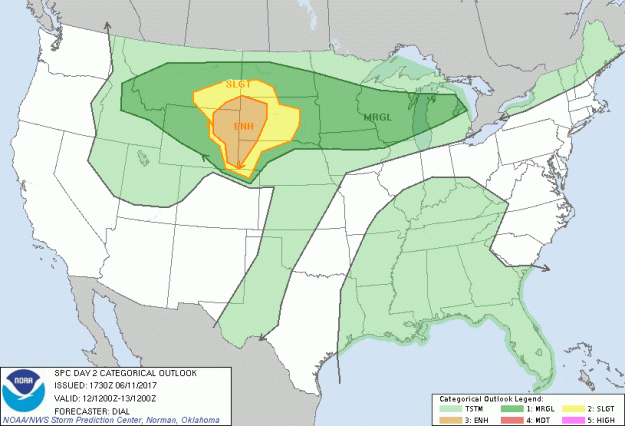
June 13th’s chase came up somewhat suddenly for me, based on a notification I had received about this outlook after being out of town, and not focused on the weather, the prior weekend. For some reason, before I even looked at anything else, weather models, discussions, etc., I had a feeling something major was going to happen.

SPC_day2_20170611

This day somehow felt different, right from the start.

IMG_0031 (3).jpg

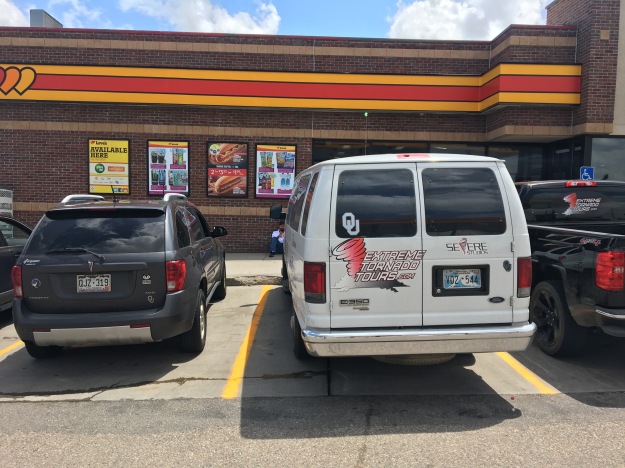
By 2 P.M., storm chasers were all over the roads, and at places like this Love’s Truck Stop in Cheyenne, Wyoming, watching the storms begin to form and trying to determine the best course of action.

RADAR_20170612

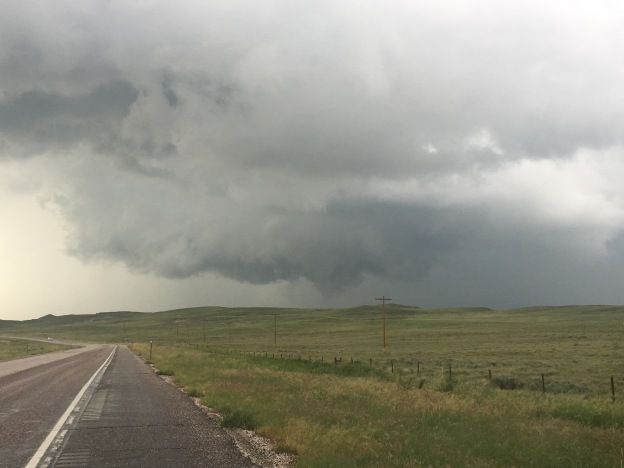
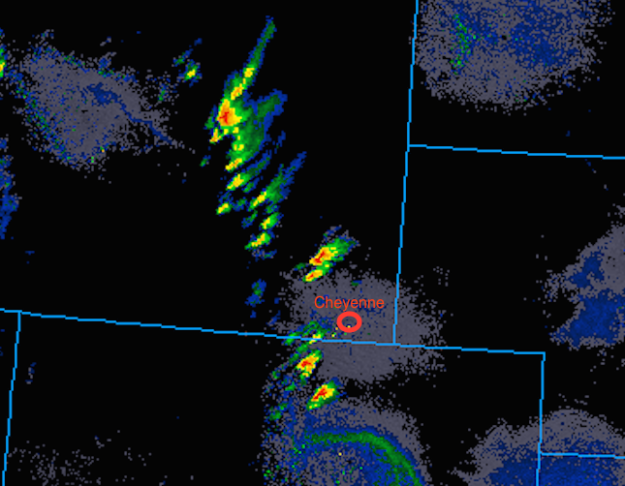
The decision we all were faced with was which set of storms to follow. The storms forming to the North were in the area previously outlined by the Storm Prediction Center as having the highest risk for the day, and in an area with great low-level rotation. But the storms to the South looked more impressive on RADAR.

Often, we need to continue to re-realize that the best course of action is to follow our instincts, and to follow them without hesitation or self-doubt. That is what I did, opting for the storms to the North.

IMG_0035 (2)

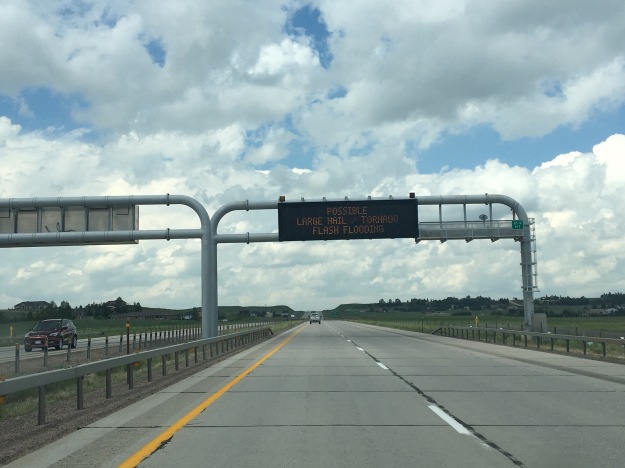
It did’t feel like a typical day in Wyoming. Storm chasers everywhere. Highway signs were alerting motorists to the potential for tornadoes and large hail. Moisture could be smelled in the air. With a moderate breeze from the East South East, the atmosphere felt less like Wyoming and more like a typical chase day in “tornado alley”

IMG_0047 (1).jpg

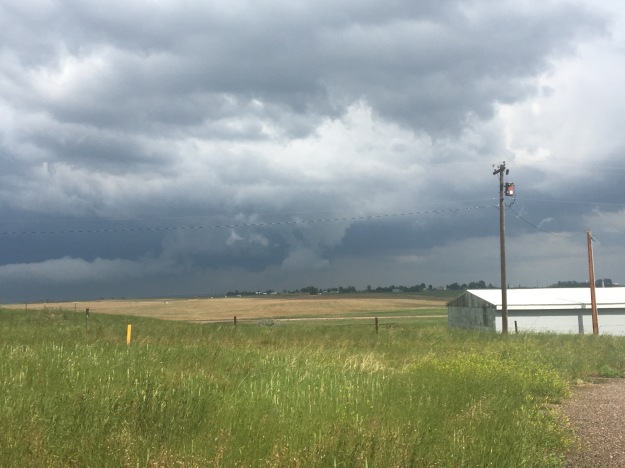
When I  caught up with the storms in Wheatland, Wyoming, hail larger than I had ever seen had already fallen. One of the good things about following a storm from behind is the ability to see hail after it has already fallen, as opposed to trying to avoid hail out of concern for safety and vehicular damage.

I stayed in Wheatland as long as possible, knowing the storm would head Northeast and I would have to leave Interstate 25. One of the disadvantages to chasing in Wyoming, as opposed to “tornado alley”, is the sparseness of the road network.

IMG_0049 (1).jpg

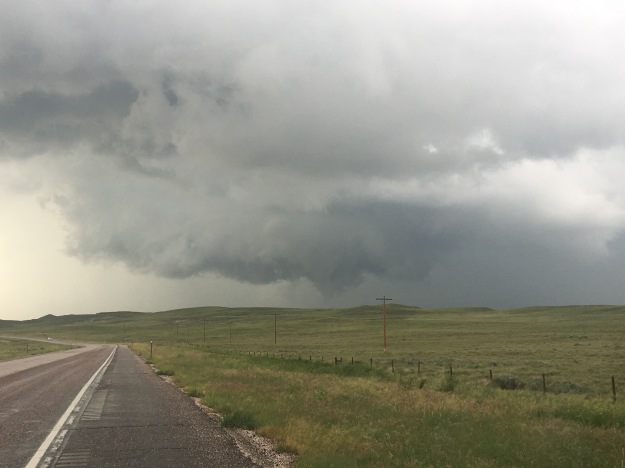
So I sat there for roughly 20 minutes. Looking at the storm, it felt like something was going to happen. All the necessary conditions were there, and the appearance and movement of the storm felt reminiscent of other situations which had spawned tornadoes.

I took a chance, using roads I had never traveled before, hoping the roads I was following would remain paved so I could follow the storm North and East.

There was a half hour time period where I had become quite frightened. I could feel the adrenaline rush through my body as the clouds circled around in a threatening manner less than half a mile in front of me. I lacked the confidence that the road would remain paved, or that I would have a reliable “out plan” if a tornado were to form this close.


After lucking out with around 10 miles of pavement, I suddenly found myself driving over wet dirt, and, at 20-30 miles per hour, gradually falling behind.

Luckily, I once again found pavement, drove by some of the natural features that makes Wyoming a more interesting place to drive through than most of “tornado alley”, and once again encountered large hail that I felt the need to stop and pick up.

IMG_0070 (1).jpg

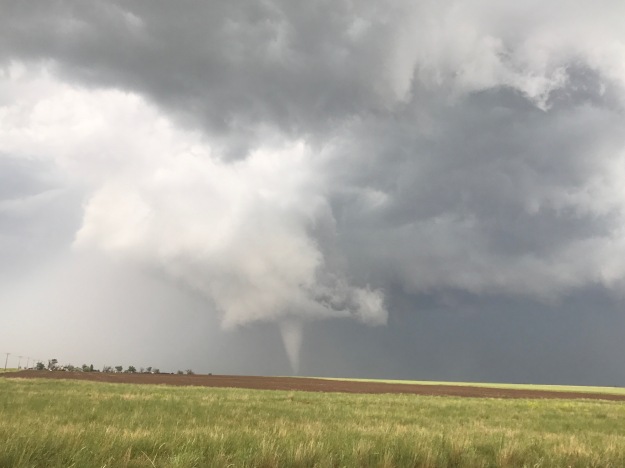
Almost an hour later, and significantly farther north along highway 85, I finally caught up to the storm, just as it had dropped it’s first, and brief, tornado. And, this time, I was a comfortable distance from the thing! Unfortunately, this tornado would lift off the ground in only a few minutes.

IMG_0075 (1)

Not too long after, I received notification that other chasers, following the storms that had formed farther South, had seen a much more impressive tornado, closer up, and had gotten better photos (the above is not my photo).

It was a strange day. Not only because Wyoming is not the typical place to see tornadoes. It also felt strange, as I had managed to do something impressive, yet still had reason to feel like a failure.

Most storm chasing is not like it is portrayed in the movies, with people getting close to storms all the time and getting in trouble. Most days, chasers do not see one. Seeing a tornado one day out of five is a very good track record for storm chasers.

Going out on a chase and seeing a tornado of any kind is impressive. Yet, to be truly happy with my accomplishment, I had to accept the fact that there was something better out there- something I did miss out on. This is a struggle we all face, in common life situations such as jobs, relationships, events, houses, etc. We often know we have done well, but always have this idea of something that is even better out there. Knowing this can make us indecisive, which will often leave us with nothing. In the age of text messaging and social media, evidence of such options has become extremely abundant, and quite hard to escape.

In a connected world, in order to be happy with ourselves, we need to find a way to both believe in ourselves, but also be accepting of the fact that someone else, somewhere out there, has done better. For that will always be the case, and we now have instant access to that knowledge. We cannot let knowledge of someone else’s more impressive accomplishments dampen our enthusiasm for our own. Otherwise, we will likely never be content.

Barbecue and Beer in Kansas City

IMG_9893

Kansas City is one of several places in America known for their barbecue.  Recently, Travel and Leisure magazine ranked it America’s best city for barbecue.  In other rankings, the city almost always places in the top 3-5.  While barbecue is sometimes the subject of fierce debate, Kansas City has a distinct barbecue style that appears to always be part of the discussion.  Regardless of how any specific barbecue fan feels about Kansas City’s sweet, savory, and saucy barbecue style, it has certainly earned significance in culinary circles, and it certainly has its fans.

IMG_9922

I came to Kansas City with only one food agenda… I wanted barbecue.  I did not bring up any specific places or dishes.  I just knew I wanted barbecue.  I’d leave the rest up to the locals.

IMG_9883

The first place I found myself was a place called Joe’s.  I was already encouraged by the name.  For some reason it feels like the restaurants with the best local food in the United States are named just someone’s first name (examples [1][2][3]).  I wonder if this is the same in other countries.

IMG_9887

We waited in line for close to an hour to eat at Joe’s.  This may be partially due to the fact that it was Memorial Day Weekend.  But, I cannot imagine that this line is too much shorter on any other Saturday in the summer.

Without even making the specific request, I found myself at one of Anthony Bourdain’s 13 places to eat before you die.

One can clearly see that this is the kind of place that values their sauces, and a variety of sauces.  This contrasts the barbecue style of Kansas City with some other places, where I was told there is greater emphasis on the meat itself, how it’s cooked and how it’s spiced.

The portion sizes ended up being somewhat deceptive.  I ordered the rib dinner, which included a half a slab of ribs, Texas Toast, and a side.  It did not look like a lot of food, but I found myself fuller than I had felt in quite some time!

IMG_9908

The next day we went to a barbecue establishment with a different feel.  Whereas Joe’s is actually in a gas station, and in Kansas, B-B’s is in Missouri, and feels more like what most barbecue places I’ve been at feel like.  The walls are more densely decorated than an Applebees, and plastic red and white table cloth covers the tables.

IMG_9909

Side note:  While technically, Kansas City, Kansas and Kansas City, Missouri are two different municipalities, they don’t feel too different.  If it weren’t for the highway signs, or the road named Stateline Rd. I would probably be unaware that I am entering a new state.

As if traveling food shows were somehow my destiny for the weekend, B-B’s Bar-B-Q was featured on Guy Fieri’s Diners Drive Ins and Dives.

It was another phenomenal meal, but once again, I overate.

In addition to eating more than I typically do, I drank after both meals, much of it being in the form of beer.  Beer, of course, is one of the most filling forms of alcohol.  So, while my tastebuds enjoyed this entire experience (Boulevard Brewing makes some excellent beer), my body was not happy.  I came away from this weekend not knowing how people here are able to eat and drink this way on a regular basis.

Despite this, it was still an amazing experience, and I got to see other things that Kansas City has to offer, including their downtown and historic Power & Light district (there has to be a reason for this, but I did not bother to look it up).

IMG_9898

One thing that plagues the modern world, and particularly my generation, is mental exhaustion.  Our minds are exhausted from the information overload which often results in analysis paralysis, which becomes extremely inefficient and exhausting.  When planning activities, we often give ourselves the following choices:

First is to select an activity that is familiar.  One that has already been done, and we are familiar with.  With this, we get a good experience without exhausting our minds planning.  However, there is no expanding our horizons.  Choosing all of our activities in this manner will inevitably lead to a rut.

The second is to do extensive research, spending hours on Yelp, Tripadvisor, and similar sites.  This, will usually ensure a good experience, but at the expense of exhausting research and planning.

The other option is to just wing it, making quick selections based on gut instincts.  This minimizes the exhaustion in selecting activities.  However, it can often lead to sub-par experiences.  I used to love to eat at randomly selected restaurants in the central business districts of small towns.  This practice lead to some unexpectedly amazing experiences.  But, there were quite a few disappointments as well.

My experience in Kansas City provided me with yet another reason community and trust are so valuable in our society.  By knowing people who are knowledgable on the subject of barbecue, I found myself at two truly great barbecue places without having to spend time researching places.  I relied on the knowledge of others.  This is something I hope we all can do more often as we seek out new places and experiences.

May 10, 2017: Funnel Cloud in Southeast Colorado

IMG_9723.jpg

May 10th was kind of a strange storm chasing day for me.  It was the kind of day that calls into questions a whole bunch of things for me.  What assumptions I make.  How I go about making decisions.  Both with regards to where and when to chase, as well as about life in a broader sense.

There are so many things that end up factoring into when and where people chose to chase severe thunderstorms.  I had chosen to go on this two-day chase (see day one) partially out of frustration I was experiencing back home.  It was one of those situations where I felt like it would just be good for me to do something I had not done in a while, for a change of pace, and I had yet to chase in 2017.

So, I went to chase on a Tuesday and Wednesday with only a slight risk for both days, something many people with jobs tend not to do, particularly when the outlook shifts so far away from home on the second day.

In fact, I was not even sold on chasing again on Wednesday, as leftover storms from Tuesday would prevent the area that I had originally thought would have the best dynamic setup for storms from developing the instability needed to fuel them.

I decided to stay out partially because of the more optimistic outlook from the Storm Prediction Center, and partially because I got an email from a friend, telling me he was excited about the outlook… in Southeast Colorado.

Still, I decided originally to target Southwest Kansas.  Given the outlook, the best place to be would have been well further south, at least into the Texas panhandle.  But, you know, those life considerations.  I did want to make it back to Denver that evening.

IMG_9657.jpg

Whenever in Western Kansas, I always kind of think the same thing.  This place is flat, but it is not as flat as Florida, or Northern Illinois.  People often assume the place is flat.  But, according to a study in National Geographic, Kansas is not even in the top 5 flattest states.

One aspect of storm chasing that is often missed by people watching storm videos, or the movie Twister, is the fact that storm chasing involves a lot of driving, and it also often involves a lot of waiting.  On many days, chasers pick a “target” location, where they believe storms are likely to form, and sit there, sometimes for hours, waiting for them to form.  Because it was unrealistic to get down to the Texas Panhandle and still get back to Denver in the evening, we chose to sit in a town called Ulysses, Kansas because my favorite weather website had analyzed another boundary near there.

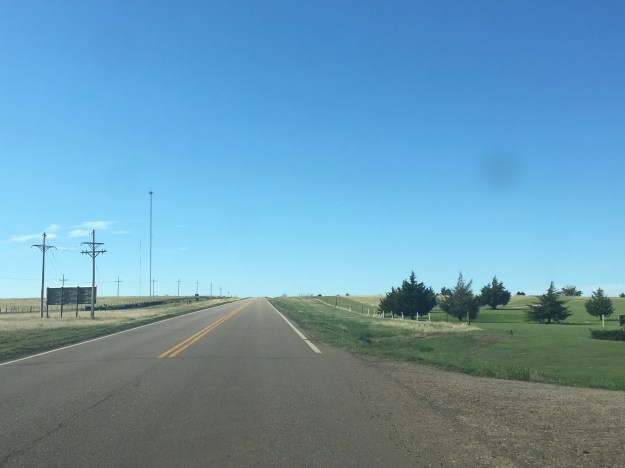
Ulysses, by the way, was named after Ulysses S. Grant, Civil War general and 18th President of the United States.  Why a place like this cares so much about this historical figure from Galena, Illinois confuses me a bit.  But, at least the town had highways in all four cardinal directions, and an empty field with a cell tower, so we could look at weather information while we wait.

And, this requires patience, and continued belief that the right location had been chosen.   But, May 10th was not a typical day.  Storms started to form in this region, first just clouds, and then even some small thunderstorms.  I was even proud to have seen a storm  start to produce rain before the RADAR images even began to reflect it!

IMG_9693

Now, that’s what I call “catching initiation”.

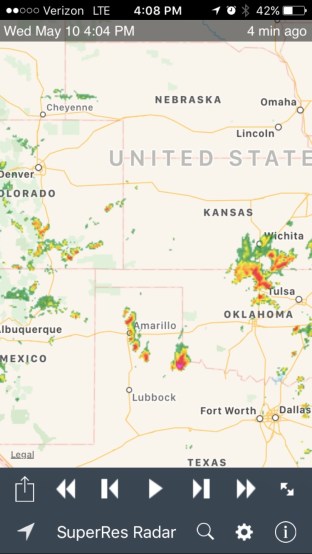
The problem is, we caught the wrong initiation.  These storms would never amount to anything.  In fact, they were so small that when I zoomed out on a RADAR image, they were barely visible!

IMG_9701

It turned out that, despite the fact that some of the sites I typically look at for weather information indicated some potential, we were in “no man’s land”.  The boundary I thought was situated near the CO/KS border was actually farther West, and storms were forming … in Southeast Colorado.  So, we had to adjust, headed back into “Colorful Colorado” (although today it would be “Colorful” for different reasons).

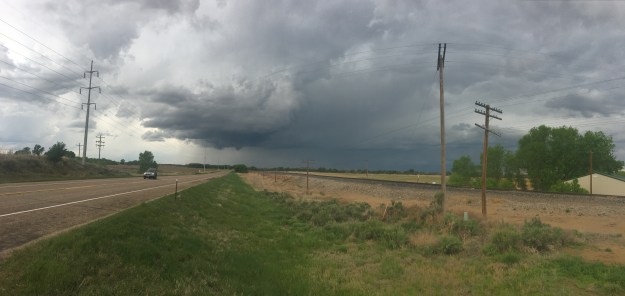
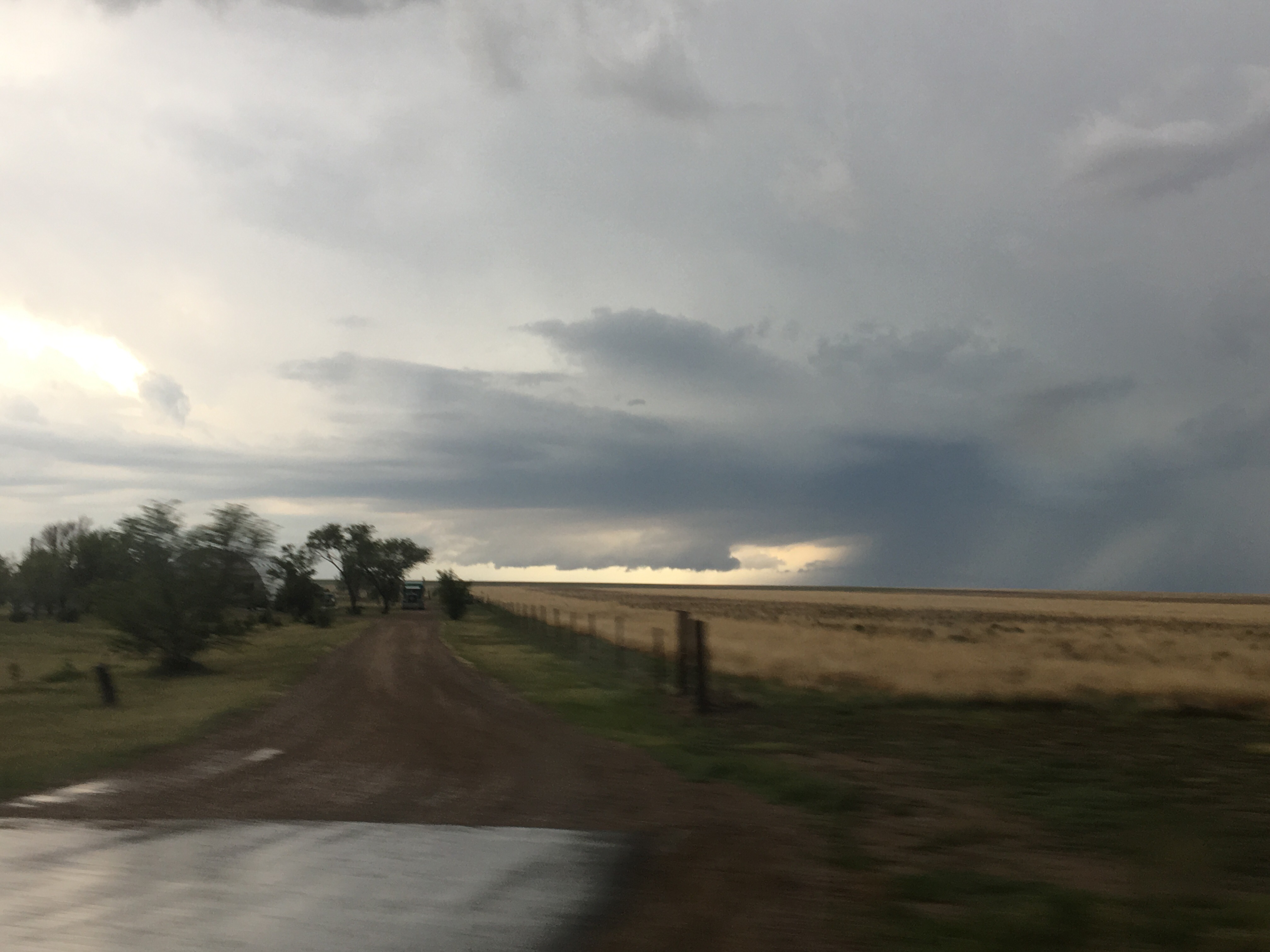
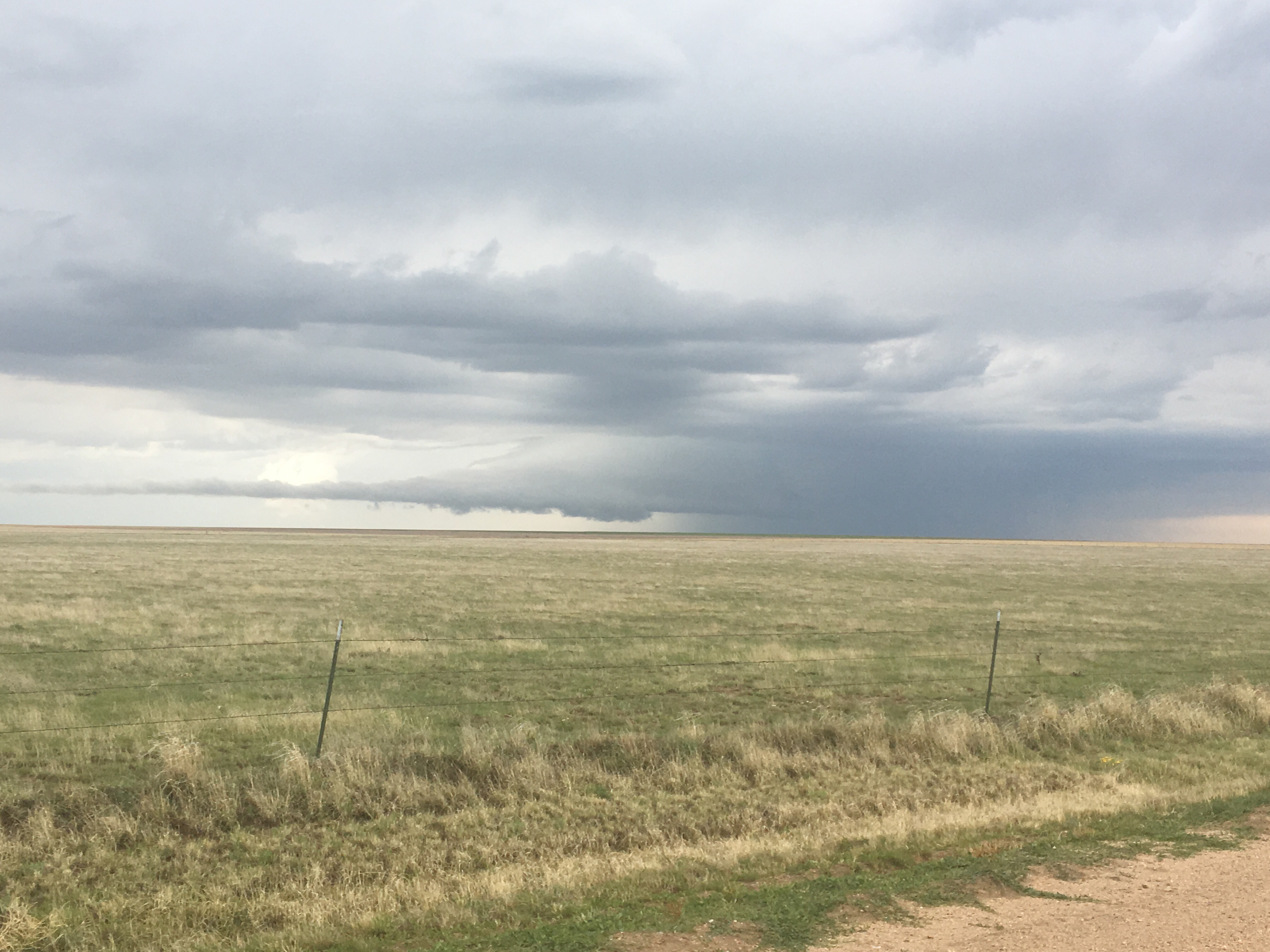
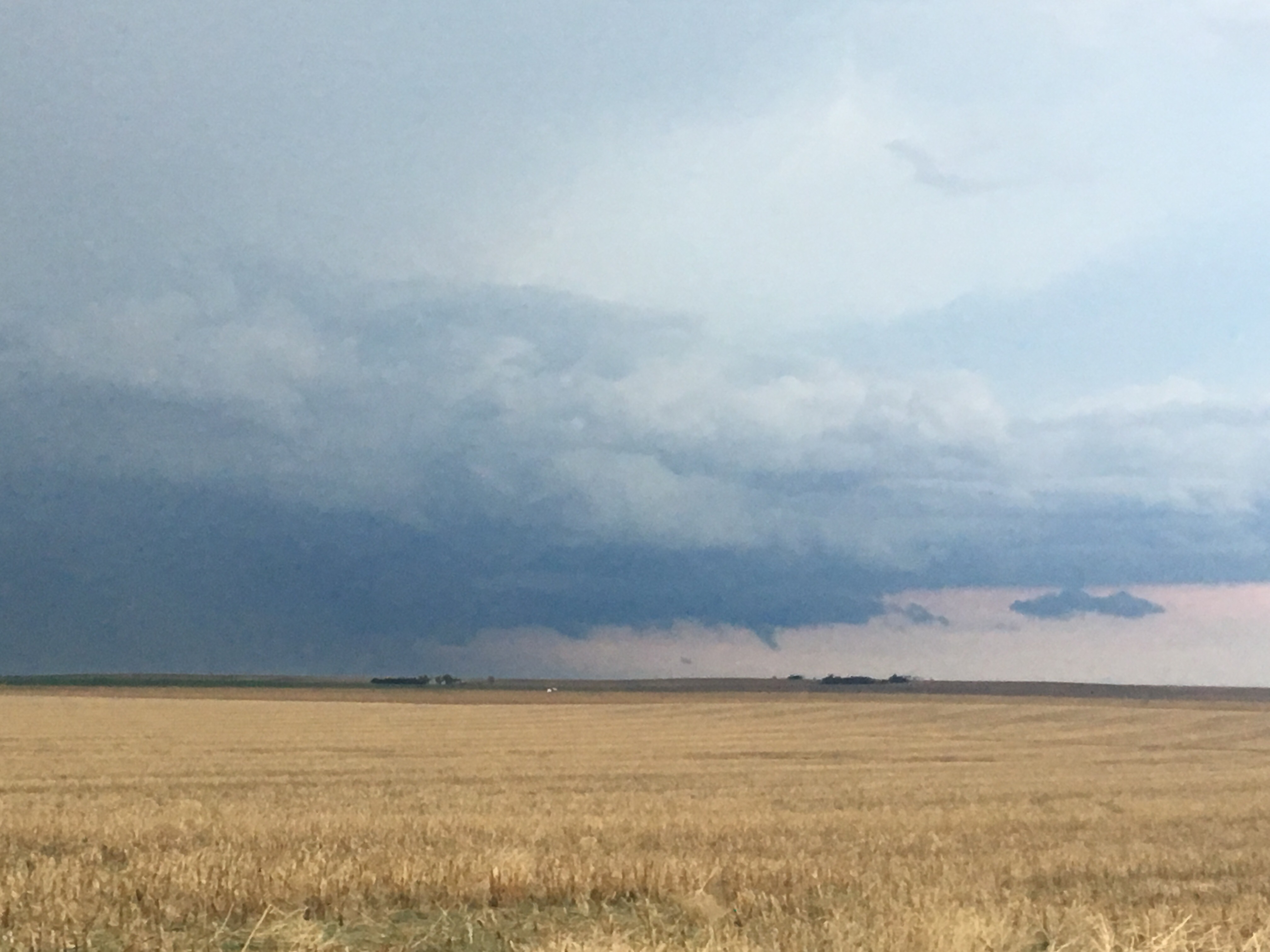
It was there we saw the main feature of the day, a funnel cloud near the town of Lamar, CO.

IMG_9722.jpg

For a while it looked like it was rotating and trying to form a tornado, but from experience I know that in Eastern Colorado only 1 in 8 of these actually turn into tornadoes.

The entire day was kind of a head scratcher.  What did my friend see that I didn’t?  What did he see that SPC kind of didn’t?  Why did so many storms form north and west of where the outlook was?

Why did my the information sources I typically point to lead me kind of to the wrong place?

I also wonder if I was chasing the right way, and for the right reasons.  The weather bends to nobody’s schedule.  The weather doesn’t care about personal preferences, conveniences, one’s life situation, or ego.  We have tools that provide good guidance into what is going to occur.  And, those tools pointed to a clear spot that they were correct about, as the biggest cluster of tornado producing storms of the day formed in Northwest Texas, near Childress, crossed into Southwest Oklahoma, and produced tornadoes.  That just didn’t fit into my plan.

The chase ended up turning into somewhat of a metaphor, for life decisions in general.  When we chose to take part in an activity, of any kind, we get the most out of it when we are willing to go “all in” per say.  This is true of jobs, hobbies, relationships, you name it.  We have to be willing to adjust, and consider a whole bunch of circumstances and other factors.  But, sitting in the middle, waiting for two or more different opportunities to possibly manifest only works well for a little while.  In the end, a choice needs to be made, and even if it is not the ideal choice, the fact that a choice was made produced a better outcome than having allowed the entire day to lapse without making one at all.

Storms With Abnormal Structure

One of the things that makes this world so amazing is the fact that we never cease to encounter surprises.  No matter how well we get to know a subject, any subject, we will encounter, and observe, from time to time, that which does not fit closely into the patterns we have learned.  We will periodically be tested, in our knowledge, and forced to rethink, and once again reason out what we have seen based on our critical thinking skills and understanding of our favorite subjects.  Like the psychologist that talks to someone new and says “I have never seen this before”, these experiences rekindle the passion we have for that which we love, remind us how complicated the world really is and how little we really know, and remind us about how interesting of a place the world truly is.

The 9th of May 2017 was a confusing chase day for me.  It is one that I am still trying to figure out, much in the same way the scientific community is still trying to determine why some storms produce tornadoes and others don’t.

SPC_Day1_2017_0509_1630

The day began with a slight risk across Eastern Colorado and New Mexico, and reason to believe, based on model output and expert opinion, that it could be a decent setup for a storm chase in East Central/ Southeastern Colorado.

The day ended up being one where I followed over half a dozen storms, over the course of the afternoon and early evening, northeastward, from near La Junta, Colorado, to just north of Goodland, Kansas.

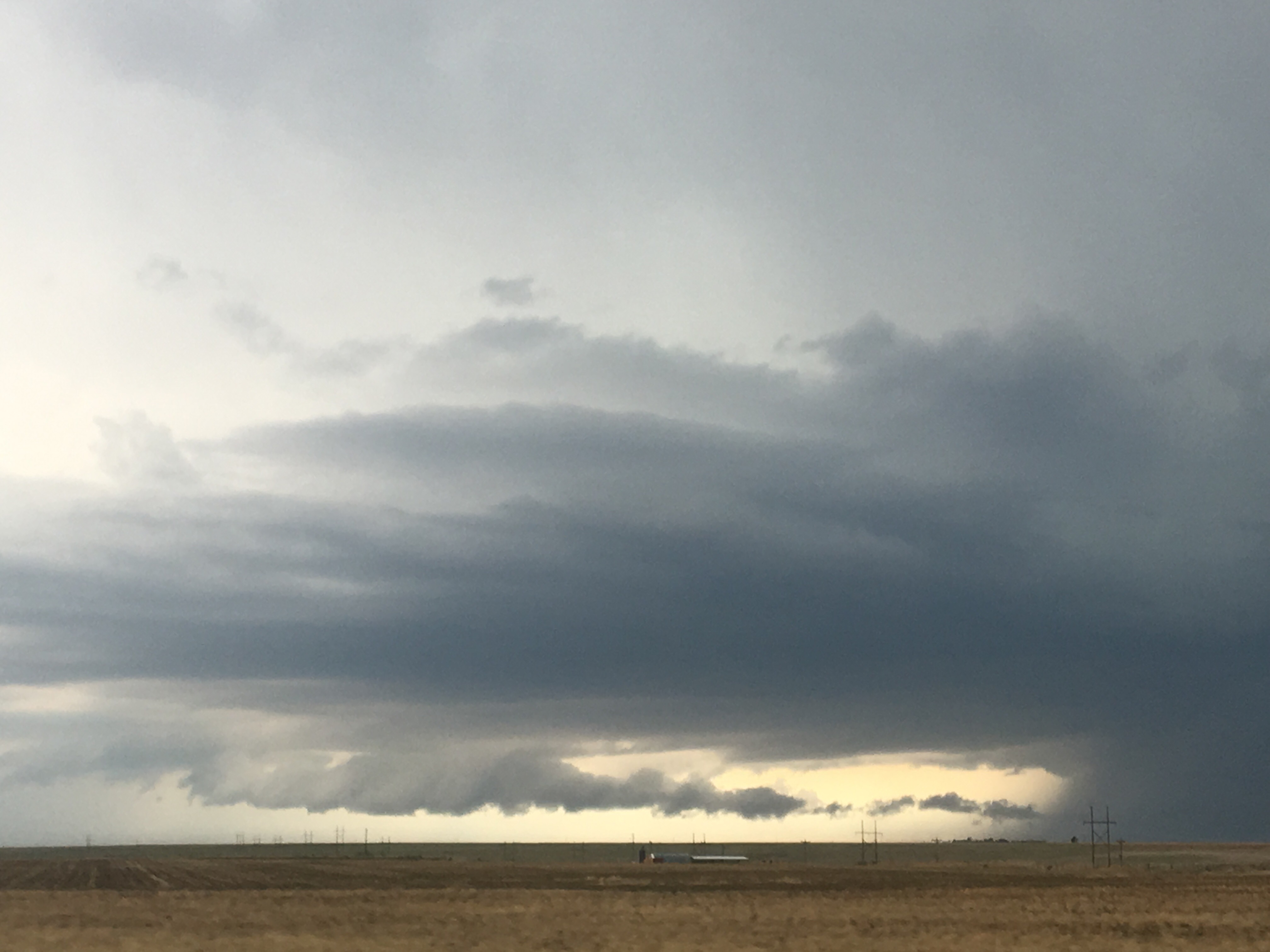
Regardless of where a storm was positioned, both relative to other storms, and relative to atmospheric boundaries such as dry-lines (the boundary between moist and dry air), which are credited with creating the lift in the atmosphere that often creates storms, all the storms would behave in much the same sort-of standard but sort-of not manner.


They would cluster together and come apart.  They had the standard boundary one would observe between the inflow and outflow portions of the storm.


Some would even show something that look like a “lowering”, which is often an indication of the mesoscale rotation that causes tornadoes.

But, these “lowerings” would show up in some strange sections of the storm, including in the front part of the storm.  This is absolutely nothing like how anyone is taught that a “supercell” thunderstorm operates.

Supercell

In the end, storms did occur, but largely outside the region SPC highlighted that morning.

Storm_Reports_20170509.gif

And, in the areas of Colorado and Kansas I had chased, nothing more than a couple of hail reports.  Although, I am quite certain that there was far more hail than what is shown on this map, as I recall driving through some areas where hail covered the ground, including multiple areas near Burlington, Colorado.


I watched these storms tease us all day.  Everything just seemed, well, weak.  In a typical tornado situation, these random-ish clouds that form around a storm, often referred to by chasers as “scud” (I don’t know why), rise and rotate, indicating that there is indeed, the vertical motion and rotation that produces tornadoes.  But, today, the rising and rotating motion in these storms all seemed, well, just weak.  It reminded me of a relationship, or a friendship, that just fizzles away as soon as any small change occurs.  It was not that there was any kind of real force or circumstance pulling these people apart.  It was just that whatever connection they had was not strong at all.

That is the way it was with these storms.  Something about the entire setup made them behave differently, but I throughout the evening, as I watched the final storms roll away into the sunset.  I could not formulate the full reason as to why these storms behaved so differently from a standard severe thunderstorm situation.


I am still wondering.  Often times severe thunderstorms don’t materialize because one key “ingredient” was missing.  Shear, instability, a good boundary, etc.  And those often lead to what is refereed to as a “bust day”.  It’s just sunny.  Or drizzly.

May 9th was not a complete “bust”, as there were storms to look at all day.  They likely never became severe because everything about the storm setup was just kind of weak:  Weak to moderate instability.  Border line helicity.  A sort of weak boundary.

And, just like the storms themselves, with multiple areas of quazi-rotating clouds, the atmosphere as a whole had no real focus.  Often times, severe thunderstorms draw upon air from hundreds of miles away for energy.  This produces scattered, but strong storms.  With hundreds of active storm cells, there was less energy for each individual storm.


Of course there are other theories.  After all, it could have all been the lack of low-level shear.  But, in the end, it felt as if the entire day was telling me something.  It was like a crash course in how to create, well, mediocrity.  Have only part of what you need before you proceed.  Focus on nothing- just spread yourself real thin.  And, choose to follow some of the rules, but completely disregard others.

The Cherry Creek Farmer’s Market

IMG_9567

What does it mean to have a “healthy community”?  I am encouraged to see more and more people actively consider their life choices, their environment, associations and just put more thought in general to how they spend their time, energy, and money.  This feels like a dramatic shift from, say, ten years ago.  However, embedded in some of the most high profile public improvement related pursuits in the modern era is an unfortunate residual strand of laziness.  After all, we do want something for nothing.

This often manifests itself in buzz phrases that people use to not-so subtly indicate some form of association with a popular present-day initiative.  Perhaps the one that bugs me the most is the term “sustainability”.  In many of its common present-day uses, the definition of this term “sustainability” has been narrowed to only mean sustainability in the environmental sense, short-changing the term of its full definition, and shortchanging discussions of “sustainability” of their full impact.

IMG_9576

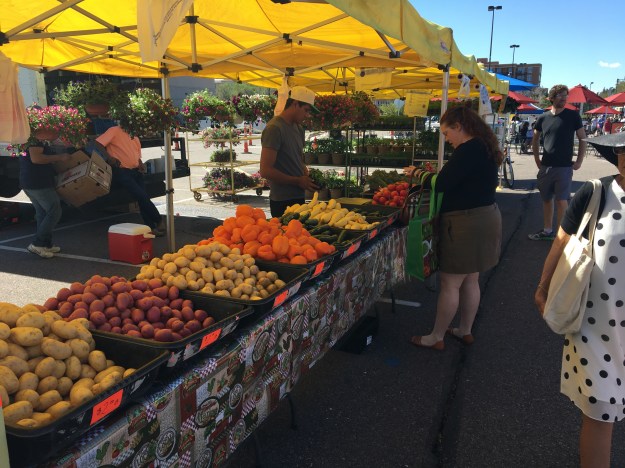
Whenever I ride a bicycle to a Farmer’s Market, I feel as if I suddenly become the personification of the term “healthy community”.  It’s the standard image, embedded in every montage that any health or parks department has put together to promote some kind of health/ community initiative in the past six years.  People riding their bikes to buy pesticide-free produce and meat products from local farmers and ranchers.

IMG_9574

IMG_9571

And there are a few booths that sell those products, including one with that cow diagram that just always confuses me.  Why are there like 50 types of beef?.  However, most of the booths at this Farmer’s Market are not vendors selling food.  In fact, I saw a somewhat random assortment of products that made me curious as to how one goes about determining what is appropriate for a Farmer’s Market.

And, as is the case with any other Farmer’s Market I have been to, there were plenty of booths where one can get food that is, well, not healthy.

IMG_9573

In Wisconsin, any Farmer’s Market I would attend would have a good number of booths selling cheese curds.  If the country ever breaks up into its 50 states, and Wisconsin becomes its own country, it would probably stock pile cheese as a strategic reserve, much the same way Canada stock piles maple syrup.

I would say a majority of the food vendors at this Farmer’s Market offer food that is not typically considered healthy; including many different varieties of baked goods, food trucks, and a bunch of stands that sell items like tamales and burritos.

Interestingly, several booths at this Farmer’s Market are operated by Local civic organizations advising residents on how to effectively garden and compost.  This gives this Farmer’s Market somewhat of a unique touch, that contributes to the health and sustainability of the community in a different way.

But, the same way being a successful person is about more than simply becoming “goal oriented”, eating well is about more than just buying things that are “organic”, and having a productive work team is about more than just “synergy”, having a healthy community is not just about initiatives like this.  There are a lot of other factors, culturally, near and far, that make this place what it is.

IMG_9554

Regardless of what we are trying to achieve, it takes time, effort and active participation.  We all want something for nothing.  We want to be able to claim some sort of accomplishment, moral validation, status or belonging by claiming association with some positively viewed buzzword, and maybe taking part in a token activity like going to a Farmer’s Market.  But, to really live healthy takes a much bigger commitment.  And there is more to having a “healthy community” than a video montage showing people like me bicycling to Farmer’s Markets.

What we do every day can be healthy, or it can be not.  For most of us, it is both, depending on the situation.  The intellectual rigor we need to truly evaluate our lives, the journey we are on and the communities we live in, involves respecting the complexity that is ourselves, our surroundings, and even places with divergent outcomes like the Cherry Creek Farmer’s Market.  It is at that point, with the understanding of places, activities and concepts beyond buzzwords and vague terms, we complete this transition, elevating our level of intellectual discourse and giving ourselves the tools we need to make the best of our lives and communities.


Moab- An Active Destination

IMG_9301

Some trips are restful, while others are more active.  There are some destinations that lend themselves to more restful trips; cottages in the woods near quaint towns, tropical beaches, and resorts.  Moab, is a place where it is nearly impossible to imagine anything other than an active itinerary, with a variety of activities, and a lot of places to see.  Situated in East Central Utah, several hours from the nearest major city, this popular tourist destination is surrounded by too much natural beauty to picture anyone coming here and spending large amounts of time sitting in one place.

First of all, Moab is surrounded by two National Parks, Arches and Canyonlands.

Both National Parks are, as National Parks tend to be, filled with tons of natural beauty and unique places.  At both National Parks, while it is possible to see a lot of interesting natural features without straying too far from the road, the best features at both parks require hiking.

FullSizeRender (1)

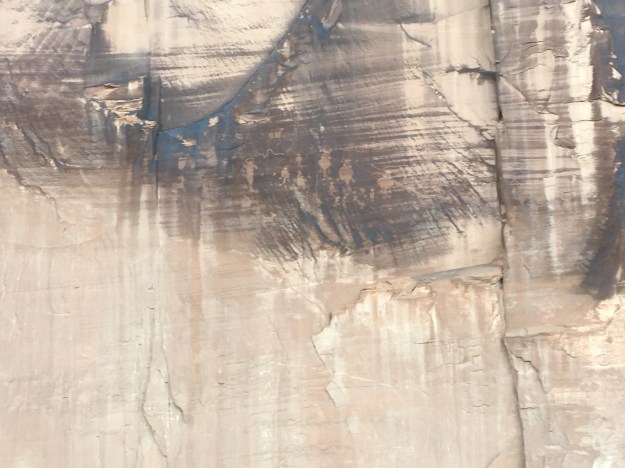
Getting to the signature feature of Arches National Park, Delicate Arch, requires a 1.5 mile hike from the Delicate Arch Trailhead.  Interestingly enough, this trail starts near the historic Wolfe Ranch, and traverses by some other unique features including some Ute Indian Rock art.

It is also quite difficult to imagine making a trip to Arches National Park and not viewing some of the other arches (Yes, it’s Arches National Park, not Arch National Park).  There is a section of the park known as Devil’s Garden, with somewhat of a network of trails taking visitors to all kinds of other arches.

The most famous of these arches is Landscape Arch, a long and wide arch whose name provides a clear recommendation as to how to orient any photograph of this particular feature (for those familiar with landscape vs. portrait  ).

IMG_9345

To get to most of the remaining arches requires a bit of a steep climb, which starts pretty much right after Landscape Arch.

IMG_9346

The hiking in the entire Moab area, not just at Arches National Park, is considerably different from the typical hiking experience.  Much of the hiking I’ve experienced, is on trails covered in dirt, gravel, and sometimes small to medium sized rocks at places such as the top of Quandry Peak.  All around Moab, I found myself on surfaces such as this one, on top of solid rock, sometimes for nearly the entire duration of the trail.  Traversing these trails required me to use my upper body more, and even do a little bit of jumping, from one rock to another.

At the top of this Mesa, there are arches with multiple partitions, arches people can hike under, and even one arch with an opening that lends itself to laying inside it to soak up the sun, the surroundings, and the experience!

The entire loop, including all the side trips in the trail network, is a total of 7.2 miles.  So, if a visitor desires to see all of these features, as well as Delicate Arch, a total of 10.2 miles of hiking is required.

And some people decide to add even more activities to their day.  In a shaded off-shoot of the Devil’s Garden Trail, I witnessed a sizable group of people playing a game of Frisbee, using the walls of this tiny canyon to make trick shots.

IMG_9391

Since immersing oneself in the here and now, and contributing to the local culture of a place creates a more enriching travel experience, I decided to play my part.

First, I decided to bring my own arches into the park..
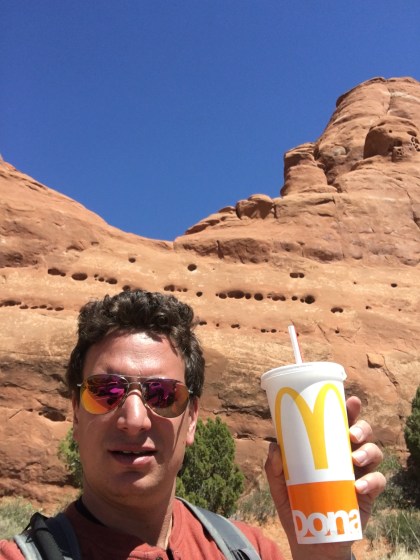
IMG_9332

Disclaimer: I did properly dispose of that cup

Then, when the opportunity presented itself, I decided it was time that we started making our own arches, contributing to the park’s plethora of natural beauty.
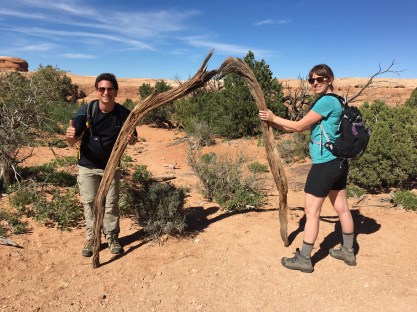
IMG_9374

IMG_9444

Canyonlands National Park is even bigger than Arches, broken up into three sections by the Colorado and Green rivers, whose confluence is right in the center of the park.  Without any bridges connecting over either river, and with the entrances to each section over an hour apart, it is all but impossible to visit more than one section in a day.
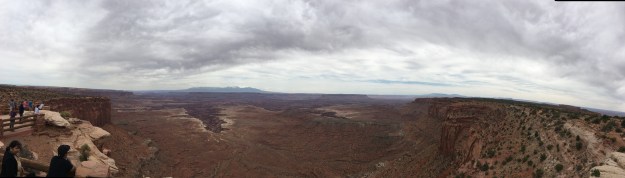
IMG_9461.jpg

The most common image of Canyonlands National Park is an almost Grand Canyon-like overlook into a deep river valley, sometimes with one of the two isolated mountain ranges in the background.  However, at the scenic overlooks in the parks’ Island In The Sky region, it is actually quite difficult to see the rivers themselves.  The canyons that make up Canyonlands National Park are quite expansive, with multiple tiers.  To see these canyons from the best vantage points requires a bit of hiking.  The hike to the Confluence Overlook (an overlook of the confluence between the Green and Colorado Rivers) is 10 miles round trip, something that could require the better part of a day!

Canyons are not the only interesting feature to Canyonlands National Park.  Being only roughly 20 miles away from Arches (as the crow flies), Canyonlands has some arches of its’ own.  The most interesting one is an arch called Mesa Arch, where one can see both the peaks of the nearby La Sal Mountain range, and actually another arch by looking through the arch at the right angle!

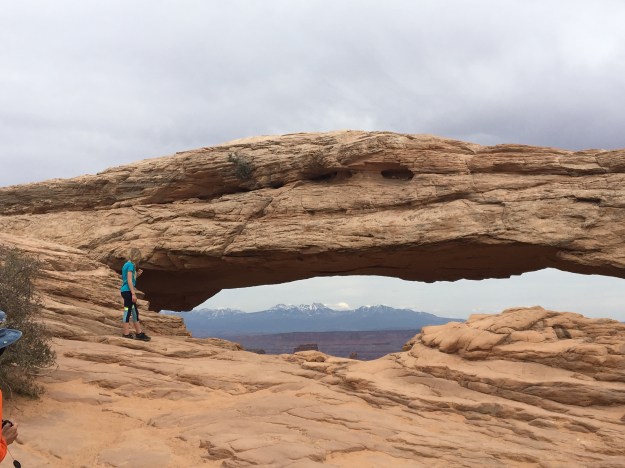
IMG_9471IMG_9468

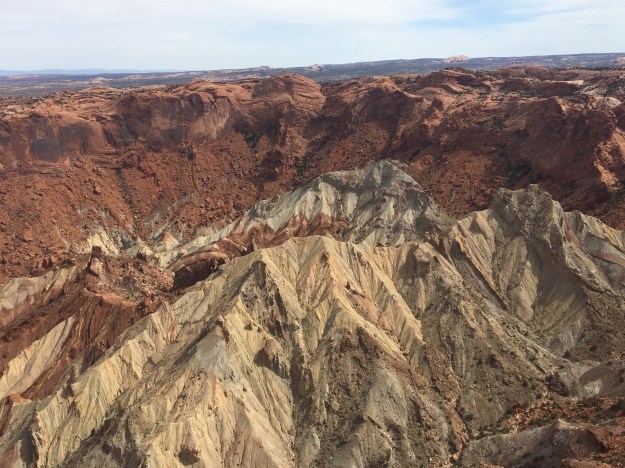
And some features are random, like Upheaval Dome.
IMG_9427

Scientists still do not know whether or not this particular salt deposit is a remanat of a meteorite that would have theoretically collided with the earth roughly 20 million years ago.

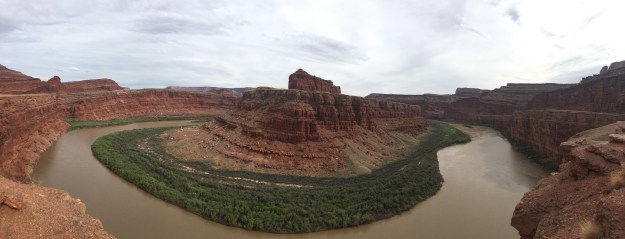
The two National Parks are not even close to all that Moab has to offer, all of which is “active” in one way or another.  Dead Horse Point State Park, located between the two National Parks, is a place where one can hike to one of Moab’s most picturesque locations: Goose Neck.
IMG_9494

The entire region, regardless of what any spot is named, or whether it contains a state or federal distinction, is rich with abundant natural beauty, and places to hike, bike, jeep, climb, or even just explore.

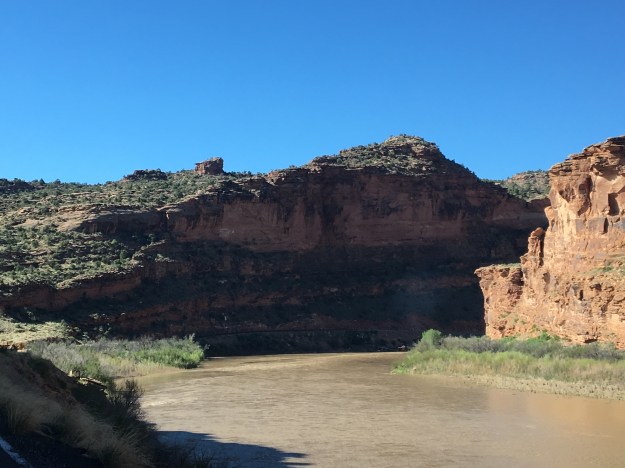
Anyone driving into Moab from the East (from Colorado), would be well advised to take the additional time it takes to follow the windy State Highway 128 through Professor Valley, essentially following the Colorado River into town.
IMG_9209

We set up camp at a place called Hunter Canyon.

Twenty minutes from town, Hunter Canyon is a place where each part of the day, from sunrise to sunset, lights up a different rock formation.  It felt almost as if nature was putting on a show, with lighting, stage props, and characters coming on and off the stage for different scenes.

I also saw bike trails nearly everywhere I went.  Moab is known as a mecca for mountain biking, an activity we did not get around to (is is… really… impossible to do EVERYTHING in Moab without something like two weeks).  But, with trails like these, Moab is also a phenomenal place for road biking.

IMG_9401.jpg

And, everywhere I went red rock formations, each one distinct from the next, would pop up, in and out of view.

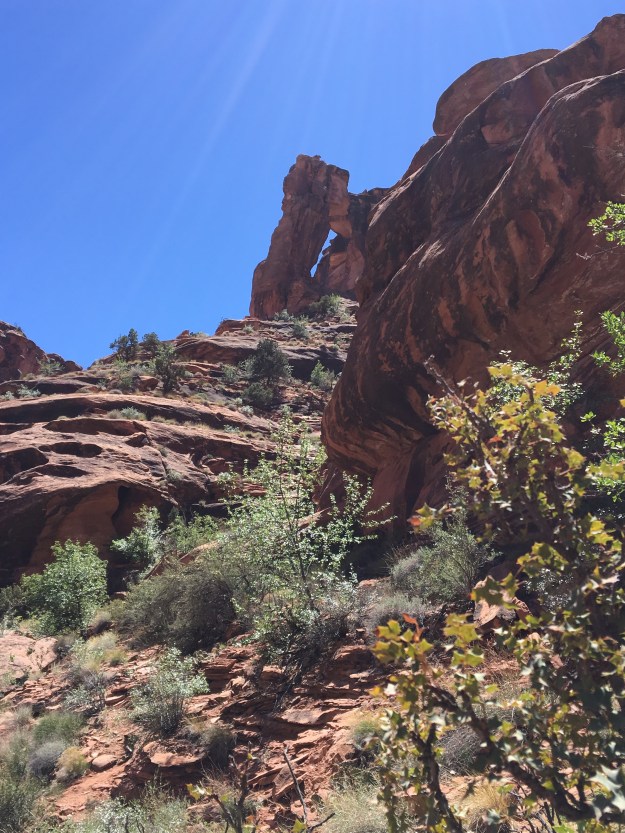
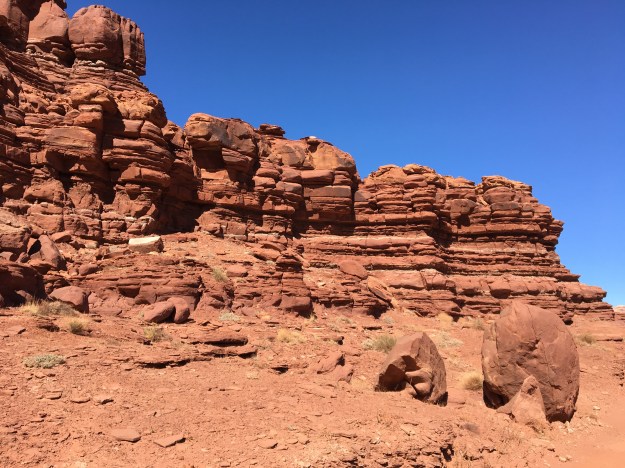
It was next to impossible not to imagine these rock formations as something else.  While driving around, I would often point out to the rest of the group what each individual rock formation looked like, or what I perceived it to look like.  Some, I said looked like specific animals, some looked like people, others, still, looked like various specific objects, such as hammers, cooking utensils, or even a turkey wishbone (by the way, the following image is an arch, residing in neither National Park, they really are everywhere)!
IMG_9237.jpg

And, what amazed me was how often others in my group would actually see the exact same thing when they look at a rock formation and say, yes, I also saw an octopus.  This means that either my imagination is quite accurate, or, I have managed to surround myself only with similar minded people.  Both are very much a possibility!
IMG_9241

But, the analogy I came to in my head most frequently, throughout the trip, is between the rock formations and the ruins of an ancient city.  Every time I saw a structure such as this one, I would imagine what is would be like if, for some unknown reason, there actually was a civilization here, many thousands of years ago.  And each one of these rock formation was actually the remnant of an ancient skyscraper, or even a larger building like Chicago’s Merchandise Mart, weathered down by thousands of years of natural erosion.  I imagined what this ancient city would have been like, in an Atlantis-like scene that would play through my mind.

Since Samantha Brown’s presentation at last month’s Travel and Adventure Show, I had been trying to live in the here and now, and experience the current culture of a place, as she had advised.

For me, this included another new activity (for me)- Jeeping!

IMG_9521

And, I got to experience some crazy roads and some crazy places.

But, as I find in many of my travels, there is no way to truly avoid thinking about the past, and imagining another setting.  A video at the Canyonlands Visitors Center explained the actual process in which these rocks came to be formed, which took place over the course of 200 million years, back to a time when much of Utah and Colorado were near sea level, with some sections underwater and others above.  In fact, that is part of the reason why there is so much small scale variance in the color of the rocks throughout this region.

Everywhere I went, everywhere I looked, there were echoes of the past, both real and imaginary, and both ancient and more recent.
IMG_9507.jpg

The experience of visiting Moab for a long weekend is as jam-packed as I have made this aritcle.  Around every corner, something new, something exciting, and something unique.  While there are some travel destinations, like Miami, one can make as active or as restful as they would desire, Moab is one destination that requires one to be active, at least in some way, to truly experience.  To come to Moab, and not wander, not explore, not do a little bit of hiking, biking, or jeeping, one would miss out on so much of what is around every corner in this region.