Category Archives: Unique Natural Features

Chasing Records- Spearfish, SD

IMG_4286

At 7:30 A.M. on January 22, 1943, the temperature in Spearfish, South Dakota was -4ºF. A mere two minutes later, the temperature had suddenly jumped to +45ºF, a swing of nearly 50 degrees in a manner of two minutes. The Great Plains is known to be a region with extremely volatile weather. However, with respect to volatility on this short of a time scale, this one event is still in the record books.

75 years later, locals, as well as those interested in weather, still talk about the event. In fact, the event is mentioned in the Wikipedia entry on Spearfish.

But, why so much volatility? Why here? The answer to that question lays in the geography of the region.

Spearfish_Topography

Spearfish sits just north of the region known as the Black Hills. The Black Hills, although detached from the Rocky Mountains, are actually quite mountainous, with peaks rising several thousand feet above the river valleys. The manner in which peaks rise up in either direction while rock formations are carved out by small creeks is quite reminiscent of the Rockies.

Just over the border, in Northeastern Wyoming, Buttes of varying colors pop out of the more open, but still hilly landscape.

Only ten miles south of Spearfish is one of what feels like 500 different waterfalls that goes by the name “Bridal Veil Falls“.

IMG_4285.jpg

It is, nonetheless, breathtaking, but, what is it about this name? Did the wedding industry  somehow collaborate with the outdoor industry to try to convince tourists looking at waterfalls to be thinking about fancy weddings through this common nomenclature? Was there an early 20th Century conversation that went something like this…

“Okay, we’ll name every other waterfall ‘Bridal Veil Falls’. In exchange, you will encourage every newlywed couple to take something referred to as a ‘honeymoon’.”
“A honeymoon.. what is that?”
“A vacation that everyone is expected to take right after getting married. Think about it, both of our industries can make a ton of money off of this. We’ll get people thinking about getting married and specifically doing so with a fancy dress, likely to cost a lot of money, and then you make sure that when they wed, they are spending money on another vacation.”
“Sounds like a win-win.”

Okay, maybe it was not exactly like that, but it does seem pecular.

As far as Spearfish is concerned, traveling in the other direction, North, from town, could not be a more opposite experience.

IMG_4287.jpg

It is the Great Plains, and specifically the Dakotas, the way most people picture it.

It is this contrast, and specifically the North-South orientation of this contrast, in Spearfish that created this record breaking temperature change. When air travels from high elevation to low elevation, it warms. It is this exact reason that Denver, Colorado, just east of the Rocky Mountains, has frequent warm spells in the middle of the winter. In fact, January 16th is the only calendar date in which Denver’s record high is lower than 65ºF (it’s 64).

With the flat, wide-open, treeless land to the North, it could not be easier for bitter cold air straight from the North Pole to reach Spearfish. However, when warmer air does come from the South, it is further warmed by its trip over the Black Hills.

IMG_6101

But, why all the fuss about setting records? Specifically, why do people care so much about bizarre records? In 1943, the news about the wild temperature swings in Spearfish provided a war-weary American public with some lighter news. And while the impact was only a bunch of broken windows, people can learn from these records.

The wild temperature ride in Spearfish demonstrates how the atmosphere works. Is there something similar to be learned by the man who broke 46 toilet seats with his head in one minute? Do people who have watched that video avoid breaking their own toilet seat at home?

Or, is there something other than intellectual curiosity at work? Records like this one are interesting to people regardless of whether or not they care about the ins-and-outs of how the atmosphere works. They are just entertaining. They also provide people with one of the main things we are all searching for in the modern world; significance.

The people of Spearfish can always bring up this wild temperature swing as something that makes their town stand out among all of the towns of roughly 10,000 people out there. It is the same for the man who bloodied his head breaking toilet seats, or that one person in everyone’s social circle that did something bizarre, like stop at every Arby’s between Chicago and Saint Louis (there are 13). They have this way of making the world just a bit more interesting.


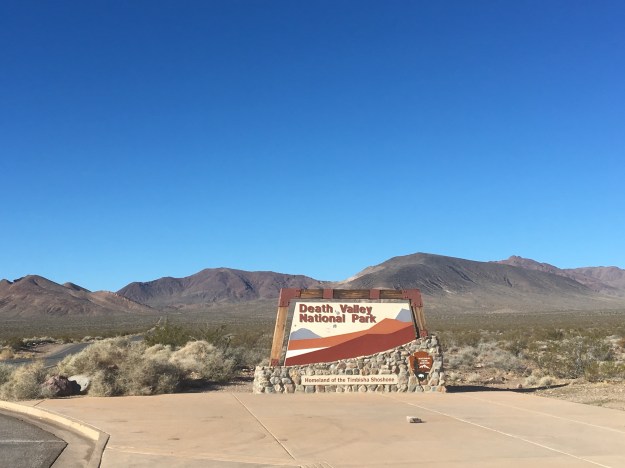
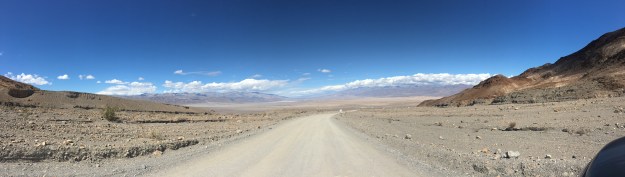
Death Valley: The Largest National Park

IMG_2899.jpg

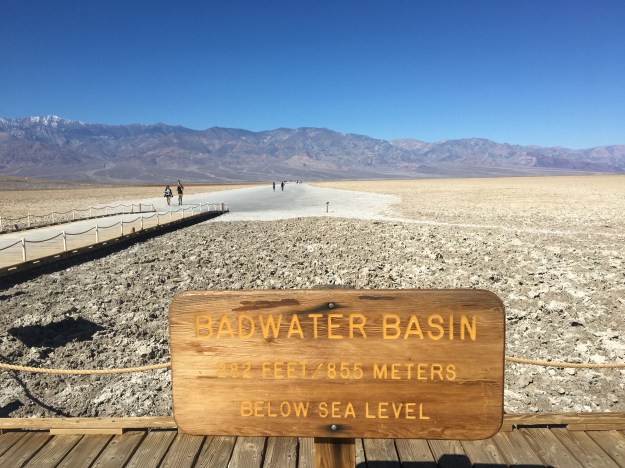
It is hard to truly describe what makes Death Valley such a wonderful and unique place. It is probably best known as the location of the lowest point in North America, Badwater Basin, located 282 feet below sea level.

IMG_2932.jpg

Land below sea level generally only exists in places with hot, dry climates, as otherwise, the low lying terrain would fill up with water. Death Valley certainly is dry! It receives less than 2 inches of rainfall per year. By contrast, Minneapolis, a city that would be considered neither dry nor wet, averages around 30 inches per year (including winter snowfall).

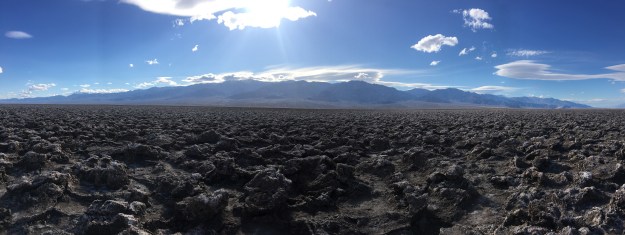
Badwater Basin, like much of Death Valley National Park, is a large scale version of everything one would imagine dryness to be.

IMG_2934

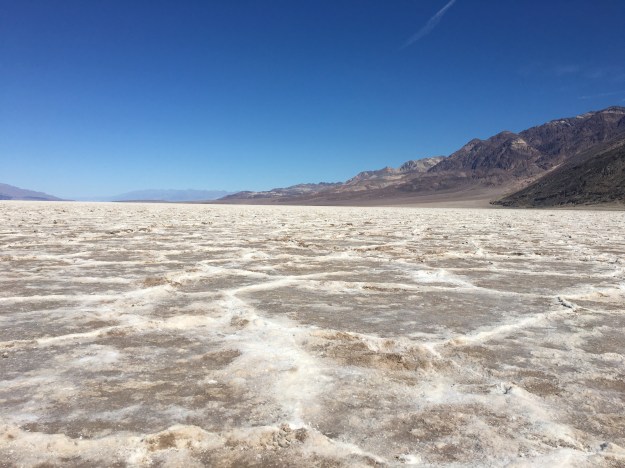
The entire basin, which stretches out longer than expected, is covered with salt, deposited in a honeycomb-like structure, creating a scene that appears to be out of some kind of documentary about deforestation or climate change.

Of course, not the entire park is below sea level.

IMG_2908.jpg

In fact, its highest point, Telescope Peak, is over 11,000 feet above sea level, and despite the dry and hot climate of the valley below it, is covered in snow, and impassible without ice gear towards the end of March. Interestingly enough, while March may be an ideal time of year to visit Badwater Basin, Furnace Creek and some of the low elevations of the park, the higher terrain makes the park actually worth visiting in the summer too (with the right hydration precautions taken of course).

At the park’s lower elevations, near and even a little bit below sea level, the hikes are a bit milder, and significantly different from a typical hike in the mountains. Shorter hikes (1 to 3 miles each way) to places like Sidewinder Canyon…

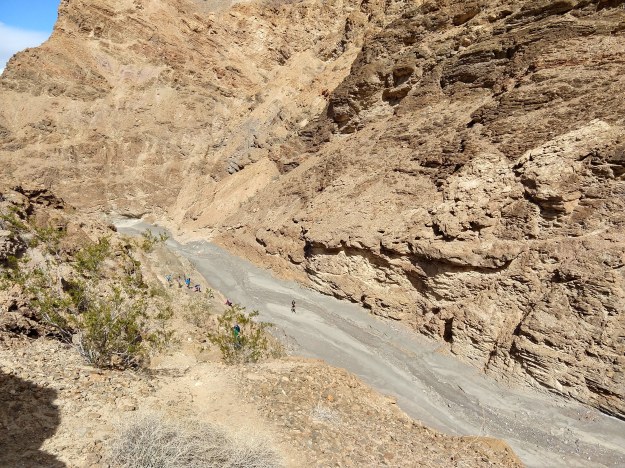
and Mosaic Canyon…

have trails that cut through the rocks, through little “slots”, and along wide flat trails that appear to have been carved out by runoff from the flash floods that occasionally occur in the park.

IMG_20180317_133410373_HDR.jpg

Death Valley is certainly a place with some unique weather patterns, and some unique weather hazards. When most outdoor activities are planning, the weather hazards most likely to be considered are related to temperature and precipitation. Extremely hot weather is Death Valley’s most obvious weather hazard. Visiting in March, or at some other point during the cooler part of the year, definitely helps visitors avoid these extremes.

IMG_2901.jpg

With wide open spaces, no trees, and complicated terrain, some crazy winds can occur in Death Valley, whipping up and and dust from the dry ground below it, covering any and all things!

IMG_2894.jpg

Storms will pass through the complicated terrain, often first producing some interesting looking clouds.

IMG_2981

Then, often times, while producing decent amounts of precipitation in the higher mountains terrain, in the valley below they will mostly just manifest as strong and gusty winds.

IMG_3027 (1)

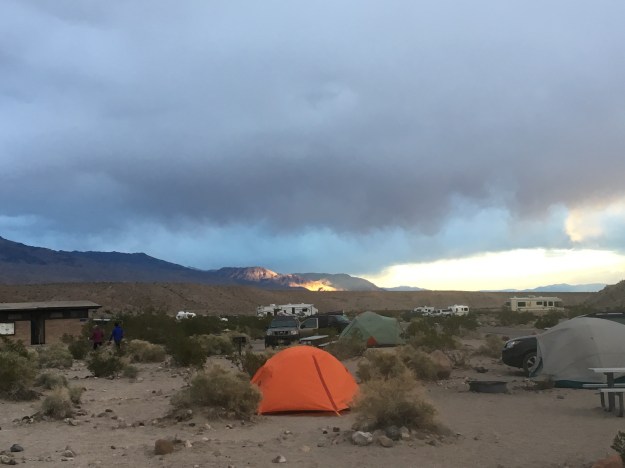
These winds can even be hazardous to campers, breaking tents, bending poles, and complicating campfires.

IMG_3040.jpg

Other than the extremes, in elevation, temperature and dryness, the rest of the park feels kind of a bit like a National Park sampler pack.

There are hikes that take visitors to amazing views of the park, but the park is not all about hiking (like Rocky Mountain National Park).

IMG_2948.jpg

The natural bridge is most certainly an “arch”, but Death Valley does not have the concentration of arches found at Arches National Park.

IMG_2984.jpg

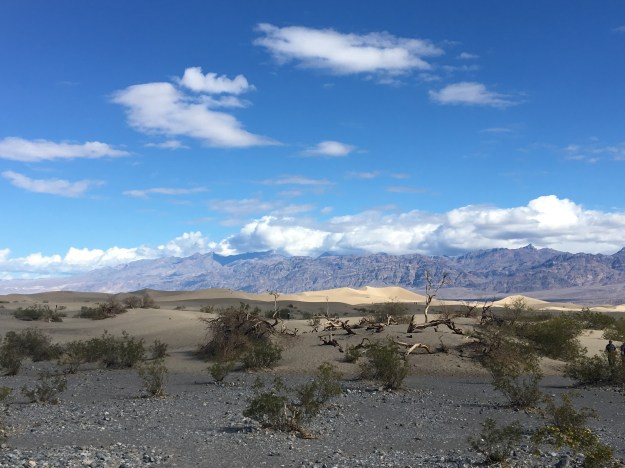
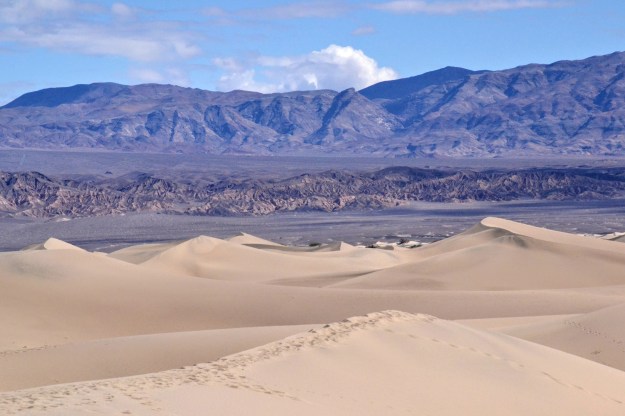
There are a few fantastic sand dunes here, but not as many as there are at Great Sand Dunes National Park.

IMG_2994DSC_0390

The park has some other unique natural features, such as the “Devil’s Golf Course”, but isn’t the constant barrage of unique features that is Yellowstone.

IMG_2992.jpg

One can even spot the occasional desert wildlife here.

IMG_20180316_134933474_HDR.jpg

Those that are into numbers already know what makes Death Valley unique; elevation, temperature, dryness. Those who are more into experiences find themselves also loving the park, but in a manner that becomes harder to articulate. Often, it is just said that the place is “beautiful”, or “amazing”.

IMG_3043

Maybe nothing more needs to be said. After all, sometimes these commonly used descriptor words, although light on specifics, along with photographs, really do tell the story. Nature, like artwork, is open to interpretation, at the behest of the beholder.

However, when covering mile after endless mile across the park, it is hard not to observe how expansive and wide open the park feels, as a result of how dry the air is.

IMG_2999

Maybe that is the reason Death Valley is also the largest U.S. national park in outside of Alaska.

The History of the Rocky Mountains

IMG_1691 (1)Many travelers are motivated to visit a variety of destinations by intellectual curiosity; Curiosity about culture, people and history. Curiosity about nature, science, and how our planet works. Unique natural features, such as Arches National Park and the Badlands, always make me wonder. How did this these distinct features come to be? Why can this be seen on this little section of our planet and seemingly not everywhere else? Is there anything similar, anywhere else?

This leads us back to history; history that pre-dates human beings. The geological processes that produced the colors, shapes and terrain we admire often occur over multiple millions of years. Some even pre-date any of our mammalian ancestors. Over the course of any one person’s lifespan, it is highly unlikely that any changes in our natural world resulting from geological processes will be noticeable. Nonetheless, geological processes can manifest themselves in some rather explosive ways, including earthquakes, volcanoes and sinkholes.

All this is true of unique natural features like Old Faithful Geyser in Yellowstone National Park, as well as the ring of volcanoes in places like Iceland and Hawaii. This is also true of the larger natural feature that in many ways defines life in Western North America; The Rocky Mountains.

As it turns out, the Rocky Mountains, as far as mountain ranges go, are quite unique.

IMG_1684 (1)

This past weekend, Drs. Robert Anderson and Lon Abbott of the University of Colorado-Boulder, lead a group of people up Sugarloaf Mountain to examine the geological history of the Rocky Mountains. This event was put on by the TEDxMileHigh organization as one of their adventures.

Sugarloaf Mountain is a relatively easy hike 15 minutes West of Boulder, along the Boulder Canyon. The distance from the trailhead to the top of the mountain is only about 1.4 miles, and the vertical gain is less than 600 feet. However, it is said to have one of the best views of Boulder Canyon in the area.

IMG_1682 (1)

This particular hike was chosen to as a backdrop for presenting Colorado’s geological history based on the specific terrain features that appear along the trail. For example, 1.7 Billion Years ago, Colorado was a shallow Ocean with tall mountains sticking up out of the ground, much the way present-day New Zealand is. Some of the mountains in the distance resemble the mountains that one would see had they been floating (or canoeing) across this area at the time.

300 Million years ago, it was a tropical seashore. The Rocky Mountains themselves formed from a period of time roughly 70 Million years ago to about 40 Million years ago. More recently (over the past 8 million years), the Great Plains, which the trail periodically overlooks, began to subside, creating the sharp contrast between the flat terrain east of the mountains and the high peaks of the Central Rockies that we see in our present day world.

IMG_1689 (1).jpg

At this exact elevation threshold, roughly 8500 feet, the type of rock observed changes, also a result of some of the long-term processes that created the Rocky Mountains.

The same combination of processes and events created some of the most celebrated unique rock formations of the region, including Red Rocks and Garden of the Gods. Thanks to the University of Colorado Department of Geology, this short hike became a trip through time.

IMG_1692 (1)

The view at the top didn’t disappoint. It was interesting to see the high peaks of the Rocky Mountains on an October day with some sun, but also plentiful cloudiness. It felt quite different from many of my hiking days Colorado, where there is often near total sunshine. I had previously forgotten about how much I enjoy seeing mountainous terrain like this, with sections of it lit by the sun, and other sections shadowed by the clouds, creating unique color contrasts that gradually shift over time.

The geological history of the Rocky Mountains is somewhat unique, and has yet to be fully explained. Geographically speaking, looking at a present day map of the world, the Rocky Mountains are fairly unique due to how far away from any major fault line they are.

IMG_1678 (1)

Many mountain ranges like the Andes and the Himalayans are right on a fault line and associated with geological activity; earthquakes and volcanoes. Colorado is not a hotbed for either, making for a somewhat unique mountain experience.

Geologists are still trying to explain why the mountains formed here the way they did. The Rockies continue to puzzle the scientific community. Why the mountains are as tall as they are when other properties of the Earth’s crust would indicate otherwise? Why did the Great Plains subside and become “disconnected” from the Front Range? Nevertheless, since geological processes are so slow, the mountains, as we see them today, are unlikely to change too much within any of our lifetimes.

Regardless of whether we are intellectually curious about why they are the way they are, or simply want to ski, hike, raft and climb, there are there and will continue to be there for us. They are confusing but consistent, much like life itself.

Get Lost in the Rockies

IMG_0386 (1)

“Dispersed Camping” is a concept that is often foreign to those living in large metropolitan areas. It is camping without a campground. There are no numbered spots. There are no amenities such as outlets, washrooms, and an office that sells water and wood. It’s just people plopping their tents down wherever they can. It is the purest, and most rugged form of camping.

Colorado has an almost limitless supply of places where people can literally just find a spot and set up camp.

National-Forests-Map-CO

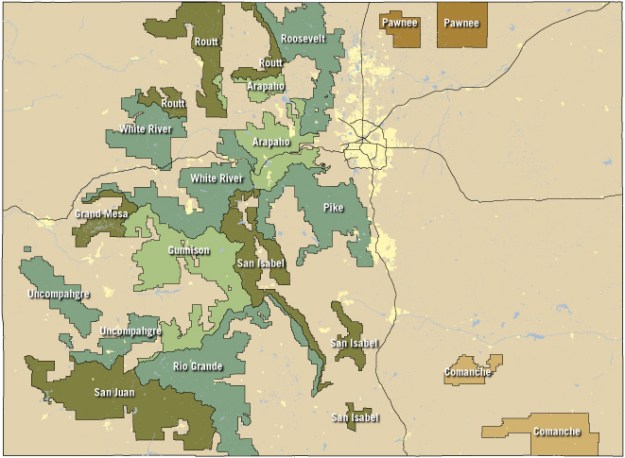
Spots for dispersed camping are usually found in National Forests, which cover nearly half the state. Specific details about which spots allow dispersed camping can be hard to find online, as each section of the National Forest system maps out their area differently. However, every section of National Forest has a significant amount of area where one can just set up camp. Many of these spots even have fire pits already set up by previous campers!

IMG_0357 (1)

During periods of heightened fire danger, it is common to for counties to issue fire bans or fire restrictions to limit the risk of wildfires. With fire being a major component of the camping experience, the status of these fire restrictions should be considered when planning any summertime mountain adventure that involves camping.

CO_FireBans_20170714

Colorado map of county fire restrictions as of July 14, 2017

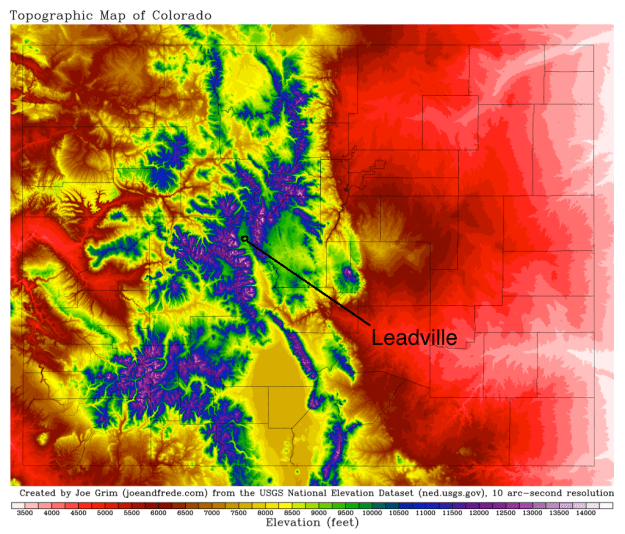
There is, perhaps, no better place to start a Rocky Mountain adventure than Leadville, Colorado, which sits at an elevation of just over 10,000 feet in the central part of Lake County, a county where there happened to not be a fire ban in mid-July 2017.

colorado_topo_Leadville

Spawned from the mid-19th Century Gold rush, and rich with old west history, the town, in the heart of the Rocky Mountains, is tucked away between mountains that rise several thousand feet higher in every direction.

This includes the Sawatch Range to the immidiate West and South, where Colorado’s two tallest peaks; Mount Elbert and Mount Massive, sit.

IMG_0364 (1)

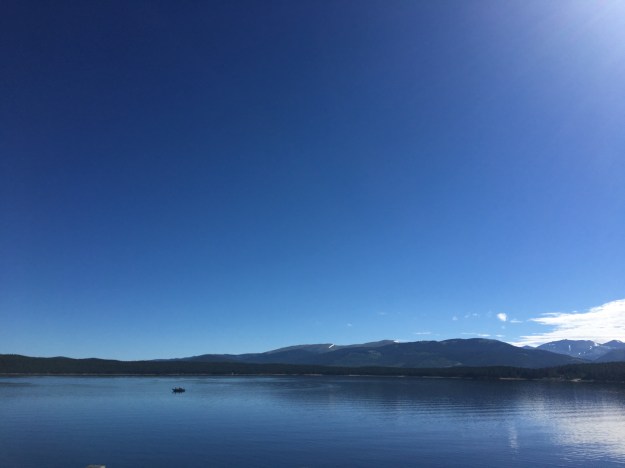
Only five miles to the west of town is Turquoise Lake.

IMG_0361 (1)

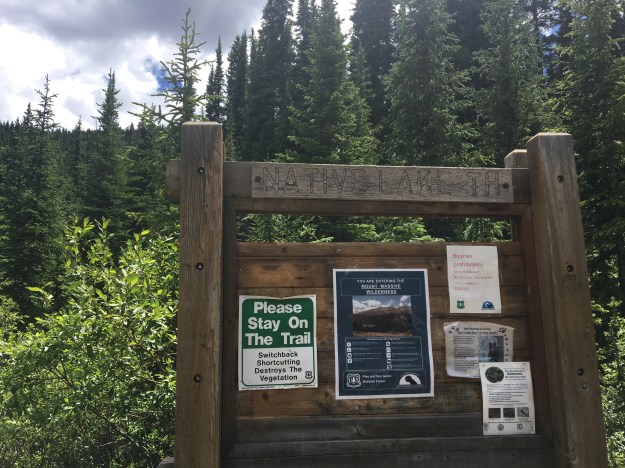
Expansive, beautiful, and protected by steep hills and dense forests, the lake stretches west, into the Mount Massive Wilderness, where densely packed trees and rugged terrain create a feeling of seclusion and wonder.

IMG_0398 (1).jpg

Wandering through the wilderness, trees partially conceal the tall mountain peaks. Like a well made movie preview, they reveal some, but not all, of what lays ahead for anyone wandering through the woods, whether on trail or off.

IMG_0400 (1)

Around every curve, the wilderness reveals what had been hidden between the trees.

IMG_0397 (1)

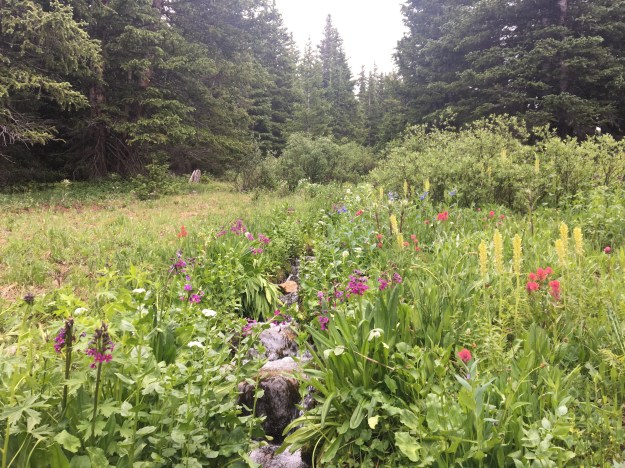
Streams reveal the source of the water that drains into Turqouise Lake below.

IMG_0401 (1)

Flowers of all colors pop out, tickling multiple senses, making the experience more vivid, more full.

IMG_0391 (1)

After roughly 90 minutes of hiking on the Highline Trail, which starts only a few miles west of Turquoise Lake, the trail climbs above the forest.

IMG_0405 (1)

Just below 12,00 feet, the trees disappear. Mountain ranges, are once again seen in every direction. The ground is surprisingly green grass, making the scene reminiscent of The Sound of Music.

At these elevations, with an atmosphere roughly 30% less thick than it is at sea level, the sun commands somewhat of a decieving presence, particularly in the months of June and July.

IMG_0411 (1)

Less deterred by the atmosphere, direct sunlight at these elevations can create an almost tropical feeling of warmth at temperatures that barely top out above 60F (16C), temperatures where some at sea level, under cloudy skies, would still be wearing jackets.

IMG_0352 (1)

Wandering through the dense pine forests that make up the Mount Massive wilderness, especially as daytime gradually faded into evening, it is easy to imagine being truly lost in the Rocky Mountains.

IMG_0350 (1)

Away from day-to-day life, hustle, drama and the like, I could not help but worry about the future. As soon as I got to the west side of Turquoise Lake (away from town) all cell signals disappeared. How long will this be the case? Are they working on connecting the whole world with Wi-Fi? If so, where will people go, to escape? To not be tempted to check their work email? Or see what was posted on social media?

The way I see it, people give up the conveniences of modern life to go on trips like this one for three reasons:

  1. Despite the fact that there is more physical labor (setting up tents, cooking, etc.), it is less stressful. There are a ton of modern life concerns that disappear in the woods (social status, money, etc.).
  2. It feels much less structured. Sure, there are patterns, but there is no calendar with a list of meetings, tasks, things to do. There are no set eating hours and itineraries.
  3. It feels more human. This is quite possibly the most significant one of all. Work and the digital age has a somewhat robotic of feel to it. We are expected to perform. We are often asked to follow sets of procedures. Emotions are not supposed to be shown. There are even places where people are expected to refrain from laughing and too much “socializing”.

If we ever get to the point where there is no place on Earth without data, WiFi, or some kind of connection to our normal stresses and responsibilities, I sure hope we have found another way in which to periodically disconnect. Or, at the very least, that most people’s attitudes about things such as mental health days, and expectations regarding work availability and how we set our priorities in life, will have changed.


An After Work Hike to Royal Arch

IMG_0176 (1).jpg

June is a month with tons of opportunities, if for no other reason than the amount of daylight many places in the Northern Hemisphere receive. The long days and late sunsets make a lot of activities possible for people who work traditional hours. It is only in and around this time of year that those working “normal working hours” (I want to make clear that I in no way advocate traditional working hours), have enough daylight for hikes, as we’ll as many other outdoor activities, on weekdays after work.


Royal Arch is a fairly strenuous three and a half mile (round trip) hike that originates at Chautauqua Park in Boulder, Colorado. Located at the Southwest edge of town, these trails are very popular, and Chautauqua Park can be quite busy at certain times of year. Although a high number of people reach this trailhead by bike or on foot (this is Boulder after all), parking is quite limited. One should not expect to find a parking spot in the lot by the trailhead any time conditions are ideal for hiking. This includes both weekend days, as well as on weeknights like this one.

IMG_0134 (1)

For a unique experience, I arrived at the trailhead at roughly 6:45 P.M. This is later than I would recommend arriving for anyone that desires to hike this trail at a moderate pace and finish before it gets dark, even at this time of year.

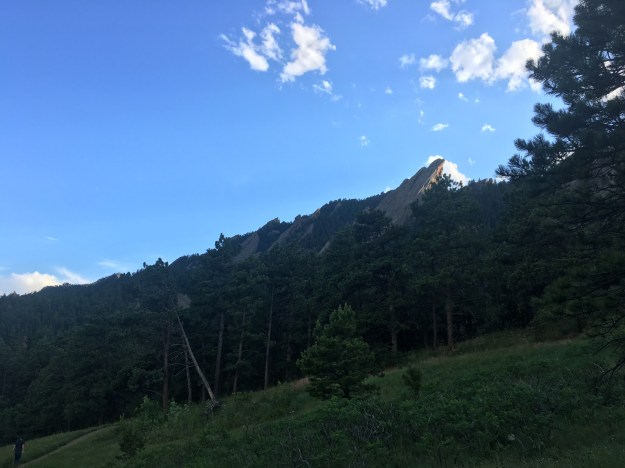
At this time of the evening, shortly after starting the hike, the sun had already descended behind the mountains to the west. Alpenglow could still be seen, hitting the top of the long flat diagonal rocks that are often referred to as the “Flatirons”.

IMG_0138 (1)

Hiking mainly after 7 P.M. also put most of the hike in the shade, as the sun was already behind the mountain peaks to the west. This made the hike more comfortable, as the temperature was in the upper 80s, a normal level for this time of year, before the hike.

Most of the trail is fairly strenuous, with a consistent climb. This changes at Sentinel Pass, which is within about a half a mile of the end of the trail.

Many hikes are said to have “false summits”; places where the trail appears to be reaching a summit, which is usually the final destination of a hike. Sentinel Pass, in a way, is both a false summit and a real summit.

IMG_0156.jpg

It is actually a summit! However, it is not the end of the trail. The trail continues. There is a short but steep descent right after Sentinel Pass. The descent is followed by another steep uphill section, where, after another 15 minutes or so of hiking, Royal Arch is reached.

IMG_0158 (1)IMG_0170 (1)IMG_0178

It ended up taking me just under an hour to reach Royal Arch. For a hike of 1.7 miles with 1600’ of net vertical, and some areas that are quite strenuous, this is a relatively quick pace.

After resting and enjoying the view for a mere 10 minutes at the top, I was still barely able to make it back down to the trailhead before darkness fell upon the area.

IMG_0183 (1).jpg

This is why I would recommend for most people to either arrive earlier (which shouldn’t be an issue for most work schedules), or bring a headlamp. Even in the week following the summer solstice, with some of the latest sunsets of the year, there are limitations to what can be done after working a typical 9-to-5-ish day.

One of life’s major challenges is making the most of whatever opportunities come our way. June, and its lengthy days, represents an opportunity to simply get outside more and get more exposure to sunshine.

For a variety of reasons it appears that the modern digital, sedentary lifestyle is taking its toll on us. It feels as if every five to ten years, some new set of dietary recommendations come out. Either a new set of foods become the secret, magic ticket to a healthier life. Or, some different type of food suddenly becomes the new “boogeyman”, and is suddenly to blame for all these widespread health problems.

I am not a health expert. However, based on my observations and reasoning, it appears that many of our health problems are related to two things; many people being way too sedentary, and, primarily in the United States, some ridiculous portion sizes. There also appears to be some merit behind staying hydrated and getting enough sleep.

Our bodies were meant to move. It’s been shown that sitting for even a couple of hours at a time can actually lead to negative health impacts, including the supply of oxygen being cut off from our brains. The predominant form of employment in 2017 is still 7-10 hours per day sitting in front of a computer. This cannot possibly be good for our minds or our bodies.

There has also been countless articles published recently regarding the connection between happiness and exposure to sunshine. Not only were we not meant to spend well over half of our waking hours seated, we also were not meant to spend nearly as much time indoors.

In our current culture, it is really hard to avoid having to perform a lot of work that requires being seated in front of a computer. Heck, writing this, I am, in fact, seated in front of a computer. This does not mean we cannot seek out and take advantage of opportunities, whenever we can, to be outdoors, be in motion,  and/ or be social (separate topic), as much as we can.

IMG_0187 (1)

On the descent, I spent half the time talking to random people. The other half, I was lost in my own thoughts. I imagined myself in various scenarios, settings I could see myself in, places I would be, people I would talk to, etc. All the scenarios I imagined involved me encouraging others. I encouraged others to believe in themselves, to have confidence, to stand up to naysayers, and to make the most of their lives. Part of that involves taking part in activities that enrich our lives. So, I encourage everyone to take advantage of summer, particularly this first part of summer, and the opportunities it affords us by checking out places like Royal Arch for evening hikes.


Greyrock Mountain- An Ideal Hike for May

IMG_9765.jpg

For the majority of people who like to hike on weekends, or in their spare time, hiking anywhere in the American West in the month of May requires two additional considerations.

  1.  There is typically still a residual snowpack at higher elevations.  While this can vary quite a bit from year to year and even day to day, even on a warm, sunny day, those that don’t want to encounter slippery conditions or deep snow covering the trails should generally stick to lower elevations.  In Colorado, that generally means below 9500 feet in elevation.
  2. Although everyone’s body behaves differently, most people still respect the seasonality of the activities they take part in, hiking less frequently in winter than in summer.  Therefore, most people still need to, in some way, work up to the most challenging hikes they will take on later in the summer.

IMG_9733

Tucked away in the Poudre Canyon 15 miles West of Fort Collins, Colorado (which is an hour north of Denver), the Greyrock Trailhead starts at an elevation of roughly 5600 feet.

IMG_9734

The hike to the top of Greyrock Mountain, on the most direct path is 3.1 miles, with an elevation gain right around 2000 feet.  For those who spent their winters either sedentary or on unrelated activities, and maybe have done two or three hikes thus far in the spring, it is strenuous enough to help get the body back into summer mode.  And, topping out at 7600 feet, it remains well below the elevations where residual snowpack and large amounts of mud would still be present on a sunny day in May.

IMG_9731

Of course, many people are aware of these seasonal considerations.  Therefore, the area does get busier than usual, particularly if it is a nice day and/or on the weekend.

Still, there is plenty of quiet to be found on this appropriately named mountain, just not the level of solitude one would expect on, say, a remote backpacking trip.

On the 13th of May 2017, a dry day in which Fort Collins reached a high temperature of 85F (and was preceded by two dry days) nearly all of the trail was dry.  It was only in certain sections, close to streams, where mud would appear.  These sections got interesting, as groups of butterflies, both red and blue, would loop around the sky, periodically congregating in and around areas of standing water.

IMG_9745

The blue butterflies are actually extremely well camouflaged, only showing their color when the wings are flapped open.

IMG_9751

IMG_9755

A closer look at the muddy surface reveals dozens of these butterflies nearly completely blended into the muddy surface, something many hikers don’t even notice!

IMG_9761.jpg

Roughly 2/3 of the way up, the first real scenic overlook is reached.  This is the point just before the two trails merge back together, at an elevation of roughly 7000 feet.

The final 600 feet of ascent looks, well, far more daunting than a typical 600 foot climb.  And, well, it is.  After a short flat area, following the scenic overlook, the trail begins to climb up a series of rocky areas, often referred to as “scrambles” by hikers.

These parts require some strategizing, both on the way up and on the way down.

The final section of the trail is the one area where it is possible to get lost.

On top of rocks, the trail passes by several lakes, where the sound of frogs can be heard, and is marked only by periodic signs 2-3 feet tall and the occasional standard rock pile (referred to as a Cairn).

IMG_9783

The summit is also just kind of a series of rocks, that need to be climbed over to reach the best lookout point.  Being at the top of Greyrock Mountain is somewhat of an unique experience.  In some ways, it feels just like being on top of the world, as noting in the immediate vicinity is at a higher elevation.

IMG_9792.jpg

However, out on the horizon to the West and Southwest reveals mountains whose peaks dwarf this one by over 5,000 feet.

It feels like a metaphor for a certain life situation that nearly every human being will find themselves in at one point.  The mountain has been climbed, a goal has been achieved, and there is reason to celebrate… temporarily.  But, there is still a lot that must be done, and much higher aspirations.  It is finishing a degree and moving on to start a new job.  It is successfully navigating nine months of pregnancy now knowing that it is hard work to raise another human being.  It is knowing that one has achieved as much as is possible in a current endeavor, and that there is something more meaningful, a higher calling, awaiting that requires a pivot, a new strategy, and renewed effort.


Moab- An Active Destination

IMG_9301

Some trips are restful, while others are more active.  There are some destinations that lend themselves to more restful trips; cottages in the woods near quaint towns, tropical beaches, and resorts.  Moab, is a place where it is nearly impossible to imagine anything other than an active itinerary, with a variety of activities, and a lot of places to see.  Situated in East Central Utah, several hours from the nearest major city, this popular tourist destination is surrounded by too much natural beauty to picture anyone coming here and spending large amounts of time sitting in one place.

First of all, Moab is surrounded by two National Parks, Arches and Canyonlands.

Both National Parks are, as National Parks tend to be, filled with tons of natural beauty and unique places.  At both National Parks, while it is possible to see a lot of interesting natural features without straying too far from the road, the best features at both parks require hiking.

FullSizeRender (1)

Getting to the signature feature of Arches National Park, Delicate Arch, requires a 1.5 mile hike from the Delicate Arch Trailhead.  Interestingly enough, this trail starts near the historic Wolfe Ranch, and traverses by some other unique features including some Ute Indian Rock art.

It is also quite difficult to imagine making a trip to Arches National Park and not viewing some of the other arches (Yes, it’s Arches National Park, not Arch National Park).  There is a section of the park known as Devil’s Garden, with somewhat of a network of trails taking visitors to all kinds of other arches.

The most famous of these arches is Landscape Arch, a long and wide arch whose name provides a clear recommendation as to how to orient any photograph of this particular feature (for those familiar with landscape vs. portrait  ).

IMG_9345

To get to most of the remaining arches requires a bit of a steep climb, which starts pretty much right after Landscape Arch.

IMG_9346

The hiking in the entire Moab area, not just at Arches National Park, is considerably different from the typical hiking experience.  Much of the hiking I’ve experienced, is on trails covered in dirt, gravel, and sometimes small to medium sized rocks at places such as the top of Quandry Peak.  All around Moab, I found myself on surfaces such as this one, on top of solid rock, sometimes for nearly the entire duration of the trail.  Traversing these trails required me to use my upper body more, and even do a little bit of jumping, from one rock to another.

At the top of this Mesa, there are arches with multiple partitions, arches people can hike under, and even one arch with an opening that lends itself to laying inside it to soak up the sun, the surroundings, and the experience!

The entire loop, including all the side trips in the trail network, is a total of 7.2 miles.  So, if a visitor desires to see all of these features, as well as Delicate Arch, a total of 10.2 miles of hiking is required.

And some people decide to add even more activities to their day.  In a shaded off-shoot of the Devil’s Garden Trail, I witnessed a sizable group of people playing a game of Frisbee, using the walls of this tiny canyon to make trick shots.

IMG_9391

Since immersing oneself in the here and now, and contributing to the local culture of a place creates a more enriching travel experience, I decided to play my part.

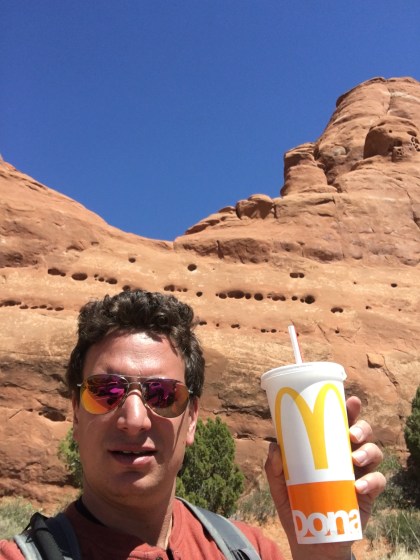
First, I decided to bring my own arches into the park..
IMG_9332

Disclaimer: I did properly dispose of that cup

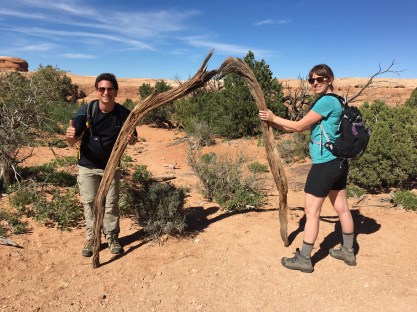
Then, when the opportunity presented itself, I decided it was time that we started making our own arches, contributing to the park’s plethora of natural beauty.
IMG_9374

IMG_9444

Canyonlands National Park is even bigger than Arches, broken up into three sections by the Colorado and Green rivers, whose confluence is right in the center of the park.  Without any bridges connecting over either river, and with the entrances to each section over an hour apart, it is all but impossible to visit more than one section in a day.
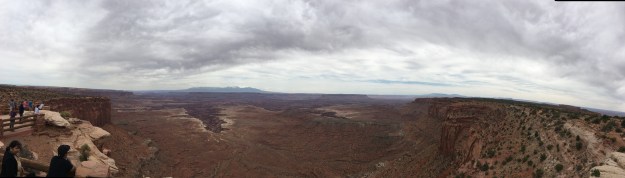
IMG_9461.jpg

The most common image of Canyonlands National Park is an almost Grand Canyon-like overlook into a deep river valley, sometimes with one of the two isolated mountain ranges in the background.  However, at the scenic overlooks in the parks’ Island In The Sky region, it is actually quite difficult to see the rivers themselves.  The canyons that make up Canyonlands National Park are quite expansive, with multiple tiers.  To see these canyons from the best vantage points requires a bit of hiking.  The hike to the Confluence Overlook (an overlook of the confluence between the Green and Colorado Rivers) is 10 miles round trip, something that could require the better part of a day!

Canyons are not the only interesting feature to Canyonlands National Park.  Being only roughly 20 miles away from Arches (as the crow flies), Canyonlands has some arches of its’ own.  The most interesting one is an arch called Mesa Arch, where one can see both the peaks of the nearby La Sal Mountain range, and actually another arch by looking through the arch at the right angle!

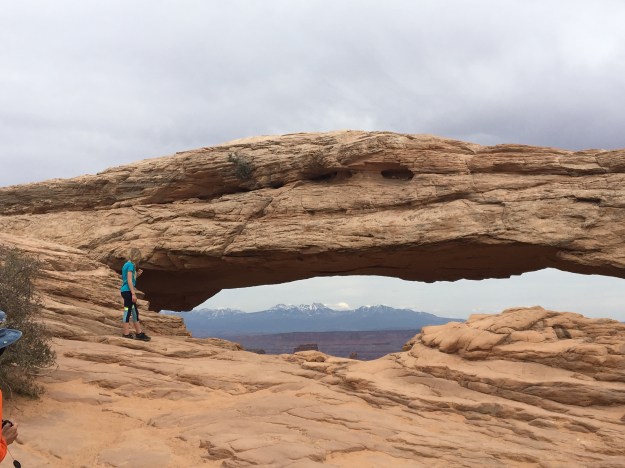
IMG_9471IMG_9468

And some features are random, like Upheaval Dome.
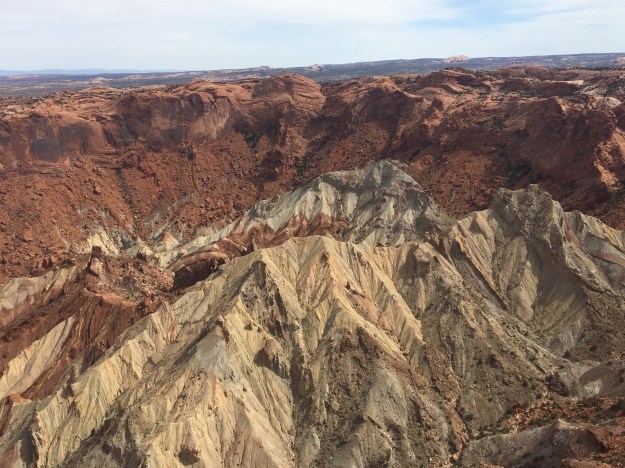
IMG_9427

Scientists still do not know whether or not this particular salt deposit is a remanat of a meteorite that would have theoretically collided with the earth roughly 20 million years ago.

The two National Parks are not even close to all that Moab has to offer, all of which is “active” in one way or another.  Dead Horse Point State Park, located between the two National Parks, is a place where one can hike to one of Moab’s most picturesque locations: Goose Neck.
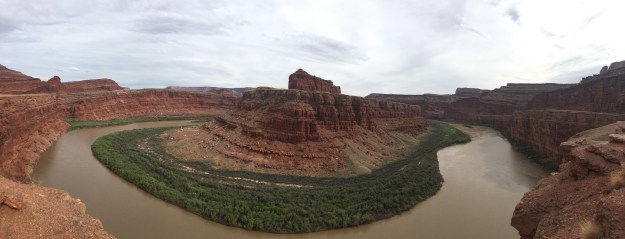
IMG_9494

The entire region, regardless of what any spot is named, or whether it contains a state or federal distinction, is rich with abundant natural beauty, and places to hike, bike, jeep, climb, or even just explore.

Anyone driving into Moab from the East (from Colorado), would be well advised to take the additional time it takes to follow the windy State Highway 128 through Professor Valley, essentially following the Colorado River into town.
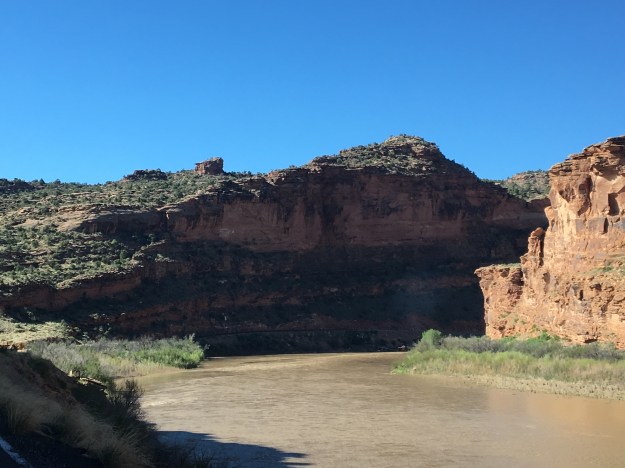
IMG_9209

We set up camp at a place called Hunter Canyon.

Twenty minutes from town, Hunter Canyon is a place where each part of the day, from sunrise to sunset, lights up a different rock formation.  It felt almost as if nature was putting on a show, with lighting, stage props, and characters coming on and off the stage for different scenes.

I also saw bike trails nearly everywhere I went.  Moab is known as a mecca for mountain biking, an activity we did not get around to (is is… really… impossible to do EVERYTHING in Moab without something like two weeks).  But, with trails like these, Moab is also a phenomenal place for road biking.

IMG_9401.jpg

And, everywhere I went red rock formations, each one distinct from the next, would pop up, in and out of view.

It was next to impossible not to imagine these rock formations as something else.  While driving around, I would often point out to the rest of the group what each individual rock formation looked like, or what I perceived it to look like.  Some, I said looked like specific animals, some looked like people, others, still, looked like various specific objects, such as hammers, cooking utensils, or even a turkey wishbone (by the way, the following image is an arch, residing in neither National Park, they really are everywhere)!
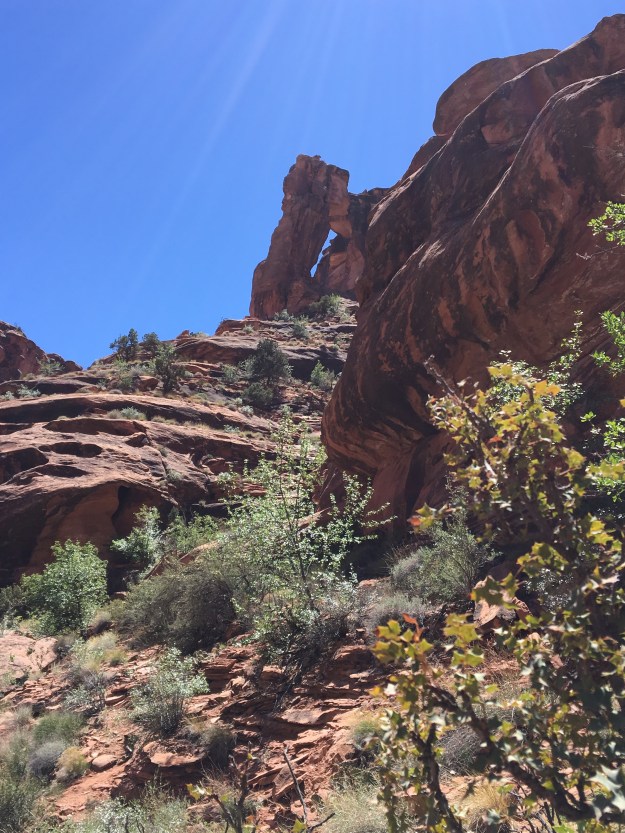
IMG_9237.jpg

And, what amazed me was how often others in my group would actually see the exact same thing when they look at a rock formation and say, yes, I also saw an octopus.  This means that either my imagination is quite accurate, or, I have managed to surround myself only with similar minded people.  Both are very much a possibility!
IMG_9241

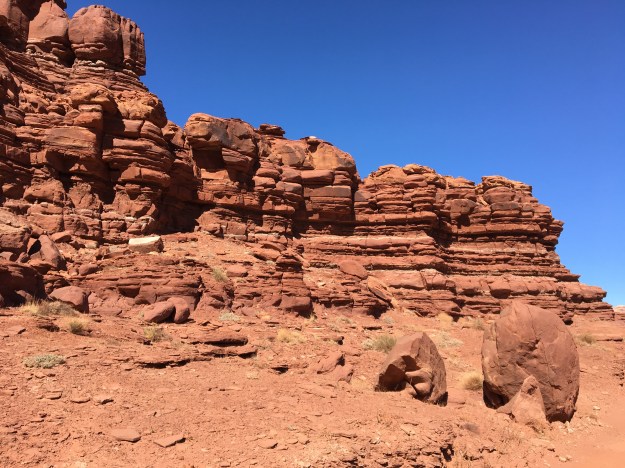
But, the analogy I came to in my head most frequently, throughout the trip, is between the rock formations and the ruins of an ancient city.  Every time I saw a structure such as this one, I would imagine what is would be like if, for some unknown reason, there actually was a civilization here, many thousands of years ago.  And each one of these rock formation was actually the remnant of an ancient skyscraper, or even a larger building like Chicago’s Merchandise Mart, weathered down by thousands of years of natural erosion.  I imagined what this ancient city would have been like, in an Atlantis-like scene that would play through my mind.

Since Samantha Brown’s presentation at last month’s Travel and Adventure Show, I had been trying to live in the here and now, and experience the current culture of a place, as she had advised.

For me, this included another new activity (for me)- Jeeping!

IMG_9521

And, I got to experience some crazy roads and some crazy places.

But, as I find in many of my travels, there is no way to truly avoid thinking about the past, and imagining another setting.  A video at the Canyonlands Visitors Center explained the actual process in which these rocks came to be formed, which took place over the course of 200 million years, back to a time when much of Utah and Colorado were near sea level, with some sections underwater and others above.  In fact, that is part of the reason why there is so much small scale variance in the color of the rocks throughout this region.

Everywhere I went, everywhere I looked, there were echoes of the past, both real and imaginary, and both ancient and more recent.
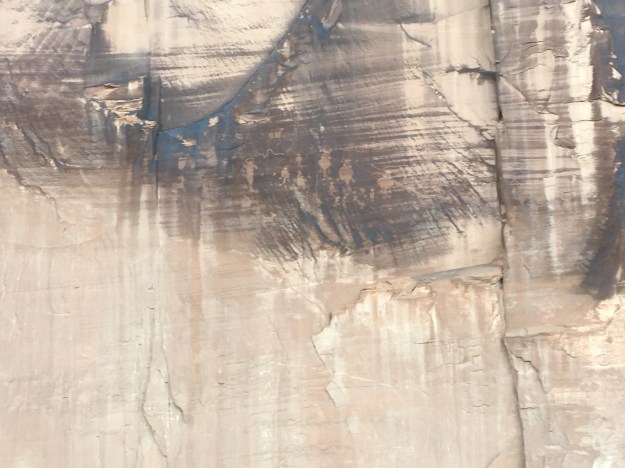
IMG_9507.jpg

The experience of visiting Moab for a long weekend is as jam-packed as I have made this aritcle.  Around every corner, something new, something exciting, and something unique.  While there are some travel destinations, like Miami, one can make as active or as restful as they would desire, Moab is one destination that requires one to be active, at least in some way, to truly experience.  To come to Moab, and not wander, not explore, not do a little bit of hiking, biking, or jeeping, one would miss out on so much of what is around every corner in this region.


The Longest Day Hike of My Life

DCIM160GOPRO

Conundrum Hot Springs

The hike from the Conundrum Trailhead to Conundrum Hot Springs is roughly 8.5 miles.  Round trip is at least 17 miles of hiking.  I say AT LEAST as I have been on plenty of hikes where side excursions, both planned and unplanned, lead to covering a total distance that exceeded the official distance of the hike.

Due to the distance, and the destination, nearly all the people we encountered on this hike were backpacking.  This is an attractive option, as the trail is pretty long but not terribly challenging, and the hot springs are the kind of destination one would want to spend a significant amount of time at.  However, Conundrum Hot Springs is a popular destination, and there are limited camping sites in the immediate vicinity of the springs.

Conundrum Hot Spring is close to Aspen, which is three and a half hours from Denver.  Some of the people in our group, myself included, were not able to leave early enough on Friday for us to be confident that we could secure a camping spot.  We ended up deciding to find a campground somewhat close to the trailhead, and hike to and from the springs as a day hike.  As an added bonus, we would not have to bring, or carry nearly as much equipment, as we would be “car camping”.  The hike would be both easier and harder.  We would not be carrying nearly as much weight, but we would be cramming 17 miles of hiking into one day.
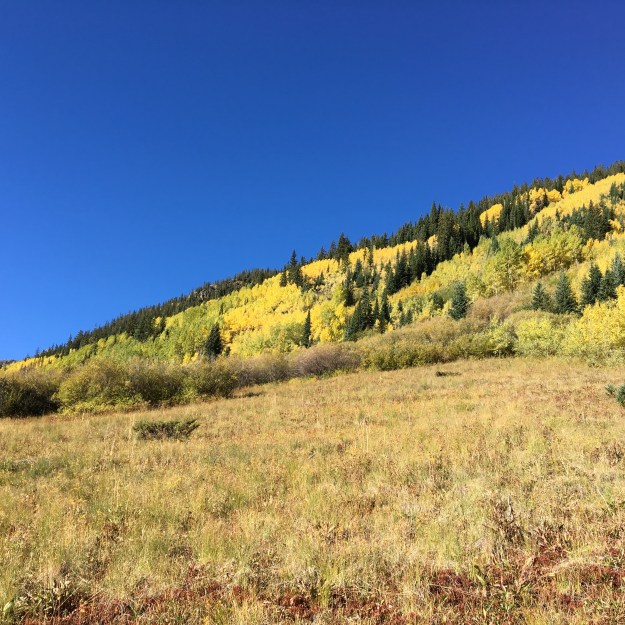
Up in the mountains of Central Colorado, trees change color earlier in the Fall than they do in many other parts of the Country.  In general, the second half of September, and maybe the first few days of October, is the best time to see the Aspen trees here change colors.  I was partially surprised by how vibrant the colors were, by September 16th.  For the first two hours or so of the drive, before sunset, we saw a preview of the kind of colors we’d be seeing during the hike, certainly early season, but vibrantly colorful, with sections of bright yellows and oranges periodically appearing in front of us.

To be sure we would have enough time, we had to wake up, eat breakfast and leave the campground at Lincoln Creek (dispersed camping roughly 40 minutes from the trailhead) all before sunrise.  We arrived at the trailhead and started hiking at roughly 15 minutes after 7 A.M.

The morning chill was both an obstacle and a boost.  Overnight temperatures dropped to roughly 30F (-1C) at the campground.  For the first 90 minutes of the hike, the ground was covered in frost.  In fact, the frost even made our first river crossing a bit slippery.

This morning cold made me cary several layers, adding a little bit to the weight of my backpack (although it was still way, way, lighter than it would have been had we been backpacking).  However, the cold weather motivated us to begin our hike at a rapid pace.

We would cover over four miles before we even reached the sun!

IMG_7577.jpg

I would describe at least the first five miles of the hike as “easy” from the standpoint of evolution gain.

img_7579img_7580img_7581

Many sections of the trail are actually close to perfectly flat, giving me plenty of time to take in the natural beauty that is around me, and also connect with my friends who I was hiking with.  When hiking, it is challenging to have a conversation when hiking up steep terrain, but fairly easy to do so in largely flat sections.

IMG_7582.jpg

The appearance of small lakes precludes the transition to the more challenging part of the trail.

This occurs somewhere around six and a half miles into the hike.  First of all, there are sections that are more technically challenging, including a couple of tricky creek crossings, and a section where one must scramble over rocks.

IMG_7589.jpg

There last two miles of the trail also includes some fairly steep sections.  I wouldn’t say they are overly challenging, but in the context of a 17 mile day that included hiking at a rapid pace towards the beginning, they ended up being fairly exhausting.

We ended up spending roughly two hours at the hot springs (including changing and eating lunch).  There were a lot of people in the hot springs, but it was not as crowded as some of us had feared.

img_7601img_7603

For a variety of reasons, the fall colors appeared even more magnificent on the way back down!  The most significant reason had to be the manner in which the trees appeared in the mid-afternoon sun.

img_7604

I was also pleasantly surprised to see a significant amount of deep orange shades.  In prior experience with fall in the Rockies, I had almost exclusively seen the yellow shade that seems to be the most common fall color for Aspen trees.  While “autumn gold” is pretty, I had, in some ways, missed wide variety of shades that leaves on maple trees take on during fall.

img_7606

I would definitely describe the color we enountered as “early season”.  There were still many Aspen trees primarily shaded green, particularly at lower elevations.  This indicates that the next two weekends could be just, or perhaps even more, colorful!  The colorful trees, the yellows and the oranges, tended to be those higher up.  The several patches of deep shaded orange I saw were nearly exclusively up closer to the tree line.

Conudnrum_FallCOlors_Sept2016.JPG

Both the hike up to the hot springs and the return trip took roughly four hours.

IMG_7607.jpg

We got back to the trailhead sometime just after 5 P.M., and, after the 40 minute drive back to Lincoln Creek, I finally got to see what the campground looked like.  And I got to do something I had not previously done.  I got to park my car with the rear left tire on top of a rock, showing off just how rugged my vehicle is.  Well, at least in an auto show pamphlet sort of way.

Capping off an exhausting day was a side excursion, to a waterfall, well, multiple waterfalls, that those of us in our group lucky enough to be able to leave early Friday had located roughly a quarter of a mile from the campground.  In fact, they hyped this place up over the course of the hike.  So, we had to go.  Additionally, this side excursion was enough for me to achieve something meaningless, but also something I am likely never again to achieve.  I recorded 50,000 steps on that step counter thing that comes with every iPhone6.  Yay me!

We would explore this likely unnamed waterfall area again Sunday morning before departing for Denver.

img_7631img_7636img_7641img_7642

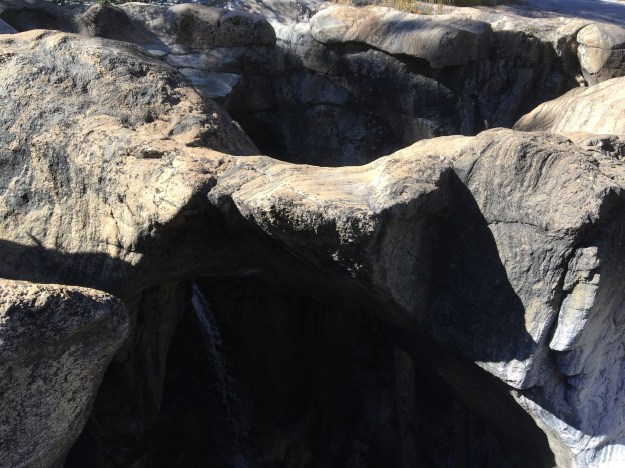
If you count all the places where water squirts out of random places in the rock, there are probably close to a dozen “waterfalls” in this area.  What a great unexpected treat!

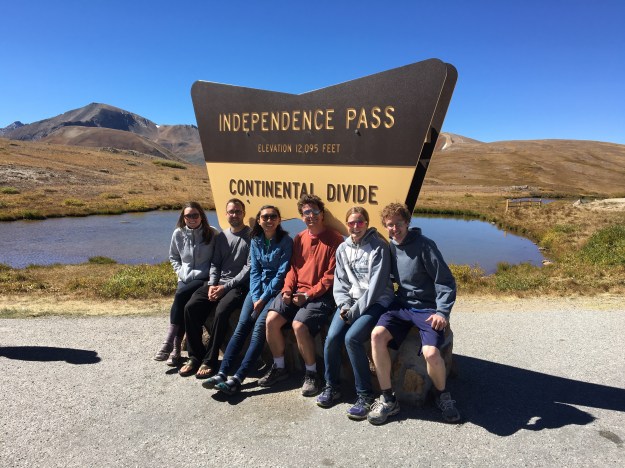
The return trip on Sunday was eventful as well, with some great stops at Independence Pass and Twin Lakes, both places I had driven by on Friday, but after the sun had already set.

img_7656img_7660

I titled this blog “The Longest Day Hike of My Life”, as, well, I can not picture a day where I hike more than 17 miles on a day trip.  However, I probably would have never imagined hiking 17 miles in one day a few years back, so there is no way to definitively say never.  I am prepared, though, for this to be my longest hike, and understand the significance of it. Like many of the adventures I had over the course of this summer, and in previous years, it was both exhausting and amazing.  But, most worthwhile experiences, from relationships to starting successful businesses and such, are.  Being exhausted after this experience should be a reminder to all of us that what is easiest is often the least rewarding, and that which is most challenging often comes with the greatest reward.


Backpacking in the Weminuche Wilderness: Day 3

IMG_7252

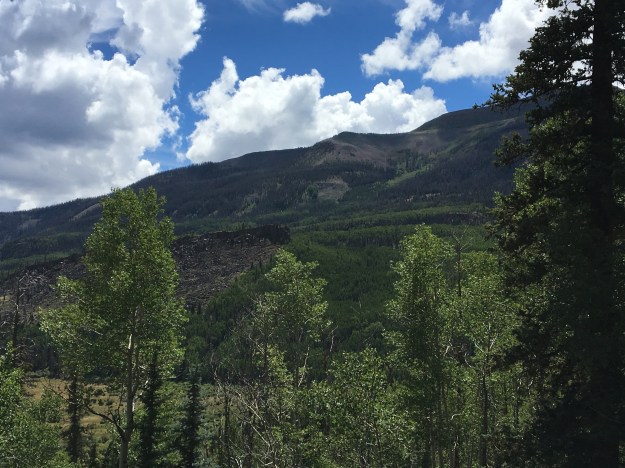
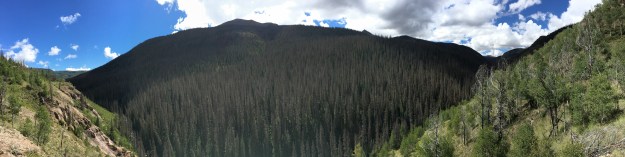
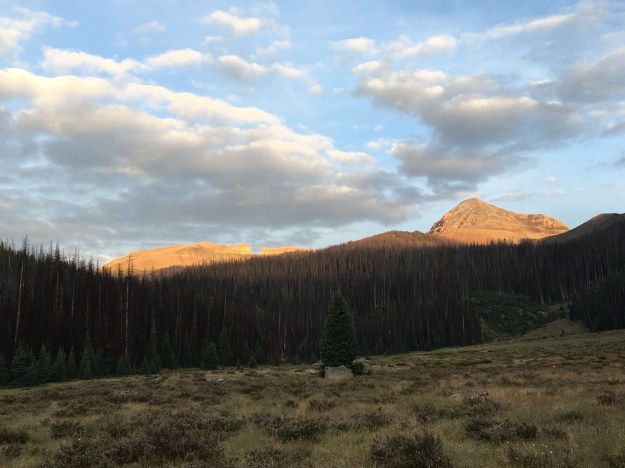
The Weminuche Wildreness appeared to be particularly devastated by the recent Mountain Pine Beetle epidemic.  While a portion of the second day was spent above the tree line and in storms for much of the journey, we wound our way in and out of the forest, alternating between hiking through the forest itself, and hiking across an open meadow where we could gaze upon the forest to both our left and our right.

IMG_7229

Throughout the State of Colorado, and throughout the West, I observe areas where the Pine Beetles have decimated the forest, changing the ecosystem forever.  Nowhere, though, have I seen a higher concentration of dead trees.  I would estimate that, over the course of the trip, some 70-75% of all the pine trees I saw, were, in fact, dead.

IMG_7228

But I did notice some signs of life, particularly at the campground Sunday (Day 3) morning.  Tucked away amongst the densely pack forests of decimated trees, little signs of life seemed to appear.  It reminded me of many American cities, circa 1982, decay being the overarching theme but, signs of life and pockets of hope beginning to appear here and there for those willing to observe.  Maybe indeed, the worst has now passed for this particular forest.  As was the case for many of our cities, it is possible that in a decade or so, we will revisit areas like this, and see once again a thriving forest, albeit, as was the case with our cities, with a different character?

IMG_7246.jpg

As is typically the case on a three day excursion like this one, the last day was primarily a descent.  As we descended, we quickly reached elevations where Aspens, rather than Pine trees made up a significant proportion of the forest.

IMG_7267IMG_7268

Maybe it is different at this latitude, farther South than the Denver area, where I live and spend most of my time.  But, it feels as if in this wilderness, Aspen trees are able to grow at some pretty high elevations.

IMG_7302

We figured out the tree line here to be somewhere close to 12,000 feet in elevation.  When looking upon sections of forest from afar like this, it is easy to picture some of these Aspen trees living at elevations close to 11,00 feet.  Over the course of my four years in the Denver area, I had grown accustomed to them disappearing between 9,000 and 10,000 feet.

Sunday’s hike was a 7.3 mile trek along the Ute Creek trail (the East Ute Creek trail we had followed the previous day merged with the main Ute Creek trail).  The trail alternated a bit, climbing up and out of the valley formed by the creek for some sections, and descending back toward the creek for others.  Due to the previous night’s onslaught of rain, which likely impacted the entire valley, the trails on this, the final day, were at times even muddier than the were the prior two days.  At the end of three days, our total distance came out around 25 miles.  I speculated as to whether the extra distance we traveled stepping around puddles, and veering left and right to avoid some of the muddiest sections of trail, over the course of three days made this a mile or so longer than it would have been had the trails been completely dry.

IMG_7287

I personally added some distance on top of that.  I love side excursions, whether hiking/backpacking, cycling, or on a road trip.  And, in addition to the side excursion to the feature known as “the window” the previous day, I took one completely on my own the final day.  Roughly halfway through the hike, I saw a place where I could cut down to the creek, and see a mini-waterfall.

IMG_7291

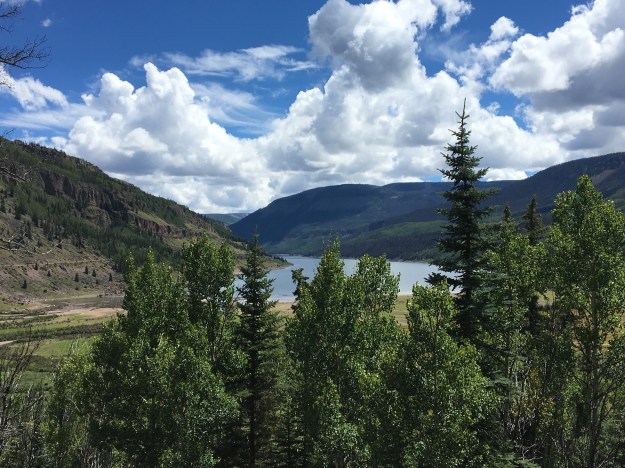
The final part of the day consisted of a small climb out of the Ute Creek valley, followed by a descent back towards the Rio Grande Reserviour.

IMG_7299

It is inevitable that, on the last day of any trip, we all begin to ponder our return home, and a return to our “normal lives”, whatever they may be.  This return, though, is somewhat unique, as a trip into the woods is not just a journey away from our jobs, or certain responsibilities, it feels more like a complete separation from the modern world, or as some people refer to it, the “real world”.  All of us were separated, not just from work, but from TV, from the news, from Twitter, and even the manner in which society is structured in the 21st Century.

Since my return to Denver was a return to, after being completely separated from, the “real world”, I started to contemplate the “real world” as one big entity, which, even for a big-picture abstract curious minded thinker like me, turned out to be strange.  I feel like we often compartmentalize the “real world” into buckets; the working world, the relationship world, the school world, etc.  We will write blogs, have conversations, confide in others about our hardships, or celebrate our successes, with respect to one specific bucket of the “real world” at a time.  Some people will even chose to accept or rebel against the modern world on a bucket-by-bucket basis.  “I’m a freelancer, happily married with two kids and a picket fences house.”  “I work 9-to-5 for a large corporation, but I only eat organically certified food.”

I’m not saying there is anything wrong with any of the partially-rebellious lifestyles I am describing here.  We often try to oversimplify the actions and lifestyles of others as being either “conformist” or “rebellious”.  When I thought about life in the woods, and the few people that actually do it, live off the grid, and off the land, I think of those people as “rebellious”.  But, then I thought of human beings as part of the animal kingdom, and thought about what all non-domesticated animals do.  They live in the woods.  They hunt their food, many wandering around nomadically.  When thought of in that manner, it is us human beings, and our domesticated cats and dogs, that are rebelling against the way the rest of the animal kingdom works by farming our food and setting up permanent shelters.

IMG_7304

At the conclusion of our journey, we had to actually wade across the Rio Grand River to get to the car, as the trail ended abruptly at the river.  This likely explained why we did not see any other people the entire time we were on the East Ute Creek and Ute Creek trails yesterday and today.

IMG_7309IMG_7310

Shortly after leaving the trailhead, I saw what looked like baby mule deer living along the steepest part of the hill.

IMG_7323.jpg

Like the journey to the Wilderness, the journey home took us by some of Colorado’s highest peaks and most stunning mountainous features.  I thought of the “real world” I was gradually re-entering, the life I live and the journey I just took.  It is not important whether we are “conforming” or “rebelling”, because, like life in the woods, it can be thought of as conformist or rebellious depending on perspective.

Those of us that are honest with ourselves, and with those around us, will undoubtedly find ourselves in both situations.  We’ll find ourselves in a place where our choices are the same as those around us, and be suseptable to being labelled “conformists”.  We’ll also, at some point, find ourselves in a place where our choices are not those of the majority, and be met with skepticism, hostility, and possibly even pressure to change.  What matters most, is not fitting into an image we may have of ourselves, whether it be the upstanding citizen, rebel, outcast, or whatever, it is that we have the courage to be all things, depending on our setting, in order to be true to ourselves.

Backpacking in the Weminuche Wilderness: Day 2

IMG_7153

Before moving to Colorado, I experienced seasons in a completely different way.  While there would be some anomalies, for the most part, winter was winter and summer was summer.  Snow was something I experienced starting in November, through the winter, probably one last time in early April, and then not again for 6-9 months.  Likewise, heat would be primarily confined to the summer months.  In other words, I experienced being cold and being warm in two separate parts of the year.  The experience would generally only mix during the in between seasons; mid-spring and mid-fall.

In Colorado it’s all different.  In Denver I’ve seen temperatures reach the lower 70s (23 C) in the middle of February.  At higher elevations snow can fall nearly year round, and there are places where snowpack persists well into the summer.

IMG_7154.jpg

Saturday morning, the start of my second day in the Weminuche Wilderness, was a cold one.  The chill had awoken me at 3:00 in the morning, when I reached for my warm hat and for the zipper to zip my sleeping bag all the way shut.  At roughly 6:30 I woke up for good, and crawled out of the tent to find ice on the fly!  Frost was found on many of the items we left outside, including this bear cannister.

It warmed up fairly quickly at the campsite making me wonder why I did not simply stay inside the tent for another hour.  All the weather forecasts we had looked at prior to this backpacking trip had indicated that a wet period was coming to a slow end, and that each day would get progressively drier (lower probability of rain).  Yet, in the morning I saw something that would indicate differently; alto-cumulus clouds.  These are puffy clouds with a base somewhat higher up in the sky than the clouds we typically see.  On some storm chases, the presence of alto-cumulus clouds indicated the presence of moisture at higher levels of the atmosphere.  This was seen as a good sign on a storm chase, but, on a backpacking trip, is a bad sign.

The first few miles of the day took us by a lake we are glad we did not chose to camp at the prior evening, and then back into the woods, where once again the trail was muddy kind of on-and-off.

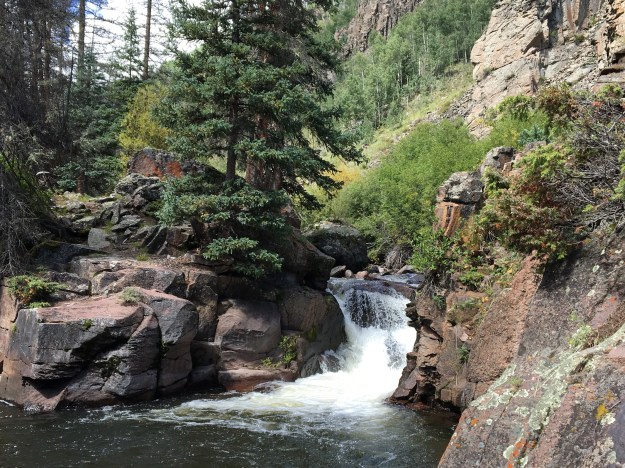
Headed farther up in elevation, towards the summit of the day, we approached the tree line, encountering several waterfalls.  This one, by far, was the most pictureqsue.

IMG_7175.jpg

I did not even know the name of any of these waterfalls.  In fact, I did not even verify that they even have a name.  It didn’t even seem important at the time.  We just liked what we saw.  At that time, most of the conversation within our group revolved around whether we would see marmots in the nearby rocks, and speculation as to what elevation the tree line was at at this latitude.

We followed the Rincon La Vaca (Cow Canyon) trail, which is also considered a section of the Continental Divide Scenic trail, above the tree line, and approached a rock formation we had been looking at since early the prior afternoon, “The Window”.

IMG_7183

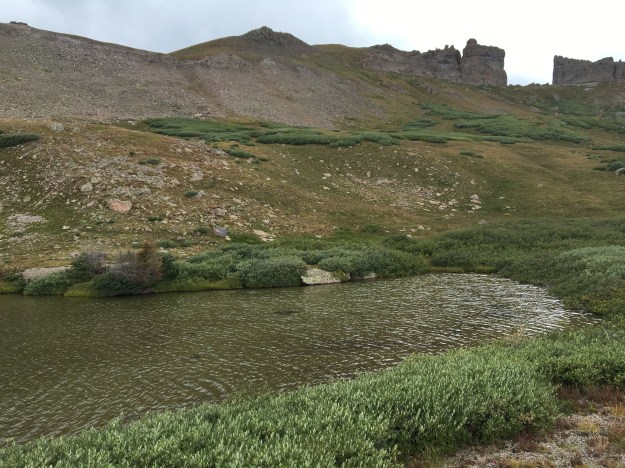
This is where we decided to stop for lunch, at a lake where we could safely refill our water bottles.

IMG_7188

It was noon when we finished eating lunch and, four of us (out of a group of six) decided, despite the potentially ominous weather, to make a side excursion.  We dropped our packs and hiked the 500-ish feet (and half a mile) up to “The Window”

We got back to the lake, where our backpacks were, around 1:00.  As soon as we prepared to move, and catch up with the rest of the group, it started to rain.  A few minutes later, ice pellets began to fall from the sky.

IMG_7200

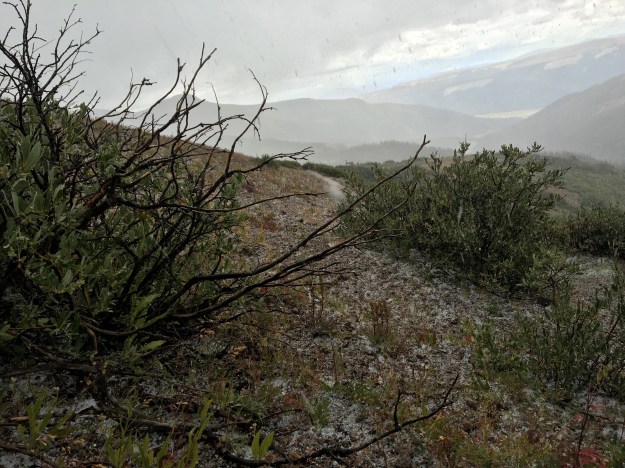
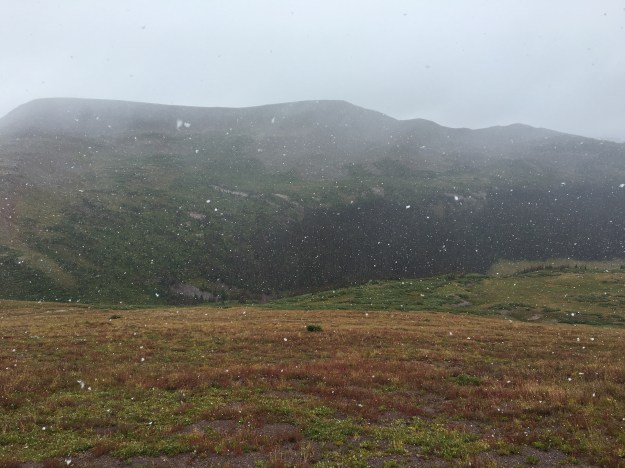
We briefly took shelter from the inclement weather, but eventually soldiered on through the not quite rain not quite ice, which would eventually change over to snow!

IMG_7203.jpg

I experienced a lot of this living in Chicago.  I called it “precipitation jambalaya”.  But, I never thought I would hike through it, and, well, am used to experiencing this in December, not late August!  Once again, that thing about the seasons!

IMG_7205

The precipitation stopped right before we turned off the Continental Divide/ Rincon la Vaca trail, and started looking for the trail we would take back towards the reservoir, the East Ute Creek Trail.

IMG_7207

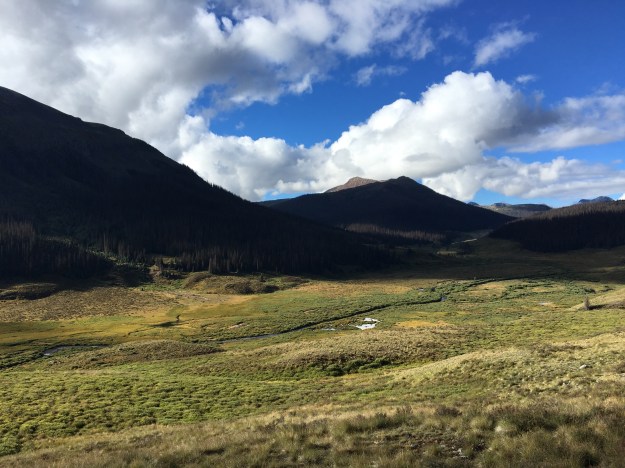
The scene looked familiar.  The shape of the Ute Creek Valley where we were headed, with an open meadow surrounded by mostly dead forests on either side looked quite similar to the Weminuche Creek Valley we had hiked through the prior day.  The trail, though, was hard to find.

For the first mile we kept losing the trail, or we just saw it show up only as a barely visible line in the grass.  We actually speculated as to whether or not this trail was so infrequently used and/or maintained that mother nature was basically starting to take it back!

IMG_7213IMG_7214

We hiked until roughly 5:00 P.M., and by the time the day was over we hike a total of 10.2 miles (11.2 for those of us that took the side excursion to “the window”).  The last hour featured two crazy river crossings where we actually removed our socks and shoes.

We found a campground near a small lake called Black Lake, where, once again, the weather took a turn for the worse.

IMG_2867.JPG

The rain started shortly after 6 P.M., and did not let up until after sundown.  I rushed back into my tent!  With all of the experiences of the day, the mixed precipitation at over 12,000 feet elevation, wading through water, and now, once again, more icy rain, I was cold!  I was way colder than I wanted to be, and way colder than I ever imagined being in the month of August.  For the first 20-30 minutes, I had to lie sitting still inside my sleeping bag, otherwise I would start to shiver.

All I could think of were things that were HOT and DRY.  I wasn’t even thinking of warm, pleasant experiences, like drinking rum on a beach in Puerto Rico at sunset.  I was thinking about things that would immediately heat me up and dry me off; sheets that were pulled directly out of the drier, a sauna, Death Valley!

IMG_7237

With the hard hiking parts over with, I had originally hoped to have kind of a party with the group on Saturday night.  We had even brought flasks, filled with whiskey for such an occasion.  But, the weather changed my plans, as the rain continued and I continued to periodically hear thunder through the 7:00 and 8:00 hours.

I also did something I never do on group trips; read.  I joke I often bring a magazine or even a book, places, but never touch it.  This time I actually read.  It was the July edition of Adventure Cyclist.  Fitting for the mood, thinking about warm places while trying to stay warm, I read full stories about cycling journeys through Morocco and Hawaii, both warm places!

I guess regardless of whether you are in an urban setting or in the wilderness, life has a way of changing plans.  In the city, it is some merger, or a random change in commodities prices.  In nature, it is the weather.  But, when it comes to rain, and anytime rain changes my plans, I always do my best not to complain.  Even while I was bummed that I was not partying with my friends and hating how cold I was in my tent, I was mindful to remember that rain is necessary for the food we eat, the water we drink, as well as everything that made this trip possible in the first place.  I do not want to be one of those people that fails to realize this, and cannot put up with a little bit of rain.