Category Archives: seasons

My First Long Day of Cycling

IMG_6357

I woke up in the morning with a good feeling.  It wasn’t a premonition regarding something specific, like when people set out to run a triathlon or take a key exam and get this feeling of confidence that they are going to achieve what they set out to do.  After all, this is a bike journey.  Accomplishment does not come at the end of this day.  It comes at the end of the last day, five days later, when I reach the coast of Maine after six days of riding.

The feeling I started the day with was just a general positive vibe, that I knew I was going to have a good day.  It is a Tuesday, a day where many people will simply be grinding out their daily lives.  For tragically many people, this means stressing out at jobs that do not fulfill them.  I get to ride my bicycle, spend the day outside, and see places I have never seen before.  I must be thankful for that.

On bike journeys there are plenty of things that can go wrong.  There’s always the possibility of unpleasant weather, unexpected storms, or an unexpected unfavorable shift in wind direction.  There are also the many possible mechanical issues that can occur to a bicycle, particularly one that was recently shipped across the country.  The feeling I got was that none of those things would happen, and that I would simply have an enjoyable day on my bicycle.
IMG_6356.jpg

Most Canadians will recognize my way of starting my day off right, with a nice breakfast at Tim Hortons.  Food is crucial on a bike trip.  It is so crucial that when I took the Adventure Cycling Association’s Leadership Training Course three years ago, it was the very first thing they talked about, before bike mechanics, camping/lodging, or even the basics of bike touring.  How to pack trailers, roof racks, panniers, etc. would not be covered until the next day!  I know one bad meal can really strain a bike trip, particularly if it’s breakfast, so I made it a good one before crossing the border back into the United States.

IMG_6360.jpg

Before leaving the Niagara area, I took one last view of the falls from a place called Goat Island.  Goat Island is between the two falls, and on the American side.  It offers a pretty good alternate view of Horseshoe Falls, which is directly across from a place called Terrapin Point.  It might be the best view on the American side of the falls, but, as I mentioned in my prior post, the Canadian side still offers better views overall.

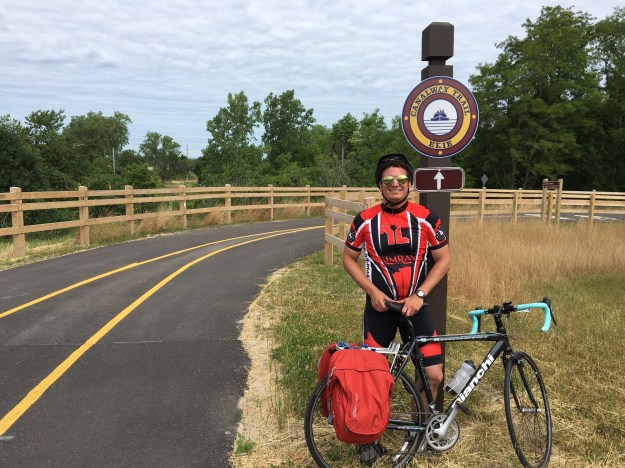
I would spend most of my day cycling on one of the Nation’s longest bike paths, the Erie Canal trail.
IMG_6367.jpg

I knew that this was going to be a flat ride.  The Erie Canal is a waterway that was built in 1824 to provide a shipping route between the Great Lakes and the Atlantic Ocean.  In order for the very concept to work, they had to find a route with very minimal elevation change.  When the canal was built, a series of locks were built to regulate the water flow.  The first town we encountered after picking up the trail was Lockport, New York, a small town with one of these locks at the center of town.


East of Lockport, the trail surface becomes crushed limestone.

IMG_6377.jpg

Staying right next to the Erie Canal, the scenery I encountered was quite constant.  Much of my day looked exactly like this.  This trail is flat, and largely straight, which is good for covering a large number of miles in one day.  I spent most of my time on this trail just thinking about the Erie Canal itself, the amount of work it must have taken to build it, and its role in transporting goods across the Union in the Civil War, which some consider to be a major factor in the eventual Union victory.

IMG_6383

On a day like today, covering a lot of miles on a trail with consistent scenery, it is easy to lose track of each individual town.  This is why one of my favorite features of the Erie Canal Trail, at least in Western New York, is these bridges.  Each of them have the name of the town labelled on top of the bridge, so as cyclists approach, they know which town they are, in fact, approaching.

IMG_6375

I generally liked Western New York for bicycling, and bicycle accommodations.  Obviously, there is the trail, but also many of the roads include wide enough shoulders to accommodate bicycling.  Additionally, New York is one of the states that has labelled state-wide bike routes, which add some level of legitimacy to cycling as a form of transportation.

The exception, at least for me and the route we followed, was Rochester.  We split off the Erie Canal trail in order to ride, and eventually camp, along Lake Ontario.  This involved getting off the trail and following State Highway 104 into town.  Like other Western New York roads, this road had a shoulder.  However, this shoulder had frequent obstacles, mainly sewers, that we needed to cut into traffic to avoid.  After that, we cut over to the lake in a suburb called Sea Breeze only to find out that the bridge we were hoping to take, over Irondequoit Bay, was closed for the summer.

IMG_6388.jpg

We were told that the bridge would re-open in November.  I am accustomed to roads being closed in wintertime, but not in summertime.  I never would have thought to even check to see if any bridge that I was hoping to take would be closed.  What was so frustrating about this was that the bridge itself, seen in the distance, and also on this map, is so short.

Screen Shot 2016-07-06 at 6.49.28 AM.png

It couldn’t cover more than fifty feet, and, as a result of that bridge being closed, we had to back track all the way around Irondequoit Bay, adding a significant number of miles to the trip.

I ended up having to invoke my backup plan.  I had already ridden more miles in one day, 112, than I had ever before in my life, smashing my previous record of 104.  Without the detour, I would already be close to my destination for the day.  But, I knew I needed to save some energy for five more days of riding.

So, I got a ride for the remainder of the day’s trip, which ended at Sodus Point, at a campground where I could watch a beautiful sunset along Lake Ontario.

IMG_6397.jpg

The obstacle I faced was not one of the ones I had anticipated.  Usually when I think of what can go wrong on a bike trip, wind, rain, and flat tires are the first things that come to mind.  A bridge closed for the summer is the last thing that would occur to me.  In fact, it took nearly three days for me to eventually realize the likely reason for a summer bridge closure; so boats can pass through from the bay into the lake.  Still, I consider this sunset along one of America’s Great Lakes a great end to a great day on my bicycle.


The Colorado Model Railroad Museum

The later half of March is a confusing time to be in Colorado.  The range of possible weather events makes it a tough time period to plan for.  In the mountains, there are plenty of times snow continues to fall, and provides more high quality snow days for skiers and snowboarders.  But, the snow does not always continue to fall, and if it doesn’t, conditions on the mountain can deteriorate fast, as warmer temperatures are likely to eat away at the snow pack.

At lower elevations there is quite a bit of variance as well.  March can easily bring Denver, Fort Collins, and even Colorado Springs long strings of 70 degree days.  It can also bring heavy snowfall, as was the case this past Wednesday.

img_5529

There’s no guarantee that the weather will cooperate for any outdoor activities.  There is always the chance that skiing conditions will continue to deteriorate without conditions for cycling or hiking at lower elevations improving.  For people like me, this time of year has the potential to be quite underwhelming.  Due to this uncertainty, I would not personally recommend people travel any great distance to visit Colorado in the later half of March or April.

With leftover snow on the ground, covering the trails and such, this weekend ended up being a good time to visit one of Colorado’s indoor attractions.  I often lament that Colorado does have some quality museums, an indoor activity, but that I rarely actually visit them as I am planning outdoor adventures.  A weekend like this, with less than inspiring weather conditions is the perfect time visit the Colorado Model Railroad Museum in Greeley.

img_5567

As should be expected from a museum dedicated to model railroads, there is quite a bit on display here.  Following the suggested self-guided tour route through the museum, I started out by going upstairs, where I viewed the model rail display in its entirety.

Although it is neat to see these trains go by, each one carrying a different type of freight across the landscape, model railroads are about so much more than just the trains.  They depicts towns, industry, and scenery.  Some of the mountains depicted on this display even contain small components of real rock.

The upper floor of this museum is like a trip back in time.  Plastered on the wall is a map of regional railways, which were once the primary way in which we traveled around the area.  After viewing the photos of historic rail depots, posters from the middle of the 20th Century promoting passenger rail service, and old train schedules on display, I imagined myself in the setting of some quasi-ambiguous time in the middle part of last century, bags packed, ready to hop aboard one of these trains to embark on an adventure.  I gaze at these maps, and think about how much I enjoy not only the adventures I have at various travel destinations, but the process of getting there, the journey.  The railways, and these models, are all about the journey!

The second half of the self guided tour takes visitors downstairs, to see the components of this elaborate model train display individually.  Each segment of model trains tell a story, but not a straightforward story.  They show a snapshot of life in different places along this train’s route.  Looking at all of these individual displays, it is quite easy to imagine oneself there, as part of the story, or as an omnipresent type of observer.  The details and creativity allow visitors to develop a story based on what they see.

img_5577

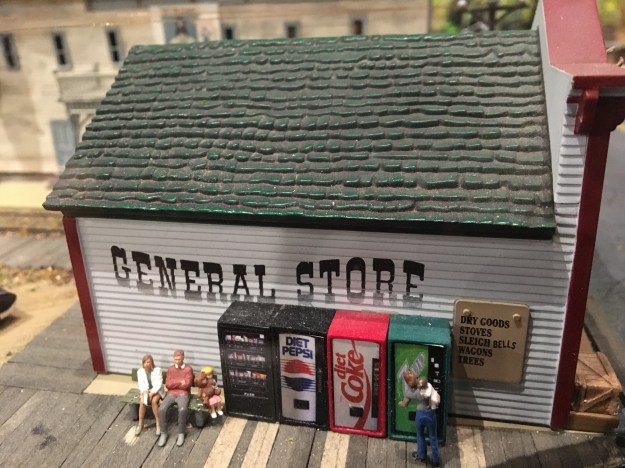
In this thriving town along the rail route, I imagine myself getting a dollar out to purchase a soda from a vending machine on a hot day.  I imagine what this family is doing.  Did they just have a fight?  The Man’s arms are folded and the daughter is turned away from her parents, clinging to a stuffed bear.

img_5575

They got creative too.  The scene here is a wildfire being put out by firefighters.  This is one of many places throughout this gigantic exhibit where specific events are depicted.  Not only do we see where stores are, where houses are and such, imagining the day-to-day life in fictitious towns along the route, periodic occurrences are displayed before us as well.

In a few areas, the builders of this display got even more creative.  My favorite one here depicts a kayaking trip gone wrong.  This kayak now inhabited by a black bear, with two people having been thrown into the water, only one still holding on to their paddle.

img_5576

A ton of work went into the displays at this particular museum.  It’s been a long time since I have been to a museum like this one, but I picture most model railway museums being similar in nature.  It is impossible to overstate how important attention to detail is when creating an exhibit like this, or even when people create model train sets for their own homes and gardens.  I do not consider myself detail-oriented enough to put something like this together.  I am also probably way too extroverted to want to spend the time putting together a display like this.

Seeing this display, first in its entirety, and then by its individual components, gave me a newfound appreciation for the attention to detail payed when creating this exhibit.  None of it would have been nearly as good had anyone involved in building this exhibit taken the attitude I often take that details matter less than the big picture.  The story of this exhibit would not be presented properly had one little item, one tiny piece of brick at 1:87 scale been slightly off.  Maybe details need not be dismissed.  Maybe those of us that are frustrated with dealing with details we deem insignificant need to just understand how they fit into the big picture.


Going Back to My Roots

“If you know your history, then you’ll know where you’re coming from”, Bob Marley explains in his classic hit song Buffalo Soldier.  It’s hard to really know how many places the functional equivalent of this phrase has been uttered throughout the history of mankind.

What does it mean to “know your history”, or “know where you’ve been”?  Is it sufficient to know your personal story?  Or, do you need to know the story of your parents, and your family’s ancestors?  How deeply must we understand the cause and effect relationships of events in the past?  After all, history, whether we are talking about it in an academic sense or in a personal narrative is about more than just facts.  When asked, nearly all people can recite the rudimentary factual aspects of their lives.  Where they were born, what schools they attended, when they moved, married, changed jobs, etc.  I always wonder, though, whether they understand their life’s events more deeply, how certain things impact one another, what emotions were involved, and what events were significant.  In other words, do they understand the “story” of their lives?

This holiday season, and by holiday season I am referring to Christmas and New Years, was kind of a trip back through my own history, or at least the places where said history took place.  First, Christmas was spent in the suburbs of Chicago, with my immediate family.  I spent a little bit of time in the City of Chicago, with friends, which is where I spent the four years before moving to Denver.  But, I largely spent that time in Buffalo Grove, a sort of typical suburb 35 miles northwest of downtown, and the place where I spent my Junior High and High School years.

IMG_4865

It’s been said, particularly of Millennials, that young adults go home for the holidays and revert into their teenager mode, subconsciously, because they have returned to the setting of their teenage years.  For me, it is a little bit more complicated.  Some things are the same, but some things are different.   Some things get a little bit more different every year.  There is the obvious course of change any particular location undergoes over time; that restaurant that closed, with a new one opening in its place, the road that was reconstructed and widened on the other side of town, and the new neighbors.  But there’s also a strange change in how we respond to things, sometimes things that are exactly the same as they were in previous years.

Over the course of our lives, we periodically re-examine things (I do this more than most).  Maybe it’s a different experience, or being exposed to a different point of view on something, or some major event.  Each year we come back with a slightly different perspective, and, that experience, which was the same exact one we had last year, the year before, and back when we were 14, is viewed differently in our own minds.  When it comes specifically to what my family does, both during the holidays, as well as in life in general, there are mixed emotions. There are some things my family does that I did not really appreciate with I was younger, but have found a new appreciation for.  There are other things now seem strange to me.  I am guessing many people who have moved a significant distance away from “home” have a similar experience at the holidays.

The Chicago area is not my full history.  The first 11.5 years of my life, I lived in New York, outside of New York City on Long Island.  I didn’t specifically travel to New York on New Years Eve as part of some plan to revisit my past.

IMG_4952

But, the two practically back-to-back trips did line up in a manner where I could not help but think along these lines.  New Years is already a time when people reflect on their lives.  Having just spent time in the place where I spent my recent past, and now being in a place where parts of my early childhood unfolded, I could not help but think it is time for me to re-connect with who I am.

IMG_4900

The move from New York to Chicago, my college and graduate school experience, jobs and more recent move to Colorado are the rudimentary facts of my life.  My “history”, is the memories, the periodic experiences, the kind of person I was and the kind of people I was around.  It is something that is remembered, hopefully accurately, and something that can be reconnected with, but only partially.  The New York of 2016 is not the New York of the 1990s.  Neighborhoods have made transitions, different kinds of people have both left and moved in, and some of the things one will experience here are significantly different.

However, some of the things are the same.  And, while I was not reliving a childhood event, coming back to the places where our formative years unfolded can help us reconnect with our roots. Through this experience, I feel like I am being called to return to my roots, the person I am, naturally, rather than the person we are all pressured to become as we adults in today’s world.  It’s like 2016 begun with what the year’s theme needs to be.  Outside of whatever negative feedback we have received, the adjustments we have made to be accepted, and who we were told to be, there is a person inside of all of us, the person we naturally are.  In this midst of everything I do in my adult life, this is a person I need to not lose sight of.  It is a person many of us need to reconnect with.  It is my sincere hope that in 2016, we all reconnect with our roots both individually and collectively.

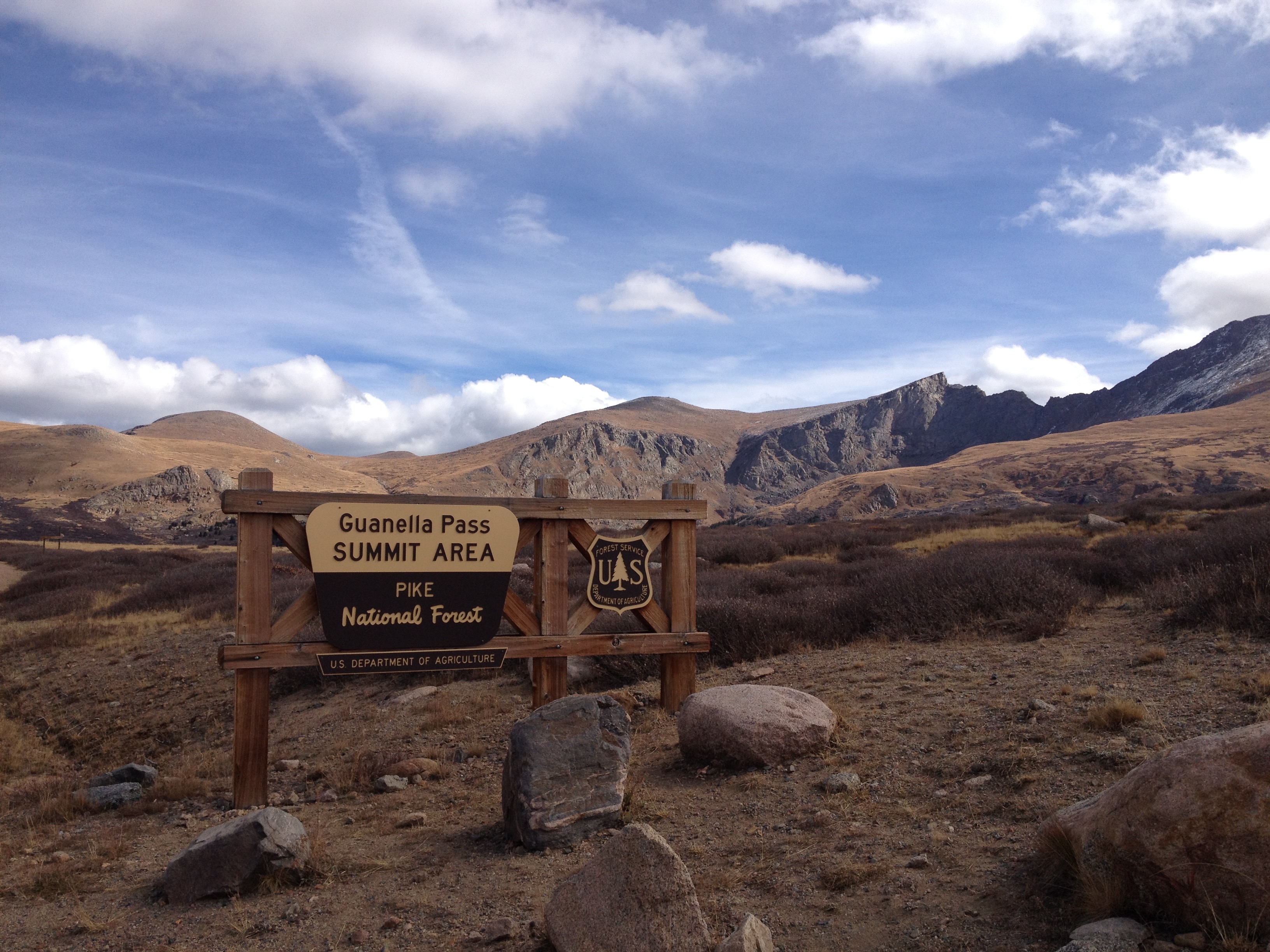
An Eerie Feeling on Guanella Pass

IMG_4557

Those that love to travel, whether they be the rare few, the people who get to travel for a living, or those who find a way to travel as much as possible, understand that Planet Earth is full of amazing places!  One of the things that makes traveling interesting is the wide variety of types of places to visit, all of which will produce different scenery, and different experiences.  It is nearly impossible to describe or capture the true range of experiences one could theoretically attain through travel, but the Discovery Channel’s Planet Earth Series does a pretty good job.

When people come to visit me here in Denver, I typically take them, in some capacity, into the mountains.  I will particularly ensure that a trip to the mountains gets on the agenda if I get visitors from places like Chicago, which couldn’t be further from any kind of mountain range.  After all, one of the reasons we travel is to see things we do not typically see.  From Denver, it doesn’t typically take too long to get somewhere spectacular.  About half an hour west of downtown, there is a segment of I-70 where the full prominence of the Central Rocky Mountains suddenly appears in quite spectacular fashion.  I remember being amazed by the view that pops out in front of me the first time I traveled up I-70.  Many photographs have been taken from this location, and it was even noted as a point of interest at the History Colorado Center.

IMG_4567

Now that I have lived in Denver for over three years, a short excursion into the mountains typically takes me to a place I have already been, sometimes even a place I have been numerous times.  However, as is noted by the Planet Earth video series, these places often look quite different during different seasons.  Those that visit Colorado in the winter or spring will see mountains covered with snow.  This view, from I-70 near Genesee, will look significantly different, likely in just a few weeks.

October is sometimes a tricky time of year to determine activities in Colorado’s Rocky Mountains.  It is that transition season where often times conditions are no longer favorable for summer activities (and many of the seasonal roads have already closed for the season), but a significant snowpack has yet to develop.  This fall has been anomalously warm here in Colorado, and the extent of the snowpack that has developed in the mountains appears in this picture below.

IMG_4566

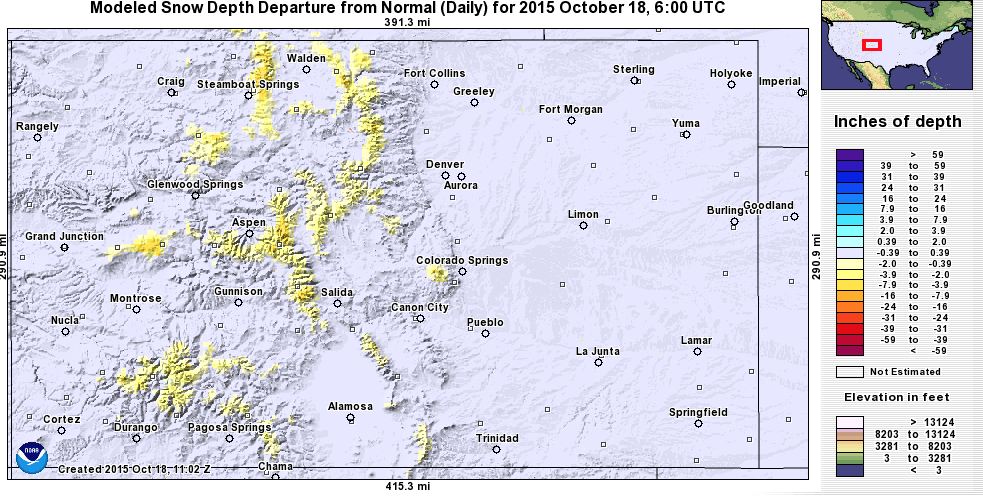
However, according to the National Operational Hydrologic Remote Sensing Center (NOHRSC), by mid-late October, the typical snowpack over the high terrain of the Central Rocky Mountains is still less than a foot (and not consistent year to year).

SnowDepth_Departure_20151008

This map displays snow depth anomalies for Sunday, October 18th according to the NOHRSC.  The actual snow depth, across the entire region, was zero.  The anomalies show just how far below normal this is, which, in the highest terrain on this map, falls into the 4 to 8 inch range, indicating that even at locations above 14,000 feet, there is typically not too much snowpack by mid-October.

Knowing that most seasonal roads would still be open due to the lack of snow, but with somewhat limited time for an excursion into the mountains, we opted to take a trip over Guanella Pass, which is still less than an hour’s drive from Denver.  Despite having been there several times, the experience for me was already new, as a new paved road had just been built, connecting the town of Grant, along highway 285, with Georgetown, along I-70.  This new road is likely to get mixed reactions, as traveling along it is now much easier (and now possible without AWD).  However, there are sections of this pass that are popular among campers, particularly people looking for a quiet camping experience.  On Sunday’s excursion, I encountered several groups of motorcycles.  The prevalence of motorcycles, and the noise they make, could possibly make some of the Guanella Pass campers seek a more remote experience elsewhere.

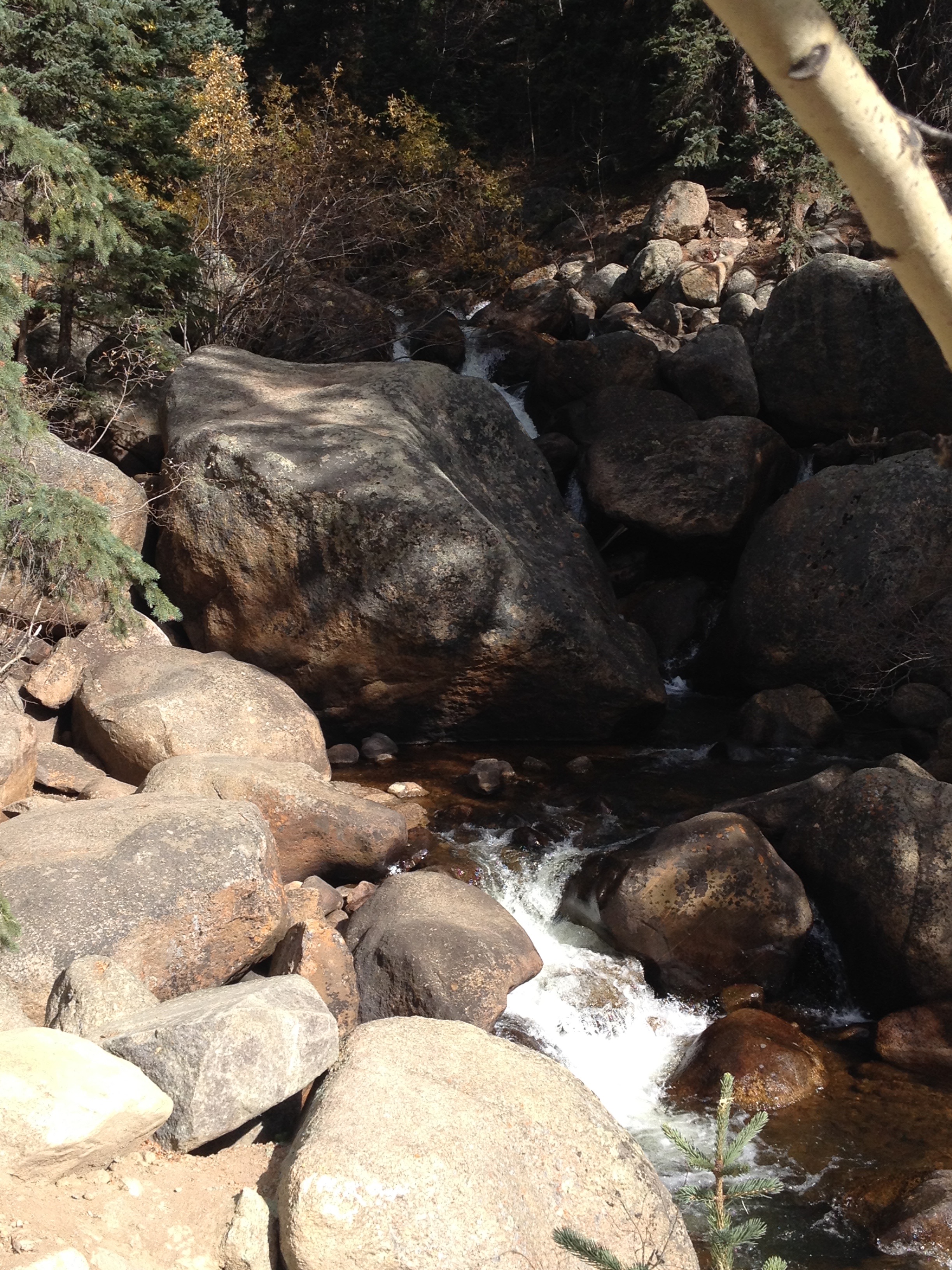
Without having to focus on driving over rocks and bumps, I noticed places I simply did not notice on previous drives up Guanella Pass, like this waterfall.

IMG_4556

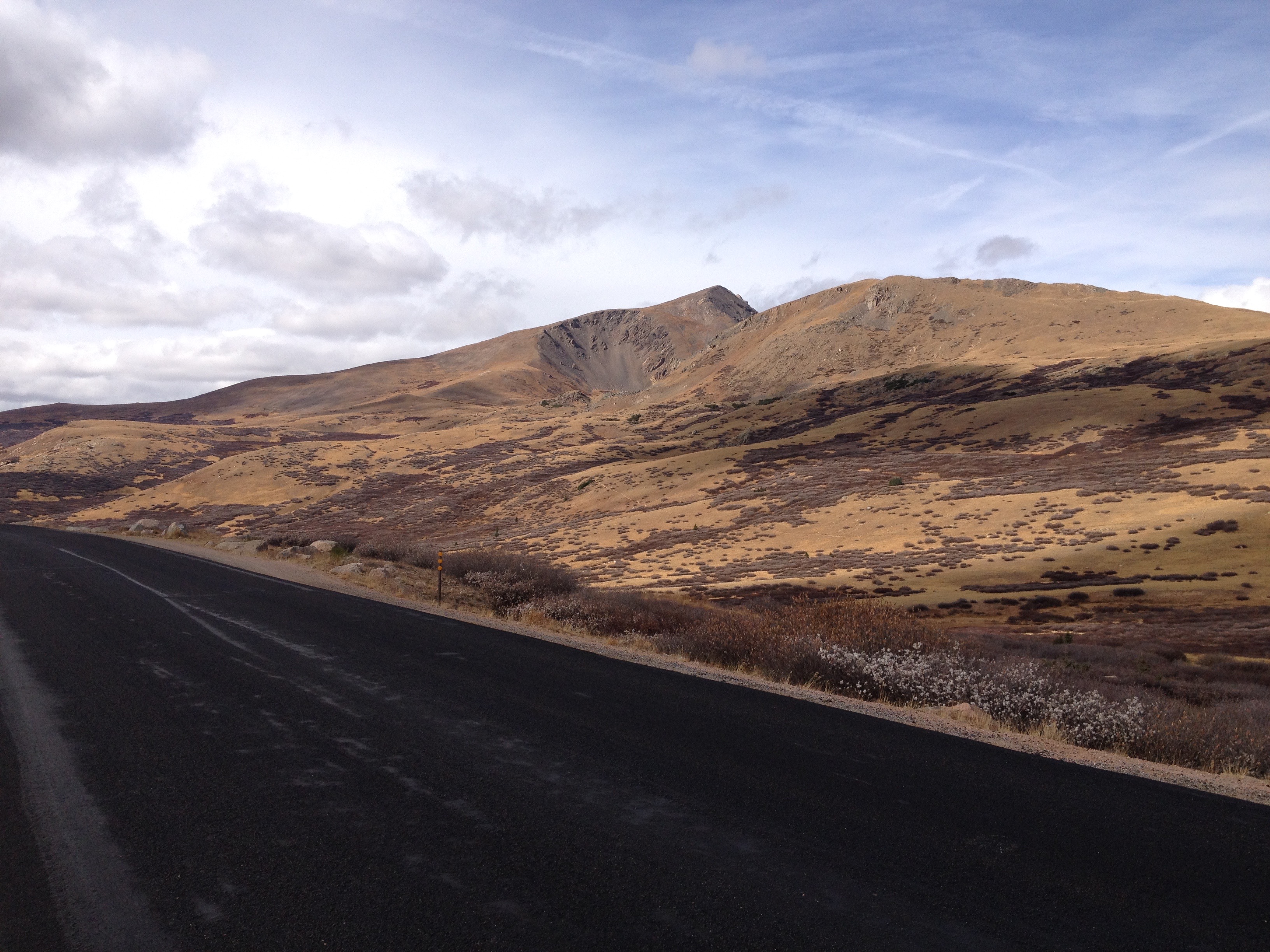
However, that was not the full extent of the new experience I had on Sunday.  The final approach to the summit took me above the tree line, where I suddenly got an eerie feeling from what was around me.

IMG_4558 IMG_4560 IMG_4563

It’s hard to describe.  It felt almost like I was on another planet.  It was isolated.  Most of the time that we stopped at the summit, we were the only ones there, and my car was the only one on the road.  The sagebrush of the alpine tundra had taken on brown color that I am not accustomed to seeing.  Some combination of the sun angle, unusual ground color, and isolation definitely gave me a really strange feeling.  It was eerie, creepy, out of this world, I really did not know what to make of it.  It was just, well, strange.

However, I came back feeling glad that different seasons can create different experiences out of the same places.  Typically, when I make the trek up to elevations just above the tree line, there is one of two experiences.

IMG_2911 IMG_4245

The alpine tundra is white in winter (and often still white well into the springtime), and green and lush in the summer.  In October, though, it took on a whole new color, one I had not seen before.

This planet has plenty of places that are unique, unlike any other place on earth.  Some of them even feel out of this world.  Sunday’s experience at Guanella Pass reminded me of two things.  A lot of these unique experiences that we plan trips to get to are seasonally dependent.  And, sometimes these experiences can happen unexpectedly.

What to Expect from winter 2015-16 in Colorado

Forecasting the weather weeks to months ahead of time can often be problematic. Computer models that project atmospheric conditions into the future typically only provide utility out to 10-14 days, depending on who you ask. After that, forecasts often become erroneous due to what is often referred to as the “chaos effect”. In fact, there are many that believe that forecasting the weather for a specific day is only useful out to roughly 7-10 days. Most people manage their weather expectations beyond the 7-10 day horizon not by forecasting a specific event, but by describing more general expected trends.  It is more common to say something like “It is likely that the period from 14-21 days out will be warmer and drier than normal across much of the Western United States”.

Scientifically credible seasonal forecasts tend to rely on larger scale phenomenon that have been shown to impact our weather in the past. Luckily, for this upcoming season, the winter of 2015-16, there are two such phenomenon that could give us some significant foresight into what we could expect out of this coming winter.

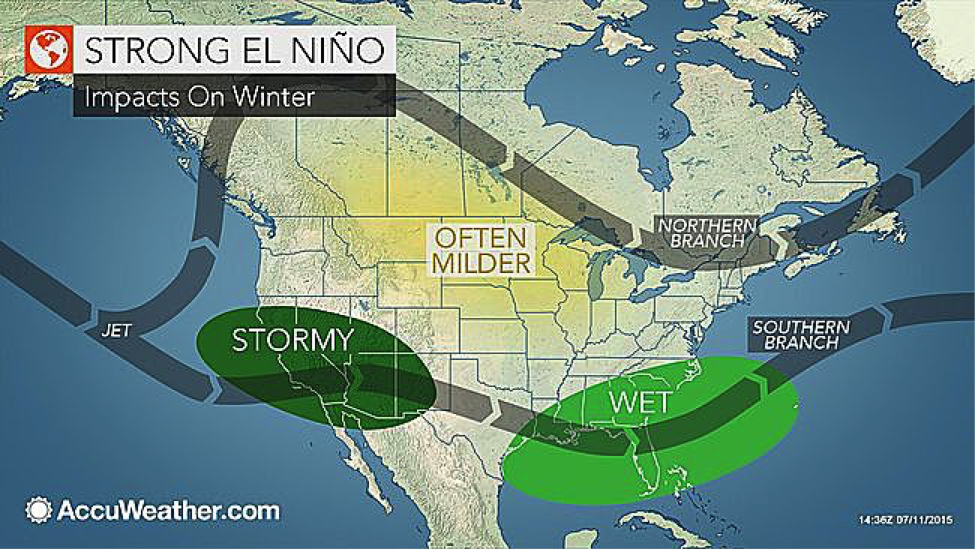
The first, and most obvious one is the strong El Nino that is already underway. Strong El Nino conditions typically bring wet weather to the Southern United States due to a strong sub-tropical jet stream. In particular, California can be the recipient of some heavy rainfall, which hopefully can help give the state some much needed relief from the extreme drought conditions than have been experiencing. The other major impact, on a national level, is that the Upper Midwest and Northern Plains tend to have milder than average winters during strong El Ninos.

El_Nino

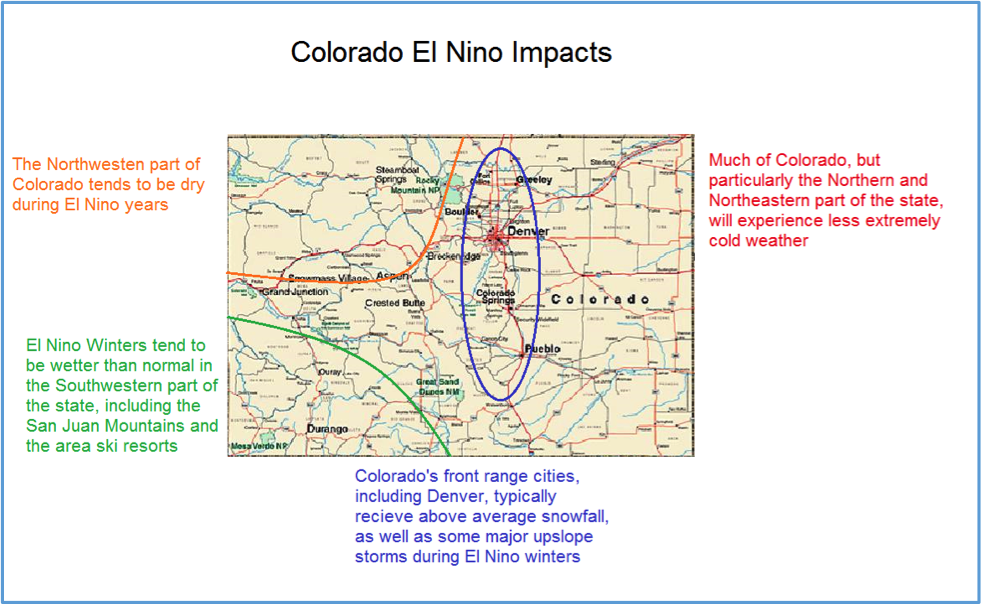
Unfortunately, maps like this one often make it ambiguous as to what impact El Nino typically has on the weather here in Colorado. On this map, as well as nearly every map of El Nino impacts, Colorado is in kind of a neutral zone, where areas to the south are wetter than usual, and areas to the north are drier than usual. However, as any resident of Colorado knows, Colorado’s rugged terrain has a significant impact on the weather here. Therefore, it is possible to discern some more local impacts that occur here in Colorado, as different large scale wind patterns are impacted by Colorado’s many mountain ranges. There are many sources of information regarding how Colorado fares during a strong El Nino year. Below is a graphical summary of these impacts.

ElNino_Colorado

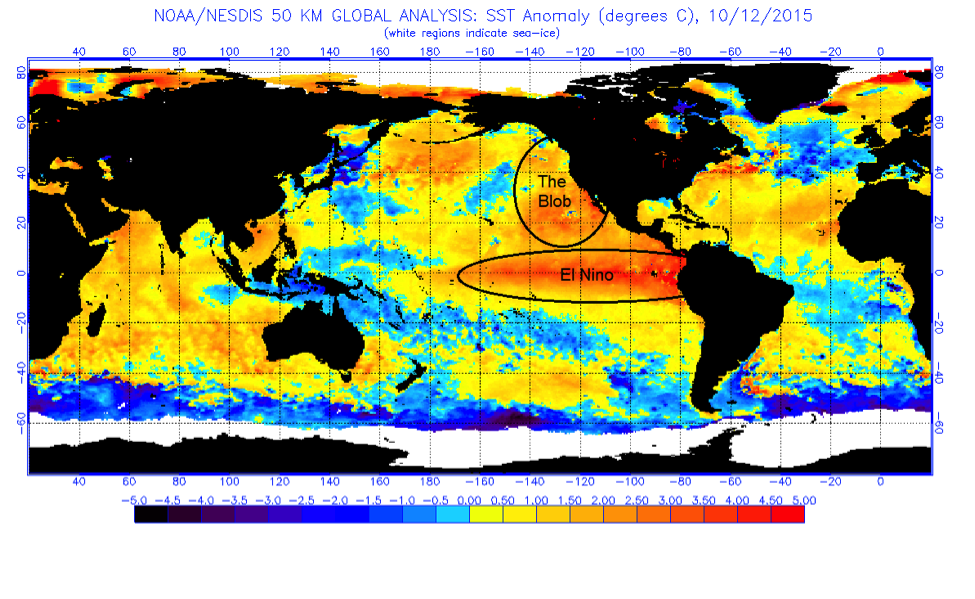
In addition to El Nino, there is another major weather feature that could have a profound impact on our weather this winter. Not only are there warmer than normal ocean temperatures along the equator associated with the strong El Nino, but there is another section of extremely warm ocean temperatures in the Pacific Ocean farther north. This section of warm temperatures off the west coast of North America is being labelled “The Blob”. “The Blob” formed due to a persistent period of warmer and drier weather over the past several years. This is the weather pattern that lead to the extreme drought in California in the first place, and, now threatens to keep much of California in drought conditions despite the El Nino.

Oct2015_SST

The easiest way to describe the impact “The Blob” is going to have on our winter weather is that it is going to try to produce conditions similar to last winter. Last winter was warm and dry over much of the West due to a persistent ridge, labelled “the ridge of death” by snow enthusiasts at OpenSnow, which is often associated with warmer sea surface temperatures off the Pacific Coast of North America.

While it is hard to imagine “The Blob” completely overwhelming the impacts of this historic El Nino, it does have the potential to modify them. Firstly, it could make the Pacific Northwest drier, and reduce the amount of rainfall California receives, particularly Northern California. Over Colorado, more frequent ridging, and/or dry Northwesterly flow aloft will reduce the likelihood of major Front Range upslope snowstorms, and increase the likelihood of a drier than normal winter over parts of Central Colorado, including many of the major ski resorts such as Vail, Breckenridge, and Copper Mountain. Those who hate extreme cold, though, will be comforted by the fact that the likelihood of sub-zero conditions across most of the state will be significantly below average this season.

Summer Persists

IMG_4449

I have been fascinated by the weather my entire life.  When it comes to our atmosphere, there is always something interesting going on.  The weather seems to find a way to continue to surprise people, behaving in different interesting ways each season, each year, each decade.  Our lives are impacted by the weather every day.  It is something that is impossible to ignore.  It is always on our minds, particularly for those that of us that love travel and outdoor activities.

At times, our plans can be frustrated, or even cancelled by changes in weather conditions.  It is the early season baseball game that was cancelled due to a freak April snowstorm.  Or the ski resorts in Lake Tahoe that had to close due to the lack of snow.

At other times, unexpected opportunities can arise.  I remember one year, when I was in college in Northwest Indiana, a place that is typically quite chilly in the wintertime, we had a series of unexpected 60 degree days in late January.  I unexpectedly found myself in Lake Michigan (albeit only knee-deep) on the 27th of January, a time of year I could normally expect to be huddled indoors.

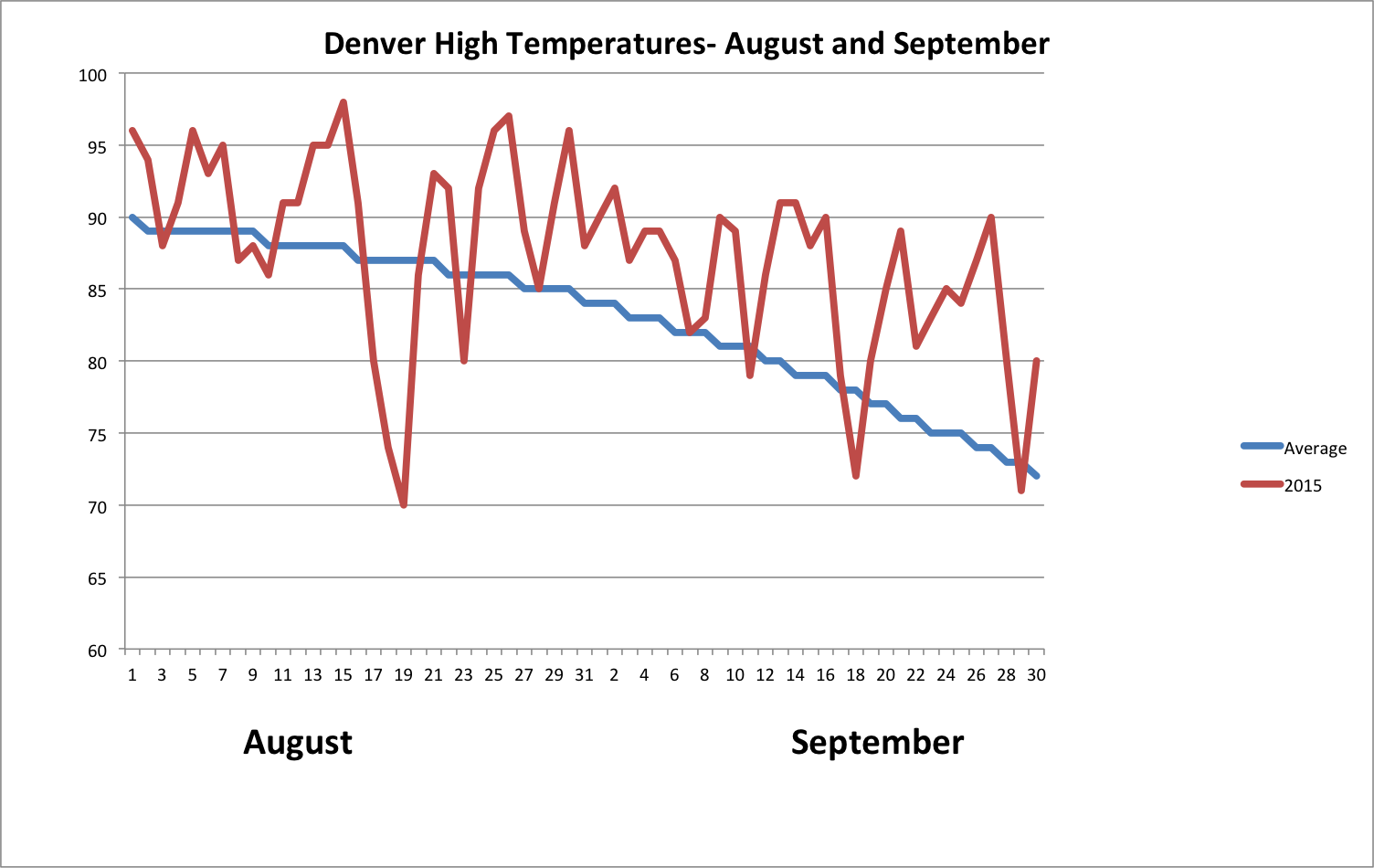
Across much of the country, the story this September was the persistence of summer.  Some places are experiencing one of to their warmest Septembers on record.  Here in Denver, it has been the same story.  September’s temperatures this year, largely resembled what is typical in August.

Denver_Aug_Sept_2015

A sensible response to hot weather in Denver is to travel up to the mountains, where it will be cooler and more comfortable.  So, in addition to my hike near Breckenridge on the 11th, I made trips up to the mountains both of the following weekends.

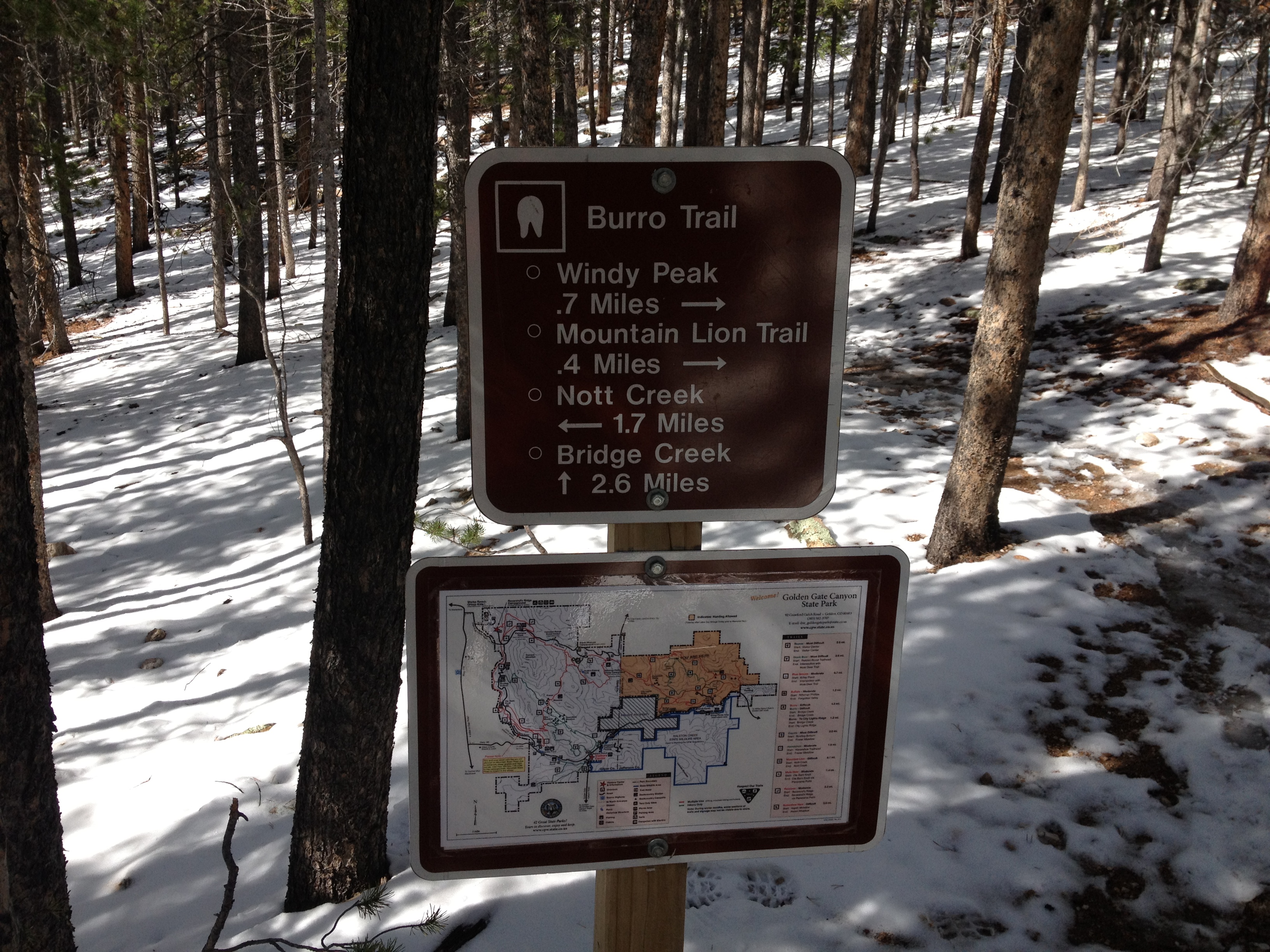
September 19th was a repeat hike, to Windy Point at Golden Gate Canyon State Park, which is actually less than an hour’s drive from Denver.  The first time I hike this particular trail, in October of 2013, the upper portions of the trail were already covered with snow.

IMG_1163

This time, I got to experience the trail without such snowpack.

IMG_4435 IMG_4430 IMG_4429 IMG_4414

My other late season hike in the mountains involved a trip to a place I had never been before, but had been meaning to check out for quite some time, the Fourth of July trail outside of Nederland.

IMG_4467 IMG_4465 IMG_4474 IMG_4478

This hike in particular, on September 26th, represents the kind of opportunity that would not have been available had it not been for the unusual resistance of summer.  This trailhead is at an elevation of just over 10,000 feet.  By late September, one would expect high temperatures only in the mid 50s at this elevation, and not the warm conditions we experienced that day.

IMG_4477

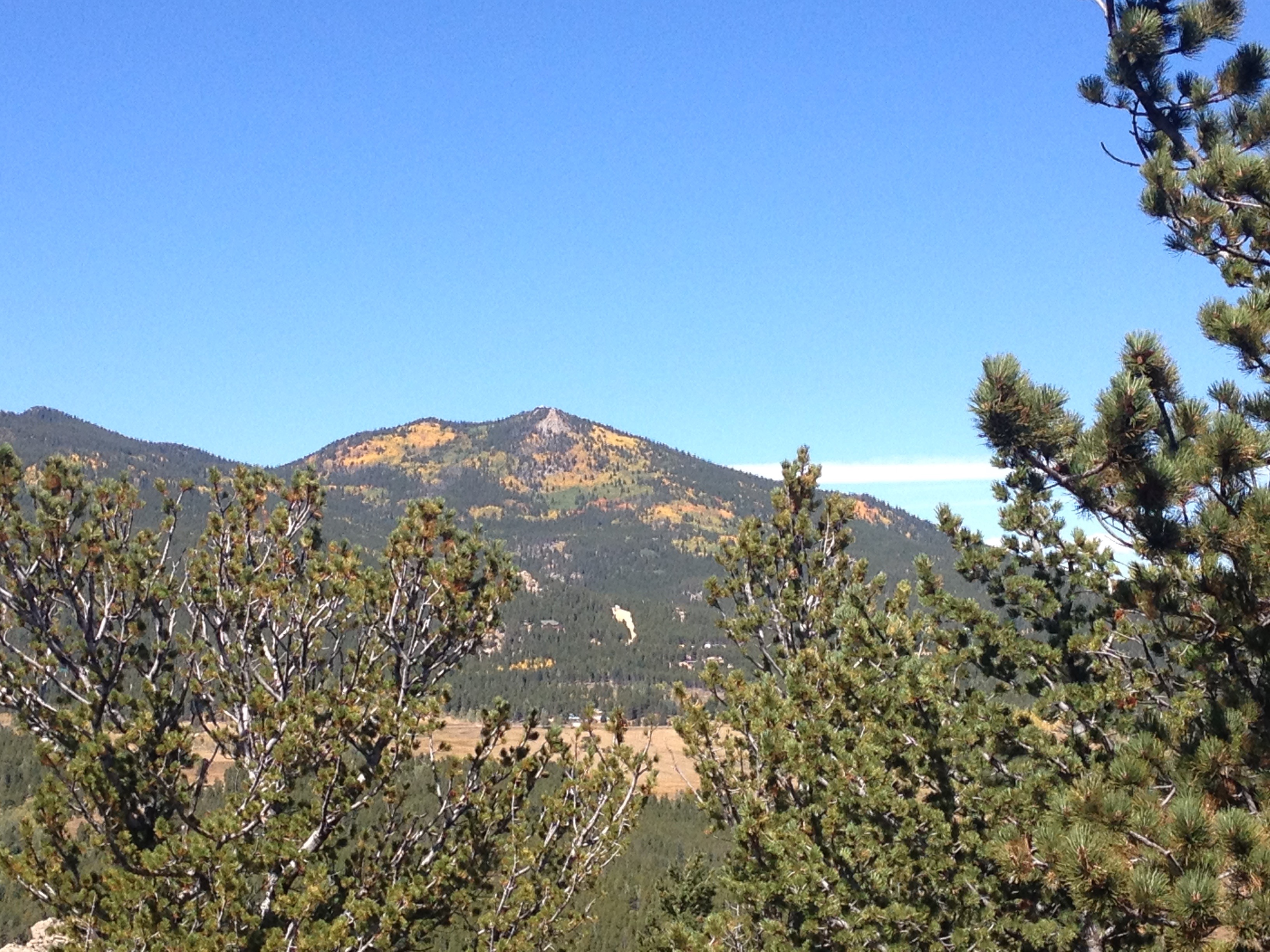
One thing I have come to notice during periods of abnormal weather is how the trees never seem to be fazed by the abnormal conditions.  In the Midwest, when we would have a mid-winter thaw, like the one I had perviously mentioned, none of the trees would start growing leaves or anything.  They would continue to stay the course, knowing what to expect from the rest of the season.  Here in Colorado, the trees are still changing colors largely on schedule, with the later part of September being peak season for fall colors at these elevations.

IMG_4483

I have actually come to realize that the most magnificent fall colors occur when there is a warm and dry fall.  As it was last year, without windy, rainy, or even snowy weather early in the year, the leaves stay on the trees longer.

IMG_2733

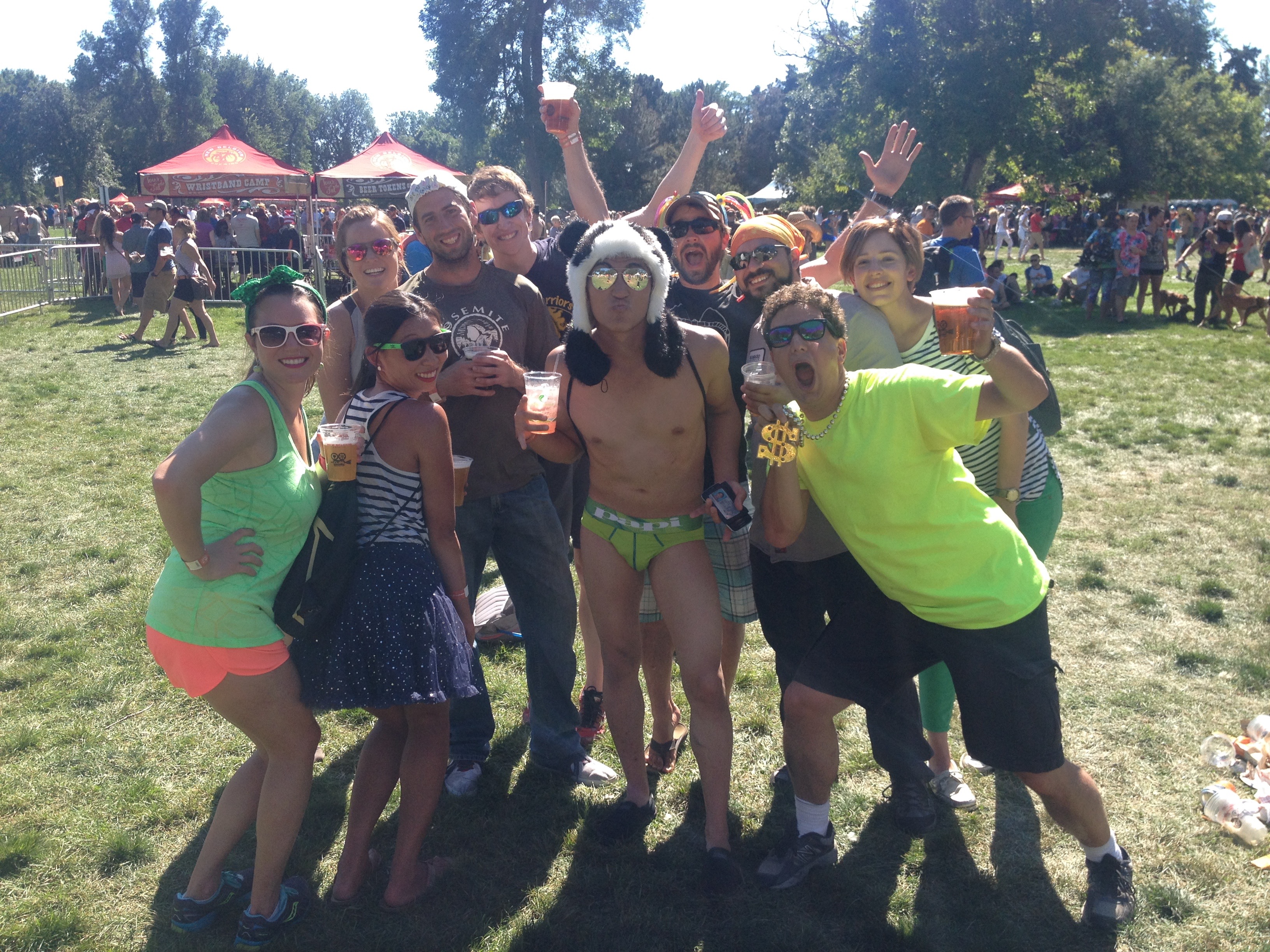
In a month where we sweated through 90 degree weather for Tour de Fat,

IMG_4372 IMG_4391

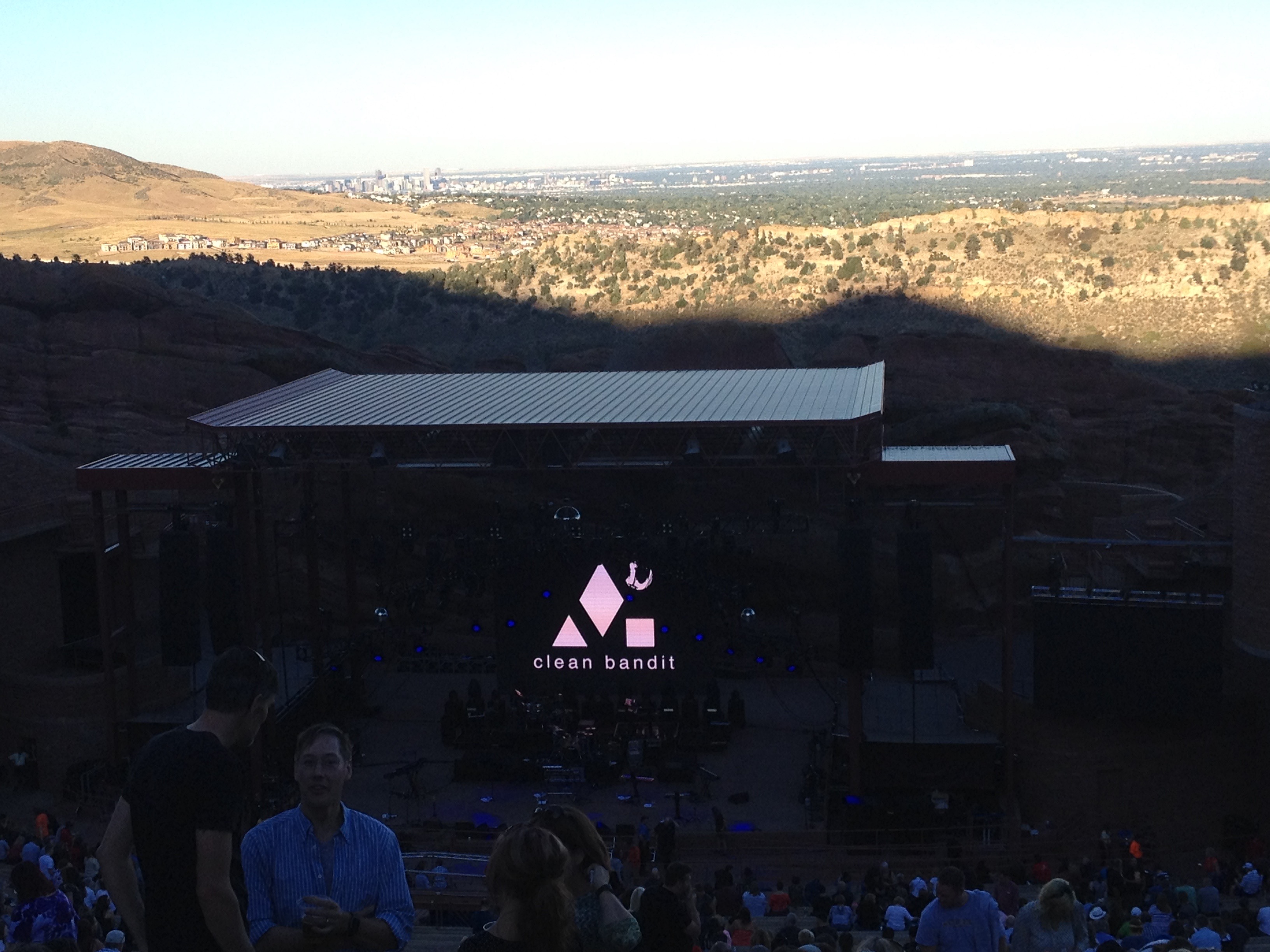
And one could attend a concert at Red Rocks without needing a jacket,

IMG_4442 IMG_4448

It is hard not to feel as if summer just has’t ended yet.  We simply got to experience summer longer than anticipated.

Whether it be a season of the year, like winter or summer, or a chapter of our lives, we all anticipate change.  We know that a change is destined to occur, and often have an idea in our heads as to when that change is destined to occur.  However, sometimes, changes do not happen at the time they are anticipated.  Sometimes in life, we are caught off guard by an unexpected change before we had fully prepared.  We all have heard of at least one person who had endured an unexpected layoff, or an unplanned medical emergency.  Other times, as is the case with the switch from summer to autumn across much of the United State this year, it takes longer than anticipated for the next chapter of our lives to begin.

As someone who loves hiking, cycling, and water sports, and is generally not too negatively impacted by hot weather, it is easy for me to welcome the unexpected extra month of summer.  It is easy for me to say, in this case, that the best way to handle this delay, in the transition from summer to autumn, is to go out and enjoy it, take advantage of the opportunities, and be patient for the next season to start.  But, I know that this is not the case for everybody.  I also remember being the one frustrated by the lack of change.  I remember one March in particular, when I was living in Madison, Wisconsin, that winter just seemed to never end- and I was beyond sick of it!

Fall is going to come.  According to the weather report, by this coming weekend, October 2nd and 3rd, most of the country will be experiencing weather more typical of fall.  Those that have grown tired of the heat, although they had to wait longer than expected for the cooler air to come, knew all along that it would, and that the changing of the season is inevitable.

IMG_4490

At some point in time, we all end up in a place where we feel our lives have stagnated.  We enter a place where our current situation, whether it be our job, or what we are doing on a day-to-day basis, has simply run it’s course.  We have gotten what we need to have gotten out of the experience.  Maybe it has become frustrating, or maybe it is just simply not inspiring to us at all.  In these situations, the cycle of winter-spring-summer-fall we all live through on an annual basis serves as a reminder that the change we desire is inevitable.  Sometimes it just takes longer than we had hoped.

Mohawk Lakes, A Moderate Hike in Central Colorado

IMG_4345

Sometimes recreation in Central Colorado can be just plain overwhelming.  I remember when I was preparing to move to Colorado, and took a look at a Colorado DeLorme atlas I had just purchased.  DeLorme makes an atlas for every state in the country.  These atlases are great for those who love outdoor recreation.  Not only are features such as campgrounds, hiking trails, waterfalls, and parks labeled on the maps themselves, but each map contains a dozen or so pages in which hot spots are listed.  These include key places to camp, fish, hunt, hike, bike, and such, as well as a list of “unique natural features”.  When I looked through my Colorado DeLorme atlas, I was suddenly overwhelmed by the amount of options available to me for many of the activities I enjoy.  I kept wondering, though, how the heck I would go about something like picking a place to hike when there are so many options.  I was actually worried that some days I would end up going nowhere due to analysis paralysis.

The most effective networks, whether they be all of the trail networks in parts of Colorado, or New York City’s network of subways, are overwhelming, and sometimes take awhile to learn.  However, the same way any New Yorker can get by without owning a car, due to all of the train lines in the city, a Coloradan can find the right hike for many different situations and many different desired experiences.

Last Friday I had a friend in town from Chicago who does not get to experience mountains on a regular basis.  On previous trips I had taken him to Rocky Mountain National Park.  This time, I wanted to take him somewhere different to see some different scenery in a different part of the state.

IMG_4321

The most talked about hikes in this part of the State tend to be the “14ers” to the South.  These hikes tend to be challenging, and, sometimes are just as much about accomplishing something (particularly to some people) as it is about the experience of hiking.

IMG_4328 IMG_4324

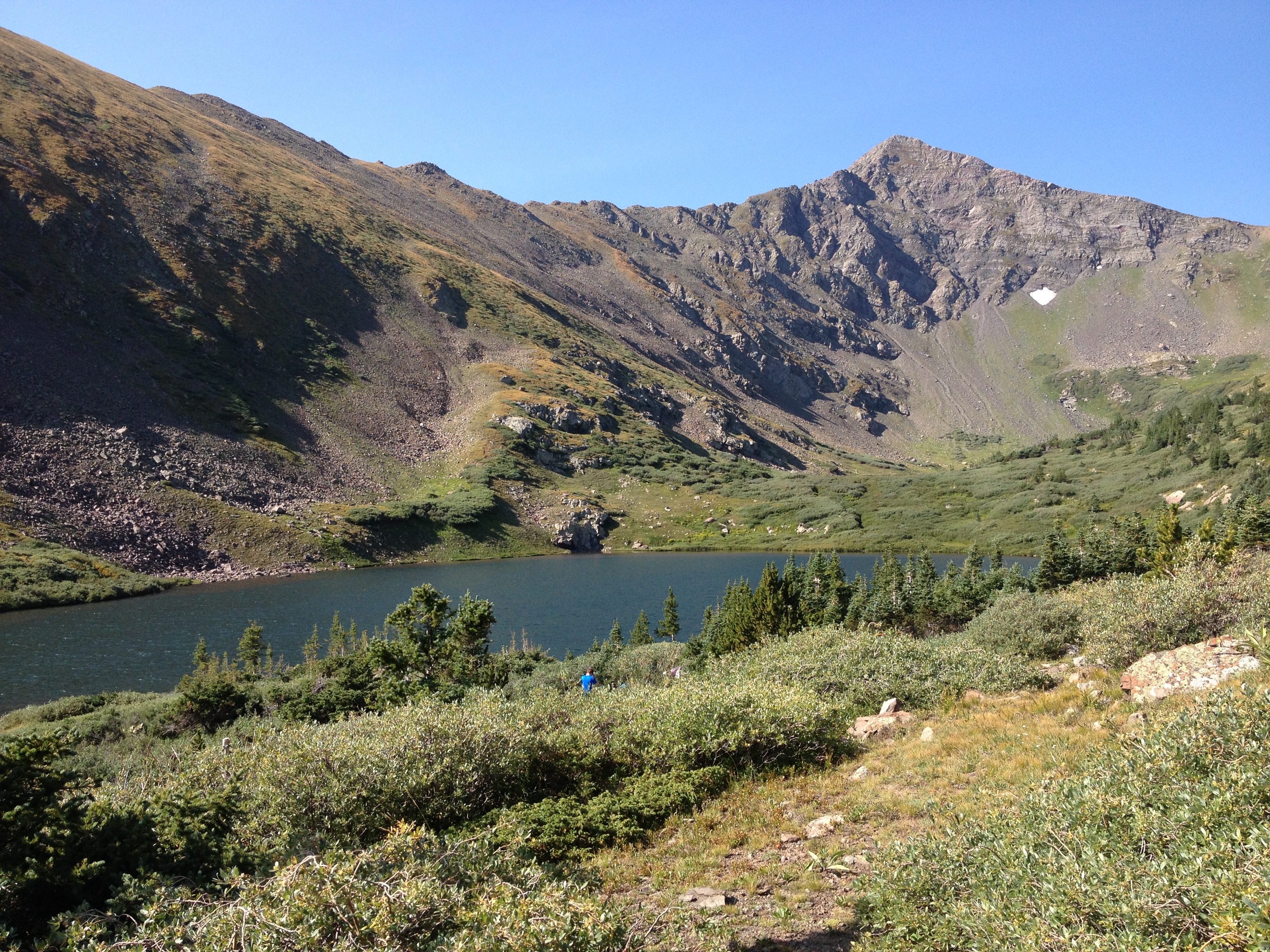
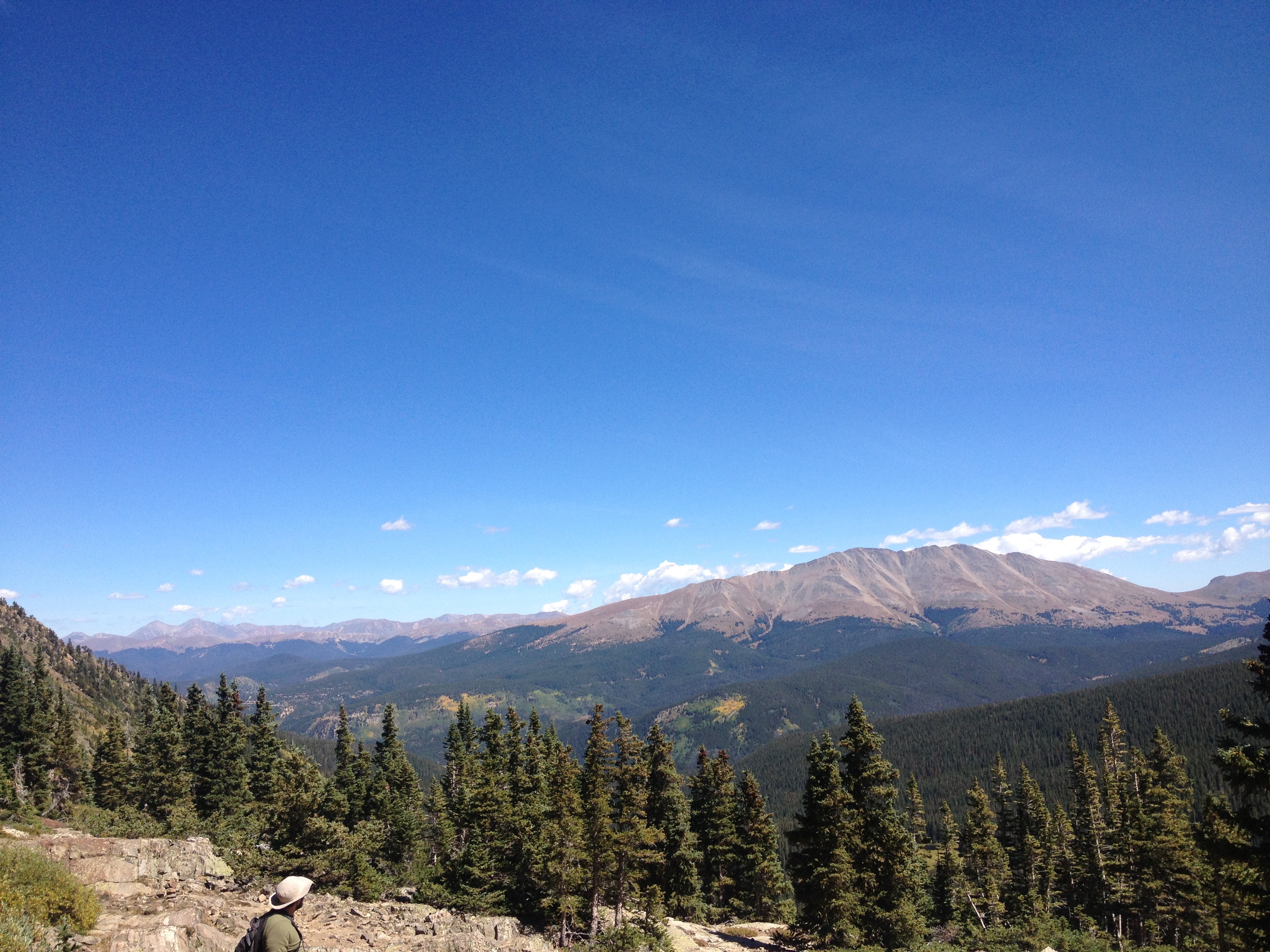
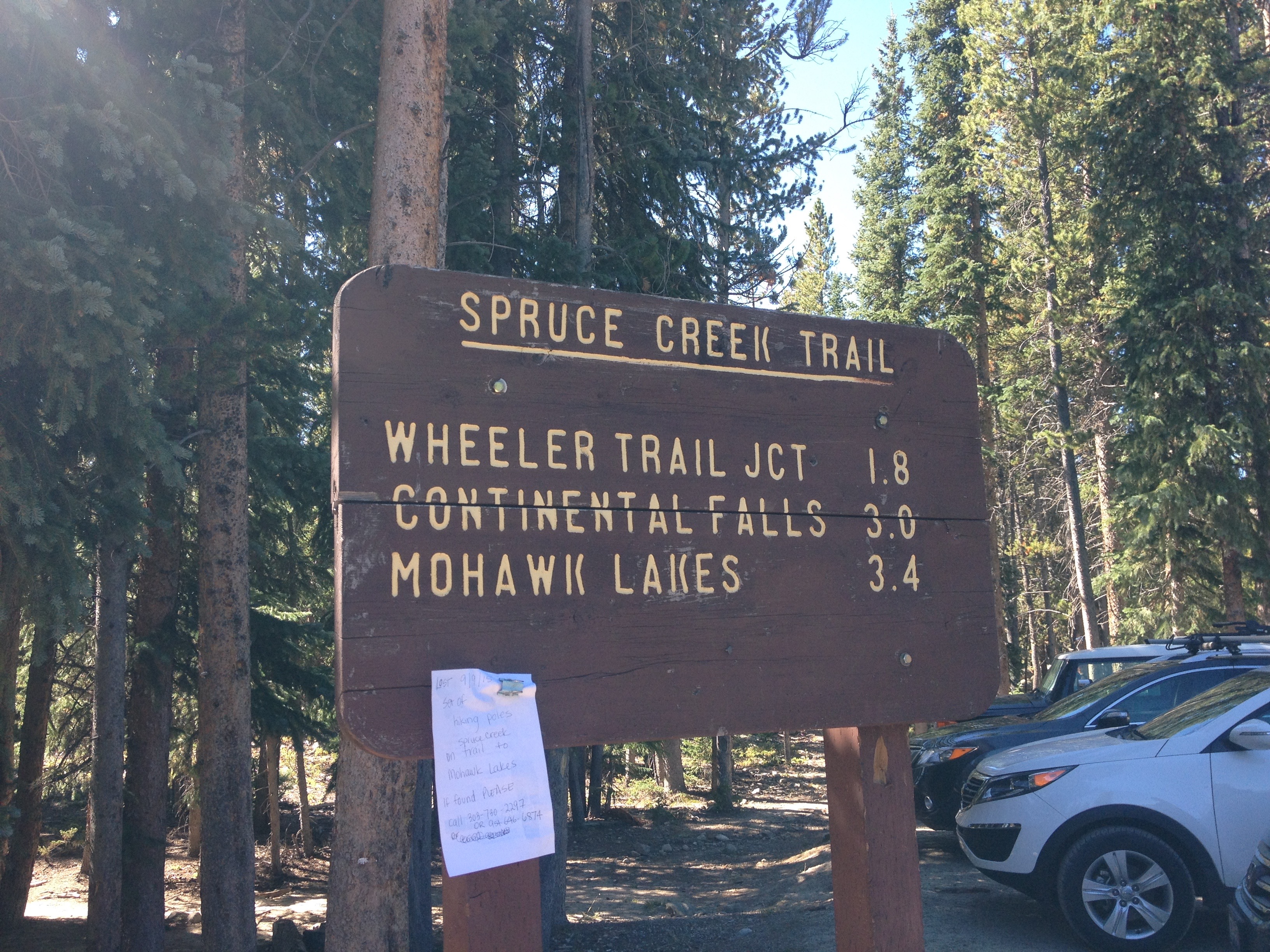
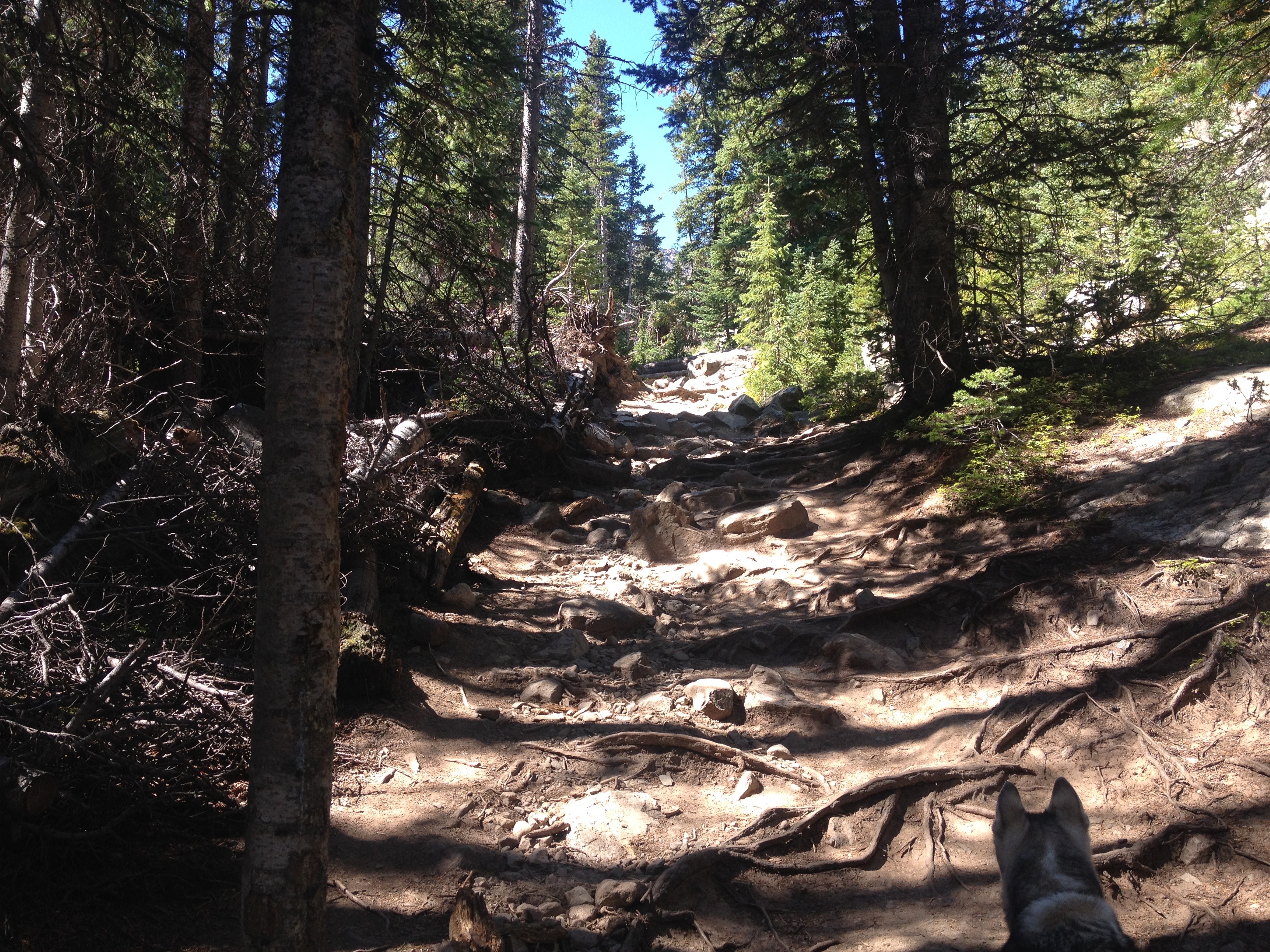
By contrast, the Spruce Creek Trail certainly fits into the “moderate” category for difficulty.  The first part of the trail is kind of a mixture of flatter and steeper areas.

IMG_4329 IMG_4330 IMG_4331 IMG_4333

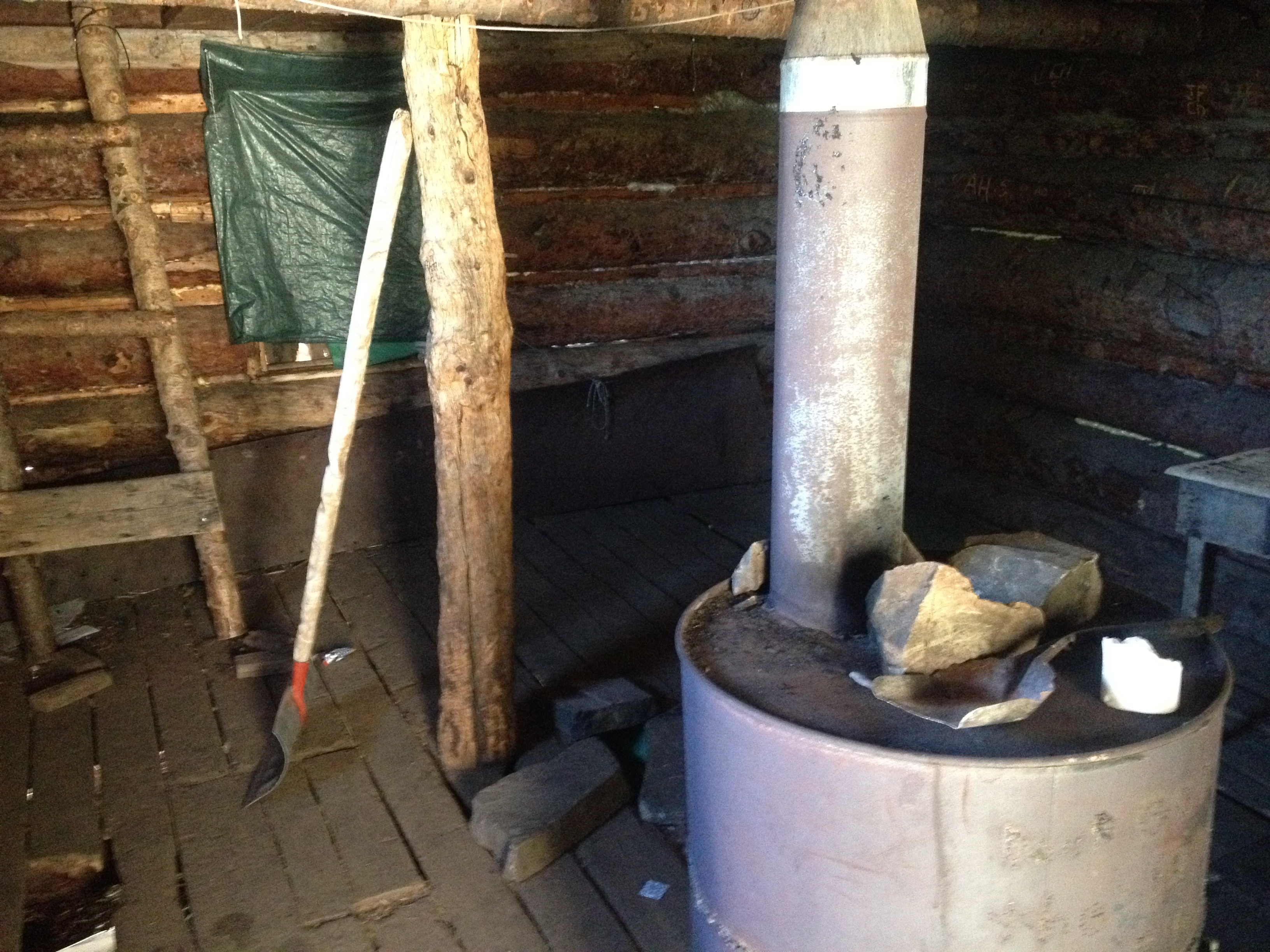
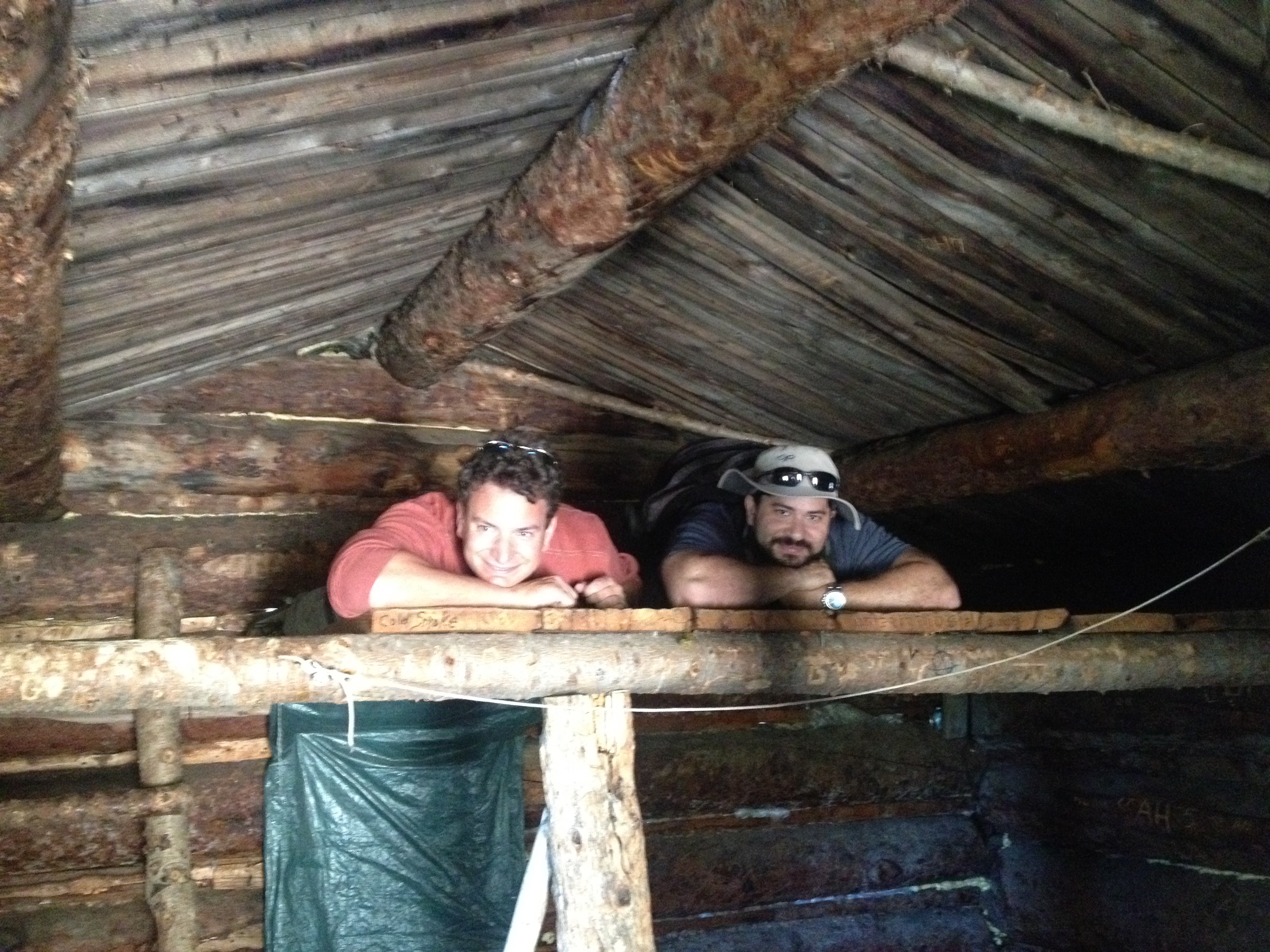
Roughly two miles into the hike we encountered this random cabin that still seemed partially functional.  With a stove and a ladder that leads to an upstairs area it is reminiscent of the cabins that people purchase as second homes.  However, it was kind of in disrepair and there were several holes in the floor.  Still, I wonder what this cabin is used for.  Do people actually stay here at night from time to time?  Did people originally stay here when this place was built?  Is it used for some other purpose, like filleting fish, or fleeing storms from time to time?  After all, this cabin is fairly close to the first major lake one encounters on this hike- Mayflower Lake.

IMG_4348 IMG_4342

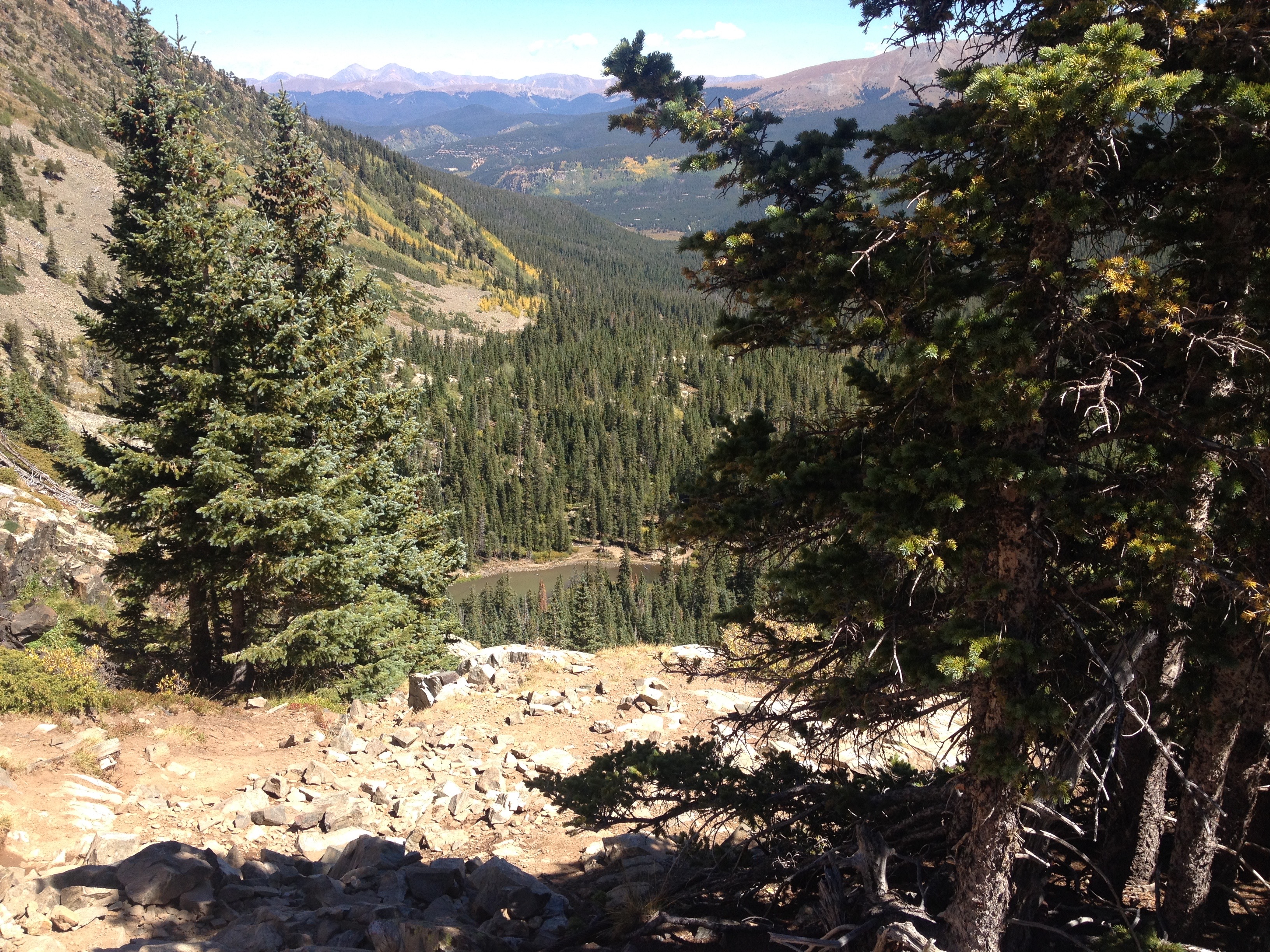
It is around here that the trail reaches somewhat of a point of inflection.  Above this elevation, the trail becomes steeper.  I honestly should have expected this type of experience.  One thing I note every time I ski at Breckenridge ski resort is the fact that the steeper terrain tends to be on the higher parts of the mountain.  If I ski on Peaks 7, 8, or 9, which is the part of the mountain closest to town and the lower part, I notice that any run I chose becomes progressively flatter as I descend.  The Mohawk Lakes, and the Spruce Creek Trail are seriously no more than 3 or 4 miles from the boundary of the ski resort.  Therefore, it makes perfect sense that one would experience the same kind of terrain.

IMG_4334 IMG_4337

The trail encounters Continental Falls several times as it switches back and forth across the mountain.  The last several hundred feet of climbing up to Lower Mohawk Lake is somewhat of a scramble making it quite different from the smooth and well marked trails that we started out on.

IMG_4346 IMG_4343

It was already nearly 1 P.M. when we arrived at Lower Mohawk Lake.  We stopped to eat lunch and decided to forgo hiking all the way to Upper Mohawk Lake, a decision I eventually came to regret after learning that we would only have had to hike an additional 0.4 miles, and only climb another 250 feet or so.

I have really come to appreciate this time of year; September, early fall.  There is a lot of pleasant weather, and many people have even told me this is the best time of year for hiking in Colorado.  In the summertime, particularly in August, there is a daily thunderstorm threat associated with the North American Monsoon.  This year that threat ended right after Labor Day when the prevailing weather patterns changed ushering in a drier period for Colorado.  On Labor Day I got caught in a brief afternoon thunderstorm.  There has not been one since.  It is almost as if Mother Nature was aware of, and chose to abide by, our society’s labeling of Labor Day as the “end of summer”.  In August mid-afternoon would typically bring at least some major cloud formations reminding hikers of the thunderstorm threat.  Last Friday the sky remained clear throughout the day.

IMG_4347

I actually think I could not have picked a more ideal time for this particular hike.  One thing I hear about the Spruce Creek Trail is that it is prone to becoming muddy during periods of heavier precipitation.  These types of trails can be problematic in early summer when there is heavier stream flow.  The later part of this summer, and now September, has been much drier across Colorado.

The hike ended up being exactly what we had wanted; a moderately challenging hike that brought us to some unique scenery.  There are many places, both geographic, and in life, where one cannot just go about finding a trail that matches the desired experience exactly.  Whether it be picking a place to hike, chosing a neighborhood to purchase a home, or picking a place of employment, sometimes the option that matches exactly what we want simply is not available at the right time.  So, we end up finding something that is pretty good, a decent match, but not exactly 100% the experience we had been looking for.  It’s just a part of life.  But, here outside of Breckenridge, I found the trail that matched exactly what we wanted, and am thankful for it.

Cool For the Summer

IMG_4314

People define the season of “summer” in various ways.  Astronomers first defined summer as the period of time from the Summer Solstice (roughly June 21st) through the Autumnal Equinox (roughly September 21st).  Later on, meteorologists developed the term “meteorological summer”, defined as the months of June, July, and August, to refer to the period of time when weather conditions (in the Northern Hemisphere) are typically most consistently warm.  Of course, if you are a kid, or a student of any kind, summer clearly runs from the last day of the Spring semester through the first day of the Fall semester.  In the United States, many individuals, particularly those in the working world, have arrived on a definition of “summer” as the period between Memorial Day Weekend (the last weekend in May) and Labor Day Weekend (the first weekend in September).  In fact, at one of my previous places of employment, “business casual” attire was permitted only during the time period between Memorial Day and Labor Day.  No matter where you are in life, if you are in the Northern Hemisphere outside the tropics, summer is coming to an end.  Tonight’s (Labor Day) sunset, for many of us, feels like the last sunset of the summer.

I still remember an episode of Saved By the Bell where Zach Morris, the main character, calls in sick on one of the first school days of the year.  The entire cast of the show had spent a crazy summer in Hawaii.  It was so exhausting, so emotional, and so full of experiences and memories, that he just needed a day to decompress from everything that had gone on over the summer.  That is very much what this weekend felt like to me.  Although I did not set aside an entire day to do nothing but process events, nor did I physically take a day off from work, school, etc., I definitely dialed it down, and put off some things in order to recuperate and process everything.

IMG_3894

For me, 2015 is what I would consider an “Epic Summer”.

As life progresses, I have come to realize that different periods of our lives mean different things.  Some years, and some seasons in particular, are just more memorable than others.  This does not mean that the other years and seasons are pointless.  It is just easier to remember and ponder the significance of certain periods.  History books specifically point to the year 1776, when the United States declared its independence from Great Britain, as a memorable year.  During the previous centuries, an emerging class known as the Burghers were gradually moving society away from Feudalism and towards Free Markets, creating many of the ideals that lead to the revolution.  There are many specific years between 1250 and 1776 that were not memorable, but still important in creating the world of 1776, as well as the world of today.

My life has a series of summers (five total including this one) I would consider “Epic”.  I consider a summer to be “Epic” if it meets several basic criterea.  First, it has to be memorable.  This obviously means experiences that are out of the ordinary.

IMG_3873

Second, in order for a time period, or an event to be considered “Epic”, it has to be one that I consider positive, and enjoyable.  After all, dealing with cancer, a major injury, or depression is memorable.  But, I would not think of it as “Epic”.

IMG_3527

Finally, I believe an “Epic” time period must also be productive rather than destructive.  After all, someone may go on a binge, or a rampage of some kind, and find it memorable, as well as enjoyable.  But, the experience may have been detrimental to their future.  So, I try to think of “Epic Summers”, as only the ones I feel like I am better off for having experienced.

IMG_4191

The first four times I had what I would consider an “Epic Summer”, I did not realize it was happening until it was over.  I later realized that those four summers were time periods I’d think about much more frequently than other times in my life.  Sometime this Spring, I looked back at those summers, and realized that many of the conditions that created the other four Epic Summers in my life were also present this year, and, that the summer that was to come could very well end up being one that I remember for the same reasons.  Now that summer 2015 has come and gone, I can say that the following conditions are what leads to an Epic Summer.

  1.  They are exhausting

IMG_2030

You are doing a lot!  Otherwise, it would not really be Epic.

2.  They involve new experiences

IMG_4242

The summer between my Junior and Senior year in College was “Epic” because I brought travel to a new level (for me) that summer.  Previously, my travel had primarily been weekend road trips in the area to places like Champaign, Bloomington, or Indianapolis.  That summer, an internship brought me to Oklahoma for several weeks and included many more experiences throughout that part of the country. This summer was my first major multi-day bicycle trip, and my first time backpacking.

3.  They involve some amount of planning

IMG_3562

For many types of adventures, logistics do need to be considered.  Where will we stay?  How will we coordinate activities?  I am not saying anyone can plan their way into an Epic Summer, nor am I saying that everything needs to be planned out.  In fact, some spontaneity is also needed.  But, many activities do need to be arranged ahead of time, particularly when they involve a significant number of people.

4.  They build on advancements we make as a person on both short and long time frames

IMG_4141

I would never have gotten to the point where I could complete a bike ride like the one I did in July had I not made steady progress as a cyclist over the years.  This includes the training and completion of my first century ride in Illinois back in 2011, another summer I consider Epic.  Prior to this summer, I worked on myself, trying to improve some of my habits and personality traits that I consider ineffective.  I made continuing to have new and interesting experiences one of my 2015 New Years goals at the start of the year.  The same goes for my first Epic Summer, the summer after my High School graduation.  That year, I took advantage of the maturity, and improvements in my self confidence that actually began to take place halfway through my Junior year.

5.  There is a mix of the familiar and the absurd

IMG_4183 IMG_4186

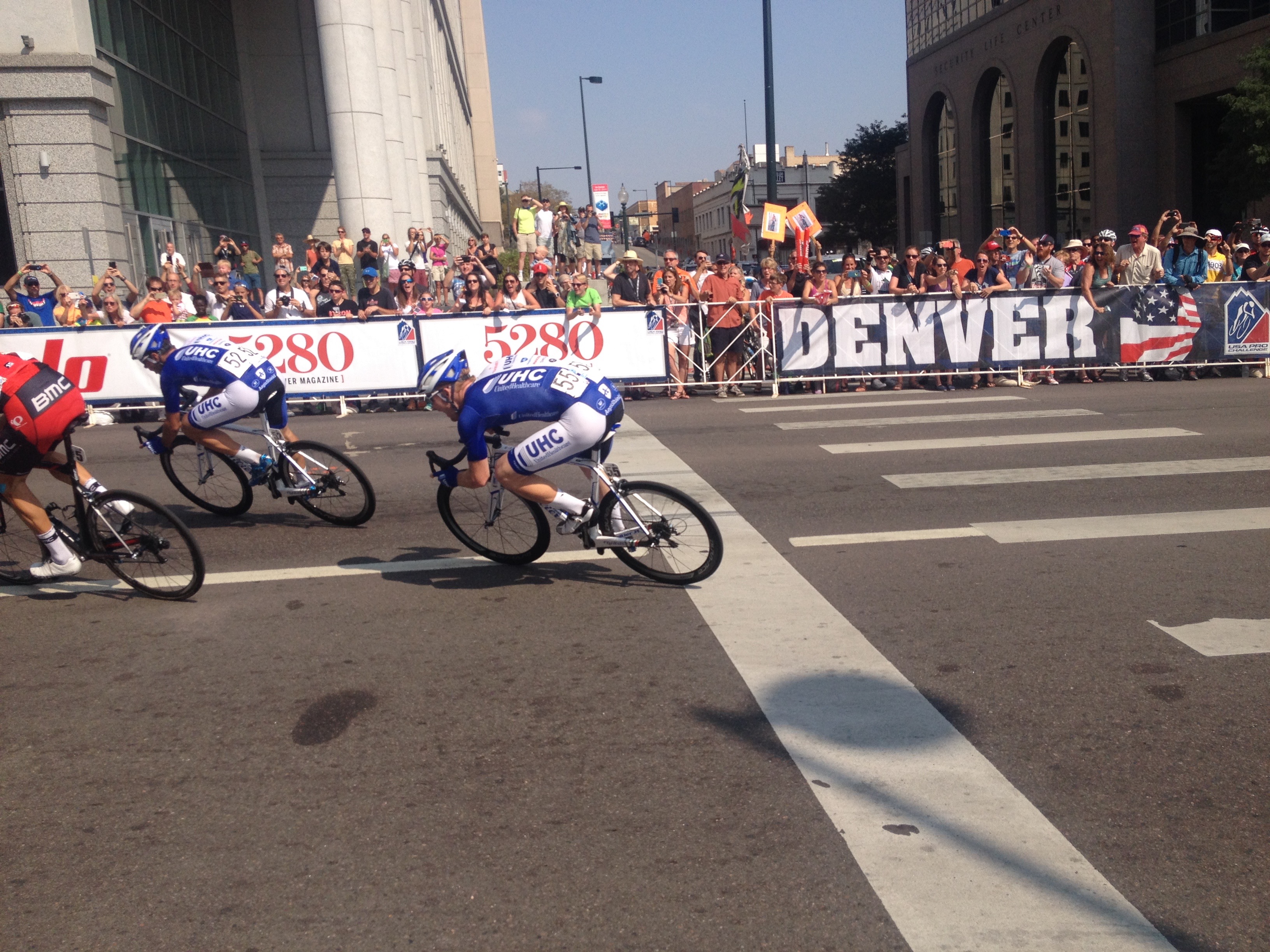
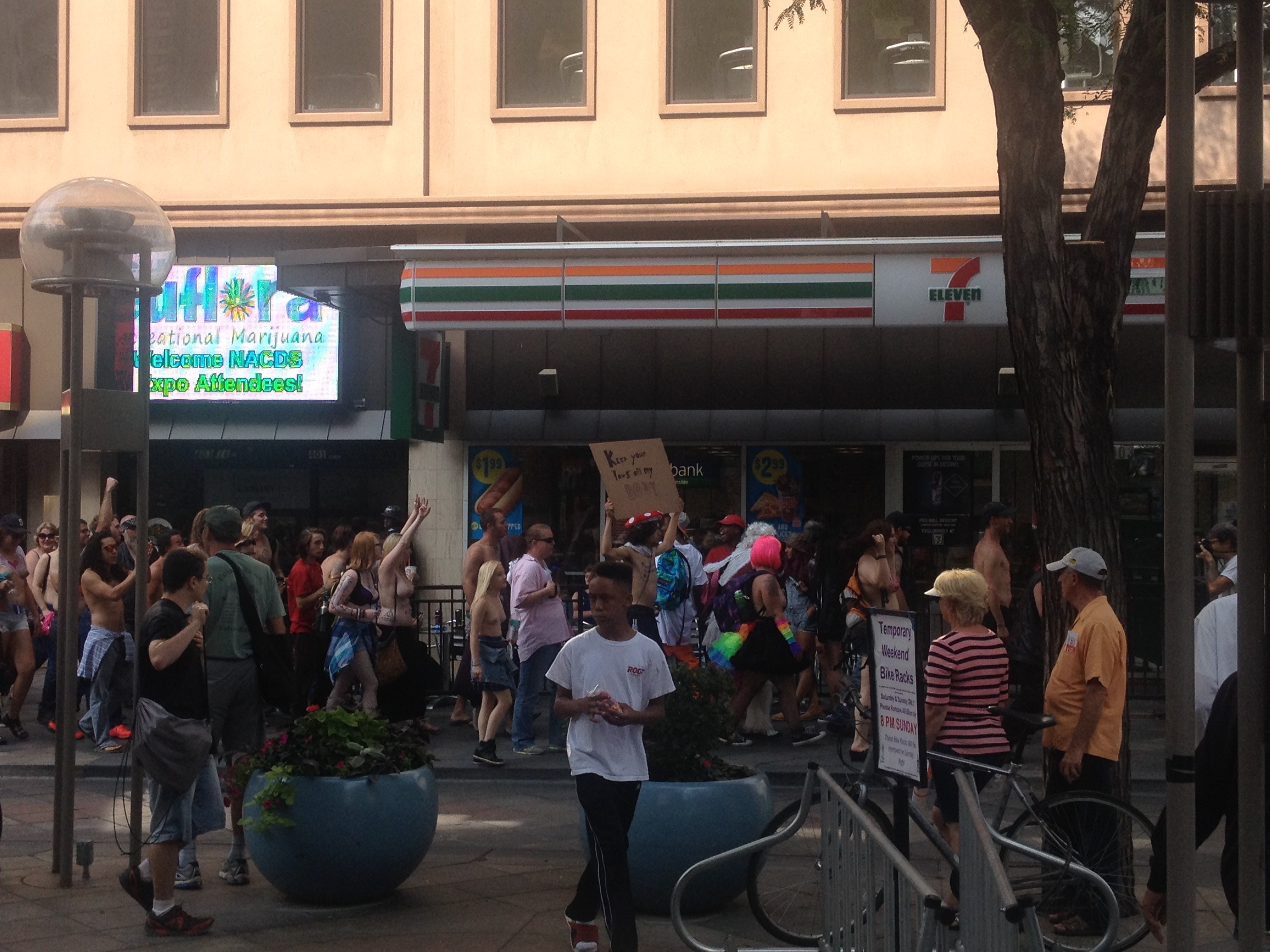
In every Epic Summer I have had, there have ben some repeats.  Like in previous years here in Denver, I attended the USA Pro Challenge and saw the exciting finish of Colorado’s version of the Tour de France.  After attending that race, I witnessed a topless protest on my way to a Weird Al Yankovich concert- quite absurd.

6. There are old friend as well as new friends

IMG_3997 IMG_4051

One thing about every time period I have ever considered an “Epic Summer”, is that it is partially about a feeling.  By that, I mean a feeling that my life is just flowing properly.  As a social person, that entails spending time with people that I have known for some time, and become comfortable with, but also continuing to expand my network and make new friends.  In each of my Epic Summers, I have had some sort of influx of new people, through work, organizations, or friends of friends in the months preceding the actual summer.

7.  They are not without conflict

IMG_3885

My first Epic Summer I was always in conflict with my parents.  This summer, I have had a lot of conflict at work.  It is hard to say why, but when you are out there in the world, and following your true moral compass, you are naturally going to have some people that do not appreciate that.

8.  They are often preceded by ruts

IMG_3446

I really do not know why this is, at least not in a logical manner, but every single epic summer I have ever had was preceded by some kind of rut.  This year, a rainy May in Denver combined with career stagnation actually bored me quite a bit.  It feels almost as if the rhythm of life is starting to hint at the need for a much more active period to come.

I come out of the summer of 2015 knowing much more about life, and much more about myself and my own desires than I did beforehand.  I have reached this state because of each and every one of the conditions listed above.  I am bummed that summer is over, but, when mentally healthy, a person can transition from one amazing experience to the next.  When I left college, I was sad, knowing that I had just had an amazing four year experience.  But, I avoided dwelling on it, which would have ruined the last few months of that experience.  Whatever comes next, in fall, may not be quite as amazing summer was.  But, all I can do is take these experiences, and the improvements I have made to myself as a result of them, and use them to help me going forward.

A Month Without Sleep

IMG_3499 IMG_3514

I guess it would be an exaggeration to say that I, or anyone else for that matter, went a whole month without sleep.  But, sometimes life, and the procession of events, activities, changes and emotions, refuses to come at you at a steady and workable pace.  One day we find ourselves stagnant and antsy, wondering what is next, and wishing for something significant to happen to us.  Then, out of nowhere, we suddenly can’t seem to keep up with all the planning, deadlines, issues, and events.  We literally find ourselves unable to spare a single hour out of a crammed week.  Sure, we always think to ourselves of ways to avoid both extremes.  We think of ways to shift some activities from busier periods to quieter periods.  But, it never seems to work out that way.  Something always comes up.  Some sort of factor we had not previously considered prevents us from utilizing those slow periods when we get antsy.  And, these periodic episodes that test our endurance are still going to come.

Both of these images were taken on restless nights during the month of June.  Both nights were restless for completely different reasons.  And, both photos are beautiful, in a very artistic sort of manner.  As I gaze at these pictures, I can’t help but imagine art enthusiasts looking at these images, discussing their settings, their emotions, their significance, all that deep stuff.  I wonder how many of these artists would come to conclusions similar to the actual stories behind these pictures.  The picture on the left is a sunset picture in the city, taken after a busy and emotional Monday at the office.  The photo on the right was taken after a particularly festive Saturday night in Vail that lasted well past sunrise Sunday morning.  Both nights I did not get any sleep, but for reasons that could not be any farther apart from one another.

June is a terrible time for any of the drama associated with “regular life”, whether it be moving, career issues, financial problems, or family and relationship issues to come up.  There is just way too much fun stuff to do- everywhere!  No matter what city you live in, there are festivals all over the place.

IMG_3628 IMG_3646

It is the peak time of year for Whitewater Rafting in this part of the country.

IMG_3589

There is the ongoing severe thunderstorm season.

IMG_3632

And, there is also tons of daylight, and pleasant weather up in the mountains.

IMG_2044

I have no time for anything else in June.  All those “regular life” things that demand my attention just need to wait.  There will be plenty of time when the snow reappears on the mountain tops, nights get longer, days get chillier, and opportunities inevitably shrink with the passing of the season, for me to turn my attention to all of that other stuff.

June, for me consisted of a plethora of experiences.  Some of them familiar.  As I did last year, I went to the GoPro games in Vail June’s first full weekend.  Just as I did last year, I went rafting the third weekend of the month.  And, as always, I spent some time out on the town, and did some goofy stuff.

IMG_3522 IMG_3511

But, some things were unique to this particular June.  I was lucky to have been joined in Colorado by some of my friends from Chicago, who came for a week to see some sights around the State.

IMG_3542

We also experienced copious amounts of rain.  Rivers and creeks expanded to cover areas that are typically dry- including bike trails.

IMG_3644 IMG_3666

On top of all that, career related anxiety, which began months ago, but mercilessly intensified during the month of June, lead me to seek out some places where I typically go to clear my head.

IMG_3668 IMG_3669

It was not until the final Sunday of June, the 28th, when I finally took a pause, and realized just how intense June had been.  It almost felt like my first real day of rest for the entire month.  You see, on top of all of the activities I have been involved in, seeking out answers related to my job, and trying to get more involved in some some social groups, I have also been training for, as well as planning out my next epic trip, which will begin in less than 48 hours.

I had always dreamed of traveling long distances by bicycle.  In fact, I am a member of the Adventure Cycling Association, and have been following their push to develop cross-country bicycle routes for years.  This fourth of July weekend, I will be embarking on the biggest journey by bicycle of my life, a ride from Bozeman, Montana to Jackson, Wyoming.

Bike_Trip_July2015

This three day, roughly 230 mile bike ride will take me through some of this country’s greatest treasures, including Yellowstone and Grand Teton National Parks.  On the way into Yellowstone, I will be riding through a region known as Paradise Valley, which includes Chico Hot Springs, and other unique features.

Planning, and training for, this ride definitely added to an already crammed month of June, but I sincerely believe it will be worth it.  Just as we have daytime and nighttime on a 24 hour cycle, we have both active and restful periods on a larger scale.  And, although July is not looking too much more restful than June for me, there will eventually will come another break in activity, another lull, another time to regroup, and “sleep”.  Maybe I’ll even figure out some of that pesky “regular life” stuff too.  But one thing is for sure, it will not be as epic as this.

Mud Season

IMG_3372

“Mud Season” is a term used to describe a time of year when a combination of melting snow and frequent rain can cause the ground to become muddy for an extended period of time.  The term originated in Northern New England to describe the first part of Spring in Maine, New Hampshire, and Vermont, when rural dirt roads are significantly tougher to pass through.  It is now used quite extensively in the Rocky Mountains as well.  Here, “mud season” refers to the time period between ski season and the onset of summer activities; basically most of April and May.  With a drier climate, Rocky Mountain “mud season” is not nearly as muddy as its New England counterpart.  But, the lull in activity produces similar results.

“Mud season”, no matter where you are physically located, is the outdoor recreation equivalent of a matinee movie showing, a red-eye flight, or well liquor.  Those who chose to travel during this time of year are rewarded with significantly cheaper hotel rates, much less traffic to contend with, and campgrounds that are significantly emptier.  However, as is the case with any other off-peak event, there is reduced demand for a reason.  And, there are tradeoffs.  Matinee moviegoers are giving up greater opportunities than those who pay more to see a movie at night, a red-eye flight can mess up sleep schedules, and well liquor can produce significantly worse hangovers.

IMG_3368 IMG_3371

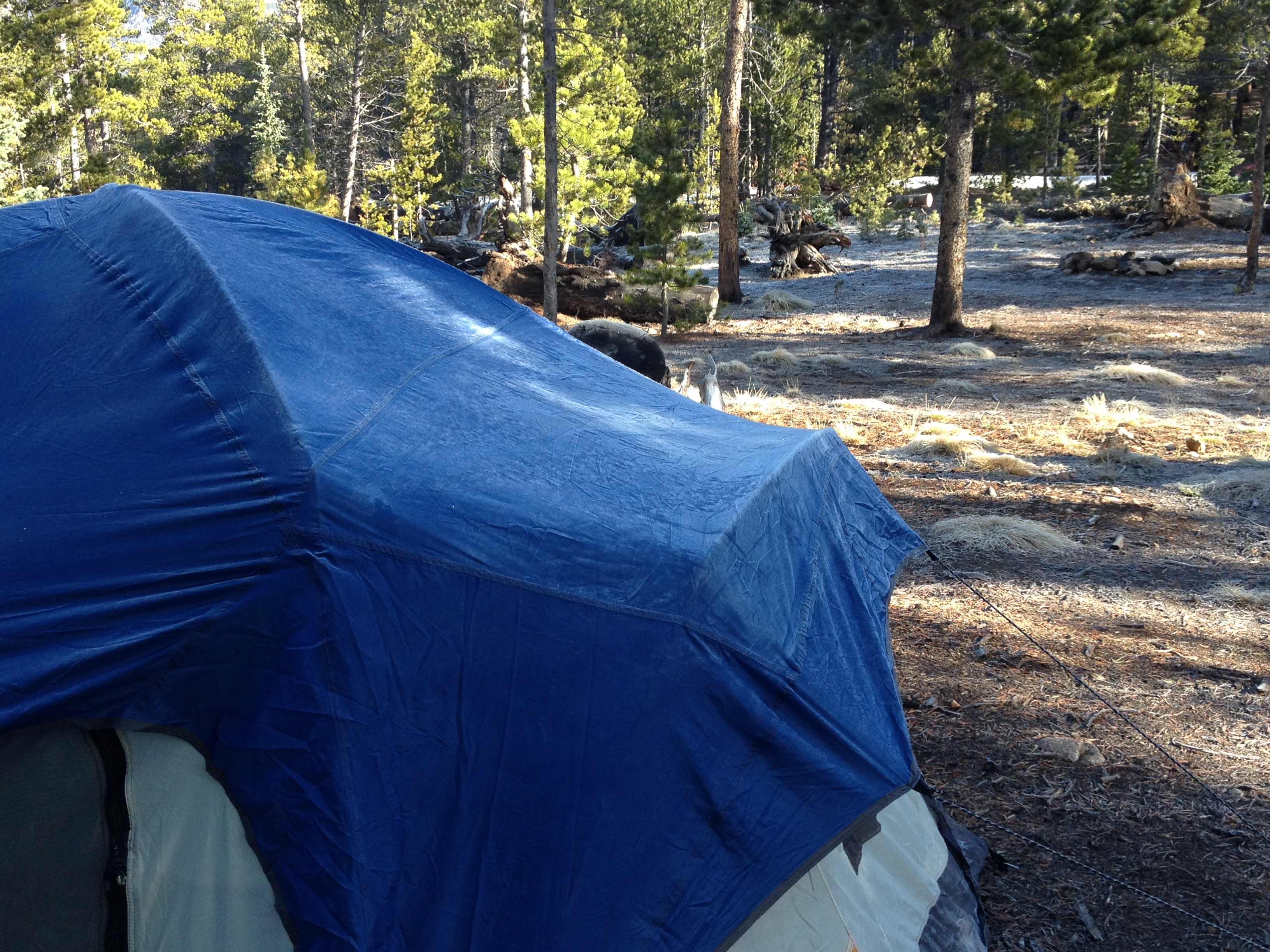
The main reason camp sites are easier to come by here in the Central Rocky Mountains in late April/ early May is that, at 10,000 feet in elevation, conditions are still not optimal.  This past weekend, both Friday and Saturday nights saw temperatures drop below the freezing mark.  Camping in these conditions is far less comfortable.  It necessitates chopping more firewood, packing more layers, and sometimes even breaking camp with frost on top of your tent!

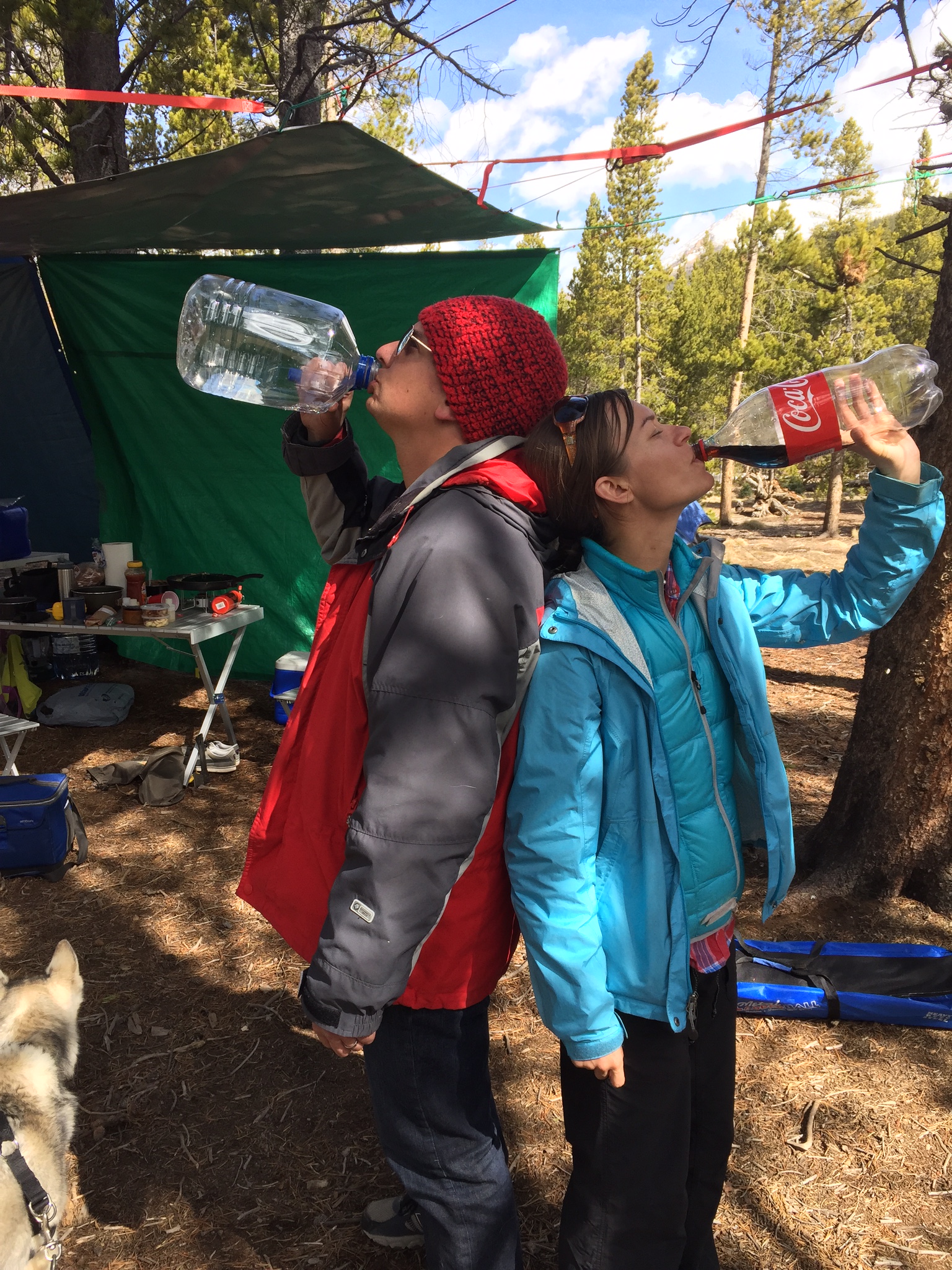
In my case, there were plenty of people around to handle campfire preparation.  This particular camping excursion was actually a multi-day birthday party.  And, at some point Saturday evening, there was around 20 people at the campfire.  It was a strange mix, being in a remote, secluded area away from civilization, but also being at a major social gathering.  We were out of cell phone range, miles from any town, and a significant distance from the nearest other campers, but also using battery powered speakers to play music at a significant volume.  It was a truly amazing experience!  I got to both be around a large group of people, but also wander into the woods and collect my thoughts in perfect silence, all in the same day!

IMG_3384

Social gatherings of these kinds are always somewhat of a balancing act.  At any social gathering like this, you will find people that will fit into the following three categories:

First, there are the people you are solidly friends with.  You have seen them sometime recently.  You have your shared experiences, your silly jokes and the like.  Most likely you have some kind of plan to see them again.  Maybe you coordinated rides with them, or even lost a silly bet on a basketball game several weeks ago.  That is what happened to me, and why I had to wear this silly sombrero for most of the weekend!

IMG_3406 IMG_3385

In the second category are people who you know, but not terribly well yet.  These are the people you would typically describe as “friends of friends”.  You’ve definitely had some experience with them.  They showed up at the bar last weekend, or the last house party you attended.  You’ve hung out with them, conversed, danced, played games at various intoxication levels.  And, maybe someday in the future someone in this category will eventually be a good friend.  But, with people in this category, the next time you will see them will be at another event coordinated by your mutual friends.

And, finally, there are the people you are meeting for the first time ever.

A balance needs to be had.  I find it important to engage with people that would fit into all three of these categories over the course of the evening.  You need to enjoy your time with your friends, but also be open to letting more people into your life.  It’s about sharing in the activities you know, reliving the experiences you have had, and continuing the ongoing jokes you already share, but also trying new activities, exploring new ideas, and creating new jokes in your circle.
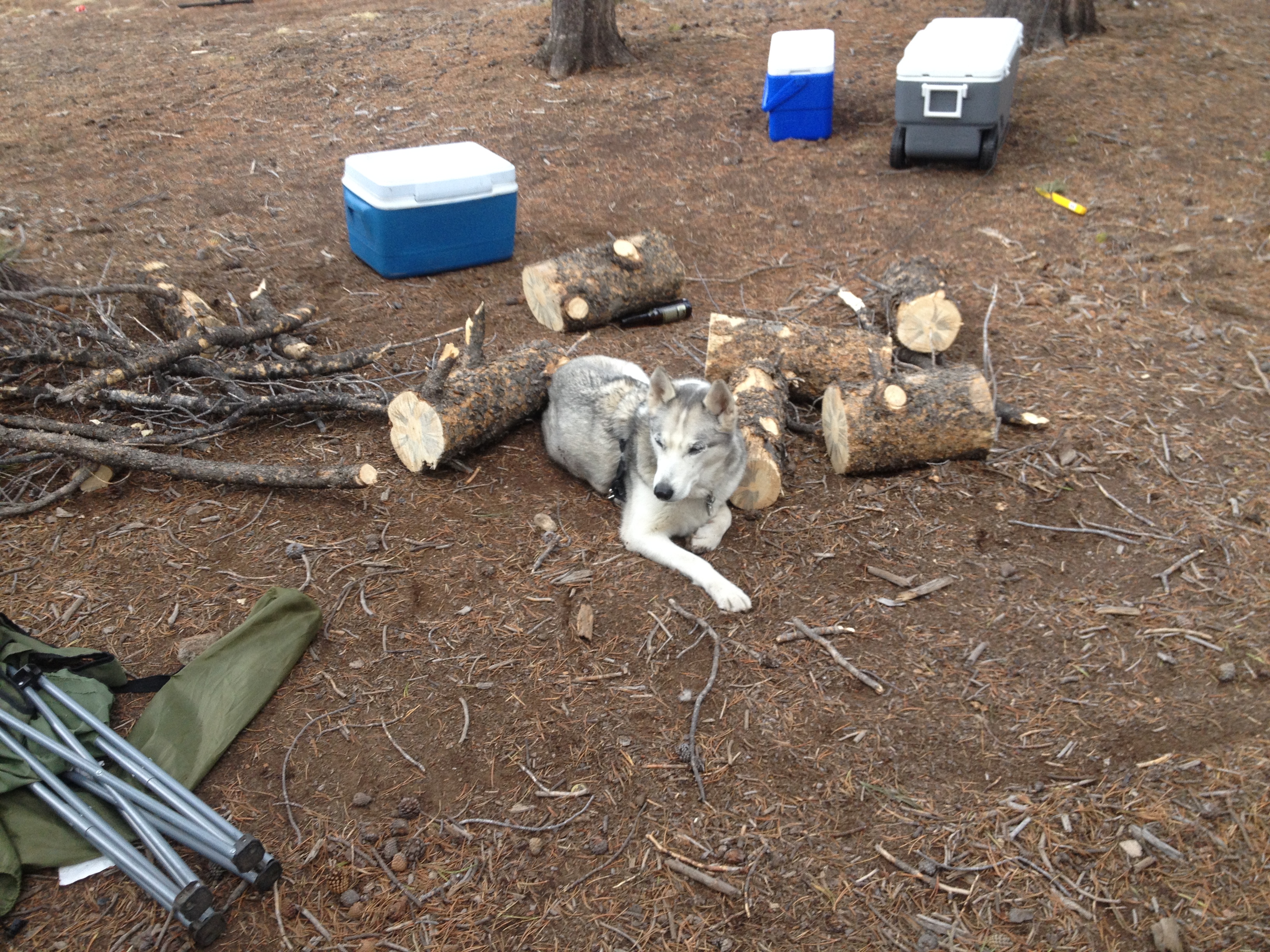
I dabbled in the old, as well as the new.  I even tried, once again, and failed, once again, at mastering the art of wood chopping.  That silly sombrero I had to wear did not help.

IMG_3396

Let’s be honest, my form here, it looks terrible, and look at all of those silly little chunks of wood that ended up splattered all over the place.  At least the activity kept me warm.

As is the case with any off-peak activity, there are some cases to take either side of tradeoff.  Someone who works a non traditional schedule may financially benefit from seeing a cheaper matinee movie.  A red-eye flight may be a more efficient use of time for someone capable of dozing off on an airplane.  And, well liquor could be a good cheaper alternative for someone whose plan for the following day does not necessitate being alert.  During “mud season” in the Rockies, hotels are cheaper and camp sites are far easier to come by.  It is also way easier to find both privacy and seclusion.  To get to a place that is truly peaceful, one must travel less distance, and often spend less time in traffic to get there.  Therefore, for those not looking to mountain bike, climb a tall mountain, or use muddy trails, it may be worth the trade-off to come up to the Rocky Mountains during “mud season”.  And, like the person who is capable of falling asleep on an airplane, or those who work non-traditional schedules, some are more adept at handling the cold nights of “mud season”.
IMG_3405

Like this Siberian Husky, who, if anything, feels at home in chillier conditions, there are off-peak opportunities out there for nearly any activity one engages in.  And, those who figure out the ones that are right for them, can save money, time and hassle.