Author Archives: Stephen Jaye

Unknown's avatar

About Stephen Jaye

My name is Stephen Jaye, I currently live in Denver, CO, but have lived in New York, Chicago, Indiana, and Wisconsin. I love the weather, I love getting out, being active, and I love exploring places. In this blog are my travel writings.

Niagara Falls: Where My Journey Begins

20160703-224931-82171740.jpg

For most visitors to this iconic location, Niagara Falls is the ultimate destination.  It is the place one travels to, spends some time at, and then subsequently travels home from.  When I think of Niagara’s typical visitors, I think of a family from a place like New York, that made the grueling six hour drive to get there, and will make the grueling six hour drive home.

I guess my sometimes fanatical quest to not be like “normal people”, whatever that means, is working.  I certainly do not feel normal.  My day, which began with an 1:15 A.M. flight out of Denver, involved traveling from airport to airport carrying not luggage or a back pack of sorts, but two panniers, one in each hand.

In a way my journey actually began at a tiny bike shop in Niagara, NY called Beeton’s Cyclery.

20160703-225445-82485961.jpg

I need to give this place a serious shout out.  I shipped my bike here.  It arrived on Friday, June 24th.  I told them I needed it by Monday, and they were able to get the bike assembled (to package a bike for shipping, the pedals, handlebars, seat, and front tire must be removed) and apply new handlebar stripping in time for me to arrive late morning Monday and start my voyage.

I brought my passport, knowing that I wanted to visit the Canadian side of the falls.  Anyone who has been to Niagara told me that the Canadian side was “better”.  I wasn’t sure what that meant.  The contrast between the two sides is quite stark.  Niagara, NY is sort of depressing.  I had trouble finding a place to grab a snack, while I gazed ahead at tall buildings and casinos on the other side.

20160703-230305-82985654.jpg

Still, I wanted to see the falls from the U.S. side first.  The plan was to meet up with my friends on the other side and spend the evening there.

On the American side, the view of the falls is somewhat awkward.

20160703-230550-83150230.jpg

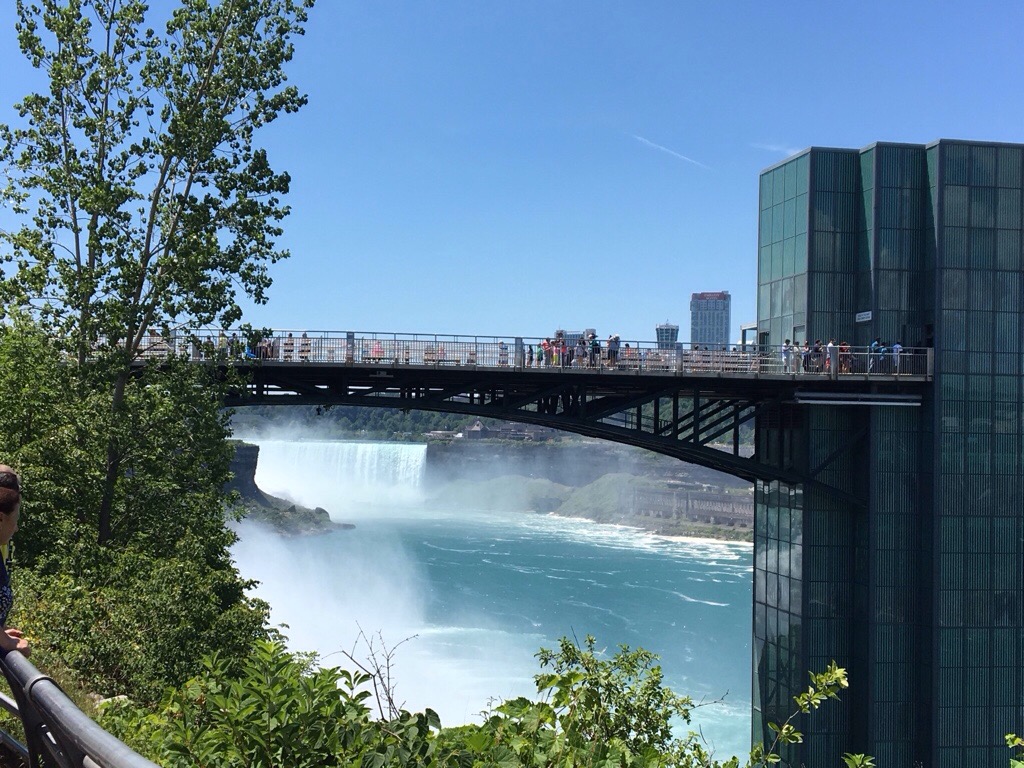
Well, it is from he riverfront. There is this overlook, where theoretically the view is spectacular, but it costs like $18 to go on it, so I didn’t.
20160703-230749-83269193.jpg

Getting to the falls on the Canadian side involved going over the same bridge that cars travel over.  The toll for bikes is only $.50 (I believe cars is $3.50), but I still had to wait in the same traffic cars wait in to cross into Canada.
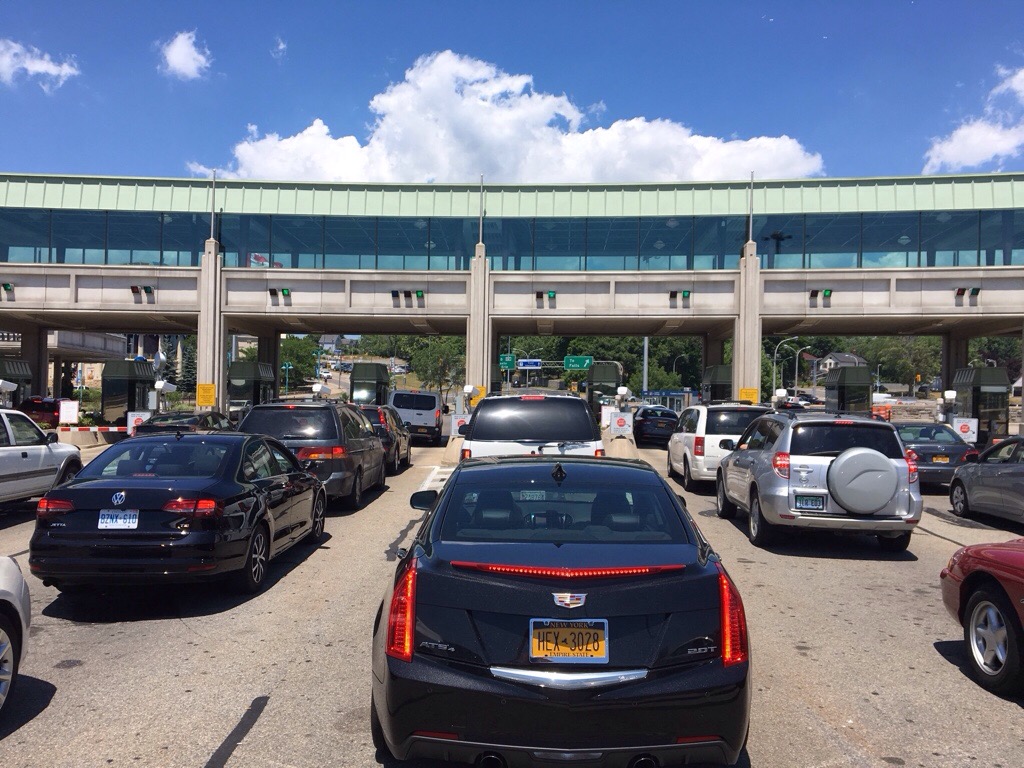
20160703-230948-83388452.jpg

Once I crossed the border, I realized why most of the tourist attractions, hotels, and buildings and such were on he Canadian side of the border.  By happenstance of geography, the views from this side of the river are better.
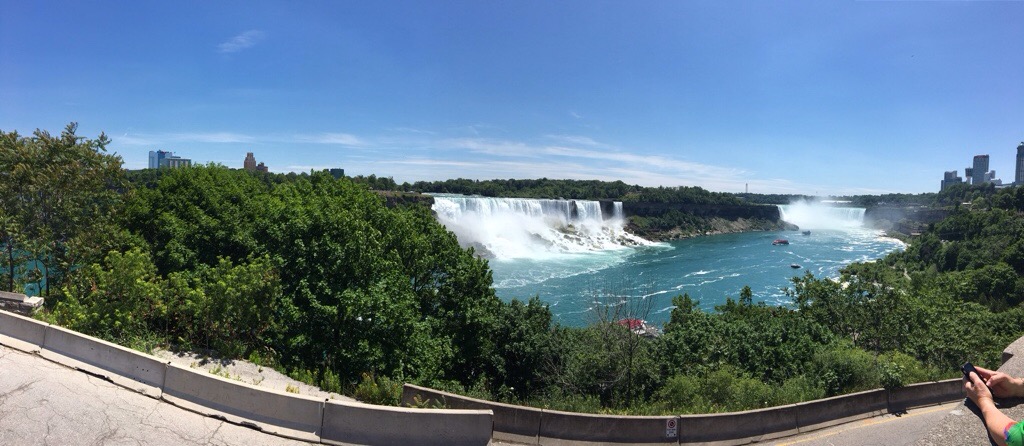
20160703-231424-83664213.jpg

20160703-231424-83664658.jpg

20160703-231425-83665101.jpg

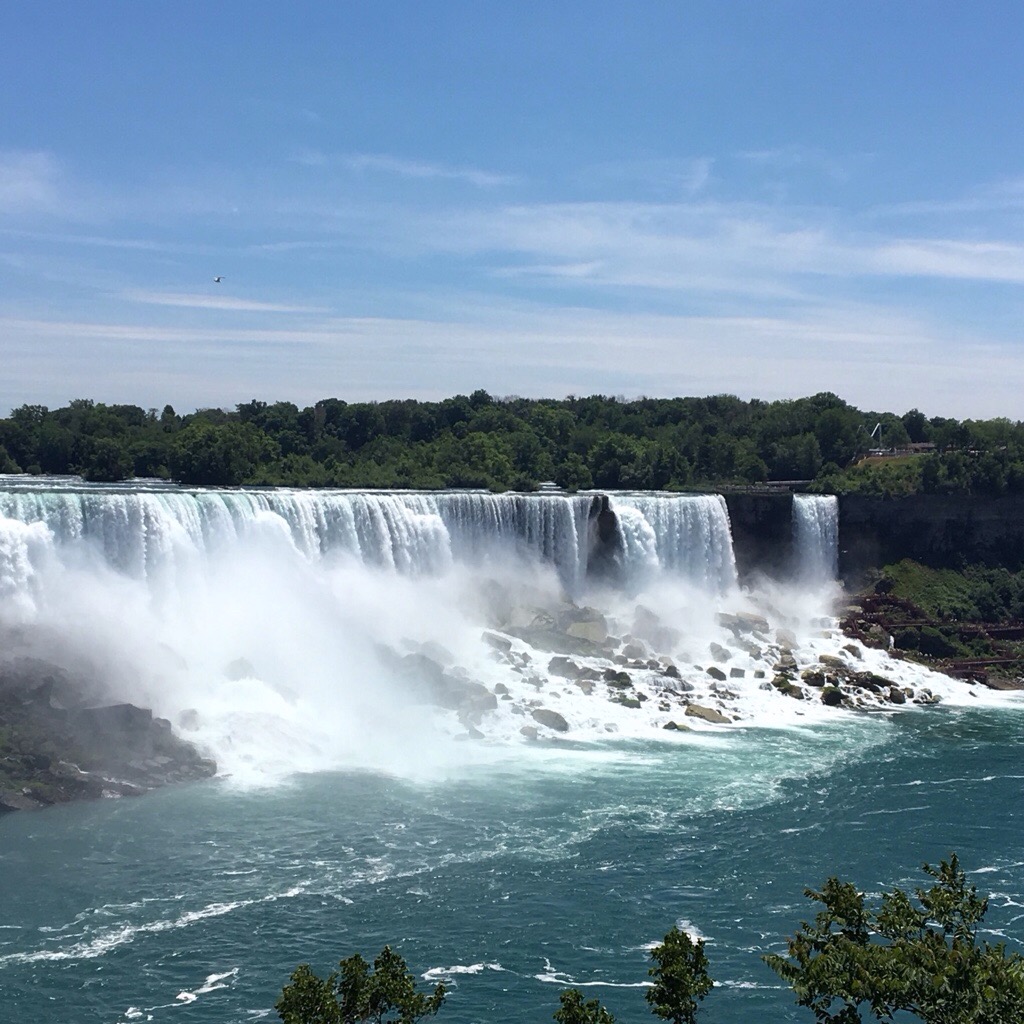
This includes both falls that make up what is called “Niagara Falls”, the American Falls, which are on the U.S. side of the river, which splits around an island, and Horseshoe Falls, which are on the Canadian side.  Both falls are magnificent.  Horseshoe Falls is more powerful, but I actually prefer American Falls, particularly the way the water hits he rocks and sort of foams up.  Both falls are best viewed from Canada.
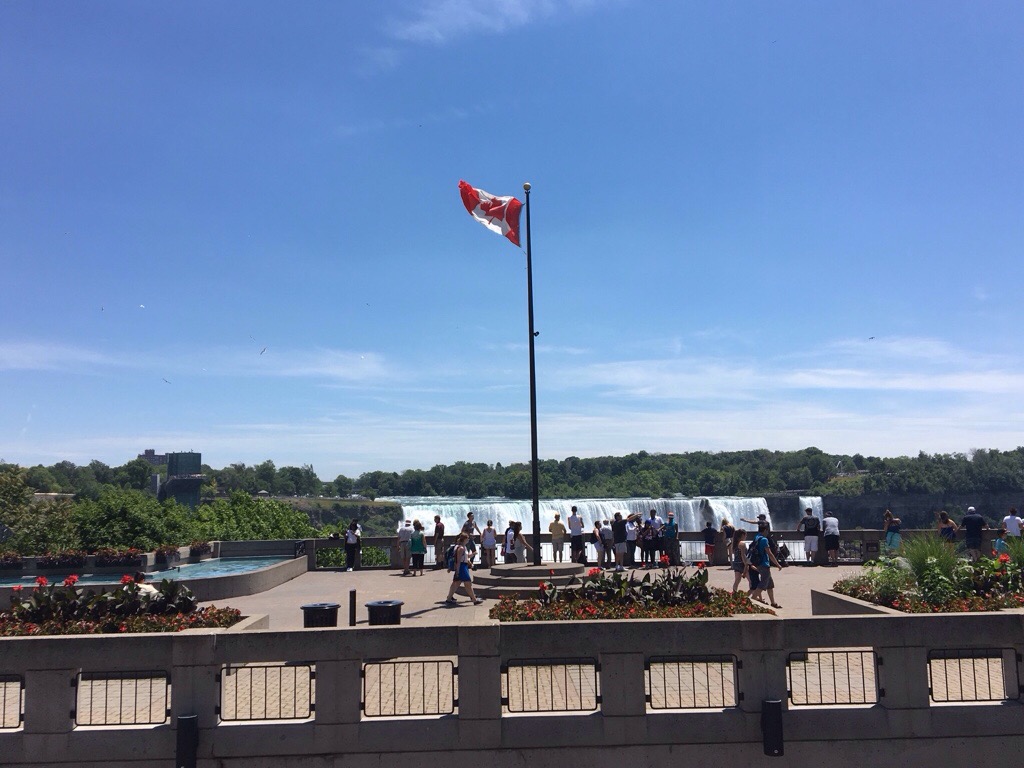
20160703-232006-84006386.jpg

I’ve always loved waterfalls for some reason.  Much like one’s taste in music or art, it is not something that can be explained.  Waterfalls just feel natural to me, they feel peaceful and even sometimes graceful.

In the world of waterfalls though, Niagara Falls is pretty much the opposite of any of the waterfalls I typically view out West.  Waterfalls in the west, such as the Lower Falls of the Yellowstone, tend to be tall and skinny, falling a much greater vertical distance, but carrying much less water.  Niagara is high volume but the vertical drop is actually less than 200 feet.

I also could never imagine waterfalls in the west being as commercialized as these.  In addition to the $18 charge for getting on the overlook in the New York side, the town of Niagara Falls, Ontario is filled with every establishment one would expect to find in a tourist trap packed together at a density I have only seen in one place before; Gatlinburg, Tennessee.
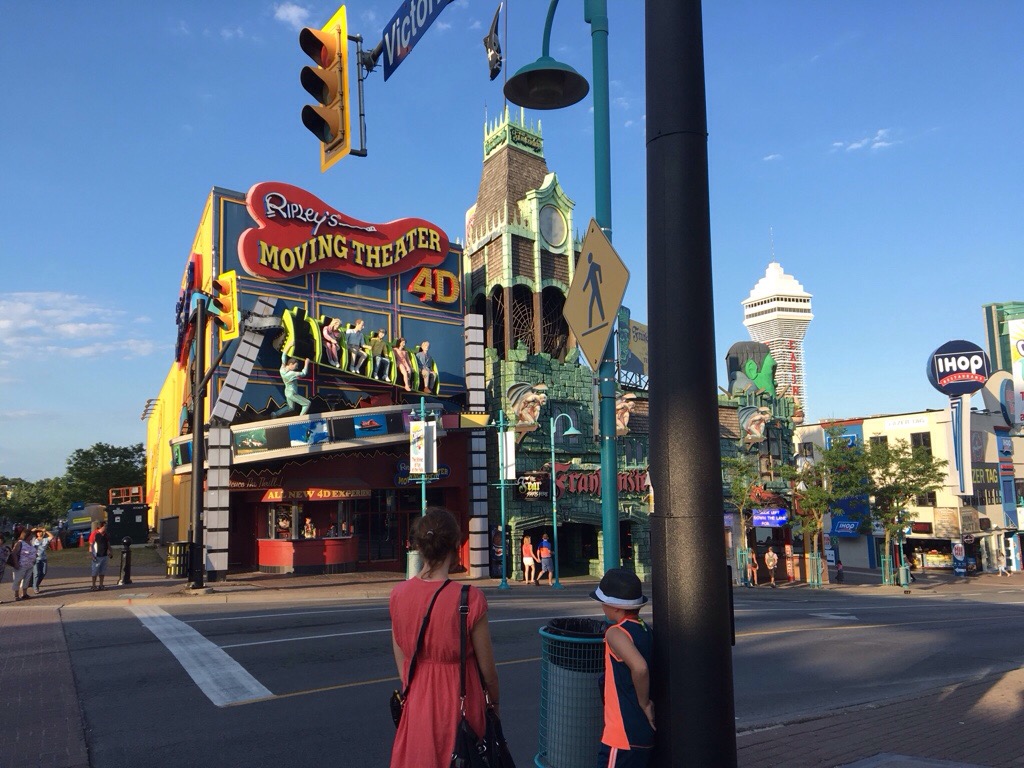
20160703-233302-84782966.jpg

20160703-233303-84783451.jpg

20160703-233304-84784380.jpg

20160703-233303-84783901.jpg

Gatlinburg, like Estes Park, is outside a popular National Park.  The hotels, mini golf, and Ripley’s Believe it or Not, are miles away from the iconic natural beauty that made those places worth preserving through the National Park system.  All of these places in Niagara Falls are within a mile or so of the falls.  In fact, one can get another perspective of the falls by riding a ferris wheel next to the mini golf course across from the laser tag.

20160703-234209-85329566.jpg

Tomorrow a long journey by bicycle begins.  Tonight, I get to continue to savor these falls, as they are lit up at dusk as part of a nightly illumination. This, like the rest of town, adds a man made touch to a natural phenomenon.  Some love it, some hate it, most find a way to enjoy it regardless of the opinion they expose.  As for me, my focus turns to the days ahead, for unlike most of the others watching the illumination, my journey is only beginning.

Taking it to Another Level

IMG_5807

I must be insane!  The same thoughts have kept popping up into my head about my upcoming trip ever since I planned it roughly six weeks ago.  I am so conflicted.  On one hand, what I am doing is significantly outside the realm of what “normal people do”.  On the other hand, compared to most long-distance cyclists, my plan is actually rather tame.

My upcoming trip involves cycling (or attempting to, we’ll see how it goes) 600 miles over the course of six days, starting at Niagara Falls, New York, and ending on the East Coast at Portland, Maine.  I am actually joining my friend Clay for half of his 1250 mile journey, which he started in Chicago.  So, while I am taking this cycling thing to a whole new level, I can’t help but think about the fact that there are plenty who do trips that are way more elaborate than mine.

BikeRoute_Sunmer2016.png

This map represents an approximation of the route that I will be taking.  There are a few things that are still up in the air, and we may improvise a bit.  But we are certainly planning to head northeast through the Adirondack Mountains as opposed to taking the most direct route through Saratoga Springs.  It will add a few miles to the trip, but we will get to see places like Old Forge, Saranac Lake, and Lake Placid.

Last year, I joined my friend for one of his journeys, but chose a much shorter segment, from Bozeman, MT to Jackson, WY.  This 230 mile bike ride took me through Yellowstone and Grand Teton National Park, and at this point is still the longest and most exhausting bike ride I have ever done.

This year, I took on a much longer ride for reasons that are somewhat personal.  I grew up on Long Island, just outside of New York City.  However, I moved away when I was only eleven years old.  Still, at face value, it always seems odd to people when they hear that I am from New York and have never been to Niagra Falls, as well as countless other places in the region.  In fact, there are nine states I have never been to, and Vermont is one of them.  In about a week’s time, my number of remaining states to visit will be down to eight!

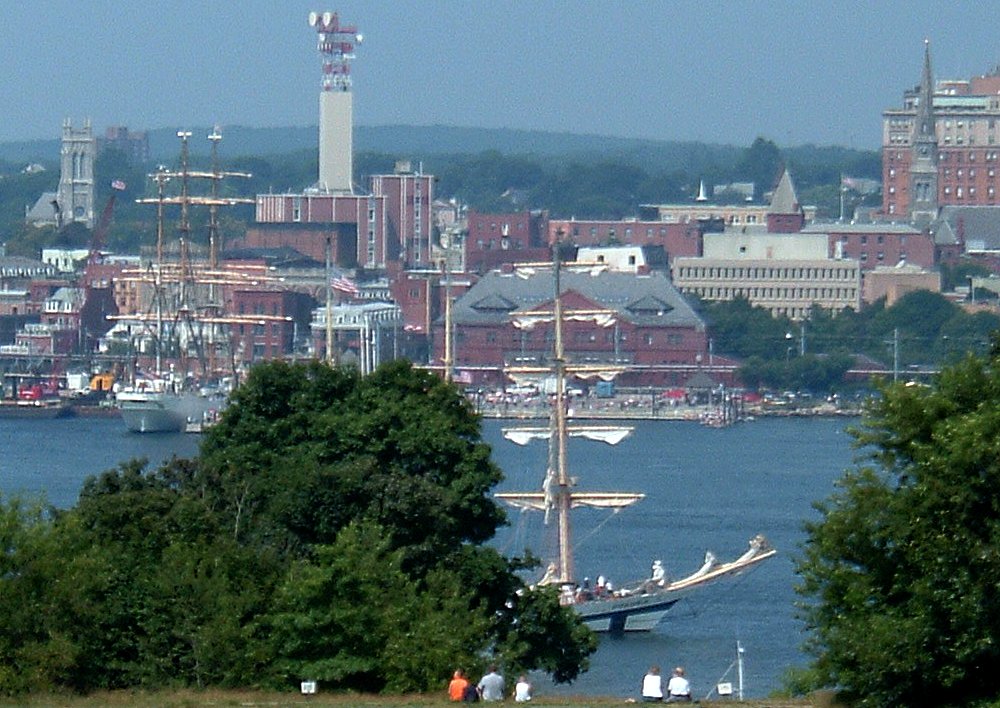
I can’t fault myself for having not been to these places.  After all, it takes many people until nearly the age of eleven to start developing an individual identity, and for many it takes even longer to develop an appreciation for travel to places of natural beauty.  I remember taking the ferry from Orient Point on Long Island to New London, Connecticut several times as a child.  While I remember the smell of the salt water, I do not remember appreciating the scenic coastal town in front of me.

After months of what still doesn’t feel like enough training, I am ready to take on the longest bike ride of my life, and see many of the places I “should have” seen as a “New Yorker”.

I feel anxious.  Will I make it?  Did I train enough?  Will it rain?  Will it get windy?  Will some other hazard emerge?  Or, will the lower elevation and relatively easier terrain (for the first half of the ride along the Erie Canal) make it feel easier than my normal cycling around Colorado’s Front Range?

Whenever I plan to do something major like this, there is also always this tug of war that goes on inside my head.  Maybe this is normal.  I don’t know.  On the surface, I understand what it means to go outside of one’s comfort zone, and do something unique.  There is a greater risk and a greater reward than sticking to activities that are easy and familiar.

Sometimes, particularly when doing something major, a part of me gets this nagging feeling of guilt inside my head, like I am skipping out on some kind of responsibility.  It’s strange, and I don’t know why it occurs.  In a way, it bums me out that this feeling occurs at all.  I know that life was meant to be lived, and the world was meant to be explored.  Yet,  in the back of my mind this feeling just occurs, making me feel like I should be doing something boring, like work, or house cleaning.
I wonder if others get that feeling too.  I wonder if we’ve been conditioned in some way to feel guilty about taking extended periods of time to do something for ourselves.  I’m glad I’ve learned to work through this feeling, preventing it from costing me countless opportunities over the years.  Still it would be nice to silence it altogether.

Sometimes we need to push ourselves, or be pushed, to truly figure out who we are.  Perhaps this requires the right level of insanity.  Last weekend, I attended two weddings, one in Breckenridge, CO, and one in Chicago, IL.  They were on back-to-back days.  This is, in some ways insane.  Yet, I did not do anything out of control, that could land me in jail or on a hospital bed.  Perhaps I have already found this proper level of insane!

A Mental Health Day

IMG_6149

I feel like I have over 100 things on my mind, all vying for space, all wearing me out.  All the changes I see around me.  The shocks, the craziness, the idiocy.  The selfishness.  My personal shortcomings, recent mistakes, how my life’s path ended up where it is and what to do about it.  How do we find a balance between order and chaos?  All the ways in which the people around me have let me down.  All the ways I let the people around me down.  How do I keep the benefits of having a smart phone (like being able to take pictures like this, after 28 miles of bicycling, which would have been tough carrying a heavier device) but avoid the pitfalls of mindless scrolling on weekdays when bored?  What is my future,  and how do I find my niche?   What is the future of our society?  The mindless violence followed by the sometimes equally idiotic responses to it.  Globalization.  Trump, Brexit, and the backlash to globalization.  But, most of all, the disappointments when experiences do not match expectations.

Simply put, I needed a mental health day.  I think we all do from time to time.  A day where we get away from jobs, computers, social media, day-to-day responsibilities, pretty much everything that causes us stress, and do something that we enjoy.  This, of course is something different for everybody, and it is not up to me to judge what any one person does for their mental health days.  Well, unless of course it is something morally reprehensible like murder or theft.

I have a firm belief in, and also a unique take on, the connection between mind, body, and spirit.  Over the course of my life, and in observing others, it is almost impossible not to observe the connection between the three.  I remember winters in Chicago, and other times when lack of exercise would in turn weigh on my mind and spirit.  Overall, improvements in one of the three realms often force improvements in the other two.  Likewise, a deterioration in one of the three realms can negatively impact the other two, like the person who develops an eating disorder after a rough breakup.

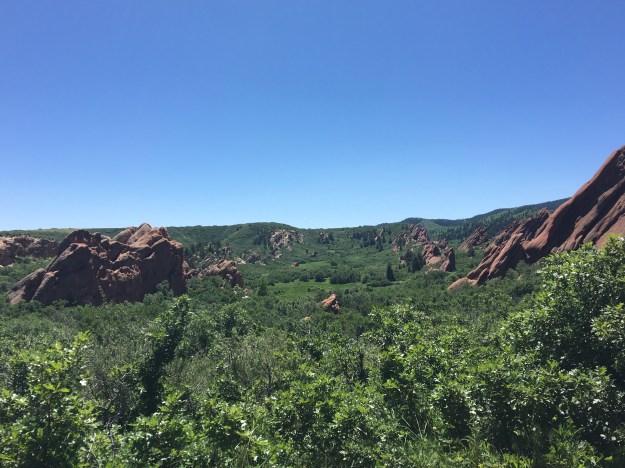
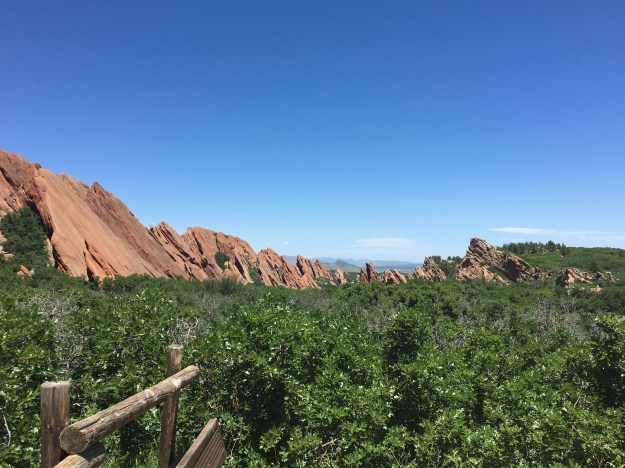
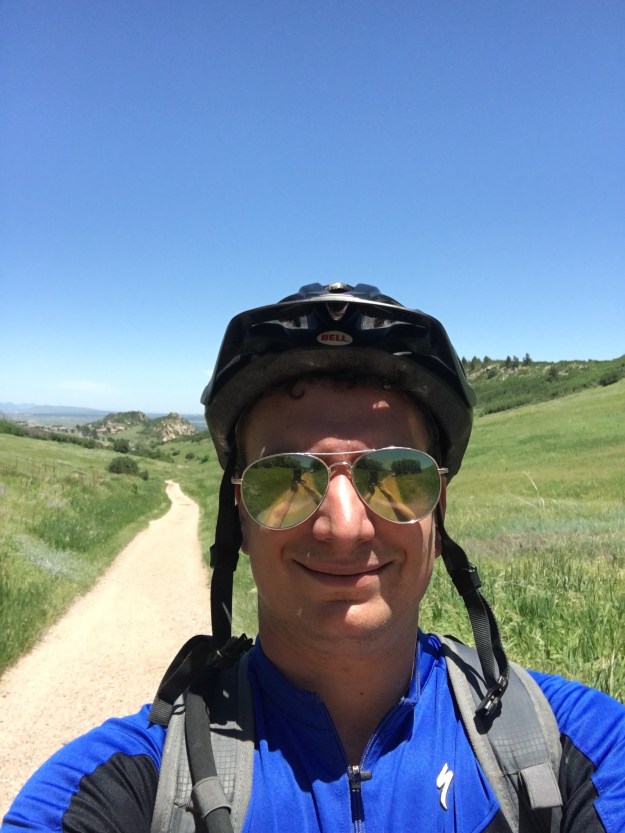
So, I decided to make my mental health day also a physical health day, with a bike ride to Roxborough State Park.  This is a ride I did two years ago.  The basic gist is that it is 28 miles each way, goes by Chattfield Reservoir, and is a significant climb over the last five or six miles.

Wednesday’s ride was even more exhausting, as temperatures soared into the 90s and a Southerly wind developed making the last several miles of climbing in harder.  Needless to say, I arrived at Roxborough exhausted.  In fact, I had to sit inside for about 15 minutes to cool off when I got there.

IMG_6140

Still, I decided to do some hiking.  Knowing that my legs were exhausted, I decided to stick to moderate trails, but ones where I can still view the essence of the park and what makes it geologically unique.
IMG_6142IMG_6143

It was after roughly 1.5 miles of hiking that the ideas suddenly started popping into my head.  Ideas about things I could be doing with my life just entered my mind.  I could do this, and present it to these people, and achieve fulfillment in this manner.  They just kept pouring in, and, for some reason, felt so simplistic to me.  Like, the only thing I need to do is just go out and do these things.

IMG_6144

These are all things that frustrate the hell out of me day and night.  Maybe it is because all of the physical exertion caused my mind to slow down enough for my brain to stop over-thinking things.  Maybe it is the freedom from all of the distractions of daily life.  It’s strange what I was contemplating.  Whenever I am in front of a computer, at an office, in a cube, or in some kind of work-like setting all of the ideas I have seem almost impossible, like a daunting challenge that would take years to attempt and would likely not result in any meaningful success.  In a way, there, I feel stuck.  Here, not so much.  Here, the same exact ideas seem quite possible.

It is here that the conspiracy theorist in me gets activated, so please bare with me, as I am the kind of person that just likes to entertain theories, even if I am not necessarily going to conclude that they are true.  I wonder if cubicles, offices, sedentary days and the like are the way “the system” maintains itself.  By “the system” I mean what I am observing around me.  A whole generation of highly educated people going to work at jobs that are well beneath the skill level they develop through college, and increasingly, post-granulate, education.  A whole generation of people submitting to rules, such as a strict 9-5 schedules and dress codes, that are no longer relevant for the kind of work that now predominates in a service sector economy.  Is the reason people continue down this path the manner in which a whole day of sitting at a computer connected to the internet and all of its distractions make them feel?

IMG_6147

People visit Roxborough State Park, and the geologically similar and more well-known Garden of the Gods, because they are unique.  If this place looked like every other place on Earth, people would not make a specific point of coming here.  So, maybe the key to being the kind of person people seek after, is to be unique.  After all, the person you meet at the party that is exactly like everyone else, is the person you don’t remember.  Sorry to be harsh.  But, it’s when someone does something unique, or interesting, that you remember that person.  Strangely, though, the world of school, and subsequently work, encourages conformity.  It encourages people to follow the worn out path and do things the way they are always done.  Maybe overcoming that conditioning and doing things our own way is the key to life, both in terms of success and happiness.

Logan Square: A Place That Still Feels Like Home

IMG_6020.jpg

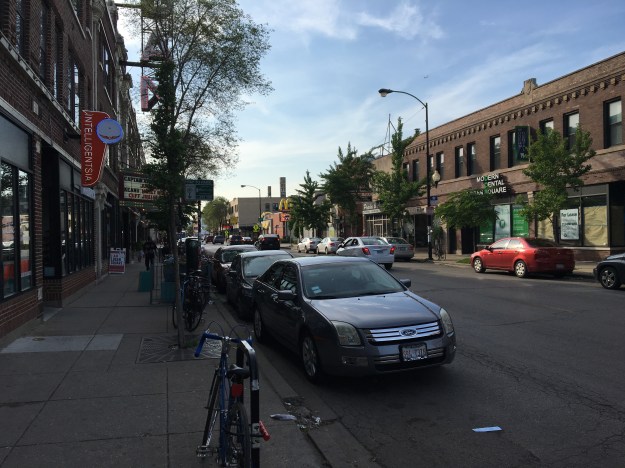
In some ways, it feels as if I never left.  I go about my business from instinct.  I do not need to look up where things are, think too hard about how to get there, and fret about to expect from the people around me.  It is all still very familiar, fresh in my memory.  Things like how the streets are laid out, where the traffic lights are, or where and how to board busses and trains are still like second nature to me.  It is what makes a place feel like “home”.  It is what many people miss after a couple of months moving to a new town, as, for most, it takes time to become truly acquainted with a city, the customs, the energy, mannerisms and the like.

It’s now been nearly four years since I moved away from this neighborhood of Chicago, situated several miles northwest of downtown, near the halfway point between downtown and O’Hare International Airport.  Four years has always been a fascinating length of time for me.  I was a teenager when I first observed the significance of this length of time – four years.  I’ve always been fascinated with observing people, what makes them the way they are and how that changes over time.  I’d think about people, including myself, who they were, what kind of life they are living, what activities they are taking part in, and what their expectations are.  These things were likely to be quite similar one year to the next, but after a four year time frame, significant differences would be observed in most people.

This may be cultural, as we are trained from a young age to break our lives down into four year increments (high school, college, etc.).  But, I noticed something else too.  It felt as if four years was how long certain unintentional transitions took to manifest.  It’s how long a person can passively absorb a new culture (by passively I mean neither actively embracing nor resisting it) before starting to also reflect it.  It is how long one can go without talking to someone before it really does start to become awkward to meet again.

IMG_6018.jpg

It’s not like everything is exactly the way it was four years ago. No place really works like that.  Over the course of time, things change: A store goes out of business, a new one pops up, a few places renovate their buildings, new signage comes in, etc.  We are accustomed to this gradual change.  In the place where we live, we do not even notice it.  It’s kind of a seamless flow.  However, after several years, the cumulative effect of all the new development becomes noticeable.  This Logan Square, the one I returned to in June 2016 is not different enough to feel foreign to me.  It feels more like when a best friend gets a different haircut, or when a house gets one room remodeled.  It’s still the same person.  It’s still the same house.  It’s still the same Logan Square, just with a couple of new features.

Logan Square is also a neighborhood in transition.  It has been for a long time.  At the turn of the century, when the renewed interest in urban living following the crime reductions that took place in many major cities during the 1990s was still a new thing, Logan Square was still run down, and kind of edgy.  It would take a few more years and several thousand more young people searching for the new urban life.  However, Logan Square was destined to become a destination for young urban professionals.  The CTA blue line runs right through the heart of the neighborhood, giving residents easy access to both downtown and O’Hare airport.  Logan Square is somewhat of a hybrid neighborhood in this sense. It is possible to live here car free. But, car ownership is not the burden it is closer to downtown, where monthly parking can get quite pricey.  Most residents pay something like $100 a year (I’m not sure what it is exactly now- not something I keep up with) for a neighborhood city sticker.

IMG_6021.jpg

The Logan Square I came back to was a Logan Square with somewhat more energy than it had several years ago.  There were more people walking around.  There was more nightlife.  There were more buildings, and a lot of new restaurants, bars, shops, just places to go in general.  This should not be surprising.  It is just a continuation of the trend that I had once been a part of.  Logan Square felt more energetic and more alive, but it definitely maintained most of its individual character.  It felt like home- just a slightly livelier home.

IMG_6024.jpg

The weekend was fast-paced, and full of events, taking me from one side of the city to the other.  Due to time constraints, I took far too many Uber rides, as it would have taken longer to take trains and busses everywhere.  I recall going up and down the Kennedy and Dan Ryan expressways, passing from one side of town to another over and over again.  This is the part of a busy weekend, which is mostly about scrambling around to as many events, and seeing as many people as possible, that fades into kind of a blur.  It’s just a blur of nighttime expressway riding, going through Hubbard’s Canyon and riding by the new Whirlyball building a whole bunch of times.

Trips back to Chicago always feel like a whirlwind for me.  Trying to spend time with family friends, etc., see as many people as possible.  But, there is more to it than that.  Everything around me seems to happen faster here.  There is something about dense urban environments that make me, and probably others around me as well, walk faster, move faster, live faster.  Events happen and plans come together much quicker.  It’s like there is something in the air, or something about seeing a lot of buildings, people, and just stuff going on all around us that makes us want to pick up the pace.  If there is one thing I truly miss about Chicago and my life there, it is that.

When You Don’t Appreciate What You Have

IMG_5987.jpg

It’s Memorial Day, and there is a lot on my mind.  Part of me feels like I “should be” doing something way more substantial this weekend, as it is one of three big weekends that define summer here in the United States.  I can’t stop thinking about all of the sales and shopping going on this weekend.  And, then, of course, I end up thinking about the ACTUAL meaning of the holiday; remembering those who have died fighting for my country.  Many people in the military, or closely associated with someone in the military, lament what this holiday has become, all about grilling in the park, going to stores, partying, etc.

I “stayed home” this weekend, which for my standards (as an antsy person) means I stayed within the Denver-Boulder-Castle Rock area.  I needed to take it easy.  My next two months are packed with activities.  Also, most places I would go would have been particularly crowded this weekend.

Confluence Park is a mere three miles from my home, and right in the middle of Downtown Denver.  In fact, when I worked in Lower Downtown (LoDo), I was able to walk here from my office on lunch hours.  I ended up being here at a very unique time of year.  The river that runs through the center of town, the South Platte, has its origins in the higher terrain of the Central Rocky Mountains.  Above 10,000 feet, snow continues to fall, and temperatures remain chilly through much of Spring.  By this time of year, that snow is melting rapidly, swelling rivers like this one with rapidly moving, cold water.  It seems like the water levels reach their highest sometime around Memorial Day.

I sat in Confluence Park with my feet in the water for roughly half an hour.  I moved around from time to time, from rock to rock, feeling the sensation of the rapid stream flow in varying patterns, with different bumps, and eddies at different spots along the river.  I even stood on top of a mini-water fall for a bit.

I thought about all of the people, running around from store to store, looking for something new today.  I even thought of myself, and how I am always looking for new places to travel, new experiences, etc.

I even thought of the other activities I took part in this weekend.

Saturday’s brewery tour by bicycle.

Sunday’s hike up Green Mountain, to a place where one can see multiple 14,000 foot peaks in one direction and Denver’s skyline in the other.

IMG_5984IMG_5985


None of these activities required traveling a long distance, or buying any fancy equipment. A basic bike, a basic pair of sneakers will due.

Sometimes it seems like we spend way too much time looking for something new, and not enough time appreciating what we already have.  After all, whether it be a place to view the skyline from above (something I did not have when I lived in Chicago), or a year old pair of shoes, everything we have was once new, was once exciting, and was once a thing we were happy to obtain.  Are we still happy to have it?  Are we still enjoying it?

Some of us have more than others.  But, no matter how much or how little any one of us has, the one thing each and every one of us has is ourselves.  We have our bodies, and what we are capable of doing.  We have our minds, the things we think of, the way we reason, etc.  And, we have our spirits, our attitudes, what makes us excited for life, what makes us empathize with one another, and what makes us stand up for what we believe in when necessary.  This is definitely something we should all learn to appreciate.  If we all spent more time appreciating ourselves, maybe we would have a more positive outlook, and a more positive impact on the world around us.

Lessons Learned?

IMG_5847

Some events in life are clear.  They can be clearly labeled a success or a failure.  The reason for the success or failure is clear, and there is a clear lesson to be learned from it.  One comes out of an event of this nature much like an idealized application of the scientific method.  A piece of new information is obtained.  It either strengthens a pre-existing theory or calls it into question.

In the real world is not ideal like that.  Many observations, an many of our life experiences do not even produce a clear cut data point, a clear “success” or “failure”, or a clear lesson to be learned.  This was certainly the case on my first storm chase of the 2016 severe storm season, on Saturday, May 7th.

It was a day that did not require me to travel far to chase.  In fact, I returned home to Denver less than eight hours after departure, something that cannot typically be expected.  If I lived in a City right in the heart of “tornado alley”, such as Oklahoma City, Topeka, or Lincoln, I would expect to be able to regularly see great storms without having to allocate an entire day.  However, Denver is a bit West of the region most prone to severe thunderstorms, much the same way Chicago is a bit East of that region.  When I moved to Denver, I did have to make some adjustment with regards to storm chasing, but I did not significantly alter my expectations regarding time spent or distance traveled on a typical one-day storm chase.

Saturday’s severe storm setup provided me with a somewhat familiar dilemma, and one that is even more common chasing storms in Colorado, where many thunderstorms are initiated by orographic features.  Severe storms need a certain environment to thrive, one that is warm an moist, but also with some kind of boundary to create low-level wind sheer, which creates the rotation necessary for supercells, and tornadoes, to form.

Saturday was not that kind of day in the Denver metropolitan area. The Denver area spent the entire day in a thick field of low level cloudiness that prevented the air from warming up.  The high temperature at Denver International Airport was only 53.  Ideal conditions were farther East.  That day the high in Fort Morgan, close to where a lot of the violent storms would hit, was 68.  As is the case with any storm chase, it is important to get into an area where the environment will be favorable for storm development.  So we drove East of the cloud deck.

IMG_5826

But then it happened, forced by the Palmer Divide, thunderstorms formed just to the North and East of Colorado Springs, in an area where conditions were not favorable for severe storms.  Sitting in Byers, roughly 40 miles East of Denver, we had a choice; do we go South and West to catch the storm now, or do we hang back and wait for the storm to reach our current location, in a more favorable environment?

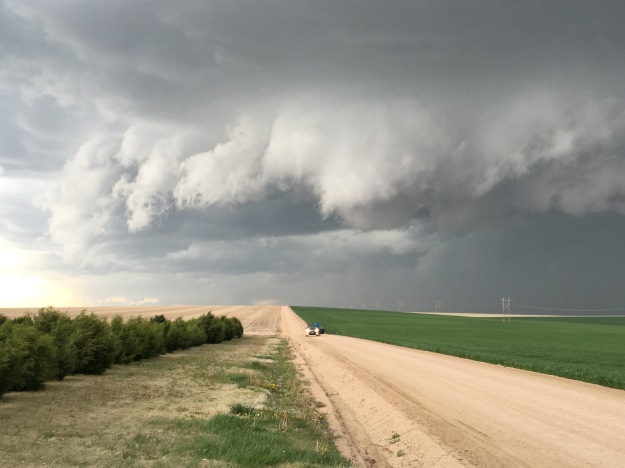
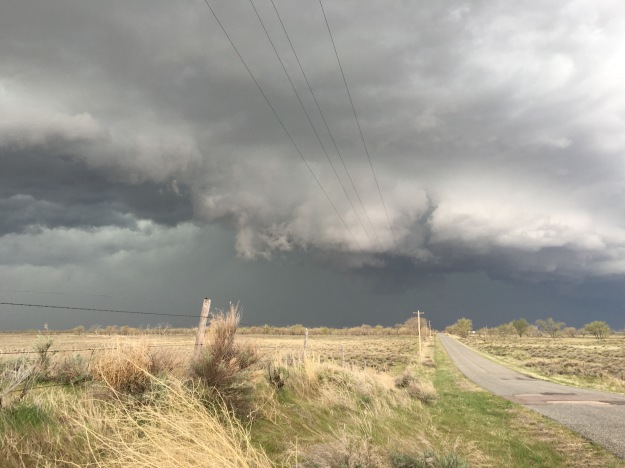
Staying back means potentially missing what the storm does in its early phases.  However, being more aggressive means possibly missing a different storm, that may form in an area with better conditions for severe storms.  On Saturday, after some deliberation, we decided to go after the first storm.  We felt cold air, possibly the coldest I have ever been in while observing a thunderstorm, and saw a strong downdraft.  This is consistent with an atmosphere that is cooler and drier than the ideal one for producing severe weather.

IMG_5831.jpg

The storm raced northward.  We ended up being a little bit limited by the relatively sparse road network in Northeastern Colorado, having to follow the storm along a series of dirt roads that connected Strasburg, CO (along I-70), to Wiggins, CO (which is along I-76).

IMG_5836.jpg

In fact, there was even a time when we were pretty much directly under where the RADAR echoes showed the center of circulation to be.  This situation sort of made me nervous.  At the time I was thinking that if a tornado were to form, it might form quite close to my current location.

IMG_5837.jpg

For roughly an hour, it seemed like the storm was kind of teasing us.  One minute, these clouds would appear to be lowering and rotating, as if a tornado were ready to form, the next minute it would all just simply disappear.

IMG_5839

It was around this time that the storm reached I-76 near Wiggings.  Here, the storm interacted with a previously existing boundary, and, according to sources, went tornadic.  However, we were never able to observe the tornado.

After this, the storm transitioned, as many severe storm clusters often do, into a large bow echo.

This is a clear indicator that the storm is entering a different phase, often associated with decay.  It has become dominated by downdrafts.  The most likely result is severe straight line winds.  At this point in time, the best thing to do is simply observe this gigantic thunderstorm, as despite no longer having the low-level rotation necessary for tornado formation, it is quite breathtaking in its own way.

Storm chasing, and storm observation is about more than just tornadoes, and it is quite unfair to describe all chases that do not result in viewing a tornado as a “failure”.  We really could not have picked a better place.  There was only one other cluster of storms that day that produced numerous severe storm reports.  That one formed farther East, a bit later, and produced tornadoes when it interacted with the same East-West oriented boundary.  We also still observed some interesting severe convective storms.

But still, it is frustrating to know that there was indeed a tornado, verified, within ten miles of where I was sitting, and I somehow did not get to actually see it.

I know being in position to view this storm was quite challenging, and it is likely that few chasers found themselves in such position to view the tornado.  But I wonder, had my group reached the I-76 corridor 15-20 minutes earlier, would we have been in the right position to see it?  We knew this boundary was there, and it was in the area with the most ideal conditions.  Was going after the storm initially an exercise in impatience?

IMG_5851.jpg

The day ended with a return trip, along I-76, back to Denver, through the area that was clearly just recently pelted with hail.  I returned knowing that there are aspects of this chase that can be considered a “success”, but others that can be considered a “failure”.  I also returned still wondering how to strike that proper balance between aggressively chasing after storms that initiate, and patiently waiting for storms to form or reach the location where the conditions appear to be most favorable.

A Visit to Albuquerque

People like to break things up into neat little groups.  It is a technique people use in order to try to simplify a world that, in reality, is quite complicated.  In the United States, we take our cities, and break them out into various groupings.  We place cities in groups based on their region, their size, and sometimes even by culture.  I am as guilty as anyone of doing this.  But, every once in a while, we find ourselves in a place that reminds us that we need to respect two basic tenants of humanity, which apply both to the Cities we visit, as an entity, as well as to each and every one of us individually.

Each City, just like every one of us, has a distinct and unique individual identity.  In this identity, we see reflections of factors such as its geographic location, its history, and some of its specific influences, such as specific personalities and prominent industries.  We also see some specific quirks that cannot be easily explained just by looking at what we observe elsewhere.  It is the same way with each and every one of us.  When we are being true to ourselves, our behavior patterns manifest in a similar unique manner, a manner that can only be described as attributed to our unique person.  I feel it every time any one of my friends responds to anything I do or say by simply saying “That’s so Steve”.

Also embedded in the character of any City I have ever visited are reflections of natural law, or the universal truths that bind us all together.

IMG_5691

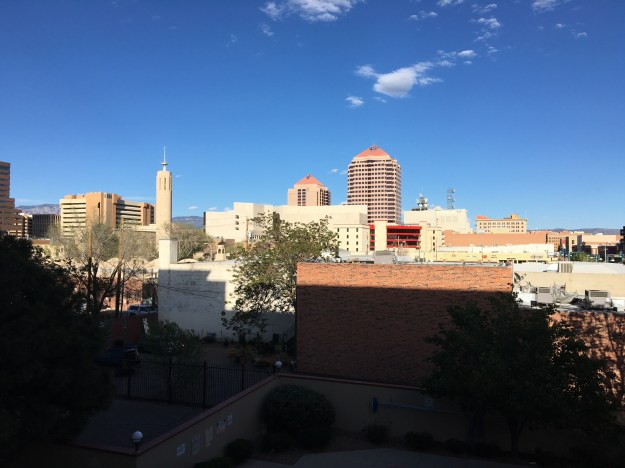
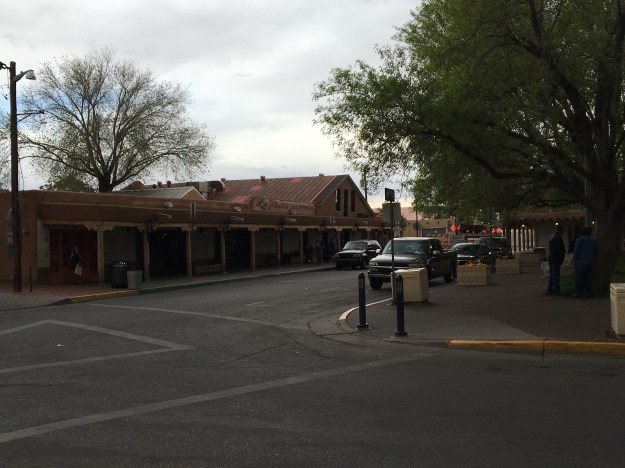
Albuquerque reminded me of both of these two basic facts.  Albuquerque has a unique heritage.  It has similar beginnings as Santa Fe, and even has an Old Town Square that reflects these beginnings.

IMG_5737.jpg

However, much of the city was built in a much more sun-belt style car-centric manner.  It is one of the most storied towns along historic U.S. route 66.  Route 66 embodies multiple eras of U.S. history, including the mass migration to California during the Great Depression, and later the first decade after the second World War, when the American road trip first became accessible to a large swath of the American people; the middle class.

IMG_5701.jpg

Route 66 connected Chicago to Los Angeles from the late 1920s through the end of the 1970s.  While the route covers a large distance, traversing many different parts of the country, it is the Southwest, New Mexico and Arizona, that is often most commonly pictured when people imagine that classic road trip on route 66.  While the exact location of the route 66 town in Disney’s Cars is not disclosed, the imagery in the movie clearly points to a southwestern location.

IMG_5728

Albuquerque celebrates its pivotal position along route 66 by both preserving some of the places that were legendary stops for travelers along this highway.

IMG_5729 (1)

As well as creating restorations that recreate the experience of being at a travel stop along the old highway, much the same way old west towns recreate the American West during the 1800s.

IMG_5694 (1).jpg

Route 66 is even the subject of a major controversy in town.  A proposed Bus Rapid Transit project, called Albuquerque Rapid Transit, would more or less follow the path of historic route 66 through town.  Residents of a hip area of town adjacent to the University of New Mexico called Nob Hill appear united in opposition to the project.  Some of the signs I saw opposing the Albuquerque Rapid Transit referenced protecting the heritage of route 66.  However, I wonder if this opposition is motivated by route 66 preservation, or the desire to avoid any changes to the neighborhood.

IMG_5693.jpg

Regardless of whether the people are motivated by the desire to preserve route 66 in its historic format, or preserve their neighborhood the way it currently is, on display here is one aspect of humanity that appears consistent across all cultures.  When people are enjoying their current situation, they generally do not desire change, and, in many cases, will fiercely oppose it.  This has been the case for me, personally, at various stages in my own life, and is also evident in a lot of the behaviors I observe in others when they react to changes in the workplace or their favorite social media outlet.

IMG_5708 (1)

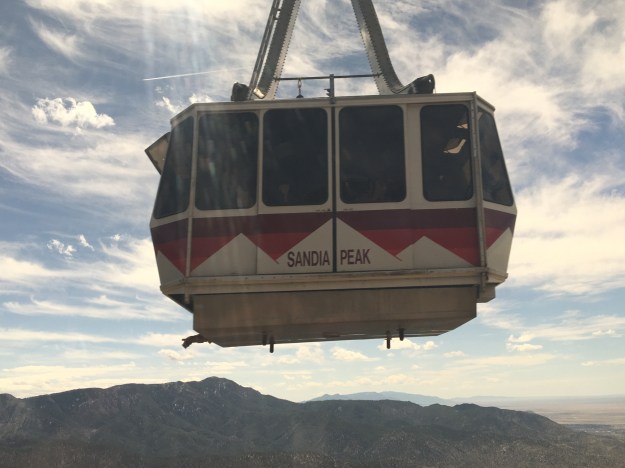
It also appears to be basic human nature to seek out a broader view of the world from time to time.  It is the reason people go to the top of the world’s tallest building, hike Mount Rainier, or sit and gaze down at Los Angeles from the Hollywood sign.  Albuquerque’s answer to this is the Sandia Peak Tramway.

IMG_5718 (1).jpg

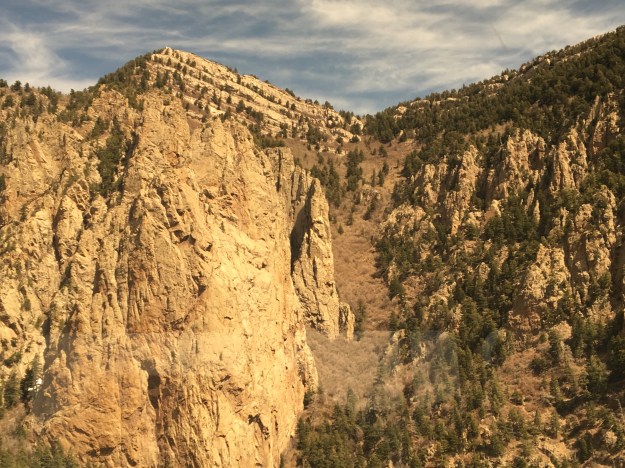
This tramway takes passengers on a 15-minute ride from a base elevation of 6559 feet (already significantly higher than the center of town), to a peak of 10,378 feet. Here, visitors to the area can see unique rock formations.


IMG_5707IMG_5723

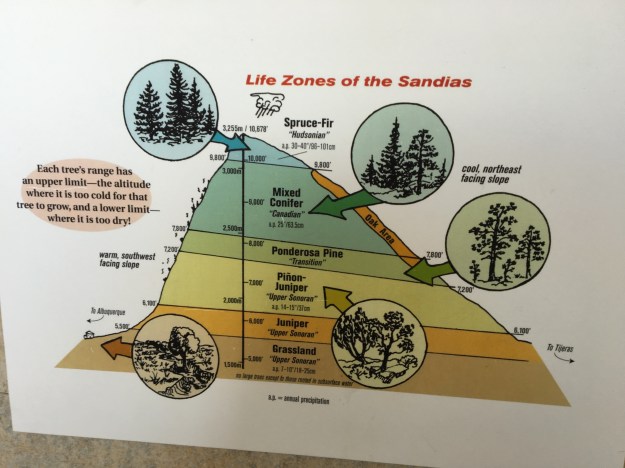
Learn about the unique biomes that can be found in the mountainous terrain (Breckenridge has a similar exhibit, but uses an actual garden).

IMG_5712

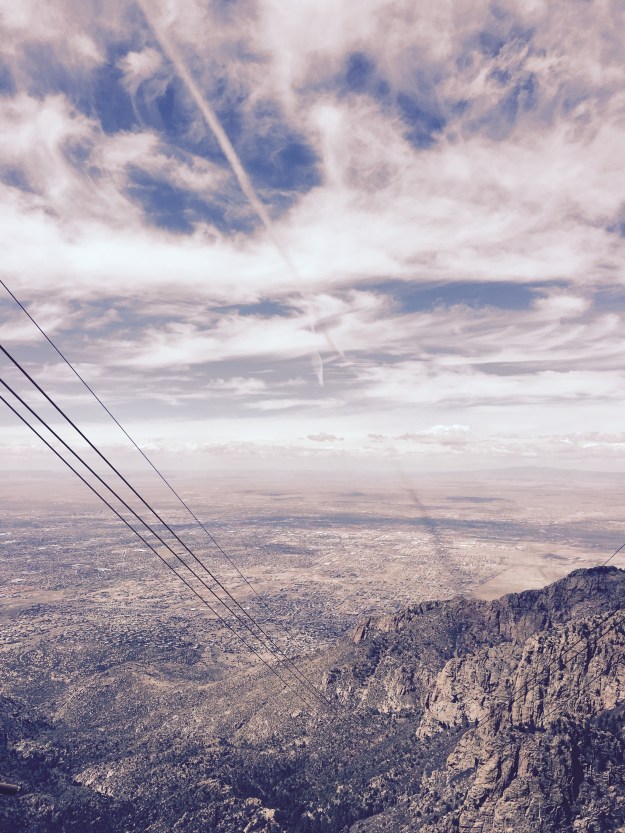
And, can get a view overlooking this city that actually covers a much broader area than just the Albuquerque city limits.  In fact, Sandia Peak is so high that it is quite difficult to make out individual buildings or even neighborhoods in town!

IMG_5716 (1)

The culture is unique as well, seeming to combine so many aspects of the West and Southwest.

IMG_5739IMG_5742

Along the Rio Grande River, which cuts through the center of town, a bike trail, as well as numerous parks provide the urban outdoor space that Westerners seem to value so much.  Whereas, in many other cities I have visited and lived in, living in close proximity to a park is desirable, but kind of a bonus, it feels as if people here in the West view being near a park as a prerequisite, a necessity of life itself!

IMG_5734.jpg

On this particular Sunday afternoon, a parade of classic cars rolled through Old Town Square, showing off their classic appeal, and the hard work each and every car owner put into maintaining their vehicle’s shine.

IMG_5733

That evening, on the West side of downtown, another group of people are gathered, also showing off their vehicles, and, almost downright partying.

When I think of all the cars revving their engines up at night, all I can say is, “That’s so Albuquerque”.  One could speculate what mix of cultural influences, old Spanish, sunbelt, Western, Hispanic, etc. lead to Albuquerque being the way it is today.  But it is more than that.  The same can be said about any other place one would visit.  That is why we travel, not just when we need to go somewhere for business, or when we wish to visit people that live in another place, but also when we desire an experience we simply cannot have in our respective hometowns.

Exploring New Mexico

IMG_5660 (1).jpgThe northbound journey out of Santa Fe, along highway 84 towards Pojoaque, and Espanola could not possibly feel any more Southwestern.  Rolling hills are covered with bushes and sagebrush.  There are some trees here, but unlike in the East, their impact on the wide open landscape is minimal.  They are but mere dots, small points in a panoramic image that shows off the entirety of the landscape of the region, stretching for miles and miles.  As a consequence, mountain ranges can be seen in the distance in multiple directions.
IMG_5662 (1).jpg

Artwork depicting the culture of the American Southwest can be seen quite frequently along this entire stretch of highway, on roadside decorations, bridges, and even buildings in the distance.  There is something about sculptures and murals like these that invariantly make me think of the Southwest, even when I am in a completely different region.  The use of colors in particular are reminiscent of this region, warm and dry but still American.  The colors are warm, reds, oranges, browns.  Even when they use “cool” colors, like green and blue, these murals somehow find a way to make these colors feel warmer than they typically do in other drawings and signage.

I wonder, as much of the artwork of the region originated with the Native tribes that thrived in the area roughly a millennium ago, if the styles that came to be predominant in this region are a mere reflection of the manner in which the landscape, and climate, impact the human psyche.  And, is this an aspect of human nature that transcends culture?  Did the Spanish, and White and Hispanic people who would later inhabit the region adopt similar artistic styles because they were responding to the same conditions around them and reflecting them in a similar manner?

The reason I was headed in this direction out of Santa Fe, other than just merely to explore, which I do believe is a reasonable pursuit in of itself, was the desire to see one of the most significant, but also confusing places in the United States; Los Alamos.  Los Alamos is a place where some of the top scientists in the world came together during World War 2 in order to build the nuclear weapons that eventually ended the war.

Of course, at the time, it wasn’t the Japanese, but the Germans who were the main subject of concern. It was rumored that the Nazis were building this capability, which could have significantly altered the course of the war.  The Manhattan Project was both highly secretive (Americans were largely unaware this was going on at the time), and quite controversial, as it still is today.

IMG_5665.jpg

The entire area has a feel that continues to reflect how Los Alamos came about.  Headed towards town, on highway 502 West from Pojoaque, road signs indicate that the stretch of highway is a “safety corridor”.  What does that even mean?  I have never seen this before.  Anywhere else, this road would have a higher speed limit, less fines, and would likely not have three lanes in each direction.  Something must be going on here.  But, is it still going on?  If so, what?  And, how much of a secret is it?

IMG_5668.jpg

The truth is, Los Alamos is a place like no other place on earth, and like the rest of New Mexico, cannot be placed in a specific category.  It is, indeed, a place where discoveries are made.  But, unlike many other towns with major labs, and I am particularly thinking of Boulder, Colorado, which is near my home, it does not appear laid back at all.  After parking, I had an intense experience crossing the street to get to the Bradbury Science Museum.  This crosswalk had a walk/ don’t walk voice command that spoke words with a level of urgency that appeared to highlight the National Security and wartime origins of this town.  It felt as if 70 years later, the mindset had never really changed from its wartime heritage.  Or, in the very least, the town had kept its infrastructure, which was built specifically for time of extremely heightened security.

IMG_5669

The Bradbury Museum is quite well done, and for those traveling on a budget, is free.

I’d say slightly over half of the museums exhibits focus on the Manhattan Project, the A-Bomb and the original history of the laboratory.  However, the laboratory is operational, and has been involved in some high caliber research over the last 70 years, in areas such as cancer detection, energy conservation, and wildfire prevention.  It is amazing to think, the same place, the same people, the same lab, and the same knowledge base was used both to create the most destructive item on the face of the earth, nuclear weapons, but also to advance humanity and help countless people better their lives!

IMG_5667.jpg

One of the reasons Los Alamos was selected as the location for this top secret lab, was that it had to attract top scientists, many of the young at the time, to a project that likely meant years in seclusion.  While these young scientists would not have the benefits of urban nightlife, for Los Alamos, and the laboratory, they found an area with plenty of opportunity for outdoor activities.  The volume of hiking trails throughout Los Alamos County (a relatively small county) reflects this history.

IMG_5677 (1).jpg

Just West of town, and the lab, is a large area known as the Santa Fe National Forest.  This National Forest, in many ways resembles the National Forests that can be found throughout Colorado.  In fact, I can picture many of the same activities, backpacking, camping, and with the Jemez River, water activities such as fishing and boating.

IMG_5680 (1)IMG_5681

The main difference I felt, between here and many of the forested areas of Colorado I regularly frequent for hikes and such, is that this area seemed significantly less crowded- emptier.

Along highway 4, the main road through the forest, there is one area hot spot, a unique natural feature known as the Soda Dam, a waterfall the flows between a rock along the Jemez River.

IMG_5682 (1).jpg

Not only does this area feature a waterfall unlike any other place on earth, but there are geothermal features that make this river a popular pseudo hot spring.  I say pseudo- hot spring, as the water is not really hot, as it is in some areas where water temperatures resemble that of a hot tub.  It is just simply warmer than you would expect it to be given its high altitude origins.  It was warm enough that people were able to comfortably swim in it.

IMG_5685.jpg

It is an area that is just simply peaceful and panoramic, the kind of place where one can simply turn off the wheels that churn in their heads as a result of everyday life, and just sit, swim, float, or fish, gazing in the distance at the majesty of the region.  Two weeks later, I still gaze at this very photograph and feel as if I am entering a much more peaceful state of mind.  I almost need to place it in front of my desk, as a stress reliever.

IMG_5686 (1).jpg

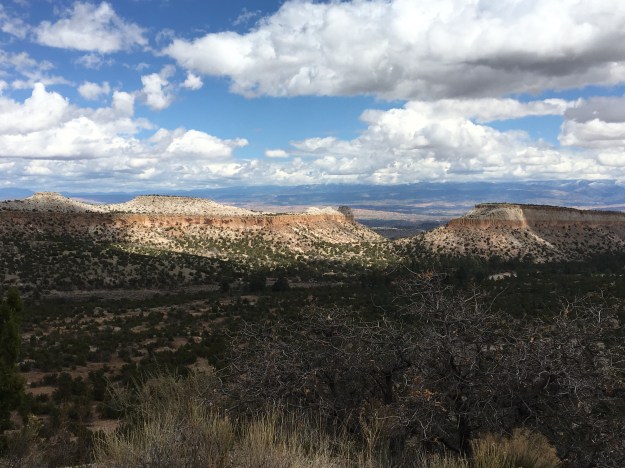
The entire west is full of areas like this, where, due to unique geological history, the rocks take on a reddish color.  This is the color that many associated with the American Southwest.  Although most of Central New Mexico is much browner, especially in April, a section of bright red suddenly appears at the South end of Santa Fe National Forest, along highway 4, at the border of Jemez Pueblo, yet another Native American village.

The day ended with a final drive down highway 550 towards Albuquerque, where the Sandia Mountains, largely to the City’s Northeast, drew gradually closer as the drive progressed.

IMG_5688 (1).jpg

Thinking about all of the beautiful places I saw over the course of the day, my main regret is spending too much of the day in the car, and not being able to stop, hike, float, walk around, and just get immerced in area.  As a travel enthusiast who unfortunately has responsibilities at home, it is all too easy to get into the trap of planning too many activities for too short of a period of time.  This often makes travel feel rushed, like there is too little time to experience some of the places we see.  Luckily, I live in Colorado, and therefore can get similar experiences, National Forest recreation areas and such, closer to home.  But, there are some subtle differences, and things that make this area unique.  I would very much like to come back here at a much more relaxed pace, and experience another side of New Mexico life.


An Old World Town in a New World Region

In the U.S.A., we are quite accustomed to the seeing certain kinds of towns in certain parts of the country.  Since cities were built earlier on the East Coast, we expect to see towns laid out like Boston, Annapolis, or Charleston.  These cities tend to be a bit more challenging to navigate, as is particularly the case with Boston.

boston_street_map

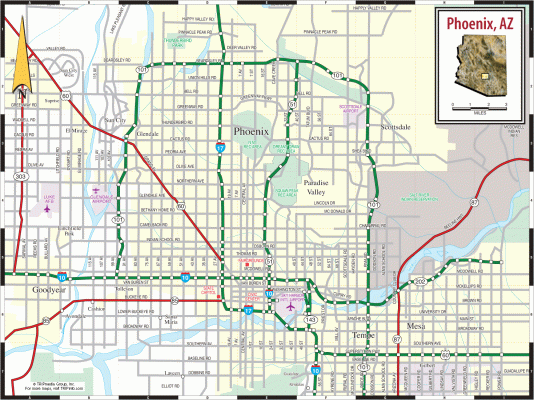
By contrast, in the Western part of the country, we expect to see towns built more around automobile (or the automobile’s predecessor in the late 19th Century, the horse drawn carriage).  Cities like Phoenix, designed with driving in mind, have mostly straight-line roads, with suburban areas having windy subdivisions.

Phoenix_Street_map

This is what we have come to expect from towns in this part of the country.  So, when I first looked at Santa Fe’s road network, I was quite surprised to see a city full of windy roads that resembled something I would expect to see along the East Coast, or in Europe.

IMG_5647.jpg

Oddly enough, New Mexico is one of the oldest regions in the U.S., at least when it comes to architecture.  The historical lineage is just different.  New Mexico is home to over a hundred Native American Pueblos that date back to long before anyone associated with the United States of America would arrive.  Many of them are still inhabited, with some having been inhabited for over 1000 years!  This is quite a long time for this part of the world.

Santa Fe, New Mexico’s capitol city was founded originally as a Spanish colony in 1610, ten years before the Mayflower would come ashore in Massachusetts, and still retains much of its original Spanish style.  In some ways, driving into New Mexico feels like entering a whole different region, fairly instantaneously.  I first noticed this storm chasing in college. It was my first time in New Mexico, or Arizona.  I was previously unaware of the prevalence of adobe style buildings in these two states, and was somewhat surprised to see how abruptly the styles of the building around me changed once I crossed the border from Texas into New Mexico.

Santa Fe appears to have retained much of its cultural heritage.  Aware that New Mexico has a substantial Spanish history, I decided that it might be a good idea to check out a Spanish restaurant downtown.

IMG_5638.jpg

Taberna came highly recommended by the staff at the hotel, and certainly did not disappoint.  The food was excellent, and, on this particular evening, a performer named Jesus Bas performed for the customers.  I sincerely, if only for a moment while sipping a glass of wine, tasting enchiladas, and hearing Spanish music, felt like I was in Spain.  Well, at the very least, it made me want to go to Spain.

IMG_5642.jpg

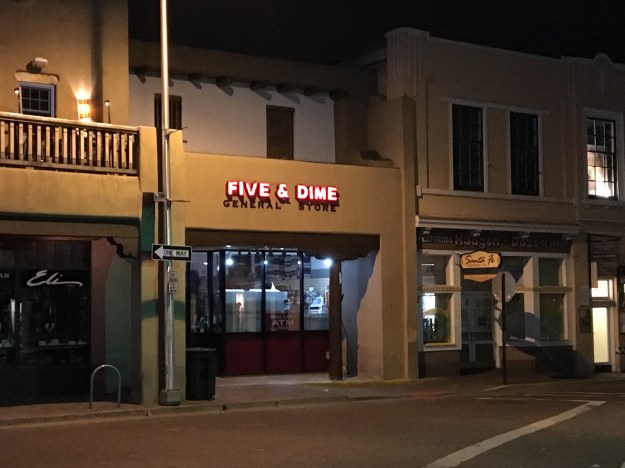
I decided to somewhat follow in the footsteps of one of the people who inspired me to start writing about my travels, Anthony Bourdaine.  For those not familiar, he is a chef who eventually became the host of a series of food related travel shows.  I watched a lot of his previous Travel Channel show No Reservations, where he did not just simply describe the food he was eating, he would also reflect upon the experience, what certain places made him feel like, and what historical context they can be placed in and such.  His current show, which is actually a bit less food focused and more focused on the travel is called Parts Unknown.  So, I was actually quite excited to see a souvenir shop actually called Parts Unknown.  Additionally, the shop is located only a few doors down from one of the places Anthony Bourdaine visited on the Season 2 episode where he travels around New Mexico; the Five and Dime, a shop where he gets a Frito Chili Pie, a commonly served dish in New Mexico.

IMG_5643.jpg

I did not end up getting the Frito Chili Pie, as there were a limited number of meals I could have here in Santa Fe.  I mostly just looked around at the souvenirs available in this shop, which featured Santa Fe’s connection to one of my favorite aspects of American History, route 66 (although the route bypassed Santa Fe starting in 1937).

IMG_5646 (1).jpg

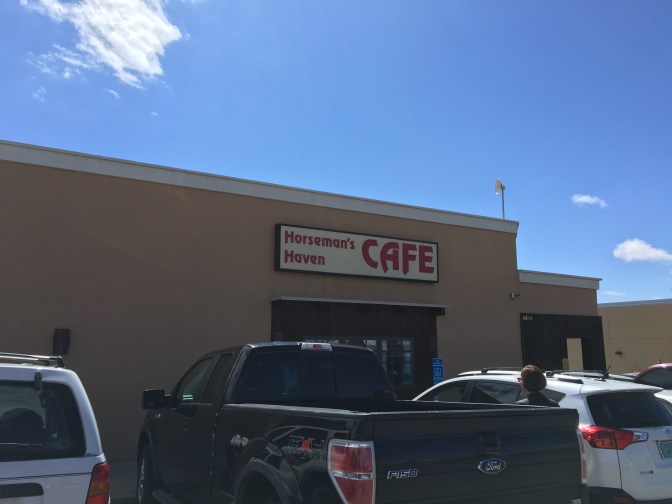
I ended up going to a place called Horesman’s Haven, a small restaurant on the edge of Santa Fe famous for authentic New Mexican style food where Anthony Bourdaine was caught off guard by the level of spice in their green chili.

IMG_5658.jpg

IMG_5659.jpg

My chili was not quite as spicy, but still packed quite a punch.  I am glad it did!  Many people try to avoid spicy food while on vacation, to avoid experiencing an upset stomach while far from home.  In this case, the level of spice was an important part of the experience.  Life is meant to be experienced.  Some people spend their entire lives trying to avoid bad outcomes.  In my view this is a sure fire way to miss out on countless rewarding experiences.  Bad outcomes are going to happen.  We just need to manage them in our own way.  Missing out on a whole bunch of experiences, and I am talking about things much more significant than one high quality meal, bears a much greater cost than the occasional unfavorable outcome.

I am guessing this is the attitude taken by the unexpectedly high number of people who make a living as an artist in this town.  In the downtown part of Santa Fe, it seemed like half of all buildings house art galleries.  Santa Fe is known for art galleries, but there seemed to be way more than is necessary to support a town of roughly 70,000 people, even if all of those people are wealthy and have dozens and dozens of pieces of artwork hanging from all of their walls.

Like New Mexico as a whole, Santa Fe appears to have an interesting set of values that does not fit neatly into one of the categories we have become familiar with.  It is western, but also European.  It is cowboy, but also quite diverse.

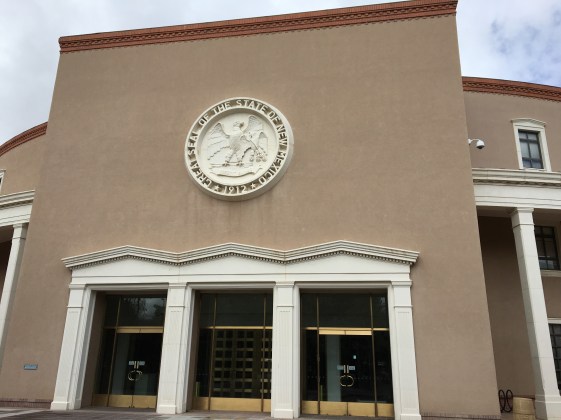
IMG_5654.jpg

It is a state capital, but has a state capital building that looks nothing like any of the other ones I have seen across the country.

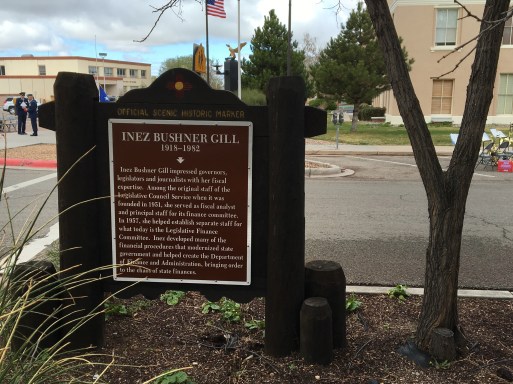
IMG_5655 (1).jpg

It is the kind of place that erects historical markers dedicated to fiscal responsibility, an important, even if not flashy, achievement, and one that reflects the western values of personal responsibility.

IMG_5656 (1).jpg

It is also a place that erects building dedicated to the memory horrible death marches in Europe.

IMG_5652.jpg

It is both “old world”, and “new world”.  It does what we all need to do, both in our own cities, and more importantly, individually.  It combines old ideas with new ideas in a way that uniquely represents its individual identity.

Road Trip to Santa Fe

IMG_5623.jpg

I spent about half a decade working in the Insurance Industry, an industry with a significant presence in Bermuda.  At workshops, conferences, and in meetings, I would regularly interact with people who lived there.  The place certainly has its draw, and with the right opportunity, a person with experience in the industry could make a really good life there, despite the high cost of living.

I often imagine what it would be like to have a totally different life, in a totally different place, particularly when traveling, or when I meet someone from somewhere far away.  While working in the insurance industry, although I never seriously considered up and moving to Bermuda, I did imagine what it would be like a couple of dozen times.  Each time I imagined it, I would always end up dwelling on the lack of room to roam around there.  The island is only 20.6 square miles, and getting anywhere else requires a flight.  I pictured myself moving there, getting my swimming trunks out, snorkeling, attending a few parties and such, but then, eventually, just getting restless, and missing something I love to do here in mainland U.S.A.; taking a road trip.

There is something I really love about road trips.  When I refer to road trips, I am not talking about simply driving somewhere.  A lot of people drive to work every day, or to a relative’s house every other weekend, and those drives don’t feel like “road trips”.  I’m talking about driving somewhere a significant distance away that is not a routine trip; somewhere that is somewhat unknown.  On road trips, we have somewhat of an idea as to what to expect, based on what we have heard, read, or researched, but we do not know it intimately.  We have not experienced the towns we will pass along the way, which exits have the best deals on gas, and where the best restaurants are.  In other words, there are still some surprises, and we are still going to encounter something unexpected.

IMG_5619

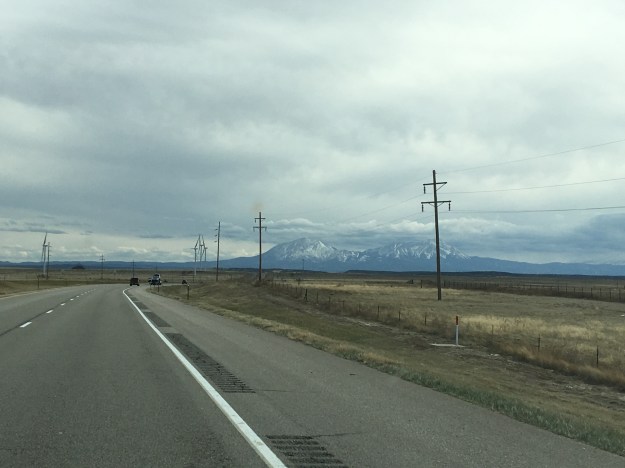
Driving south along I-25, the first indication that one is reaching the Southernmost portion of Colorado is the Spanish Peaks.  While visible farther north, they take prominence south of Pueblo. The Spanish Peaks are nowhere near the tallest features in Southern Colorado.  In fact, within 30 miles or so, there are 5 mountains taller than 14,000 feet (14ers)!  But, since they are relatively isolated from other natural features, and can be seen quite some distance, they are a prominent landmark toady (an entire region is named Spanish Peaks country, as well as the names of countless business in the region), and were a prominent landmark on the old Santa Fe Trail.

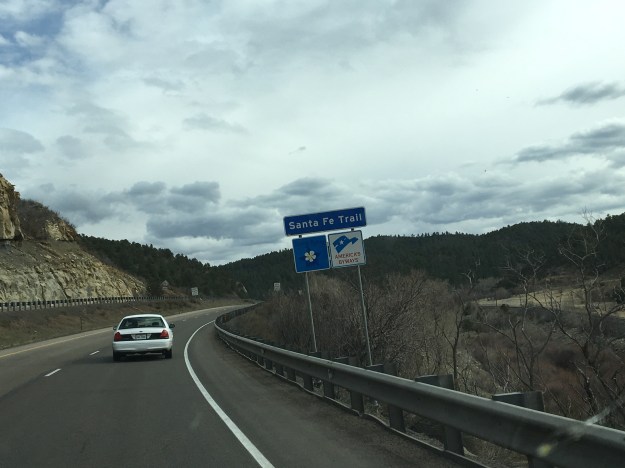
Approaching Trinidad, CO, the last town before the New Mexico border, the Spanish Peaks disappear from the horizon as the highway enters a much hillier region approaching Raton Pass.  It is here that the path of Interstate 25 joins with the old Santa Fe Trail, which it will more or less follow for the remainder of the trip to Santa Fe.  This trail was first pioneered by the Spanish and later played a pivotal role in American history including westward expansion, and the eventual conquest of the Southwest from Mexico.

IMG_5622.jpg

I had mixed expectations of Raton Pass.  Many years back, I was on a ten-day storm chase. Our group was situated in Clovis, New Mexico, which is quite close to the Texas-New Mexico border.  We were discussing the possibility of chasing upslope storms roughly an hour northeast of Denver the following day.  Some of us brought up the possibility of driving west to Raton so we can take the Interstate to our target destination, but the group leader balked at the idea, instead suggesting driving up 385, as he felt it might be risky to take a large convoy of chase vehicles over Raton Pass.  We ended up deciding not to drive up to Northeastern Colorado, as, in the morning, the storm outlook had weakened, and we no longer felt it worth the drive.  By the way, this is common on storm chases, you really never know where you will end up going.  However, ever since then, I had kind of wondered what it was like to drive over this pass.

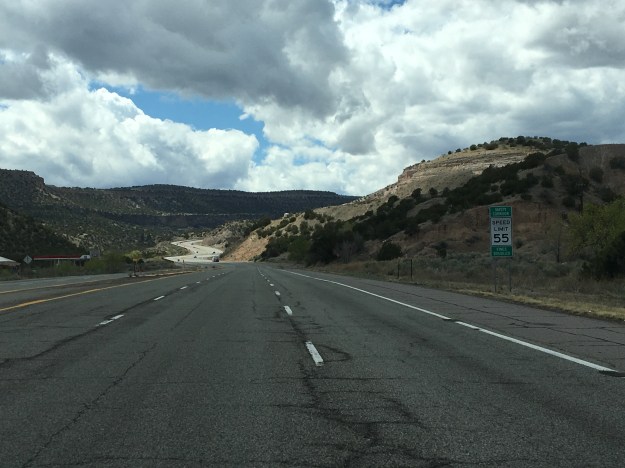
As the photos indicate, the road gets windy as motorists climb from Trinidad, at roughly 6000′ in elevation, over Raton Pass, which tops out at 7834′.  It’s definitely not nearly as rough as heading over the Rocky Mountains along I-70 or I-80, but definitely is a much more major incline than anything a group of people that drives largely in the Great Plains from Texas up to South Dakota would typically experience.

IMG_5626.jpg

Oh, and in one of the strangest of coincidences, the top of the pass is right at the border of Colorado and New Mexico.  This is odd as, first of all, the Colorado-New Mexico border is defined as the 37th parallel, and has nothing to do with where any mountain pass is located, and roads through mountain passes are built to take the safest and most effective route.  The fact that the place where this road crosses the 37th parallel most effectively happens to also be the high point seems to me as a pure coincidence.  Maybe someday I will read into this, the story behind the road and such, but I have yet to do so.

After a descent into Raton, the road reaches a segment that is long, flat, open, and rather empty.

I switched the music on the radio to classic rock, The Clash, Ozzy, Queensryche and such.  For some reason, there is something about the sound of guitar rock that makes more sense while driving through scenery like this than many other forms of music.  As the afternoon passed along this landscape, cloudy skies gave way to peaks from the sun only every once in a while.  A few periods of gentile, chilly rain fell from the skies.  In some ways it reminded me of a storm chase gone horribly wrong, the day slowly but surely slipping away with no prospects of favorable storm conditions developing.  However, in other ways, the drive was relaxing, allowing me to think without any distractions.

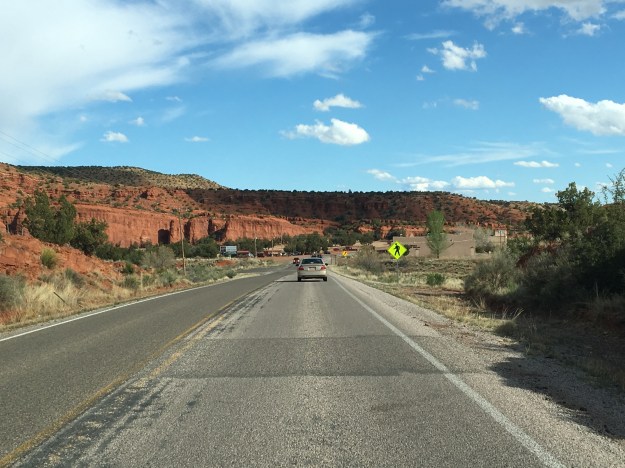
After passing through a town called Las Vegas, NM (which I assure you is nothing like the Las Vegas in Nevada), the highway turns West.  It kind of loops the last 60 or so miles into Santa Fe, even heading back northward for the last ten miles, following the route of the old Santa Fe trail.  However, unlike the previous 100 or so miles, this part of the trail, and the drive, is far from flat.

To the right, is the southernmost part of the Sangre de Cristo mountain range, and an area now part of the Santa Fe National Forest.  It is these mountains that the trail routed 19th century pioneers around.  To the left are a series of bluffs which, luckily, the trail did not have to also bypass, as it would have added many more miles to the journey.  The road itself slowly climbs over Glorietta Pass, descending only slightly into New Mexico’s Capitol City- Santa Fe.